🔧 Step-by-Step Answer Walkthrough For Easy Level
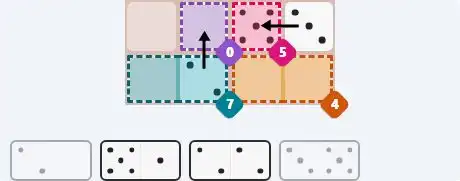
The second cell of the top row must show exactly zero — its sum constraint allows no other value. Check all four dominoes in today's set: only [2|0] has a blank pip. For that blank to land in the top row, the domino must be placed vertically, with 0 pointing up and 2 pointing down. That places (0,1)=0 and (1,1)=2.
The two-cell region in the bottom row's left half must sum to 7. Cell (1,1) is already set to 2. Its partner (1,0) therefore needs 5. Scan the remaining dominoes — [5|1], [2|2], [3|5] — and [5|1] is the only one with a 5-pip. Place it vertically in the first column: 5 at the bottom, 1 at the top. That sets (1,0)=5 and (0,0)=1.
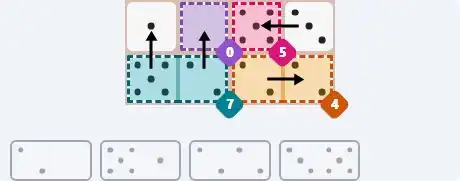
The third cell of the top row must show exactly 5. Two dominoes remain: [2|2] and [3|5]. Only [3|5] carries a 5. Place it horizontally across the top-right pair: 5 at (0,2) and 3 at (0,3). The two empty-type cells at (0,0) and (0,3) require no constraint check.
One domino remains — [2|2] — and one region remains: the bottom-right pair at (1,2) and (1,3), which must sum to 4. Place [2|2] horizontally: 2+2=4. Every constraint is satisfied. Puzzle complete.
🔧 Step-by-Step Answer Walkthrough For Medium Level
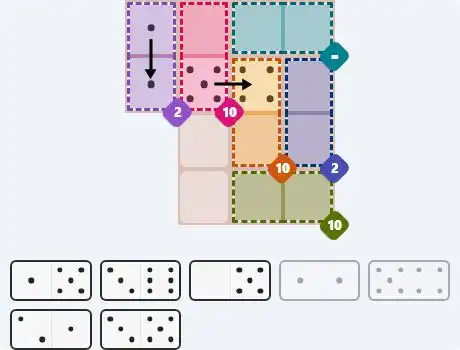
Cells (0,0) and (1,0) together must sum to 2. That's a tight target — only a pip-pair totaling 2 will work. Go through today's seven dominoes and ask which one adds up to exactly 2 across its two sides: only [1|1] does. Place it vertically in the left column with 1 at the top and 1 below.
Cells (0,1) and (1,1) must sum to 10. No single domino straddles both cells — each belongs to a different domino placed along its own row. [5|4] placed horizontally at row 1, columns 1–2, gives (1,1)=5 and (1,2)=4. With (1,1)=5 locked in, (0,1) needs 5 to reach the target. [1|5] placed horizontally at row 0, columns 2–1, gives (0,2)=1 and (0,1)=5. Sum check: 5+5=10 ✓.
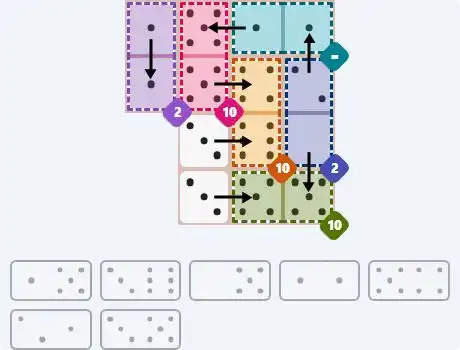
Cells (1,2) and (2,2) share a sum constraint of 10. Cell (1,2)=4 from the previous step, so (2,2) must be 6. Among the remaining dominoes, only [3|6] has a 6. Place it horizontally at row 2: (2,1)=3 and (2,2)=6. The cell at (2,1) falls in an empty region — no constraint to check.
Cells (0,2) and (0,3) must be equal. Cell (0,2)=1 from [1|5] already placed, so (0,3) must also be 1. [2|1] placed vertically at column 3 delivers exactly that: (1,3)=2 at the bottom, (0,3)=1 at the top. The sum=2 constraint on (1,3)+(2,3) then requires (2,3)=0. [0|5] placed vertically at column 3, rows 2–3: (2,3)=0 and (3,3)=5.
One domino remains — [3|5] — and one region remains: (3,2) and (3,3) must sum to 10. Cell (3,3)=5 from the previous step, so (3,2) must be 5 as well. Place [3|5] horizontally at row 3: (3,1)=3 and (3,2)=5. Sum check: 5+5=10 ✓. Puzzle complete.
🔧 Step-by-Step Answer Walkthrough For Hard Level
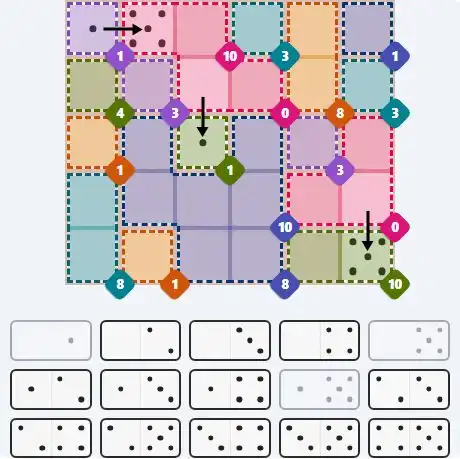
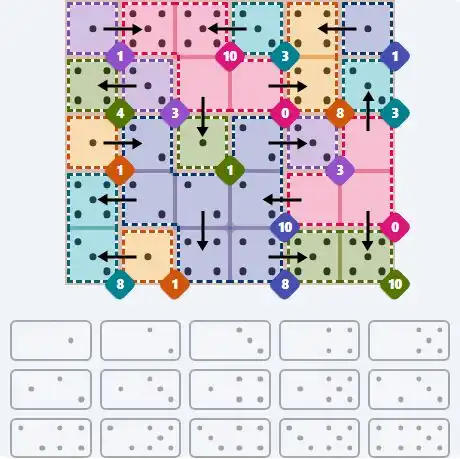
Two regions require every pip to be zero: [1,2]+[1,3] (sum=0) and [2,5]+[3,4]+[3,5] (sum=0). That's five zero-constrained cells. The set of 15 non-double dominoes contains exactly five zero-pip tiles: [0|1], [0|2], [0|3], [0|4], and [0|5]. Each one must send its zero end into one of these five cells — no domino goes to waste and none is available for other placements. Establishing this mapping is the structural first move.
Cell (2,2) must equal exactly 1 — it carries a standalone sum=1 constraint. It sits directly below (1,2), which is a zero-region cell. A domino bridging (1,2) and (2,2) would carry pips 0 and 1 — that's [0|1] and nothing else. Place [0|1] vertically: (1,2)=0, (2,2)=1 ✓. This locks the anchor for the two-cell zero region and confirms [0|1]'s placement in the left zero cluster.
Cell (0,5) must be 1 (standalone sum=1). Cell (1,3) is in the zero region and must be 0. Cells (0,4) and (1,4) must sum to 8. [1|4] placed horizontally at the top right fills (0,5)=1 and (0,4)=4. [0|4] placed horizontally at row 1 fills (1,3)=0 and (1,4)=4. Sum check: (0,4)+(1,4)=4+4=8 ✓. [0|4] also accounts for the zero-region cell at (1,3).
Cell (0,0) must be 1 and cell (0,3) must be 3. [1|5] placed horizontally: (0,0)=1, (0,1)=5. [3|5] placed horizontally: (0,3)=3, (0,2)=5. Sum check: (0,1)+(0,2)=5+5=10 ✓. Constraints (0,0)=1 ✓ and (0,3)=3 ✓.
Cells (1,0) and (1,1) are both standalone: (1,0) must be 4, and (1,1) must be 3. [3|4] placed horizontally bridges them: (1,1)=3, (1,0)=4. Both constraints satisfied simultaneously.
Cell (2,0) must be 1 and cell (2,4) must be 3. [1|2] placed horizontally: (2,0)=1, (2,1)=2. [2|3] placed horizontally: (2,3)=2, (2,4)=3 ✓. These two placements also seed the large non-contiguous region in the next step.
Cells [2,1]+[2,3]+[3,1]+[3,2]+[3,3] must sum to 10. Two of those cells are now fixed: (2,1)=2 and (2,3)=2. The remaining three — (3,1), (3,2), and (3,3) — must sum to 6. The only way to partition 6 across three non-negative pip values using the available dominoes is 2+2+2. Each of those three cells must equal 2.
Cells (3,4), (3,5), and (2,5) must all be zero. [0|2] placed horizontally at row 3: (3,4)=0 and (3,3)=2 ✓. [0|3] placed vertically at column 5, rows 1–2: (1,5)=3 ✓ (standalone sum=3) and (2,5)=0 ✓. [0|5] placed vertically at column 5, rows 3–4: (3,5)=0 and (4,5)=5.
Cells (3,1) and (3,2) still need domino assignments. [2|5] placed horizontally: (3,1)=2 ✓ and (3,0)=5. [2|4] placed vertically: (3,2)=2 ✓ and (4,2)=4. The sum=8 constraint on (3,0)+(4,0): (3,0)=5, so (4,0) must be 3. [1|3] placed horizontally: (4,1)=1 ✓ (standalone sum=1) and (4,0)=3 ✓.
One domino remains — [4|5]. The sum=8 pair at (4,2)+(4,3) has (4,2)=4 already; (4,3) must be 4 as well. The sum=10 pair at (4,4)+(4,5) has (4,5)=5 already; (4,4) must be 5. Place [4|5] horizontally: (4,3)=4 and (4,4)=5. Both constraints verified: 4+4=8 ✓, 5+5=10 ✓. Puzzle complete.
💬 Community Discussion
Leave your comment