🚨 SPOILER WARNING
This page contains the final answer and the complete solution to today's NYT Pips puzzle. If you haven't attempted the puzzle yet and want to try solving it yourself first, now's your chance!
Click here to play today's official NYT Pips game first.
Want hints instead? Scroll down for progressive clues that won't spoil the fun.
🎲 Today's Puzzle Overview
Ian Livengood's easy grid opens on two independent footholds that quickly resolve the whole board. A triple-equals region spanning [0,2], [1,2], and [1,3] forces the [1,1] domino, distributing 1's across the top-right corner. Immediately below, a greater‑10 region on two cells in row 2 demands a sum exceeding 10; the only way to satisfy it uses the [6,2] and [5,1] dominoes in a cascade that also feeds the less‑3 cell and the bottom‑left equals triplet. The deduction graph is shallow but tightly interlocked, with each placement unlocking the next.
Rodolfo Kurchan's medium puzzle packs a row of sum constraints along row 0 that act like a combination lock. The leftmost sum‑6 pair, sum‑2 pair, sum‑10 pair, and an equals pair are all forced by the available pip values, but interestingly none of them is satisfied by a single domino. Instead, solo sum‑5 cells at [3,2] and [3,3] crack the puzzle first—only the [5,5] domino covers both—while a sum‑2 singleton at [2,0] pulls in the [1,2] domino. From there the top row unfolds as a precise domino‑sharing chain, with each region borrowing values from a neighboring domino placed in a crossing orientation. The result is a compact 4×8 solving graph with no unused slack.
Rodolfo Kurchan's hard grid is a 10×5 battlefield centered on a sprawling equals region that forces six separate cells to zero. Many individual cells carry fixed sum or inequality constraints—sum‑1 at [0,0], sum‑2 at [1,1], sum‑3 at [2,2], sum‑4 at [3,3], and so on—each locking a pip value early. The zero block at [5,0]–[5,3], [6,1], and [7,1] then becomes a distribution hub: dominoes carrying a 0 must be placed to hit each of those cells while simultaneously satisfying the adjacent sum‑4 and unequal regions. Solving this NYT Pips hard is an exercise in resource mapping, as you allocate zero‑bearing dominoes to exactly the right squares and then fill the non‑zero distinct digits of the unequal set. The final steps reconcile a sum‑9 vertical pair and an equals‑6 duo, completing a dense, satisfying deduction graph.
💡 Progressive Hints
Try these hints one at a time. Each hint becomes more specific to help you solve it yourself!
🎨 Pips Solver
Click a domino to place it on the board. You can also click the board, and the correct domino will appear.
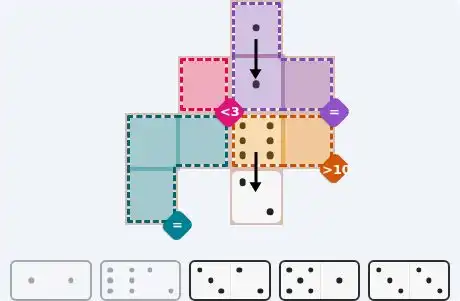
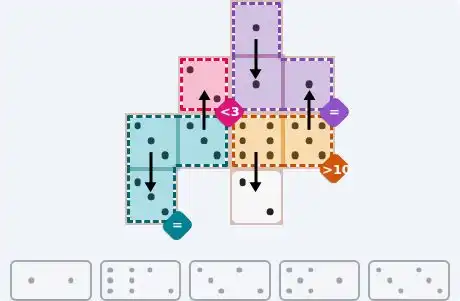
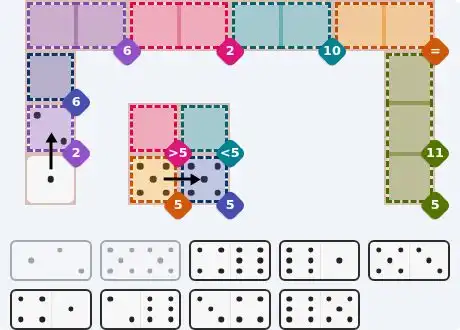
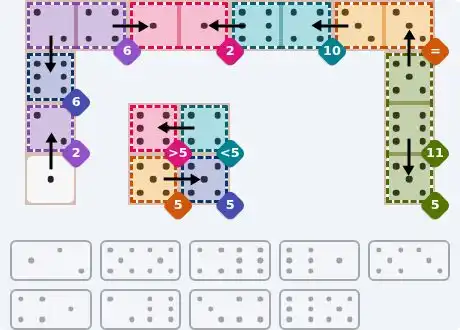
✅ Final Answer & Complete Solution For Hard Level
The key to solving today's hard puzzle was identifying the placement for the critical dominoes highlighted in the starting grid. Once those were in place, the rest of the puzzle could be solved logically. See the final grid below to compare your solution.
Starting Position & Key First Steps
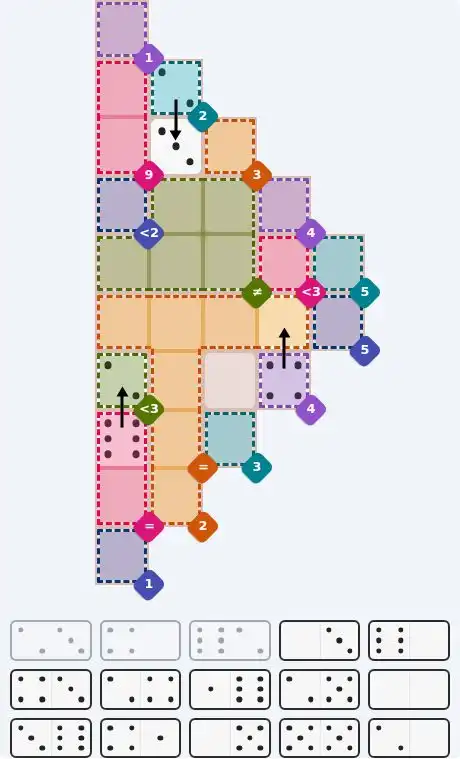
This image shows the initial puzzle grid for the hard level, with a few critical first placements highlighted.
Final Answer: The Solved Grid for Hard Mode
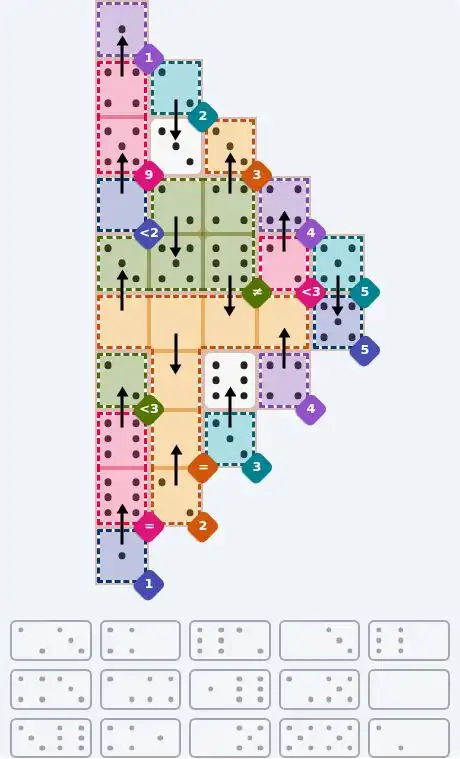
Compare this final grid with your own solution to see the correct placement of all dominoes.
💬 Community Discussion
Leave your comment