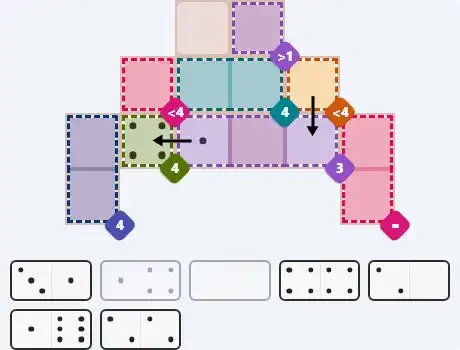
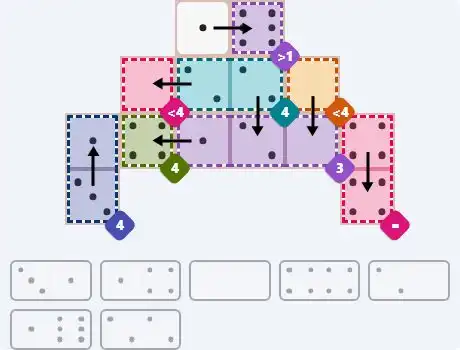
NYT Pips Hints & Answers for March 29, 2026

Mar 29, 2026

🚨 SPOILER WARNING

This page contains the final **answer** and the complete **solution** to today's NYT Pips puzzle. If you haven't attempted the puzzle yet and want to try solving it yourself first, now's your chance!

Click here to play today's official NYT Pips game first.

Want hints instead? Scroll down for progressive clues that won't spoil the fun.

🎲 Today's Puzzle Overview

Today's Pips puzzles are edited by Ian Livengood, who also constructed the easy grid himself. That puzzle has a staircase shape — just ten cells and five dominoes — with a single bottom cell whose value is locked in immediately by a sum constraint. Everything else follows in a clean upward chain, making this one of those satisfying easy grids where one observation does all the work.

The medium and hard puzzles come from Rodolfo Kurchan. The medium is seven dominoes on a compact layout, and the strategy mirrors the easy: find the one cell that needs no inference, then follow the cascade. The interesting wrinkle is a three-cell sum in the middle rows that constrains two different dominoes at once — once you account for it, the rest slots together quickly.

The hard puzzle today is notably anchor-rich: four separate single-cell constraints appear across the grid, giving you multiple guaranteed starting values before you've committed to a single placement. That generosity is by design — the real puzzle lies in untangling the intersecting equals chains across rows 0 and 5, where the grid's two long horizontal constraints pull in opposite directions. If you trace both ends first and work inward, it's one of the more methodical hard grids in recent memory.

💡 Progressive Hints

Try these hints one at a time. Each hint becomes more specific to help you solve it yourself!

💡 One cell gives you everything for free
A single-cell region at the bottom of the grid tells you exactly what pip value belongs there. No guessing — the sum is locked in. Start there.
💡 Follow the chain upward
Once the bottom cell is set, two sum regions stack directly above it. Each one gives you the cell above it for free. You'll have three cells locked in before you need to think hard about anything.
💡 Complete solution
The single-cell sum at [4,1] forces that cell to hold exactly 3. [0|3] is placed horizontally: [3] at [4,1], [0] at [4,2]. The right-column sum of 5 then gives [3,2] = 5, placing [5|5] horizontally across row 3: [5] at [3,1] and [5] at [3,2]. The middle sum of 5 resolves next: [2,1] + 5 = 5 → [2,1] = 0. [0|4] goes horizontally: [0] at [2,1], [4] at [2,0]. Two dominoes remain for the top section. The greater-than-4 constraint at [1,2] demands a value of 5 or 6 — only [3|6] can deliver this. [3|6] is placed horizontally: [3] at [1,1], [6] at [1,2]. Finally [3|3] fills the top pair: [3] at [0,0] and [3] at [0,1], completing the three-cell equals region with all values equal to 3.
💡 There's one cell with a direct answer
A single-cell sum region tells you exactly what pip value lives there. That cell is your entry point — everything else branches out from it.
💡 The anchor is in row 2, middle section
Once you pin that cell to 4, the domino covering it extends one step to the right. The value on the right end feeds directly into a three-cell sum region — so your second deduction comes quickly too.
💡 Complete solution
The single-cell sum at [2,1] forces [2,1] = 4. [1|4] is placed horizontally: [4] at [2,1], [1] at [2,2]. The three-cell sum [2,2]+[2,3]+[2,4] = 3 becomes 1+[2,3]+[2,4] = 3, so [2,3]+[2,4] = 2. The less-than-4 constraint at [1,4] and the remaining pip values point to [0|0]: it goes vertically at [1,4] and [2,4], both cells = 0, satisfying the less-than-4 and leaving [2,3] = 2. [2|2] places vertically: [2] at [1,3], [2] at [2,3]. Now [1,2]+[1,3] = 4 → [1,2] = 2. [2|0] places horizontally: [2] at [1,2], [0] at [1,1] — [0] is less than 4 ✓. The greater-than-1 constraint at [0,3] rules out placing the 1-end of [1|6] there, so [1|6] goes with [1] at [0,2] and [6] at [0,3]. Last two dominoes: [3|1] at [2,0]–[3,0] summing to 4, and [4|4] at [2,5]–[3,5] for the equals region.
💡 Four cells are already solved
Before placing a single domino, scan for single-cell sum regions. There are four of them — four cells with exact values already known. List them and let them anchor your solve.
💡 The bottom row has a four-cell equals chain
Cells [5,3] through [5,6] must all share the same value. One of your anchored cells is in that row. The domino that fits those four equal cells — plus another that satisfies two separate single-cell constraints nearby — will lock down the entire bottom section.
💡 The lower-left corner forces an unusual placement
Once you know [5,0] from the bottom row, the greater-than-10 region on the left column pins [4,0] to a specific value. That constraint has only one valid domino — and only one valid orientation. Place it and the two empty cells nearby become known.
💡 Work the right edge to unlock the top row
Cell [1,6] = 0 points you to its domino immediately. From there, the sum-of-10 region at [0,5]–[0,6] resolves, which locks the two-cell equals above it, which finally gives you the value shared across the long four-cell equals chain at the top of the grid.
💡 Complete solution
Four pinned cells: [1,0]=1, [1,6]=0, [5,1]=1, [5,2]=1. Bottom row equals [5,3]–[5,6]: [0|0] placed at [5,4]–[5,5] (both = 0), so all four equal cells are 0. [0|1] places at [5,3]–[5,2]: [0] at [5,3], [1] at [5,2] ✓. [6|1] places at [5,0]–[5,1]: [6] at [5,0], [1] at [5,1] ✓. Left column: [4,0]+[5,0] > 10 → [4,0]+6 > 10 → [4,0] ≥ 5. [4|5] must orient with [5] at [4,0] and [4] at [3,0] (the [4] orientation gives 4+6=10, which fails >10). [4|1] places at [2,0]–[1,0]: [4] at [2,0], [1] at [1,0] ✓. Right edge: [4|0] at [0,6]–[1,6]: [4] at [0,6], [0] at [1,6] ✓. Sum [0,5]+[0,6]=10 → [0,5]=6. [6|6] at [0,4]–[0,5]: both = 6. Equals [0,3]=[0,4]=6. [5|6] at [0,2]–[0,3]: [5] at [0,2], [6] at [0,3] ✓. Four-cell top equals [0,0]=[0,1]=[0,2]=[1,2]=5. [5|5] at [0,0]–[0,1] ✓. [2|5] at [2,2]–[1,2]: [2] at [2,2], [5] at [1,2] ✓. Three-cell equals column [2,2]=[3,2]=[4,2]=2: [2|2] at [3,2]–[4,2] ✓. Right-side sums: [4|4] at [2,6]–[3,6]: 4+4=8, and [0,2] at [5,6]–[4,6]: [0] at [5,6], [2] at [4,6] → 4+4+2=10 ✓. [4|6] at [3,4]–[2,4]: 4+6=10 ✓.

🎨 Pips Solver

Mar 29, 2026

Click a domino to place it on the board. You can also click the board, and the correct domino will appear.
Final Answer & Complete Solution For Hard Level

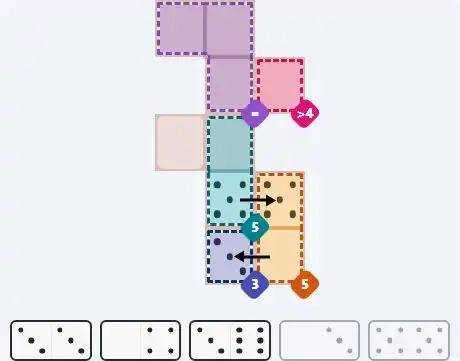
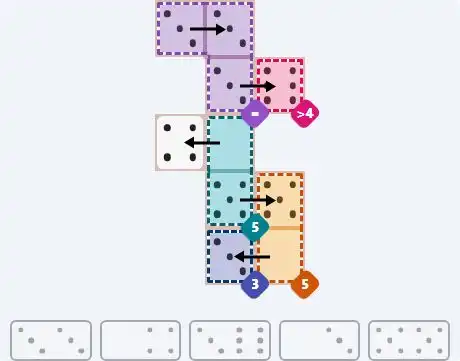
The key to solving today's hard puzzle was identifying the placement for the critical dominoes highlighted in the starting grid. Once those were in place, the rest of the puzzle could be solved logically. See the final grid below to compare your solution.

Starting Position & Key First Steps
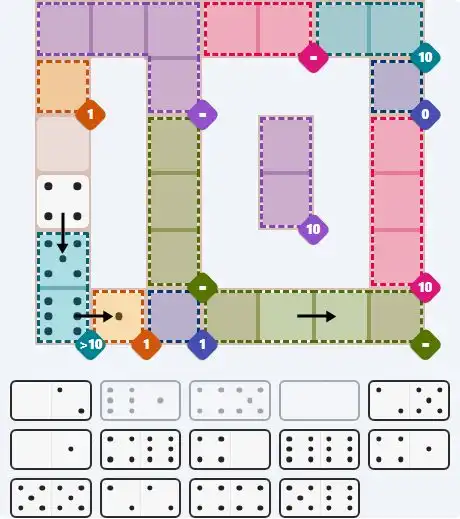
Pips hint for March 29, 2026 – hard level puzzle grid with critical first placements and strategy

This image shows the initial puzzle grid for the hard level, with a few critical first placements highlighted.

Final Answer: The Solved Grid for Hard Mode
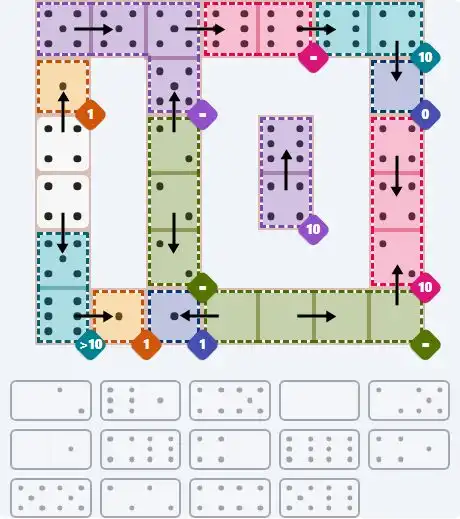
NYT Pips March 29, 2026 hard puzzle full solution grid showing final answer with hints

Compare this final grid with your own solution to see the correct placement of all dominoes.

🔧 Step-by-Step Answer Walkthrough For Easy Level

1
Step 1: Read the bottom anchor
The region at [4,1] is a single-cell sum equal to 3. That cell must hold exactly 3 pips — no deduction required. Now check the domino list for a domino that can place a 3 at [4,1]. The neighboring cell is [4,2]. Of the available dominoes, [0|3] is the right fit: [3] at [4,1], [0] at [4,2]. (If you tried [3|3] or [3|6] here, the sum region above would break — as you'll see in the next step.)
2
Step 2: Chain upward through the right column
With [4,2] = 0 known, the sum region covering [3,2] and [4,2] must total 5: [3,2] + 0 = 5 → [3,2] = 5. The domino sitting at [3,2] must carry a 5. [5|5] has both ends equal to 5 — place it horizontally across row 3: [5] at [3,1] and [5] at [3,2]. Both cells in the right section are now filled.
3
Step 3: Cascade into the middle section
Now that [3,1] = 5, the sum region above it activates: [2,1] + [3,1] = 5 → [2,1] + 5 = 5 → [2,1] = 0. The domino covering [2,1] must have a 0 at that cell. [0|4] fits: placed horizontally with [0] at [2,1] and [4] at [2,0]. The cell at [2,0] carries no constraint — the empty region just marks it as unconstrained — so the 4 lands there freely.
4
Step 4: Finish the top section
Two dominoes remain — [3|3] and [3|6] — for four cells: [0,0], [0,1], [1,1], [1,2]. The greater-than-4 constraint at [1,2] demands a value of at least 5. Only [3|6] can place a 6 at [1,2]. Place [3|6] horizontally across row 1: [3] at [1,1], [6] at [1,2]. That satisfies the >4 constraint. The three-cell equals region then requires [0,0] = [0,1] = [1,1] = 3. [3|3] placed horizontally at [0,0]–[0,1] delivers this exactly. Puzzle solved.

🔧 Step-by-Step Answer Walkthrough For Medium Level

1
Step 1: Pin the anchor cell
The single-cell sum region at [2,1] demands exactly 4. That cell is fixed: [2,1] = 4. Which domino can place a 4 at [2,1] while covering [2,2]? [1|4] is the answer — place it horizontally: [4] at [2,1], [1] at [2,2]. No other domino works here without contradicting a constraint later.
2
Step 2: Use the three-cell sum to constrain the right side
The region covering [2,2], [2,3], and [2,4] must total 3. With [2,2] = 1 already placed, the equation becomes 1 + [2,3] + [2,4] = 3, so [2,3] + [2,4] = 2. The less-than-4 constraint at [1,4] limits what can go there. [0|0] is the cleanest fit: both ends = 0, both satisfy <4, and it places vertically at [1,4]–[2,4] with [2,4] = 0. That forces [2,3] = 2.
3
Step 3: Resolve the inner row with the new values
[2,3] = 2 calls for a domino with a 2 at that cell. [2|2] fits at [1,3]–[2,3]: [2] at [1,3] and [2] at [2,3]. Now the sum region [1,2]+[1,3] = 4 activates: [1,2] + 2 = 4 → [1,2] = 2. The domino at [1,1]–[1,2] must carry a 2 at [1,2]: [2|0] works, placing [2] at [1,2] and [0] at [1,1]. Check: [1,1] < 4 → 0 < 4 ✓.
4
Step 4: Place the final three dominoes
Three cells remain on the right side and left column. The greater-than-1 constraint at [0,3] eliminates the option of placing a 1 there. [1|6] must go with [6] at [0,3] and [1] at [0,2] — that's the only valid orientation. Left column: [2,0] and [3,0] must sum to 4, filled by [3|1]: either (3,0)=3 and (2,0)=1 or the reverse — both give the correct sum of 4. Right column: [4,4] at [2,5]–[3,5] satisfies the equals constraint with both cells = 4. All regions check out.

🔧 Step-by-Step Answer Walkthrough For Hard Level

1
Step 1: Collect all four pinned cells
Four single-cell sum regions give you free values before any placement: [1,0] = 1 (sum = 1), [1,6] = 0 (sum = 0), [5,1] = 1 (sum = 1), [5,2] = 1 (sum = 1). Write these down. They will drive most of the board.
2
Step 2: Solve the bottom row
Cells [5,3], [5,4], [5,5], [5,6] must all be equal. With [5,1] = 1 and [5,2] = 1 already set, what value do the four equal cells share? [0|0] places at [5,4]–[5,5]: both = 0, so all four equal cells are 0. [0|1] then places at [5,3]–[5,2]: [0] at [5,3] (matches the equals group), [1] at [5,2] ✓. [6|1] fills the bottom-left pair: [6] at [5,0], [1] at [5,1] ✓.
3
Step 3: Force the left column placements
Now [5,0] = 6. The greater-than-10 region requires [4,0] + [5,0] > 10 → [4,0] + 6 > 10 → [4,0] ≥ 5. Domino [4|5] is in the set: placing [5] at [4,0] and [4] at [3,0] gives 5 + 6 = 11 > 10 ✓. The reverse orientation ([4] at [4,0], [5] at [3,0]) gives only 4 + 6 = 10, which fails the strict greater-than. [4|5] must orient with [5] at [4,0]. Then [4|1] fills the cells above: [4] at [2,0], [1] at [1,0] ✓.
4
Step 4: Unlock the top row from the right side
[1,6] = 0 identifies its domino immediately. [4|0] places at [0,6]–[1,6]: [4] at [0,6], [0] at [1,6] ✓. The sum region [0,5] + [0,6] = 10 → [0,5] + 4 = 10 → [0,5] = 6. [6|6] at [0,4]–[0,5]: both = 6. The equals region [0,3] = [0,4] → [0,3] = 6. [5|6] at [0,2]–[0,3]: [5] at [0,2], [6] at [0,3] ✓.
5
Step 5: Cascade through the top equals and the middle column
The four-cell equals region [0,0] = [0,1] = [0,2] = [1,2] is now anchored at [0,2] = 5. All four must equal 5. [5|5] at [0,0]–[0,1] ✓. [2|5] places at [2,2]–[1,2]: [2] at [2,2], [5] at [1,2] ✓. The three-cell equals column [2,2] = [3,2] = [4,2] = 2 is now anchored. [2|2] at [3,2]–[4,2] ✓. For the right side: [4|4] at [2,6]–[3,6] (both = 4), and [0|2] at [5,6]–[4,6] ([0] at [5,6], [2] at [4,6]) → column sum 4+4+2 = 10 ✓. [4|6] at [3,4]–[2,4]: 4+6 = 10 ✓. Puzzle complete.

💡 Pro Tips for Similar Puzzles

Start with Constraints
Always begin with the most constrained regions - sum regions with small numbers or tight spaces.
Use Equal Regions
Use "equal" regions as anchors - they eliminate many possibilities quickly.
Work Systematically
Let the rules guide your placement rather than guessing randomly.
Double-Check
Verify each region's rules are satisfied before moving to the next.

🎓 Keep Learning & Improve