NYT Pips Hints & Answers for April 2, 2026

Apr 2, 2026

🚨 SPOILER WARNING

This page contains the final **answer** and the complete **solution** to today's NYT Pips puzzle. If you haven't attempted the puzzle yet and want to try solving it yourself first, now's your chance!

Click here to play today's official NYT Pips game first.

Want hints instead? Scroll down for progressive clues that won't spoil the fun.

🎲 Today's Puzzle Overview

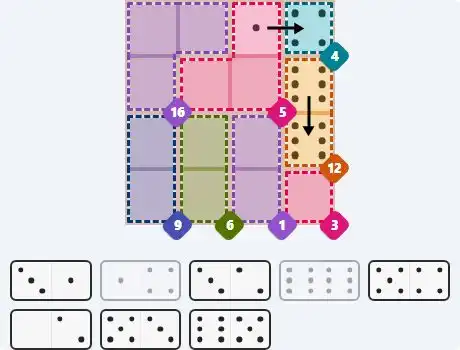
Today's Pips for April 2, 2026, edited by Ian Livengood, opens with an Easy grid that wears its shape like a puzzle within the puzzle. The board is cross-shaped — a full top row, two stripped-down middle rows with only two cells each, and a full bottom row — built by Livengood himself from five dominoes. That hollow middle is a clue: the right-side column runs all the way from top to bottom without interruption, and its constraint asks every cell to match. Find out what value fills that column and you've cracked the heart of the puzzle.

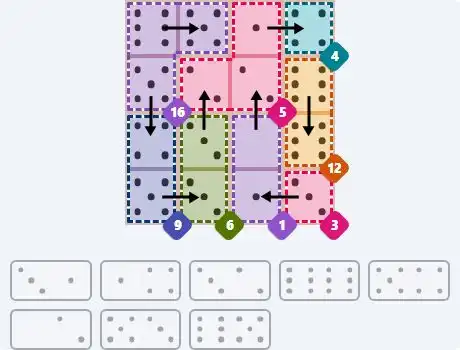
Rodolfo Kurchan constructed both the Medium and Hard grids. The Medium puzzle fits all eight of today's dominoes into a 4×4 square with a deceptively clean design. Every region uses a sum constraint, but two of those regions hold only a single cell — and that's precisely where you want to start. A single cell with a fixed target names one specific domino half, and today's set is small enough that the chain from there goes quickly. The 6–6 double makes a guest appearance exactly where it has to.

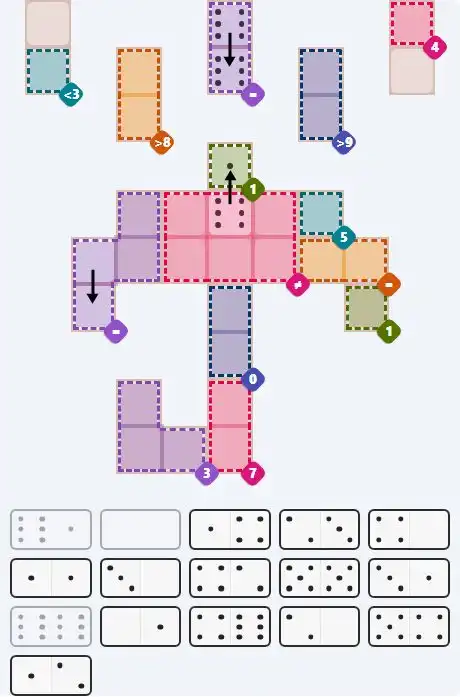
Kurchan's Hard puzzle is something else entirely: a sprawling sparse grid where sixteen dominoes are scattered across ten rows and nine columns, most cells sitting in isolation from their neighbors. The constraint variety is wide — equals, unequal, less-than, greater-than, sums, and empty unconstrained cells all appear together. Two separate zero-sum regions sit far apart on the board, yet they share a dependency: every zero-pip domino in the set is claimed before you've placed a single tile elsewhere.

💡 Progressive Hints

Try these hints one at a time. Each hint becomes more specific to help you solve it yourself!

💡 One column is doing all the work
There's a four-cell region that runs the full height of the right side of the grid. Its constraint asks every cell to show the same pip count. That's a very demanding ask — start there before you touch anything else.
💡 A double is the only domino that fits
Two cells in that equals column are adjacent and both must match. The only domino that can fill two touching cells with identical values is a double. Find which double is in today's set, place it in those two cells, and the rest of the column tells you exactly what value the whole region must be.
💡 Full solution
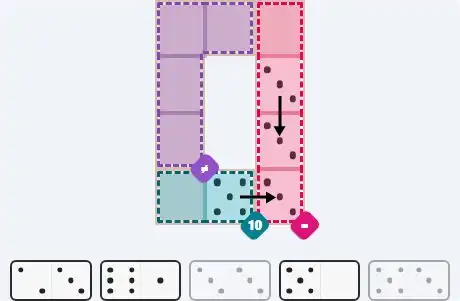
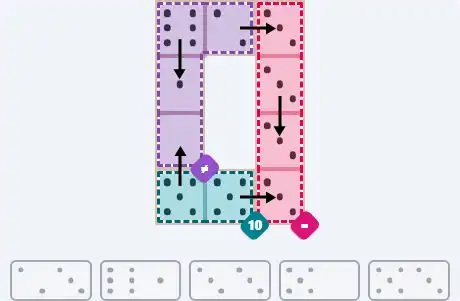
Place [3|3] vertically at cells (1,2) and (2,2) — both show 3. The equals region now forces (0,2)=3 and (3,2)=3. The [2|3] domino covers (0,1) and (0,2): with (0,2)=3, the 2-pip lands at (0,1). The [5|3] domino covers (3,1) and (3,2): with (3,2)=3, the 5-pip lands at (3,1). Sum-10 at the bottom pair: (3,1)=5, so (3,0) must be 5. The [5|0] domino covers (3,0) and (2,0): (3,0)=5 and (2,0)=0. Finally [6|1] fills (0,0) and (1,0) with 6 and 1. Unequal region check: (0,0)=6, (0,1)=2, (1,0)=1, (2,0)=0 — all four different. Puzzle complete.
💡 Two cells already know their answer
Two of today's regions each contain a single isolated cell, and a single cell can only hold one value. Find those two cells and read off their required pip count — you'll know exactly which domino halves go there before you've placed anything.
💡 The double has only one legal home
One of today's dominoes is a double — both sides identical. There's only one region where the sum target is large enough and the cell count is exactly right for a double to fit. Slot it in, and two key values lock down simultaneously.
💡 Full solution
Single-cell (0,3) must be 4 → [1|4] placed horizontally: (0,2)=1, (0,3)=4. Single-cell (3,3) must be 3 → [3|1] placed horizontally: (3,3)=3, (3,2)=1. Sum-1 at (2,2)+(3,2)=1: (3,2)=1, so (2,2)=0. [0|2] placed vertically: (2,2)=0, (1,2)=2. Sum-5 at (0,2)+(1,1)+(1,2)=5: 1+[1,1]+2=5, so (1,1)=2. [3|2] placed vertically: (2,1)=3, (1,1)=2. Sum-6 at (2,1)+(3,1)=6: (2,1)=3, so (3,1)=3. [5|3] placed horizontally: (3,0)=5, (3,1)=3. Sum-9 at (2,0)+(3,0)=9: (3,0)=5, so (2,0)=4. [5|4] placed vertically: (1,0)=5, (2,0)=4. Sum-12 at (1,3)+(2,3)=12: the [6|6] double is the only option — place it vertically: (1,3)=6, (2,3)=6. One domino remains — [6|5]. Sum-16: (0,0)+(0,1)+(1,0)=16, (1,0)=5, so (0,0)+(0,1)=11. [6|5] gives exactly 6+5=11. Place horizontally: (0,0)=6, (0,1)=5. Puzzle complete.
💡 Before placing anything, look at what must be zero
Two separate regions on this board both require a total of exactly zero. That means every pip in both regions must be blank. Count how many zero cells that creates — then count how many zero-pip dominoes today's set actually contains.
💡 A four-cell equals region locks down an entire corner
Somewhere on the board, four cells form an equals region — all must show the same pip count. The only domino that can anchor two of those cells with equal values is a double, and there's only one double in the set whose value matches what the region can be. Place it, and the other two cells in that region are forced too.
💡 Less-than and greater-than constraints cut your options sharply
Several regions use inequality constraints rather than fixed sums. A less-than constraint rules out all but the very lowest values; a greater-than with a large target rules out nearly every small domino. Use these regions to eliminate options for the dominoes that land there.

🎨 Pips Solver

Apr 2, 2026

Click a domino to place it on the board. You can also click the board, and the correct domino will appear.

Final Answer & Complete Solution For Hard Level

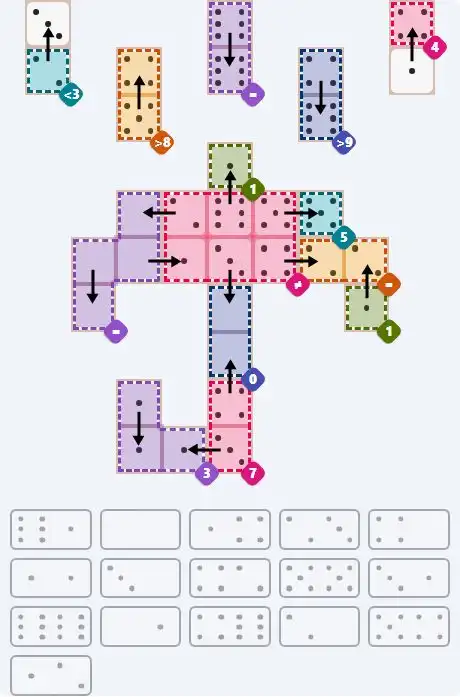
The key to solving today's hard puzzle was identifying the placement for the critical dominoes highlighted in the starting grid. Once those were in place, the rest of the puzzle could be solved logically. See the final grid below to compare your solution.

Starting Position & Key First Steps

Pips hint for April 2, 2026 – hard level puzzle grid with critical first placements and strategy

This image shows the initial puzzle grid for the hard level, with a few critical first placements highlighted.

Final Answer: The Solved Grid for Hard Mode

NYT Pips April 2, 2026 hard puzzle full solution grid showing final answer with hints

Compare this final grid with your own solution to see the correct placement of all dominoes.

🔧 Step-by-Step Answer Walkthrough For Easy Level

1
Step 1: The equals region anchors the whole puzzle
The four cells in column 2 — (0,2), (1,2), (2,2), (3,2) — must all show the same pip value. Two of those cells are adjacent: (1,2) and (2,2). For two touching cells to hold equal values, a double is the only domino that works. Today's set has exactly one double: [3|3]. Place it vertically at (1,2) and (2,2). Both cells show 3, so the entire equals region must be 3. That means (0,2) and (3,2) also need 3.
2
Step 2: Two dominoes orient themselves from the column
The [2|3] domino covers (0,1) and (0,2). Since (0,2) must be 3, the 2-pip goes to (0,1). Similarly, the [5|3] domino covers (3,1) and (3,2). Since (3,2) must be 3, the 5-pip goes to (3,1). Both dominoes orient without ambiguity.
3
Step 3: Sum-10 at the bottom drives the rest
The two-cell region at (3,0) and (3,1) must total 10. Cell (3,1)=5 is already fixed. So (3,0) must be 5 as well. The [5|0] domino covers (3,0) and (2,0) — with (3,0)=5, the blank lands at (2,0).
4
Step 4: The last domino satisfies the unequal constraint automatically
The only remaining domino is [6|1], which fills (0,0) and (1,0). The unequal region contains (0,0), (0,1)=2, (1,0), and (2,0)=0. Placing [6|1] with 6 at (0,0) and 1 at (1,0) gives the set {6, 2, 1, 0} — all four values distinct. Constraint satisfied. Puzzle complete.

🔧 Step-by-Step Answer Walkthrough For Medium Level

1
Step 1: Two isolated cells reveal two domino halves immediately
Region (0,3) is a single cell with sum=4, so it must hold exactly 4 pips. Region (3,3) is also a single cell with sum=3, so it must hold exactly 3 pips. Scan the domino list for a tile with a 4-pip face that can reach (0,3): [1|4] placed horizontally covers (0,2)=1 and (0,3)=4. For (3,3)=3: [3|1] placed horizontally covers (3,3)=3 and (3,2)=1.
2
Step 2: Sum-1 forces a chain through the middle
Cells (2,2) and (3,2) must sum to 1. Cell (3,2)=1 is already set, so (2,2) must be 0. The [0|2] domino connects (2,2) and (1,2) vertically: (2,2)=0, (1,2)=2. Now check sum-5 at (0,2)+(1,1)+(1,2)=5. Cell (0,2)=1 and (1,2)=2 are known, so (1,1)=5-1-2=2. The [3|2] domino connects (2,1) and (1,1) vertically: (2,1)=3, (1,1)=2.
3
Step 3: Sum-6 and sum-9 resolve the left column pair
Sum-6 at (2,1)+(3,1)=6: (2,1)=3, so (3,1)=3. The [5|3] domino covers (3,0) and (3,1) horizontally: (3,0)=5, (3,1)=3. Sum-9 at (2,0)+(3,0)=9: (3,0)=5, so (2,0)=4. The [5|4] domino covers (1,0) and (2,0) vertically: (1,0)=5, (2,0)=4.
4
Step 4: The double fills the only sum-12 region
Cells (1,3) and (2,3) must sum to 12. Among the remaining dominoes, only [6|6] can produce a sum of 12 across two cells. Place it vertically: (1,3)=6, (2,3)=6.
5
Step 5: The last domino closes the top row
The final domino is [6|5], covering (0,0) and (0,1) horizontally. Sum-16 at (0,0)+(0,1)+(1,0)=16: (1,0)=5 is already set, so (0,0)+(0,1) must equal 11. [6|5] gives 6+5=11 exactly. Place it as (0,0)=6, (0,1)=5. All constraints satisfied. Puzzle complete.

🔧 Step-by-Step Answer Walkthrough For Hard Level

1
Step 1: All zero-pip dominoes are assigned before the first placement
Two regions require zero sums: the equals region at (4,2), (5,1), (5,2), (6,1) forces all four cells to the same value — and the only value reachable here is 0. The sum-0 region at (6,4) and (7,4) forces both to 0 as well. That's six zero-constrained cells across two regions. Today's set contains exactly the dominoes needed to supply them: the [0|0] double plus several other zero-bearing tiles. None of those dominoes can go anywhere else.
2
Step 2: Place the [0|0] double in the equals region
Cells (5,1) and (6,1) are adjacent vertically and both must be 0. The [0|0] double is the only domino that places equal values in two touching cells, and 0 is the only value all four equals-region cells can share. Place [0|0] vertically: (5,1)=0, (6,1)=0. The other two cells in the region — (4,2) and (5,2) — must also be 0, each supplied by a different domino.
3
Step 3: The equals region completes with [2|0] and [0|1]
Cell (4,2) is part of the equals region (must be 0) and connects to (4,3) via the [2|0] domino. With (4,2)=0, [2|0] placed horizontally gives (4,3)=2. Cell (5,2) must also be 0 and sits next to (5,3). The [0|1] domino placed horizontally gives (5,2)=0, (5,3)=1.
4
Step 4: Sum-0 at the middle column forces two more dominoes
Cells (6,4) and (7,4) must sum to 0, so both are 0. The [3|0] domino connects (5,4) and (6,4) vertically: (6,4)=0 and (5,4)=3. The [4|0] domino connects (8,4) and (7,4) vertically: (7,4)=0 and (8,4)=4. Check sum-7 at (8,4)+(9,4)=7: (8,4)=4, so (9,4) must be 3.
5
Step 5: The less-than constraint at (1,0) resolves [2|3]
Cell (1,0) must be less than 3, meaning it holds 0, 1, or 2. The [2|3] domino covers (1,0) and (0,0). Its faces are 2 and 3 — only 2 satisfies the constraint. Place [2|3] vertically: (1,0)=2, (0,0)=3. (0,0) is an empty-type cell, so no further constraint applies.
6
Step 6: Equals at (0,4)/(1,4) is filled by the only double left
Cells (0,4) and (1,4) must be equal. The [6|6] double is the only remaining double in the set — place it vertically: (0,4)=6, (1,4)=6.
7
Step 7: Sum=4 at (0,8) and the [1|4] domino
Cell (0,8) must equal 4. The [1|4] domino covers (1,8) and (0,8) vertically: (0,8)=4, (1,8)=1. (1,8) is an empty-type cell — no constraint to satisfy.
8
Step 8: Greater-than constraints place two more dominoes
The region at (1,2) and (2,2) must exceed 8. The [5|4] domino covers (2,2) and (1,2) vertically: (2,2)=5, (1,2)=4. Sum=9>8 ✓. The region at (1,6) and (2,6) must exceed 9. The [4|6] domino covers (1,6) and (2,6) vertically: (1,6)=4, (2,6)=6. Sum=10>9 ✓.
9
Step 9: Sum=1 at (3,4) anchors the [6|1] domino
Cell (3,4) must equal 1. The [6|1] domino covers (4,4) and (3,4) vertically: (3,4)=1, (4,4)=6. Now check the 6-cell unequal region at (4,3), (4,4), (4,5), (5,3), (5,4), (5,5) — all six must differ. Known so far: (4,3)=2, (4,4)=6, (5,3)=1, (5,4)=3. Remaining cells are (4,5) and (5,5), which must take values from the unused set. The [5|5] double covers (4,5) and (4,6): with sum=5 required at (4,6), (4,6)=5 and (4,5)=5. The [4|2] domino covers (5,5) and (5,6): (5,5)=4, (5,6)=2. Unequal check: {2, 6, 5, 1, 3, 4} — all six distinct. ✓
10
Step 10: Equals at (5,6)/(5,7) and sum=1 at (6,7) close the right side
Cells (5,6) and (5,7) must be equal. (5,6)=2 is already set, so (5,7)=2. The [1|2] domino covers (6,7) and (5,7) vertically: (6,7)=1, (5,7)=2 ✓. Sum=1 at (6,7)=1 ✓.
11
Step 11: Sum=3 at the bottom-left cluster and sum=7 close the puzzle
Cells (8,2), (9,2), and (9,3) must sum to 3. The [1|1] double covers (8,2) and (9,2) vertically: both show 1. The [3|1] domino covers (9,4) and (9,3) horizontally: (9,4)=3 ✓ (from step 4), (9,3)=1. Sum check: 1+1+1=3 ✓. Sum-7 at (8,4)+(9,4): 4+3=7 ✓. All constraints satisfied. Puzzle complete.
💡 Pro Tips for Similar Puzzles

Start with Constraints
Always begin with the most constrained regions - sum regions with small numbers or tight spaces.
Use Equal Regions
Use "equal" regions as anchors - they eliminate many possibilities quickly.
Work Systematically
Let the rules guide your placement rather than guessing randomly.
Double-Check
Verify each region's rules are satisfied before moving to the next.

🎓 Keep Learning & Improve