NYT Pips Hints & Answers for April 1, 2026

Apr 1, 2026

🚨 SPOILER WARNING

This page contains the final **answer** and the complete **solution** to today's NYT Pips puzzle. If you haven't attempted the puzzle yet and want to try solving it yourself first, now's your chance!

Click here to play today's official NYT Pips game first.

Want hints instead? Scroll down for progressive clues that won't spoil the fun.

🎲 Today's Puzzle Overview

Here's the real April Fools' joke for 2026: open any of today's three Pips puzzles and you'll notice that the entire center of the board is blank. All three grids — Easy, Medium, and Hard — use the exact same hollow-square layout, with dominoes placed only along the outer perimeter of a 6×6 frame. The interior 4×4 area is completely empty. Editor Ian Livengood and constructor Rodolfo Kurchan built three distinct puzzles around one shared punchline: there's nothing in the middle.

For Easy, that ring shape actually works in the solver's favor. The perimeter is visible all at once, and two single-cell sum constraints at the top-left corner hand you the opening domino without any deduction. From there you can work your way around the frame in one clean loop — top row, right column, left column, bottom row — without ever needing to think about the center that isn't there.

Medium and Hard pack more constraint density into the same hollow outline. Kurchan threads equals regions and sum targets around corners, so values found on the left edge feed into the top row, the top row feeds into the right column, and the right column closes back into the bottom. It's a puzzle that works entirely from the outside in — which, on April Fools' Day, feels exactly right.

💡 Progressive Hints

Try these hints one at a time. Each hint becomes more specific to help you solve it yourself!

💡 Two cells name themselves
Two cells at the top-left each carry their own sum constraint — the only directly stated cell values in today's puzzle. Use both of them before touching anything else.
💡 The right column is all one value
Four cells run down the far-right edge under an equals constraint. The top cell of that column is set by a domino from the top row — find its orientation and all four cells snap into place.
💡 Full answer
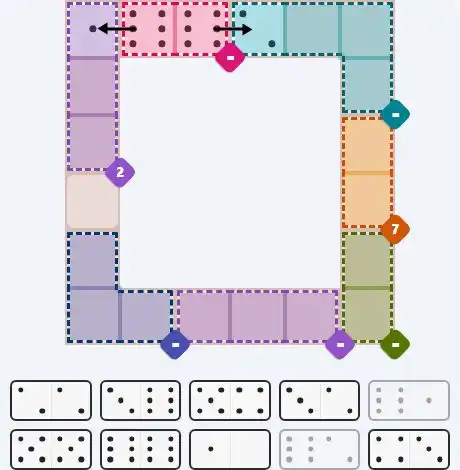
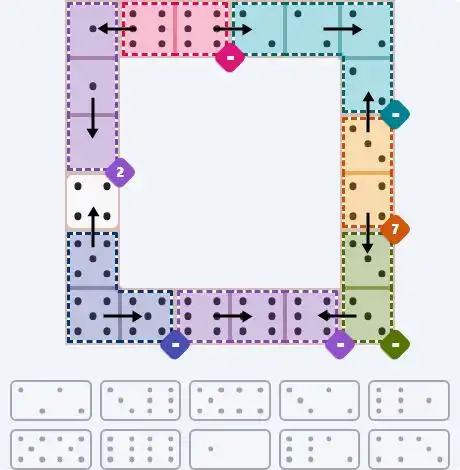
Place 4|1 horizontally at the top-left, 4 on the left. Three top-center cells all need 6: 6|6 across the first two, then 0|6 with 0 at the far-right edge. Right column is now all 0s — 0|0 for rows 1–2, then 0|3 with 0 on top. Left column rows 2–4 sum to 15 with 5+5+5: place 5|5 in the lower pair, 4|5 above with 5 at the bottom. Bottom row: 2|2 on the left, 2|3 with 2 on the left, 3|3 at the right end.
💡 Left column total is almost nothing
Three cells down the far-left column must reach a sum that barely clears zero. That target immediately filters today's dominoes down to one specific combination of pip values.
💡 Top-row equals regions chain together
Two separate equals regions span the top row. The value in the first one is set by the left-column solve. That same value flows directly into the second region, which then extends down the right edge of the board.
💡 Full answer
Left column sum=2 (1+1+0): place 6|1 at row 0 with 1 at col 0 and 6 at col 1, then 1|0 vertically below. Equals [cols 1–2]: both 6 — place 6|2 (6 at col 2, 2 at col 3). Equals [col 3 through row 1 col 5]: all 2 — 2|2 at row 0 cols 4–5, then 3|2 down the right edge (2 on top). Sum [right col rows 2–3]=7: 3+4 — place 4|3 with 4 on top. Equals [right col rows 4–5]: both 3 — place 3|6 at row 5 (3 at col 5, 6 at col 4). Empty cell row 3 col 0 gets 4 from 5|4 (5 below it). Bottom-left equals: 5|5 at row 5 cols 0–1. Bottom-center equals: 6|6 at row 5 cols 2–3.
💡 Top row pulls in two directions
The top row holds both a less-than region and a greater-than region. These opposing constraints on neighboring cells set strict limits on acceptable pip values — map out the ranges before placing anything.
💡 Mid-right equals pair has a neighbor
Two cells mid-way down the right column must hold equal values. The constraint immediately below that pair also involves the right column — locking the equals pair early solves two problems at once.
💡 Left column sum has one clean answer
Three cells down the far-left must sum to 8. One double-pip domino handles two of those cells at once, leaving the third cell straightforward to determine.
💡 Bottom row: four constraints, one pool
The bottom row packs an equals pair, a greater-than cell, a second equals pair, and a less-than cell back to back. They share the same small group of remaining dominoes — treat the row as a connected system rather than four independent problems.
💡 Full answer
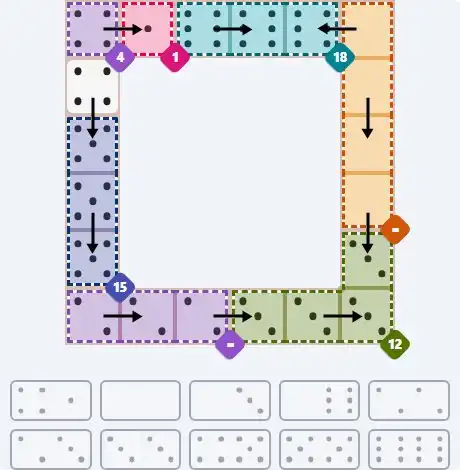
Left column sum=8: 1|1 at rows 0–1 (both = 1), 6|4 below (6 at row 2, 4 at row 3). Column sum=7: row 3 is 4, so row 4 = 3 — place 3|0 (3 at row 4, 0 at row 5). Equals [row 5 cols 0–1]=0: place 4|0 across cols 1–2 (0 at col 1, 4 at col 2). Equals [row 5 cols 3–4]: place 0|0. Row 4 col 5=3, row 5 col 5<2: place 3|1 at rows 4–5 col 5. Right-col equals [rows 1–2]: row 3 col 5>3, so place 4|1 at rows 3–2 col 5 (4 on top, 1 below), forcing equals value=1. Place 1|5 at rows 0–1 col 5 (5 at row 0, 1 at row 1). Place 2|4 at row 0 cols 3–4 (2 at col 3, 4 at col 4): 4+5=9>8 ✓. Place 3|3 at row 0 cols 1–2: 3>2 ✓, 3+2=5<6 ✓.

🎨 Pips Solver

Apr 1, 2026

Click a domino to place it on the board. You can also click the board, and the correct domino will appear.
Final Answer & Complete Solution For Hard Level

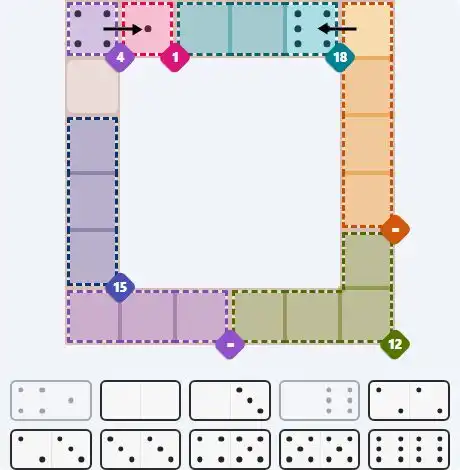
The key to solving today's hard puzzle was identifying the placement for the critical dominoes highlighted in the starting grid. Once those were in place, the rest of the puzzle could be solved logically. See the final grid below to compare your solution.

Starting Position & Key First Steps
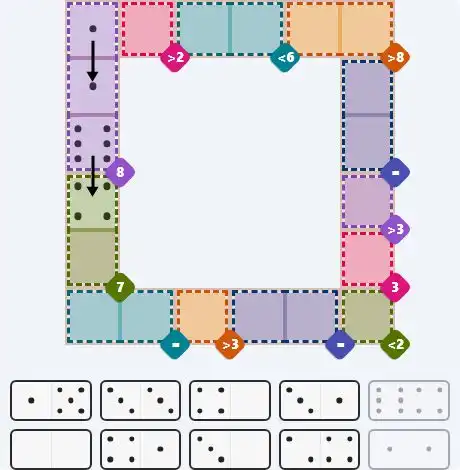
Pips hint for April 1, 2026 – hard level puzzle grid with critical first placements and strategy

This image shows the initial puzzle grid for the hard level, with a few critical first placements highlighted.

Final Answer: The Solved Grid for Hard Mode
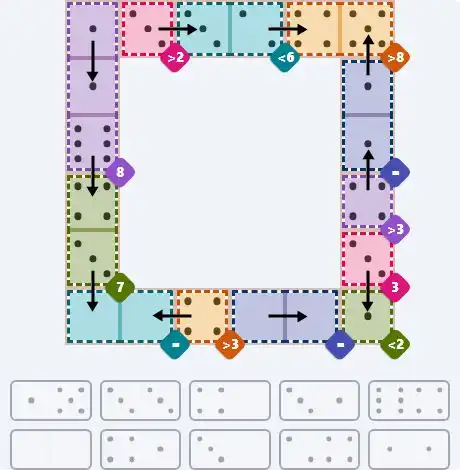
NYT Pips April 1, 2026 hard puzzle full solution grid showing final answer with hints

Compare this final grid with your own solution to see the correct placement of all dominoes.

🔧 Step-by-Step Answer Walkthrough For Easy Level

1
Step 1: Top-left corner gives away the first domino
The leftmost cell in the top row carries a sum of 4 — that cell holds exactly 4 pips, no calculation needed. The cell immediately to its right has a sum of 1. The 4|1 domino is the only piece in today's set with those two values. Place it horizontally across the top-left corner with 4 on the left.
2
Step 2: Three top-center cells can only be 6
The three top-center cells must sum to 18. Each cell tops out at 6 pips, and 6+6+6 is the only triple that reaches 18. Slot 6|6 into the first two cells. For the third you still need a 6 — orient 0|6 so 6 faces left toward the center and 0 sits at the far-right edge of the top row.
3
Step 3: Right column is all zeros
Four cells down the far-right edge must all equal the same value. The top cell of that column was just set to 0 in the previous step. All four cells must match — place 0|0 vertically to cover the next two cells down, then 0|3 below that with 0 on top and 3 at the bottom.
4
Step 4: Left column requires three fives
Three cells down the left side (rows 2–4) must sum to 15. Each cell maxes at 6, and 5+5+5 is the only combination that works. Place 5|5 vertically across the bottom two of those cells, then orient 4|5 in the top cell with 5 at the bottom.
5
Step 5: Bottom row closes perfectly
The three-cell equals region on the left side of the bottom row requires a shared value — place 2|2 horizontally first, then extend with 2|3 oriented with 2 on the left. All three equals cells now read 2. The last domino, 3|3, drops into the right end of the row. Final check: the four-cell sum region at the bottom-right reads 3+3+3+3=12 ✓. Puzzle complete.

🔧 Step-by-Step Answer Walkthrough For Medium Level

1
Step 1: Left column sum rules out nearly everything
Three cells down the far-left must total exactly 2. The only way to reach that with three adjacent cells is 1+1+0. Place 6|1 horizontally at the top of the column: 1 at col 0, 6 at col 1. Then 1|0 vertically below: 1 at row 1 col 0, 0 at row 2 col 0. Left-column sum: 1+1+0=2 ✓.
2
Step 2: First top-row equals anchors at 6
The equals region links col 1 and col 2 of the top row. Col 1 was just set to 6, so col 2 must also equal 6. Place 6|2 horizontally: 6 at col 2 and 2 at col 3.
3
Step 3: Second equals region fills four cells at value 2
The second equals region spans cols 3–5 of row 0 plus row 1 col 5. Col 3 was just set to 2, so all four cells must equal 2. Place 2|2 horizontally at cols 4–5 of row 0. Then 3|2 vertically in the rightmost column: 2 at row 1, 3 at row 2.
4
Step 4: Right-column sum and equals wrap up the right side
The two-cell sum at rows 2–3 of col 5 must equal 7. Row 2 is 3, so row 3 must be 4. Place 4|3 vertically: 4 at row 3, 3 at row 4. The equals pair at rows 4–5 must both be 3 — place 3|6 horizontally at row 5: 3 at col 5, 6 at col 4.
5
Step 5: Left-mid and bottom row complete the board
Row 3 col 0 is an empty region with no constraint. Place 5|4 vertically at rows 3–4 col 0: 4 at row 3, 5 at row 4. The equals region at row 4 col 0 and row 5 cols 0–1 all need to equal 5 — place 5|5 horizontally at row 5 cols 0–1. The final equals region at row 5 cols 2–4 must all be 6 — col 4 is already 6 — so place 6|6 at cols 2–3 to finish the board.

🔧 Step-by-Step Answer Walkthrough For Hard Level

1
Step 1: 1|1 anchors the left column
Three cells down the far-left (rows 0–2) must sum to 8. The 1|1 domino placed vertically at rows 0 and 1 contributes 1+1=2, so row 2 must carry 6. Place 6|4 vertically below: 6 at row 2, 4 at row 3.
2
Step 2: Column sum of 7 forces two more cells
The two-cell sum at rows 3–4 of col 0 must equal 7. Row 3 just became 4, so row 4 must be 3. Place 3|0 vertically: 3 at row 4, 0 at row 5.
3
Step 3: Bottom-left equals opens the bottom row
The equals region covers row 5 cols 0 and 1. Col 0 is 0, so col 1 must also be 0. Place 4|0 across cols 1–2 of row 5: 0 at col 1, 4 at col 2. The greater-than constraint at col 2 checks out immediately: 4>3 ✓.
4
Step 4: Bottom-right constraints resolve as a group
The equals pair at row 5 cols 3–4 needs equal values — 0|0 fits cleanly with both cells at 0. For col 5: row 4 carries a single-cell sum of 3, and row 5 must be less than 2. Place 3|1 at rows 4–5 col 5: 3 at row 4, 1 at row 5. Check: 1<2 ✓.
5
Step 5: Right column equals pair and its neighbor
Rows 1–2 of col 5 must hold equal values. Row 3 col 5 carries a greater-than-3 constraint — so it's 4, 5, or 6. Place 4|1 at rows 3–2 col 5: 4 at row 3 (>3 ✓), 1 at row 2. Both equals cells now read 1. Place 1|5 at rows 0–1 col 5: 1 at row 1, 5 at row 0.
6
Step 6: Top row satisfies three constraints at once
Row 0 col 5=5. The greater-than constraint on cols 4–5 requires their sum to exceed 8: col 4+5>8, so col 4≥4. Place 2|4 at row 0 cols 3–4: 2 at col 3, 4 at col 4. Sum=4+5=9>8 ✓. For cols 1–2: the less-than constraint requires col 2+col 3<6, so col 2+2<6 meaning col 2≤3. Place 3|3 at cols 1–2: both cells = 3. Check [0,1]=3>2 ✓ and [0,2]+[0,3]=3+2=5<6 ✓. Puzzle complete.

💡 Pro Tips for Similar Puzzles

Start with Constraints
Always begin with the most constrained regions - sum regions with small numbers or tight spaces.
Use Equal Regions
Use "equal" regions as anchors - they eliminate many possibilities quickly.
Work Systematically
Let the rules guide your placement rather than guessing randomly.
Double-Check
Verify each region's rules are satisfied before moving to the next.

🎓 Keep Learning & Improve