🔧 Step-by-Step Answer Walkthrough For Easy Level
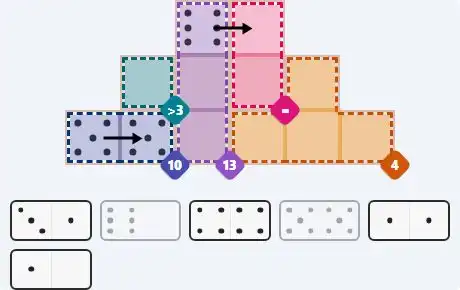
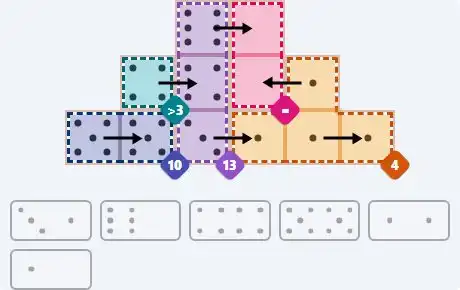
Two cells on the far left of the bottom row carry a sum constraint of 10. Look through the six available dominoes and ask which one — as a pair of pips — adds up to exactly 10. Only [5|5] does. Place it horizontally across those two cells. The left side of the bottom row is now fixed.
Three cells run vertically through the center of the pyramid — one in each row — and their pips must sum to 13. One of those cells (the bottom one) is already adjacent to the placed [5|5], but belongs to a different domino. Which three pip values from today's remaining dominoes can reach 13? The combination is 6+4+3. Place [6|0] at the top of this column with its 6 pointing into the column and its 0 extending right. Place [4|4] in the middle row with one 4 in the column and the other extending left. Place [3|1] in the bottom row with its 3 at the column cell and its 1 extending right.
The pyramid's top tier holds just two cells under an equals constraint — both must show the same pip. The [6|0] domino already placed its 0 at the right cell of that pair (top row, right position). So the left cell must also show 0. [1|0] delivers this: place it with its 0 at the inner top-row position and its 1 extending right and downward into the four-cell region below.
The four-cell region sums to 4. Three of its cells are already determined by the dominoes placed so far — they each show a pip of 1 (from the tails of [3|1], [1|0], and the slot waiting for [1|1]). One cell remains: the bottom-right corner pair. [1|1] is the only domino left, and placing it there gives 1+1+1+1=4. Puzzle complete.
🔧 Step-by-Step Answer Walkthrough For Medium Level
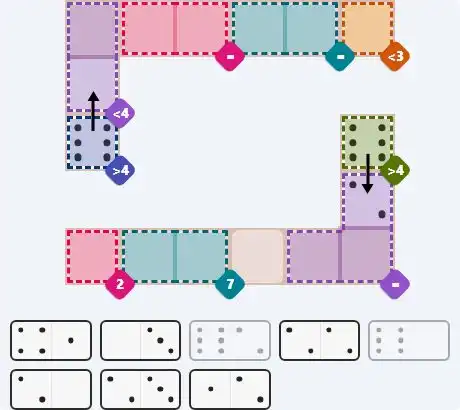
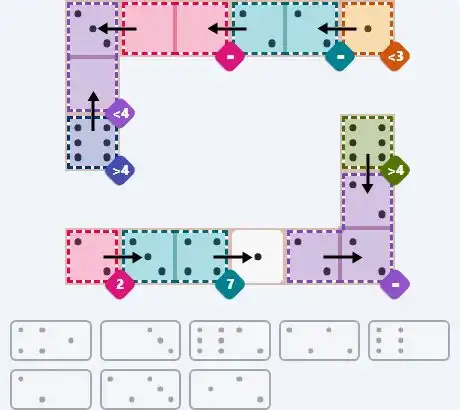
Two single cells — one at the lower end of the left column, one at the upper end of the right column — each require a pip value greater than 4. Scanning today's eight dominoes, only [6|0] and [6|2] carry a pip above 4. Each gets exactly one of those spine cells. The question is which goes where.
The lower-right corner region requires three cells to all show the same pip: the bottom of the right column plus the right-end pair of the bottom row. If [6|0] occupied the right column, its lower cell would show 0, and you'd need two more 0s in the bottom-right corner — but no [0|0] domino exists in today's set. So [6|2] must go in the right column, with its 2 at the lower cell, and [6|0] goes in the left column, with its 6 at the lower cell and its 0 rising to the upper cell.
The right column's lower cell now shows 2. The three-cell equals region connecting it to the bottom row's rightmost pair must all be 2. Place [2|2] horizontally across those two bottom-right cells — both showing 2 — completing the equals trio.
The far-right cell of the top row must be less than 3. Of the remaining dominoes, only [1|2] can place a value below 3 there — put its 1 at the far right and its 2 in the adjacent cell. Those two cells are also part of an equals pair, but [1|2]'s 2 lands one cell to the left of the equals boundary. The actual equals pair is the next two cells: the one just filled (showing 2 from [1|2]) and its neighbor. That neighbor must also be 2, so [2|0] goes there with 2 pointing right and 0 pointing left.
The far-left pair of the top row has an equals constraint: both cells in it must match. The inner cell now shows 0 (from [2|0]'s left end), so the outer cell must also be 0. Place [0|3] with its 0 at the inner position and its 3 at the far-left corner. The less-than-4 constraint covering the far-left top cell and the left column's upper cell checks out: 3 < 4 and 0 < 4.
Three dominoes remain for the six bottom-row cells. The far-left single-cell constraint requires a pip of exactly 2 — place [2|3] with its 2 there and its 3 one step right. The sum-of-7 constraint on the next two cells has 3 as its left value; it needs a right value of 4. Place [4|1] with its 4 satisfying the sum and its 1 filling the last cell. Puzzle complete.
🔧 Step-by-Step Answer Walkthrough For Hard Level
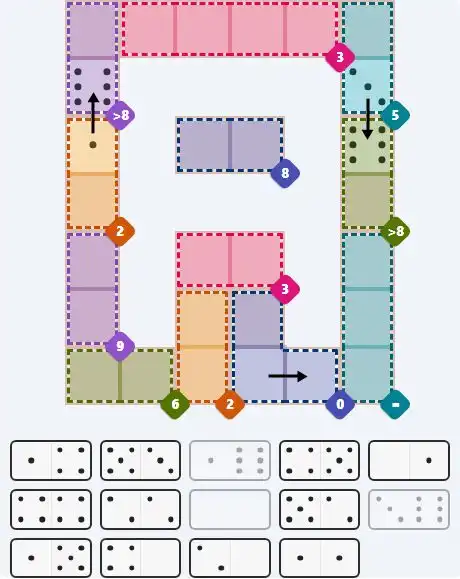
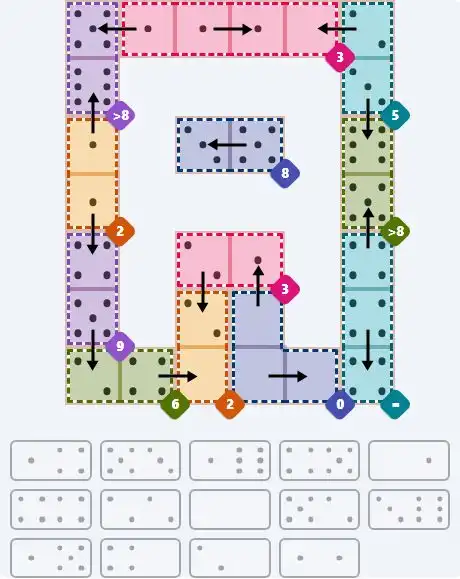
Three cells in the lower-center area must all show 0 — their combined sum is 0, and no individual pip can be negative. The [0|0] double-blank fills two of them in one tile. The third cell has a 0 forced on it too, and the [0|1] domino satisfies this: place its 0 in that third cell, with its 1 rising upward to the cell above.
The 1 placed by [0|1] now sits at the right cell of a two-cell sum=3 region. Its partner to the left must show 2. The [2|2] domino fills that spot — one 2 at the constrained cell, the other extending downward into the column below.
Two cells stack vertically in this column: the lower 2 from [2|2] is the upper one, and the cell below it needs the total to reach 2. So the lower cell must be 0. The [4|0] domino places its 0 there and its 4 to the left in the bottom row.
The two-cell constraint at the bottom-left of the board sums to 6. The right cell of that pair now shows 4 (from [4|0]), so the left cell must be 2. The [5|2] domino delivers: its 2 at the bottom-left, its 5 rising upward to the cell above.
The two-cell column above the [5|2] placement must sum to 9. Its lower cell shows 5, so the upper cell must be 4. The [1|4] domino fits vertically — 4 at the lower cell, 1 at the cell above it. That 1 is now the lower cell of a sum=2 pair in the left interior, forcing the cell above it to be 1 as well. The [1|6] domino places its 1 there and its 6 one step higher.
The two-cell column at the very top-left has a combined sum greater than 8. Its lower cell now shows 6 (from [1|6]). For 6 plus something to exceed 8, the upper cell needs at least 3 — and in practice the only remaining domino that fits is [1|5], which places its 5 at the top cell (5+6=11 > 8 ✓) and its 1 one step right along the top row.
Four cells across the top row — including the 1 just placed by [1|5] — must sum to 3. That 1 accounts for one pip; the remaining three cells must contribute 2 more. The [1|1] domino fills the next two cells (1+1=2), and the [2|0] domino places its 0 in the fourth cell (total: 1+1+1+0=3 ✓), with its 2 extending right to the far end of the top row.
The far-right top cell shows 2 (from [2|0]). The sum=5 constraint on that cell and the one below it means the lower cell needs 3. The [3|6] domino fits vertically — 3 at the top, 6 dropping below. That 6 is now the upper cell of the greater-than-8 right pair.
The greater-than-8 right pair has 6 at its top cell; its lower cell needs at least 3 for the sum to exceed 8. The [4|5] domino places its 5 there (6+5=11 ✓) and its 4 in the cell below that — which is the top of the three-cell equals column. All three cells in that column must match, so each must be 4. The [4|4] double-four fills the remaining two cells of the equals column.
One domino remains: [5|3]. One region remains: a two-cell horizontal pair in the interior that must sum to 8. Place [5|3] with its 5 on the right cell and its 3 on the left — 3+5=8. Puzzle complete.
💬 Community Discussion
Leave your comment