NYT Pips Hints & Answers for March 28, 2026

Mar 28, 2026

🚨 SPOILER WARNING

This page contains the final **answer** and the complete **solution** to today's NYT Pips puzzle. If you haven't attempted the puzzle yet and want to try solving it yourself first, now's your chance!

Click here to play today's official NYT Pips game first.

Want hints instead? Scroll down for progressive clues that won't spoil the fun.

🎲 Today's Puzzle Overview

Today's Pips puzzles are edited by Ian Livengood, who also constructed the easy puzzle himself. The easy grid is compact and elegant — just five dominoes arranged in a 3×5 layout — built around a single cell whose value is uniquely determined from the start. If you spot that anchor and trace where it leads, you won't need many hints at all.

The medium and hard puzzles come from Rodolfo Kurchan, a prolific puzzle constructor whose designs tend to reward patient, sequential solvers. The medium puzzle's most distinctive feature is a long chain of equals regions that ripple outward from a single placed domino — once you find the entry point, each step follows logically from the last. The hard puzzle scales this up across a seven-row grid, where multiple horizontal equals chains interact with vertical sum constraints in a richly interlocked solve.

Whether you're warming up with the easy or grinding through the hard, today's puzzles reward the habit of finding what's forced before reaching for what's merely possible. Start with the most constrained region, place with confidence, and let the cascade do the rest.

💡 Progressive Hints

Try these hints one at a time. Each hint becomes more specific to help you solve it yourself!

💡 Find the fixed cell first
One region constrains exactly one cell to a specific value. Once you know it, a chain reaction opens up through the top of the grid.
💡 The middle column unlocks the top row
The cell with a fixed value sits in the middle column of row 1. Use that pip count together with the sum constraint spanning the top of the same column — you'll land the value of its neighbor immediately.
💡 All five dominoes placed
The [4|3] domino drops into column 2 — [4] at row 0, [3] at row 1, satisfying the single-cell sum of 3. That forces the top-row sum to resolve: [0,1] must be 6, so [2|6] runs horizontally across the top-left ([2] at [0,0], [6] at [0,1]). With the greater-than constraint at [0,0] satisfied, [6|6] stands vertically in column 0 rows 1–2 for the equals region. The remaining two dominoes share the right side: [3|5] descends column 4 ([3] at [1,4], [5] at [2,4]), and [5|0] lies sideways in row 2 with [5] at [2,3] and [0] at [2,2], completing the bottom sum of 10.
💡 Two sums of 10 anchor both ends
There are two regions that must each total 10. Identify which domino fits each, and the equals constraint on the left side falls right into place.
💡 The middle column is your entry point
The single-cell sum in the middle of row 1 pins one pip value exactly. From there, work outward — the top-row sum, the left-column equals, and the bottom-right sum all resolve in sequence.
💡 Complete solution
The [4|3] domino sits in column 2, rows 0–1: [4] above, [3] below, satisfying the single-cell sum of 3. The top-row sum then gives [0,1]=6, placing [2|6] horizontally: [2] at [0,0] (meeting the greater-than-1 constraint), [6] at [0,1]. The equals region on the left column places [6|6] vertically in rows 1–2. For the bottom-right: [3|5] descends column 4 with [3] at [1,4] (greater than 1) and [5] at [2,4]. Finally [5|0] lies in row 2 with [5] at [2,3] and [0] at [2,2], completing the sum of 10.
💡 One cell, one value — no ambiguity
A region isolates a single cell and gives it a precise sum. That cell's value is known before you've placed anything. Start there and work outward.
💡 The fixed cell belongs to [4|3]
The single-cell sum forces [1,2]=3. Of the dominoes available, only [4|3] can cover that cell with a 3 — placing [4] at [0,2] above it. Now the top-row sum region becomes solvable.
💡 Cascade: middle column to top row to left column
[4|3] in column 2 forces [0,1]=6 via the sum of 10. That pins [2|6] across the top-left: [2] at [0,0], [6] at [0,1]. Now only [6|6] can satisfy the equals region in column 0 rows 1–2.
💡 Two dominoes, two right-side regions
After placing [4|3], [2|6], and [6|6], you have [3|5] and [5|0] left. The greater-than constraint at [1,4] and the sum of 10 at the bottom-right together pin which domino goes where.
💡 Full solution, step by step
[4|3] → column 2, rows 0–1 ([4] on top, [3] below). [2|6] → top-left horizontal ([2] at [0,0] satisfying >1, [6] at [0,1]). [6|6] → column 0, rows 1–2. [3|5] → column 4, rows 1–2 ([3] at [1,4] satisfying >1, [5] at [2,4]). [5|0] → row 2 right section ([5] at [2,3], [0] at [2,2]) — completing the bottom sum of 10.

🎨 Pips Solver

Mar 28, 2026

Click a domino to place it on the board. You can also click the board, and the correct domino will appear.
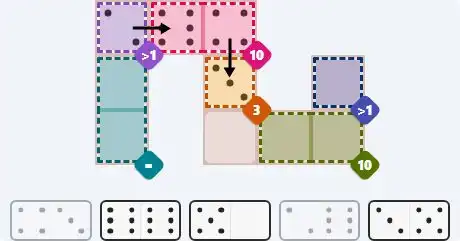
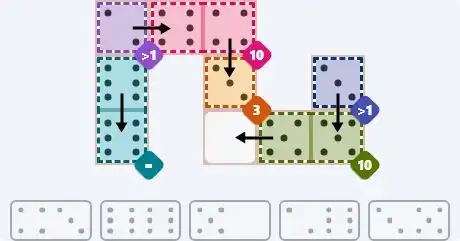
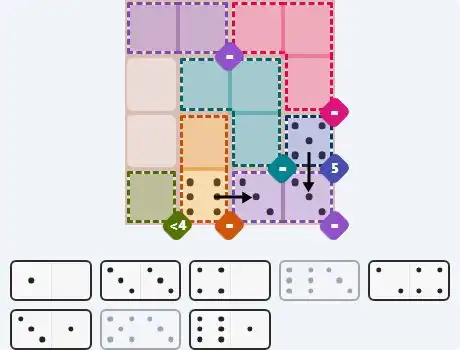
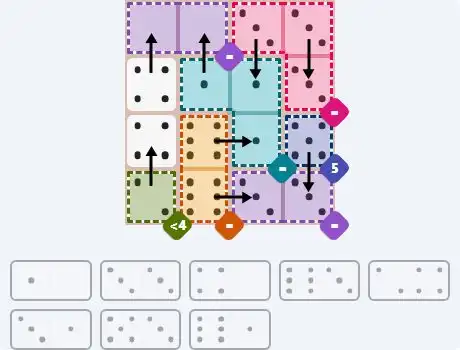
Final Answer & Complete Solution For Hard Level

The key to solving today's hard puzzle was identifying the placement for the critical dominoes highlighted in the starting grid. Once those were in place, the rest of the puzzle could be solved logically. See the final grid below to compare your solution.

Starting Position & Key First Steps
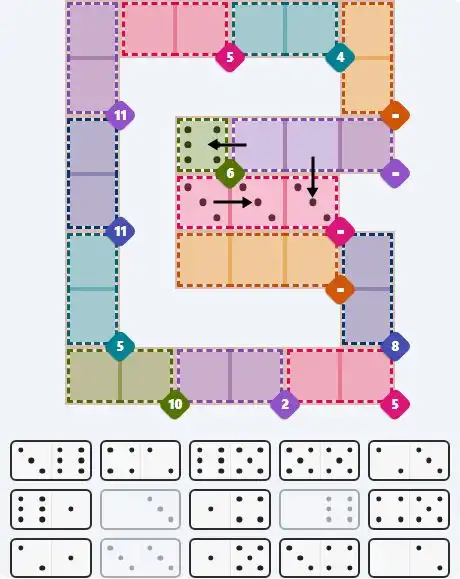
Pips hint for March 28, 2026 – hard level puzzle grid with critical first placements and strategy

This image shows the initial puzzle grid for the hard level, with a few critical first placements highlighted.

Final Answer: The Solved Grid for Hard Mode
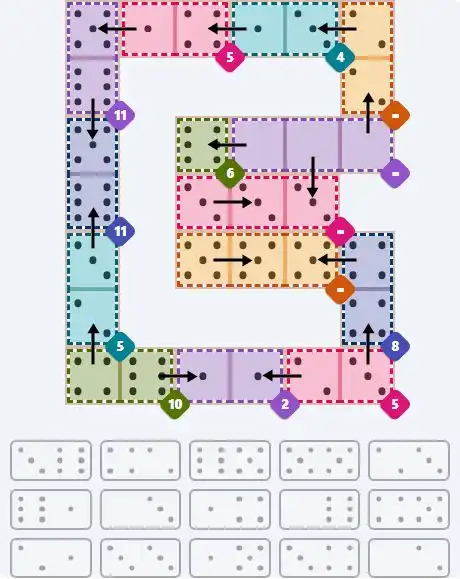
NYT Pips March 28, 2026 hard puzzle full solution grid showing final answer with hints

Compare this final grid with your own solution to see the correct placement of all dominoes.

🔧 Step-by-Step Answer Walkthrough For Easy Level

1
Step 1: Lock in the middle cell
The region at [1,2] is a single-cell constraint requiring a sum of 3. That cell must hold exactly 3 pips. Scan the domino set: both [4|3] and [3|5] contain a 3. Consider which one can place a 3 at [1,2] while fitting legally on the grid.
2
Step 2: Place [4|3] and resolve the top-row sum
[4|3] is the right choice — if [3|5] were used here, the 5-end would need to sit somewhere else and the remaining constraints become impossible. With [4|3] placed vertically ([4] at [0,2], [3] at [1,2]), the sum region covering [0,1] and [0,2] now reads: [0,1] + 4 = 10, so [0,1] = 6. Only [2|6] can deliver a 6 to [0,1] — it runs horizontally: [2] at [0,0], [6] at [0,1]. The greater-than-1 constraint at [0,0] is satisfied by the 2.
3
Step 3: Fill the left column with [6|6]
The equals region links [1,0] and [2,0] — both cells must share the same pip value. Only [6|6] satisfies an equals constraint on its own, and it fits perfectly here: placed vertically in column 0, rows 1–2.
4
Step 4: Resolve the right side
Two dominoes remain — [3|5] and [5|0] — for the two right-side constraints. The greater-than-1 condition at [1,4] is satisfied by either a 3 or a 5. Test [3|5] descending column 4: [3] at [1,4], [5] at [2,4]. Then [2,3] + [2,4] = 10 → [2,3] + 5 = 10 → [2,3] = 5. [5|0] placed sideways in row 2 delivers this: [5] at [2,3], [0] at [2,2]. Everything checks out — the puzzle is solved.

🔧 Step-by-Step Answer Walkthrough For Medium Level

1
Step 1: Find the only fixed cell
The region at [1,2] sums to exactly 3 using one cell. This tells you directly that [1,2] = 3. Two dominoes in the set contain a 3: [4|3] and [3|5]. Only [4|3] can reach [1,2] with a 3 while covering an adjacent cell with a 4, so [4|3] is placed vertically in column 2 — [4] at [0,2], [3] at [1,2].
2
Step 2: Resolve the top-row sum
Now that [0,2] = 4, the sum region [0,1] + [0,2] = 10 becomes [0,1] + 4 = 10, forcing [0,1] = 6. Look for a domino that can carry 6 to [0,1]: [2|6] fits horizontally across [0,0]–[0,1]. Its placement also satisfies the greater-than-1 condition at [0,0], where [0,0] = 2.
3
Step 3: Place [6|6] in the equals region
The equals region spans [1,0] and [2,0]. Both cells must have the same pip value. The only domino in the set that guarantees equal pips on both ends is [6|6] — place it vertically in column 0, rows 1–2.
4
Step 4: Deduce the right side from two remaining dominoes
With [4|3], [2|6], and [6|6] placed, only [3|5] and [5|0] remain. The greater-than-1 region at [1,4] needs a value of at least 2. Try [3|5] descending column 4: [3] at [1,4] (3 > 1, satisfied), [5] at [2,4]. Then the bottom sum region gives: [2,3] + 5 = 10 → [2,3] = 5. [5|0] placed sideways with [5] at [2,3] and [0] at [2,2] fills this exactly. All regions are satisfied.

🔧 Step-by-Step Answer Walkthrough For Hard Level

1
Step 1: Anchor on the single fixed cell
The region at [1,2] contains exactly one cell and requires a sum of 3 — so [1,2] = 3 with certainty. Of the available dominoes, [4|3] is the fit: [4] at [0,2], [3] at [1,2]. No other domino can legally cover this cell with exactly 3 while satisfying the grid geometry.
2
Step 2: Unpack the top-row sum
With [0,2] = 4 established, the sum region [0,1] + [0,2] = 10 resolves to [0,1] = 6. Scan for a domino with a 6 that can reach [0,1]: [2|6] fits horizontally, placing [2] at [0,0] and [6] at [0,1]. This also clears the greater-than-1 constraint at [0,0] — the value 2 exceeds 1.
3
Step 3: Confirm the left-column equals with [6|6]
The equals region at [1,0] and [2,0] demands identical pip values in both cells. The only self-equalizing domino in the set is [6|6]. Place it vertically in column 0 rows 1–2. This is forced — no other domino can satisfy an equals constraint on both its cells.
4
Step 4: Choose between the final two dominoes
After [4|3], [2|6], and [6|6] are placed, [3|5] and [5|0] remain. Two constraints guide the remaining placements: [1,4] must be greater than 1, and [2,3] + [2,4] must sum to 10. If [3|5] descends column 4 with [3] at [1,4] and [5] at [2,4], then [2,3] must be 5 to reach the sum of 10. Test [5|0] laid sideways in row 2: [5] at [2,3], [0] at [2,2] — this works. Confirm [1,4] = 3 > 1. All five dominoes placed, all regions satisfied.

💡 Pro Tips for Similar Puzzles

Start with Constraints
Always begin with the most constrained regions - sum regions with small numbers or tight spaces.
Use Equal Regions
Use "equal" regions as anchors - they eliminate many possibilities quickly.
Work Systematically
Let the rules guide your placement rather than guessing randomly.
Double-Check
Verify each region's rules are satisfied before moving to the next.

🎓 Keep Learning & Improve