NYT Pips Hints & Answers for March 25, 2026

Mar 25, 2026

🚨 SPOILER WARNING

This page contains the final **answer** and the complete **solution** to today's NYT Pips puzzle. If you haven't attempted the puzzle yet and want to try solving it yourself first, now's your chance!

Click here to play today's official NYT Pips game first.

Want hints instead? Scroll down for progressive clues that won't spoil the fun.

🎲 Today's Puzzle Overview

Wednesday's Pips brings two constructors to the table: Ian Livengood handles the Easy and Medium grids, while Rodolfo Kurchan takes charge of the Hard puzzle. Livengood is known for tightly logical designs where a handful of constraint cells do all the heavy lifting — both of today's easier grids reward solvers who identify their entry points before placing a single domino.

The Easy puzzle is a compact 4×4 grid built around just six dominoes. Two single-cell constraints anchor it immediately, and once you've dealt with those, an equals region across the top row locks itself almost automatically. It's the kind of puzzle that feels satisfying precisely because the logic clicks into place so cleanly.

Kurchan's Hard puzzle is a different beast entirely. The grid stretches seven rows tall but stays narrow, with twelve dominoes threaded through a sparse layout. The key insight is directional: everything flows bottom-up. A single zero-constrained cell at the very bottom-left sets off a cascade that climbs the entire left column before finally unlocking the top row through a neat chain of sum pairs.

💡 Progressive Hints

Try these hints one at a time. Each hint becomes more specific to help you solve it yourself!

💡 Let the locked cells lead the way
This grid has two cells that each carry a strict numerical constraint — they must hold one exact value and nothing else. Identify them before placing anything else. Those two anchors will unravel the rest of the puzzle for you.
💡 The equals region at the top is your main chain
Once you've placed the domino that satisfies the sum constraint on the left edge, its partner lands below it as a free cell. Meanwhile, the three-cell equals region across the top row can only be satisfied by one available domino — and it pairs naturally with whatever you settle at the top-right corner.
💡 Full solution
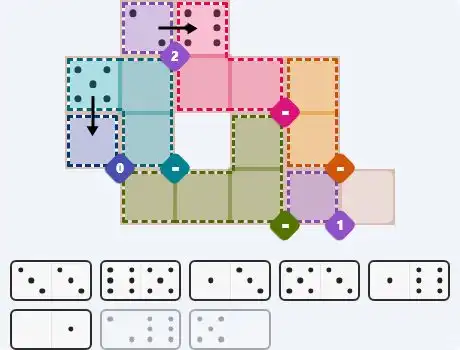
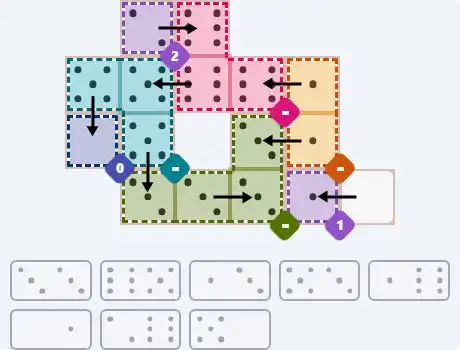
Cell [1,0] must be 6, so the 3-6 domino goes vertically at [1,0][2,0] — 6 on top, 3 below. Cell [0,3] must be 5, so the 5-2 domino goes horizontally at [0,3][0,2] — 5 on the right, 2 on the left. The equals region [0,0][0,1][0,2] all become 2, filled by the 2-2 domino at [0,0][0,1]. The equals region [2,3][3,3] needs two matching values: the 4-0 domino goes vertically at [2,3][1,3] with 4 in [2,3] and 0 in [1,3]. The 4-4 domino fills [3,2][3,3], matching [2,3]=4. Finally the 5-5 domino lands at [3,0][3,1], completing the sum-14 constraint with 5+5+4.
💡 One mandatory zero starts everything
There's a single-cell region in this puzzle that must hold zero — exactly zero. Finding which domino delivers that value and where its partner lands will ignite a chain reaction through the equals constraints that covers most of the board.
💡 Follow the fives across the middle
The zero-constrained cell sits in the second row on the left side. Once that domino is in place, its partner forces a specific value into an adjacent cell — and that value is exactly what the three-cell equals region needs. Watch how it spreads through three separate cells, each demanding a different domino to match.
💡 Full solution
Cell [2,0] must be 0, so the 5-0 domino goes vertically at [1,0][2,0] — 5 on top, 0 below. The equals region [1,0][1,1][2,1] all become 5: the 6-5 domino places [1,1]=5 and [1,2]=6; the 5-3 domino places [2,1]=5 and [3,1]=3. Cell [0,1] must be 2, so the 2-6 domino goes horizontally at [0,1][0,2] — 2 then 6. The equals region [0,2][1,2][1,3] all become 6: [1,3]=6 via the 1-6 domino, which also places [1,4]=1. That triggers equals region [1,4][2,4]: the 1-3 domino at [2,4][2,3] puts [2,4]=1 and [2,3]=3. The four-cell equals region [2,3][3,1][3,2][3,3] all become 3, completed by the 3-3 domino at [3,2][3,3]. The 0-1 domino finishes the bottom row with 1 in [3,4] and 0 in [3,5].
💡 Start at the very bottom
This tall, sparse grid hides its entry point at the bottom-left corner. One cell there carries an absolute constraint that pins its value to a single possibility. That one placement kicks off a chain that works its way upward through the entire left column before eventually unlocking the top row.
💡 Zero anchors the left edge, then sixes take over
With the bottom-left cell forced to zero, its domino partner reveals a value that drives the three-cell equals region along the bottom row. Trace up the left column: a sum constraint two rows from the bottom gives you another fixed value, and that value cascades upward through two separate equals constraints — both demanding the same number all the way through rows 3 and 4.
💡 The left column chain reaches row 2
Once you've established that [3,0], [4,0], and [4,1] are all the same value, the domino covering [3,0] and [2,0] sets [2,0] to a new value. The equals region [1,0][2,0][2,1] forces all three cells to match, and the domino covering [1,0] determines [0,0] — that cell is the key that unlocks the entire top row.
💡 The top row is a chain of sum pairs
With [0,0]=4 established, the sum-5 constraint at [0,0][0,1] immediately gives you [0,1]=1. The domino that covers [0,1] also sets [0,2]=2, which feeds the sum-8 constraint at [0,2][0,3] to give [0,3]=6. The 6-6 domino fills [0,3][0,4], and the sum-7 at [0,4][1,4] gives [1,4]=1. From there the right column resolves downward one constraint at a time.
💡 Complete solution
[6,0]=0 (sum constraint): the 0-5 domino goes horizontally at [6,0][6,1], setting [6,1]=5. Region [6,1][6,2][6,3] all become 5: the 5-5 domino covers [6,2][6,3]. [5,0]=5 (sum constraint): the 6-5 domino goes vertically at [4,0][5,0], setting [4,0]=6. Region [3,0][4,0][4,1] all become 6: the 6-0 domino at [3,0][2,0] sets [2,0]=0; the 4-6 domino at [4,2][4,1] sets [4,2]=4. Region [1,0][2,0][2,1] all become 0: the 0-4 domino at [1,0][0,0] sets [0,0]=4; the 2-0 domino at [2,2][2,1] sets [2,2]=2. Top row: [0,0]+[0,1]=5 so [0,1]=1 — the 2-1 domino at [0,2][0,1] sets [0,2]=2. [0,2]+[0,3]=8 so [0,3]=6 — the 6-6 domino at [0,3][0,4] sets [0,4]=6. [0,4]+[1,4]=7 so [1,4]=1 — the 1-3 domino at [1,4][2,4] sets [2,4]=3. [2,4]+[3,4]=6 so [3,4]=3 — the 0-3 domino at [4,4][3,4] sets [4,4]=0. [4,4]+[5,4]+[6,4]=6: the 4-2 domino at [5,4][6,4] gives 0+4+2=6.

🎨 Pips Solver

Mar 25, 2026

Click a domino to place it on the board. You can also click the board, and the correct domino will appear.
Final Answer & Complete Solution For Hard Level

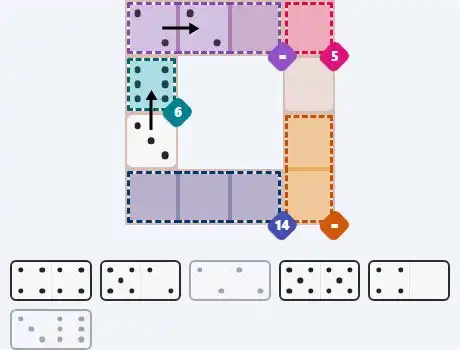
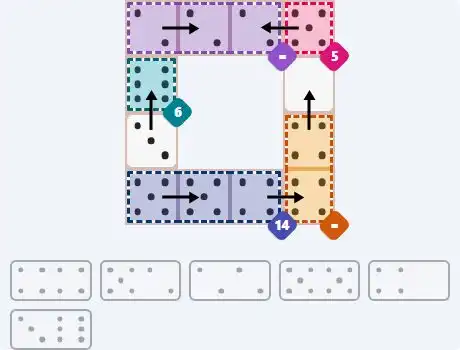
The key to solving today's hard puzzle was identifying the placement for the critical dominoes highlighted in the starting grid. Once those were in place, the rest of the puzzle could be solved logically. See the final grid below to compare your solution.

Starting Position & Key First Steps
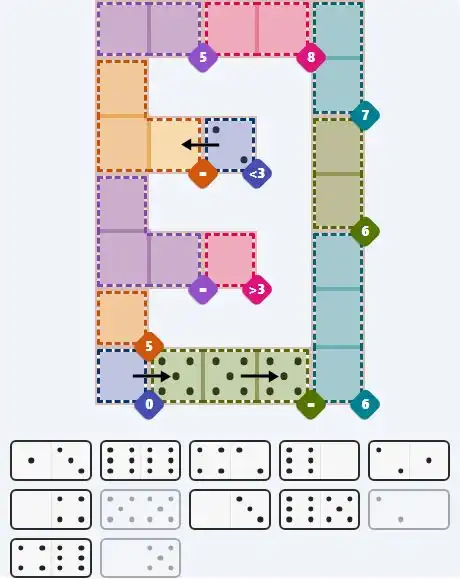
Pips hint for March 25, 2026 – hard level puzzle grid with critical first placements and strategy

This image shows the initial puzzle grid for the hard level, with a few critical first placements highlighted.

Final Answer: The Solved Grid for Hard Mode
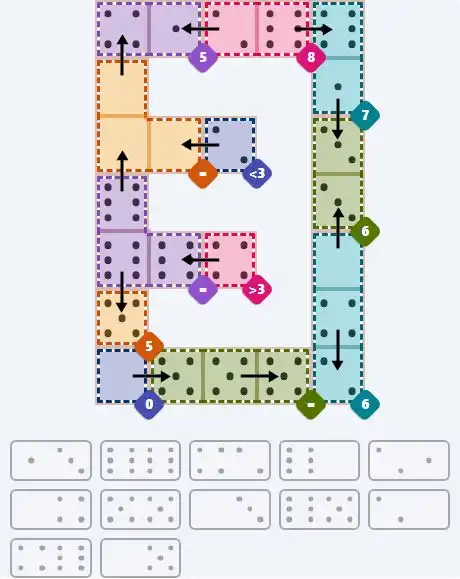
NYT Pips March 25, 2026 hard puzzle full solution grid showing final answer with hints

Compare this final grid with your own solution to see the correct placement of all dominoes.

🔧 Step-by-Step Answer Walkthrough For Easy Level

1
Step 1: Claim the sum-6 cell
Cell [1,0] is a single-cell region that must sum to exactly 6. Scan the six dominoes — only the 3-6 piece contains a 6. Place it vertically at [1,0][2,0] with 6 in the upper cell and 3 below. That's your first anchor.
2
Step 2: Fill the top-right corner
Cell [0,3] must sum to 5. The 5-2 domino is the natural fit. Lay it horizontally at [0,3][0,2] — 5 in the corner cell, 2 extending left. This also sets [0,2]=2, which is important for what comes next.
3
Step 3: Complete the top equals region
The three-cell equals region spans [0,0], [0,1], and [0,2]. With [0,2] already fixed at 2, every cell in the region must also be 2. The 2-2 domino drops neatly across [0,0][0,1], filling all three cells with matching values.
4
Step 4: Resolve the right-side equals pair
The equals region [2,3][3,3] requires both cells to share the same value. With the remaining dominoes, the 4-0 piece goes vertically at [1,3][2,3] — 0 in [1,3] and 4 in [2,3]. Now [3,3] must also be 4, which the 4-4 domino handles across [3,2][3,3].
5
Step 5: Place the final domino
Only the 5-5 domino remains. It settles horizontally into [3,0][3,1]. Verify the sum: [3,0]+[3,1]+[3,2] = 5+5+4 = 14. Constraint confirmed, puzzle complete.

🔧 Step-by-Step Answer Walkthrough For Medium Level

1
Step 1: Lock in the zero
Cell [2,0] is constrained to sum to 0, so it must hold a zero-pip face. The 5-0 domino is the right fit — place it vertically at [1,0][2,0], with 5 in [1,0] and 0 in [2,0]. That zero is non-negotiable, and everything else flows from it.
2
Step 2: Spread the fives
The equals region covers [1,0], [1,1], and [2,1]. With [1,0]=5 already set, all three cells must equal 5. The 6-5 piece placed horizontally at [1,1][1,2] puts 5 in [1,1] and 6 in [1,2]. The 5-3 piece placed vertically at [2,1][3,1] puts 5 in [2,1] and 3 in [3,1].
3
Step 3: Anchor the top pair
Cell [0,1] must sum to 2. The 2-6 domino fits horizontally at [0,1][0,2] — 2 in [0,1] and 6 in [0,2]. That sets up the next equals region cleanly.
4
Step 4: Chase the sixes across row 1
The equals region [0,2][1,2][1,3] requires all three to match. With [0,2]=6 and [1,2]=6 already in place, [1,3] must also be 6. The 1-6 domino goes horizontally at [1,3][1,4] — 6 in [1,3] and 1 in [1,4].
5
Step 5: Finish the right side
The equals region [1,4][2,4] requires [2,4] to also equal 1. The 1-3 domino slides vertically at [2,4][2,3] — 1 in [2,4] and 3 in [2,3]. The four-cell equals region [2,3][3,1][3,2][3,3] all become 3: with [2,3]=3 and [3,1]=3 confirmed, the 3-3 domino covers [3,2][3,3]. The 0-1 domino finishes the grid with 1 in [3,4] (satisfying the sum-1 constraint) and 0 in [3,5].

🔧 Step-by-Step Answer Walkthrough For Hard Level

1
Step 1: Zero at the bottom-left
Cell [6,0] must sum to 0 — there's only one possible value. The 0-5 domino is the piece that delivers it: place it horizontally at [6,0][6,1] with 0 in the corner and 5 extending right. That 5 is now fixed in [6,1].
2
Step 2: Fill the bottom row equals region
The equals region [6,1][6,2][6,3] requires all three cells to match. With [6,1]=5 established, both [6,2] and [6,3] must also be 5. The 5-5 double slides in horizontally across [6,2][6,3], completing the bottom row.
3
Step 3: Climb the left column with sixes
Cell [5,0] must sum to 5. The 6-5 domino goes vertically at [4,0][5,0] — 6 in [4,0] and 5 in [5,0]. Now [4,0]=6 triggers the equals region [3,0][4,0][4,1]: all three must be 6. Place the 6-0 domino vertically at [3,0][2,0] to set [3,0]=6 and [2,0]=0. Place the 4-6 domino horizontally at [4,2][4,1] to set [4,1]=6 and [4,2]=4.
4
Step 4: Follow the zeros up to row 0
The equals region [1,0][2,0][2,1] requires all three to match. With [2,0]=0, both [1,0] and [2,1] must also be 0. The 0-4 domino placed vertically at [1,0][0,0] puts 0 in [1,0] and — crucially — 4 in [0,0]. The 2-0 domino placed horizontally at [2,2][2,1] puts 2 in [2,2] and 0 in [2,1]. Cell [2,2] is a less-than-3 constraint: 2 < 3, confirmed.
5
Step 5: Unlock the top row and right column
With [0,0]=4, the sum-5 at [0,0][0,1] gives [0,1]=1. The 2-1 domino at [0,2][0,1] sets [0,2]=2. The sum-8 at [0,2][0,3] gives [0,3]=6. The 6-6 domino at [0,3][0,4] sets [0,4]=6. The sum-7 at [0,4][1,4] gives [1,4]=1. The 1-3 domino drops vertically at [1,4][2,4], setting [2,4]=3. The sum-6 at [2,4][3,4] gives [3,4]=3. The 0-3 domino at [4,4][3,4] sets [4,4]=0. Finally, [4,4]+[5,4]+[6,4] must sum to 6: the 4-2 domino at [5,4][6,4] gives 0+4+2=6.

💡 Pro Tips for Similar Puzzles

Start with Constraints
Always begin with the most constrained regions - sum regions with small numbers or tight spaces.
Use Equal Regions
Use "equal" regions as anchors - they eliminate many possibilities quickly.
Work Systematically
Let the rules guide your placement rather than guessing randomly.
Double-Check
Verify each region's rules are satisfied before moving to the next.

🎓 Keep Learning & Improve