NYT Pips Hints & Answers for April 5, 2026

Apr 5, 2026

🚨 SPOILER WARNING

This page contains the final **answer** and the complete **solution** to today's NYT Pips puzzle. If you haven't attempted the puzzle yet and want to try solving it yourself first, now's your chance!

Click here to play today's official NYT Pips game first.

Want hints instead? Scroll down for progressive clues that won't spoil the fun.

🎲 Today's Puzzle Overview

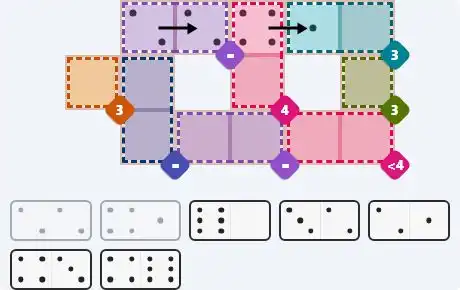
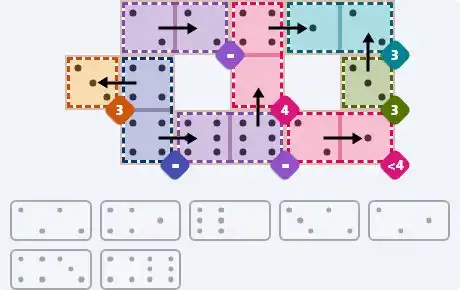
Ian Livengood's easy grid for April 5 looks almost like two narrow columns stitched together by a single cell in the middle. The puzzle opens with two single-cell sum clues across the top, both naming the same pip value. That immediately points to one shared high-value domino face, and from there the two vertical equals regions settle into matching stacks: sixes on the left, threes on the right, and finally ones across the bottom.

Livengood's medium puzzle has a different rhythm. Three separate clues each fix a single cell exactly: one 4, one 3, and another 3. Those anchors are spread across the board, but together they determine the two top-row sum regions and force a zero into the center column. Once that zero lands, the lower equals region turns into a 6-pair, and the last horizontal domino drops into place almost by itself.

Rodolfo Kurchan's hard puzzle for today is compact but tightly chained. Nearly every region is either a two-cell sum or a small equals group, so one placement tends to feed the next immediately. The top row already tells a strong story: a sum of 4, an equals pair, and a sum of 12 sit side by side, and the domino set only supports one clean arrangement. By the time the middle row locks a three-cell equals region at value 5, the entire bottom row is reduced to a neat 3-1-1-1 pattern.

💡 Progressive Hints

Try these hints one at a time. Each hint becomes more specific to help you solve it yourself!

💡 The top row names the same value twice
Both top corners are single-cell sum clues, and both ask for exactly 4 pips. That means two different dominoes must contribute a 4-face immediately, which trims today's easy set faster than it first appears.
💡 The center columns want matching stacks
Two vertical equals regions sit side by side. Once one of the 4-faced dominoes is placed, each column starts advertising the value it wants all the way down.
💡 Full solution
Place [4|6] vertically at the far left: 4 at (0,0) and 6 at (1,0). The equals region below forces (2,0)=6, so [0|6] goes vertically with 6 at (2,0) and 0 at (3,0). On the right, [3|4] fits vertically with 4 at (0,2) and 3 at (1,2); the equals region below makes (2,2)=3, so [3|2] goes horizontally with 3 at (2,2) and 2 at (2,1). Bottom-left single-cell sum=5 fixes [5|1] across (4,0) and (4,1), giving (4,0)=5 and (4,1)=1. The last domino [1|0] stands at the lower right: (4,2)=1 and (3,2)=0. Bottom equals check: 1=1. Puzzle complete.
💡 Three single cells do the opening work
This grid has three one-cell clues that already know their value: a 4 near the top, a 3 on the left, and another 3 on the far right. Read those first before worrying about the larger regions.
💡 A zero in the center unlocks the lower equals pair
One top-column sum of 4 can only be completed by pairing a 4 with a 0. Once that zero drops into the middle, the equals region beneath it becomes much easier to finish.
💡 Full solution
Top-left equals pair uses the [2|2] double across (0,1) and (0,2). Single-cell sum=4 at (0,3) makes [4|1] run across the top with 4 at (0,3) and 1 at (0,4). Sum=4 down the next column then forces [6|0] vertically with 0 at (1,3) and 6 at (2,3), so the lower equals pair at (2,2)-(2,3) now needs 6 and is completed by [4|6] horizontally with 6 at (2,2). Single-cell sum=3 at (1,5) makes [3|2] place 3 at (1,5) and 2 at (0,5), which also satisfies the top-row sum=3 with (0,4)=1. Single-cell sum=3 at (1,0) is filled by [4|3] horizontally with 3 at (1,0) and 4 at (1,1); the equals region below forces (2,1)=4. The last domino [2|1] goes across (2,4) and (2,5) as 2 and 1, and 2+1=3 stays under the less-than-4 limit. Puzzle complete.
💡 The top row almost solves itself
Look at the four regions across the top two rows: sum 9, sum 4, an equals pair, and sum 12. The available dominoes have very few ways to hit those totals cleanly, especially the equals and 12-sum slots.
💡 The middle equals trio settles on one value
There is a three-cell equals region in the center of the board. Once one of its cells is fixed from a neighboring sum, the other two fall into the same value and one double suddenly gets an obvious home.
💡 The bottom row is four ones wrapped around a three
After the middle resolves, the last two regions are unusually constrained: one single cell must be 3, and the four-cell sum beside it must total 4. That leaves almost no freedom in how the remaining dominoes can land.
💡 Full solution
Start with the top row: [4|2] goes across (0,0)-(0,1), and [1|2] places 2 at (0,2), satisfying the sum-4 pair. The equals region at (0,3)-(1,3) must be 0, so [5|0] goes vertically with 0 at (1,3) and 5 at (2,3). Sum=12 at (0,4)-(1,4) can only be [0|6], giving 6 at both cells: 6 at (0,4) and 6 at (1,4). Then row 1 sum=2 at (1,1)-(1,2) forces [5|1] with 1 at (1,1) and 1 at (1,2)'s neighbor already fixed by [1|2]. In row 2, sum=6 at (2,0)-(2,1) is the [3|3] double. The center equals trio at (2,3),(3,2),(3,3) is now fixed at 5, so [5|5] fills (3,2) and (3,3). Sum=5 at (2,4)-(3,4) becomes [6|2] with 2 at (2,4) and 3 below supplied by [1|3], which places 1 at (4,4) and 3 at (3,4). Sum=11 at (3,0)-(3,1) is completed by [3|5] and [1|6], giving 5 and 6. The bottom-left single cell is 3, so [3|5] places 3 at (4,0). The four-cell sum on the bottom row must total 4, so [1|1] fills (4,2) and (4,3), and [1|6] contributes the remaining 1 at (4,1). Final check: 1+1+1+1=4. Puzzle complete.

🎨 Pips Solver

Apr 5, 2026

Click a domino to place it on the board. You can also click the board, and the correct domino will appear.
Final Answer & Complete Solution For Hard Level

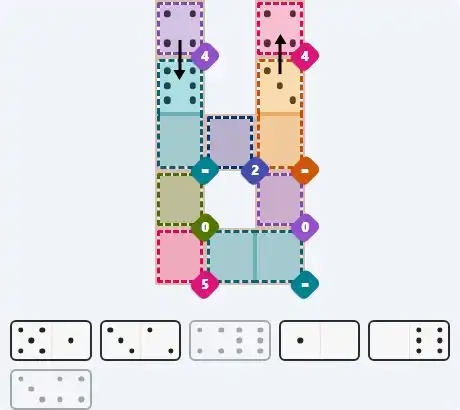
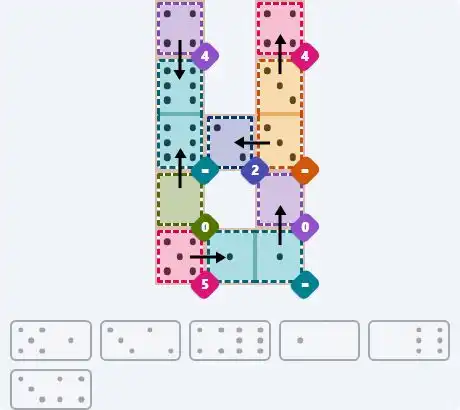
The key to solving today's hard puzzle was identifying the placement for the critical dominoes highlighted in the starting grid. Once those were in place, the rest of the puzzle could be solved logically. See the final grid below to compare your solution.

Starting Position & Key First Steps
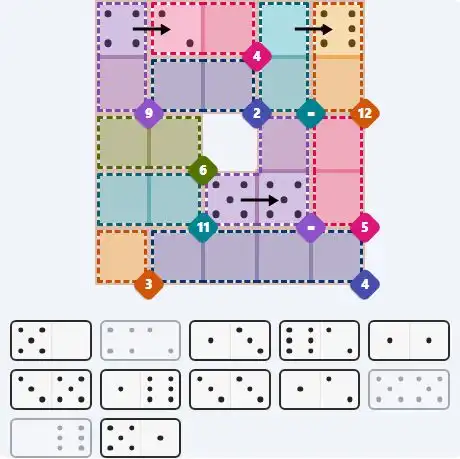
Pips hint for April 5, 2026 – hard level puzzle grid with critical first placements and strategy

This image shows the initial puzzle grid for the hard level, with a few critical first placements highlighted.

Final Answer: The Solved Grid for Hard Mode
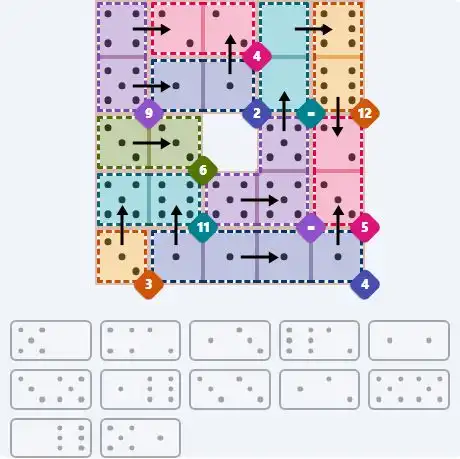
NYT Pips April 5, 2026 hard puzzle full solution grid showing final answer with hints

Compare this final grid with your own solution to see the correct placement of all dominoes.

🔧 Step-by-Step Answer Walkthrough For Easy Level

1
Step 1: The two top cells each demand a 4
Cell (0,0) is a single-cell sum of 4, and cell (0,2) is also a single-cell sum of 4. So two dominoes must place a 4 directly into those top cells. Among today's pieces, [4|6] and [3|4] are the only candidates that can do that cleanly.
2
Step 2: The left equals column becomes all 6s
Place [4|6] vertically at (0,0) and (1,0): 4 on top, 6 below. The equals region at (1,0) and (2,0) means both cells must match, so (2,0)=6 as well. That forces [0|6] vertically at (3,0) and (2,0), with 6 at (2,0) and 0 at (3,0).
3
Step 3: The right equals column becomes all 3s
Now place [3|4] vertically at (1,2) and (0,2): 3 at (1,2), 4 at (0,2), satisfying the top-right single-cell sum. The equals region at (1,2) and (2,2) forces (2,2)=3. The [3|2] domino then goes horizontally at (2,2) and (2,1), giving (2,2)=3 and (2,1)=2. The single-cell sum at (2,1) checks immediately.
4
Step 4: The bottom row fixes the last two dominoes
Cell (4,0) is a single-cell sum of 5, so [5|1] must cover (4,0) and (4,1) with 5 at the left and 1 at the right. The remaining domino [1|0] fills (4,2) and (3,2), giving (4,2)=1 and (3,2)=0. That satisfies the single-cell sum of 0 at (3,2).
5
Step 5: Final equals check closes the board
The last unresolved region is the equals pair at (4,1) and (4,2). Step 4 gave both cells the value 1, so the region matches perfectly. Every clue on the board is now satisfied. Puzzle complete.

🔧 Step-by-Step Answer Walkthrough For Medium Level

1
Step 1: Three one-cell clues identify three values immediately
Cell (0,3) must be 4, cell (1,0) must be 3, and cell (1,5) must also be 3. Those three anchors already point to [4|1], [4|3], and [3|2] as important early dominoes.
2
Step 2: The top-left equals pair is the [2|2] double
Cells (0,1) and (0,2) must be equal. The cleanest way to satisfy that pair is the [2|2] double placed horizontally across them. Both cells become 2 immediately.
3
Step 3: The two top-row sum regions fix a 1 and a 2
Place [4|1] horizontally at (0,3) and (0,4): 4 at (0,3) and 1 at (0,4). The top-right sum region requires (0,4)+(0,5)=3, so (0,5)=2. That forces [3|2] vertically with 2 at (0,5) and 3 at (1,5), satisfying the one-cell sum there.
4
Step 4: The column sum of 4 forces a zero underneath
Region (0,3)-(1,3) must total 4. Since (0,3)=4 is already fixed, (1,3)=0. The [6|0] domino must therefore stand vertically at (2,3) and (1,3), placing 0 at (1,3) and 6 at (2,3).
5
Step 5: The lower equals pair locks to 6 and the left side locks to 4
The equals region at (2,2) and (2,3) now includes a 6 at (2,3), so (2,2) must also be 6. Place [4|6] horizontally at (2,1) and (2,2), giving (2,1)=4 and (2,2)=6. The equals region at (1,1) and (2,1) now forces (1,1)=4. Since (1,0)=3 is already fixed, [4|3] fits across (1,1) and (1,0).
6
Step 6: The last domino satisfies the less-than region
The only domino left is [2|1], and it fits across (2,4) and (2,5) as 2 and 1. The final region is a less-than-4 sum across those two cells: 2+1=3, which is safely under the limit. All constraints are satisfied. Puzzle complete.

🔧 Step-by-Step Answer Walkthrough For Hard Level

1
Step 1: Top-row totals narrow the opening immediately
Region (0,1)-(0,2) must sum to 4. The natural way to hit that with today's set is to make both cells 2, using [4|2] for one side and [1|2] for the other. At the same time, the equals region at (0,3)-(1,3) strongly suggests a zero pair, and the sum-12 column at (0,4)-(1,4) can only be 6+6.
2
Step 2: Place [4|2], [1|2], [5|0], and [0|6] across the top structure
Set [4|2] across (0,0) and (0,1), giving 4 and 2. Place [1|2] so that (0,2)=2 and (1,2)=1, satisfying the top-row sum of 4. Put [5|0] vertically at (2,3) and (1,3), with 0 in the equals cell at (1,3). Then [0|6] goes across (0,3) and (0,4), giving (0,3)=0 and (0,4)=6, which forces (1,4)=6 to complete the sum-12 region. The equals pair at (0,3)-(1,3) is now 0 and 0.
3
Step 3: Row 1 sum=2 and row 2 sum=6 resolve with low doubles
Cells (1,1) and (1,2) must total 2. Since (1,2)=1 is already fixed, (1,1)=1, so [5|1] must place 1 there and 5 at (1,0). That also completes the left vertical sum of 9: 4+5=9. In row 2, cells (2,0) and (2,1) must total 6, and the [3|3] double is the clean exact fit.
4
Step 4: The center equals trio becomes all 5s
Cell (2,3) is already 5 from [5|0]. The three-cell equals region at (2,3), (3,2), and (3,3) therefore forces both lower cells to 5 as well. The [5|5] double drops into (3,2) and (3,3). This is the key middle-board lock.
5
Step 5: The right side of the middle band resolves from sum=5
Region (2,4)-(3,4) must total 5. With (2,4)=2 from [6|2], the lower cell must be 3, so [1|3] fits vertically at (4,4) and (3,4), placing 3 at (3,4) and 1 at (4,4). The [6|2] domino then naturally fills (1,4) and (2,4) with 6 and 2.
6
Step 6: Sum=11 across row 3 determines 5 and 6
Cells (3,0) and (3,1) must total 11. The remaining high dominoes are [3|5] and [1|6]. Since cell (4,0) is a single-cell sum of 3, [3|5] must place 3 at (4,0) and therefore 5 at (3,0). That leaves [1|6] to place 6 at (3,1) and 1 at (4,1). Row-3 sum check: 5+6=11.
7
Step 7: The bottom row is forced to 3,1,1,1,1
Cell (4,0)=3 is already fixed from Step 6. The four-cell region at (4,1),(4,2),(4,3),(4,4) must sum to 4. Cells (4,1) and (4,4) are already 1, leaving 2 total for the middle pair. The [1|1] double fits perfectly at (4,2) and (4,3), making the whole row 1+1+1+1 across that region. Sum check: 4 exactly. Every remaining clue is satisfied. Puzzle complete.

💡 Pro Tips for Similar Puzzles

Start with Constraints
Always begin with the most constrained regions - sum regions with small numbers or tight spaces.
Use Equal Regions
Use "equal" regions as anchors - they eliminate many possibilities quickly.
Work Systematically
Let the rules guide your placement rather than guessing randomly.
Double-Check
Verify each region's rules are satisfied before moving to the next.

🎓 Keep Learning & Improve