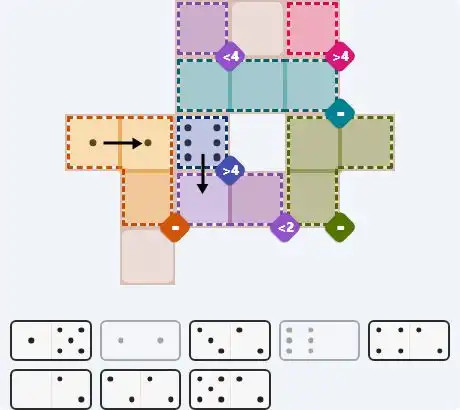
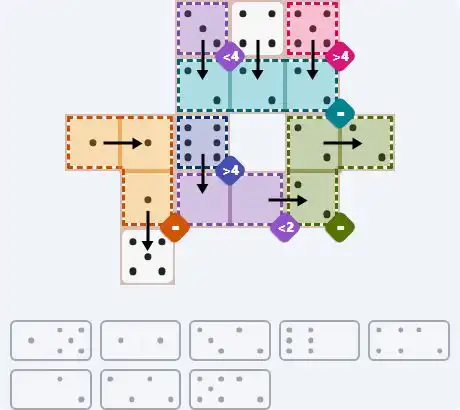
NYT Pips Hints & Answers for March 22, 2026

Mar 22, 2026

🚨 SPOILER WARNING

This page contains the final **answer** and the complete **solution** to today's NYT Pips puzzle. If you haven't attempted the puzzle yet and want to try solving it yourself first, now's your chance!

Click here to play today's official NYT Pips game first.

Want hints instead? Scroll down for progressive clues that won't spoil the fun.

🎲 Today's Puzzle Overview

Sunday's Pips is edited by Ian Livengood, who brings a clean, satisfying structure to both the easy and medium puzzles. Today's easy has a pleasing symmetry — twin single-cell constraints anchor both top corners, and the rest of the board cascades naturally from there. The medium steps things up with a mix of equals chains and paired less-than/greater-than constraints that reward careful comparison.

The hard puzzle is the work of constructor Rodolfo Kurchan, a specialist in mathematically elegant logic puzzles. All 15 dominoes from the double-blank to the double-four appear exactly once across a 5×7 board. Most cells carry single-cell sum constraints that reveal their pip values outright — the real challenge is tracking which dominoes have been placed and using the uniqueness of the full set to identify the few remaining "empty" cells.

If you're building your Pips instincts, today's easy and medium are good workouts for the core mechanic: find a constrained cell, determine its pip, and reason outward. The hard puzzle rewards methodical players who keep a running tally of which dominoes still need a home.

💡 Progressive Hints

Try these hints one at a time. Each hint becomes more specific to help you solve it yourself!

💡 Look at the corners
Two cells in the top corners each have a single-cell sum constraint. Start there — those values are given to you directly.
💡 The corners unlock the edges
Both top-corner cells must equal 6. Each one is the top of a vertical domino. Once you know those two dominoes, the cells directly below them are revealed, and the pair-sum constraints in row 1 become easy to solve.
💡 Full solution
The top-left corner is 6 — the 6-0 domino sits vertically in column 0, so [1,0]=0. The top-right corner is also 6 — the 4-6 domino sits vertically in column 5, so [1,5]=4. Now row 1's pair sums: [1,0]+[1,1]=5, and since [1,0]=0, [1,1]=5. The 5-5 domino extends down to [2,1]=5. On the other side, [1,4]+[1,5]=5 and [1,5]=4, so [1,4]=1. The 3-1 domino extends down to [2,4]=3. Finally, the only remaining domino is 2-3: [2,2]=2 (matching the sum=2 constraint) and [2,3]=3, which satisfies the equals region since [2,3]=[2,4]=3.
💡 Symmetry is your friend
Notice anything about the left and right sides of the board? There's a mirrored structure here that cuts your work in half.
💡 Two 6s, two columns
Both single-cell sum constraints require 6. Only two dominoes contain a 6: the 4-6 and the 6-0. One anchors the left side of the board, one the right. Placing these dominoes locks in row 1 values on both sides, and the pair-sum constraints do the rest.
💡 Full solution
Both top corners equal 6. The 6-0 domino goes vertically in column 0 ([0,0]=6, [1,0]=0), and the 4-6 domino goes vertically in column 5 ([0,5]=6, [1,5]=4). The left pair-sum: [1,0]+[1,1]=5, so [1,1]=5, placing the 5-5 domino down to [2,1]=5. The right pair-sum: [1,4]+[1,5]=5, so [1,4]=1, placing the 3-1 domino down to [2,4]=3. The equals region at [2,3] and [2,4] confirms [2,3]=3=3. Last domino: 2-3 fills the bottom center with [2,2]=2 and [2,3]=3.
💡 Two constraints, two corners
Two cells on the board have single-cell sum constraints. Find them — their values are locked in without any guessing.
💡 Corner values point to specific dominoes
Both top corners require sum=6, so each holds a 6. Only two dominoes in today's set contain a 6. Assign one to each corner — but think about direction. Each domino must extend to an adjacent cell that's on the board.
💡 Place the 6s, then check row 1
The 6-0 domino sits vertically in column 0 ([0,0]=6, [1,0]=0). The 4-6 domino sits vertically in column 5 ([0,5]=6, [1,5]=4). Now look at the two pair-sum regions in row 1: [1,0]+[1,1]=5 and [1,4]+[1,5]=5. With one value in each pair already known, the other cell is forced.
💡 Row 1 forces the middle column
From [1,0]=0, the pair sum gives [1,1]=5. The 5-5 domino extends down: [2,1]=5. From [1,5]=4, the other pair sum gives [1,4]=1. The 3-1 domino extends down: [2,4]=3. Now the equals region [2,3]=[2,4] tells you [2,3]=3 as well.
💡 Full solution
One domino remains: 2-3. The sum=2 constraint at [2,2] means [2,2]=2, so the domino runs horizontally with [2,2]=2 and [2,3]=3. This satisfies both the single-cell sum at [2,2] and the equals region at [2,3]=[2,4]=3. All five dominoes placed: 6-0 (col 0), 4-6 (col 5), 5-5 (col 1), 3-1 (col 4), 2-3 (bottom center).

🎨 Pips Solver

Mar 22, 2026

Click a domino to place it on the board. You can also click the board, and the correct domino will appear.
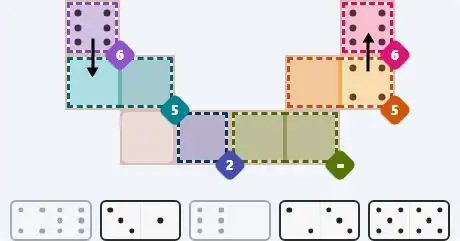
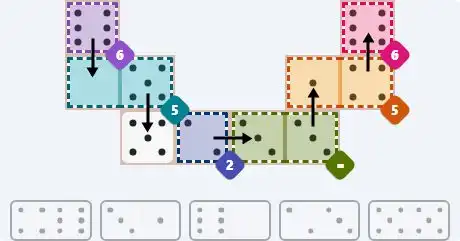
Final Answer & Complete Solution For Hard Level

The key to solving today's hard puzzle was identifying the placement for the critical dominoes highlighted in the starting grid. Once those were in place, the rest of the puzzle could be solved logically. See the final grid below to compare your solution.

Starting Position & Key First Steps
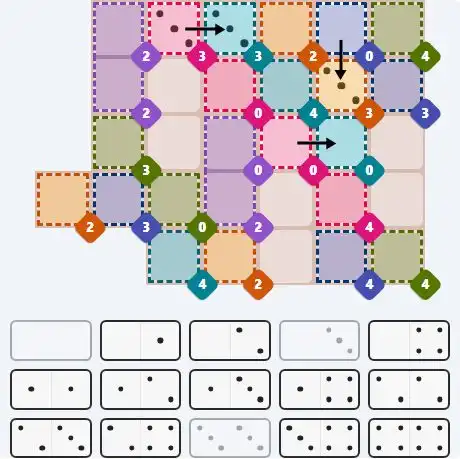
Pips hint for March 22, 2026 – hard level puzzle grid with critical first placements and strategy

This image shows the initial puzzle grid for the hard level, with a few critical first placements highlighted.

Final Answer: The Solved Grid for Hard Mode
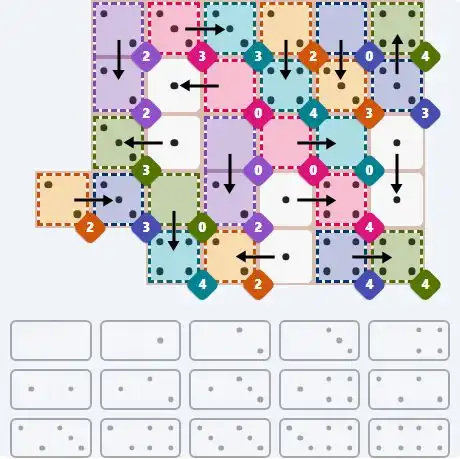
NYT Pips March 22, 2026 hard puzzle full solution grid showing final answer with hints

Compare this final grid with your own solution to see the correct placement of all dominoes.

🔧 Step-by-Step Answer Walkthrough For Easy Level

1
Step 1: Read the corners directly
Cell [0,0] has a sum constraint of 6 — that cell alone must equal 6. The only domino with a 6 that can sit in the top-left is the 6-0, placed vertically so [0,0]=6 and [1,0]=0. The same logic applies to [0,5]: sum=6, and the 4-6 domino fills column 5 with [0,5]=6 and [1,5]=4.
2
Step 2: Pair sums in row 1
With the corner dominoes placed, row 1 has two constrained pairs. [1,0]+[1,1] must equal 5, and [1,0]=0, so [1,1]=5. [1,4]+[1,5] must equal 5, and [1,5]=4, so [1,4]=1.
3
Step 3: Extend the middle dominoes downward
The 5-5 domino contains both 5s. Since [1,1]=5, the partner cell must also be 5, and it extends down to [2,1]=5. For the right side, [1,4]=1 is part of the 3-1 domino — its other pip is 3, extending down to [2,4]=3.
4
Step 4: The equals region confirms itself
The equals constraint on [2,3] and [2,4] requires both cells to hold the same pip. We already know [2,4]=3, so [2,3]=3 as well. No guessing needed — the constraint is already satisfied.
5
Step 5: Place the last domino
One domino remains: 2-3. The sum=2 constraint at [2,2] pins [2,2]=2, so the domino runs horizontally: [2,2]=2 and [2,3]=3. Both constraints satisfied. Puzzle complete.

🔧 Step-by-Step Answer Walkthrough For Medium Level

1
Step 1: Anchor the corners
Both top-corner cells have single-cell sum=6 constraints. Cell [0,0]=6 is the top of the 6-0 domino placed vertically: [0,0]=6, [1,0]=0. Cell [0,5]=6 is the top of the 4-6 domino placed vertically: [0,5]=6, [1,5]=4.
2
Step 2: Resolve the pair sums
The region [1,0]+[1,1] must sum to 5. Since [1,0]=0, we get [1,1]=5. The region [1,4]+[1,5] must also sum to 5. Since [1,5]=4, we get [1,4]=1.
3
Step 3: Trace the dominoes downward
The 5-5 domino places [2,1]=5 below [1,1]=5. The 3-1 domino places [2,4]=3 below [1,4]=1.
4
Step 4: Equals region confirms bottom row
The equals constraint on [2,3] and [2,4] means they must be equal. Since [2,4]=3 is already determined, [2,3]=3 follows. No additional deduction needed.
5
Step 5: Last domino placed
The only unused domino is 2-3. The sum=2 constraint at [2,2] fixes [2,2]=2, making the domino horizontal: [2,2]=2, [2,3]=3. All constraints satisfied.

🔧 Step-by-Step Answer Walkthrough For Hard Level

1
Step 1: Read the single-cell constraints
Most cells have individual sum constraints, so read the board and record their pip values directly. From row 0: [0,2]=3, [0,3]=3, [0,4]=2, [0,5]=0, [0,6]=4. From row 1: [1,1]=2, [1,3]=0, [1,4]=4, [1,5]=3, [1,6]=3. From row 2: [2,1]=3, [2,3]=0, [2,4]=0, [2,5]=0. From row 3: [3,0]=2, [3,1]=3, [3,2]=0, [3,3]=2, [3,5]=4. From row 4: [4,2]=4, [4,3]=2, [4,5]=4, [4,6]=4. The empty cells — [1,2], [2,2], [2,6], [3,4], [3,6], [4,4] — will be determined by elimination.
2
Step 2: Place the fully-revealed dominoes
Several dominoes are determined outright. [0,5]=0 and [1,5]=3 — vertical in column 5 → the 0-3 domino. [0,4]=2 and [1,4]=4 — vertical in column 4 → the 2-4 domino. [0,2]=3 and [0,3]=3 — horizontal in row 0 → the 3-3 domino. [3,0]=2 and [3,1]=3 — horizontal in row 3 → the 2-3 domino. [3,2]=0 and [4,2]=4 — vertical in column 2 → the 0-4 domino. [2,4]=0 and [2,5]=0 — horizontal in row 2 → the 0-0 domino.
3
Step 3: Fill in the column 6 and row 0 dominos
[0,6]=4 and [1,6]=3 — vertical in column 6 → the 3-4 domino. [0,1]=2 and [1,1]=2 — vertical in column 1 → the 2-2 domino. [4,5]=4 and [4,6]=4 — horizontal in row 4 → the 4-4 domino. [4,3]=2 and [4,2] is already taken by the 0-4 domino, so [4,3] pairs with the empty cell [4,4].
4
Step 4: Resolve the empty cells by elimination
Empty cell [1,2] must pair with an adjacent cell. [1,1]=2 is taken (2-2 domino). [0,2]=3 is taken (3-3 domino). The only available neighbor is [1,3]=0. So [1,2] is part of a horizontal domino with [1,3]=0. This is the 0-1 domino → [1,2]=1. Empty cell [2,2] is adjacent to [2,1]=3 (its only free neighbor at this stage). Which unused domino pairs 1 with 3? The 1-3 domino → [2,2]=1, placed horizontally with [2,1]=3.
5
Step 5: Last three empty cells
Empty cell [2,6] can only pair with [3,6] (another empty cell). Which unused domino has two equal pips that both equal 1? The 1-1 domino → [2,6]=1, [3,6]=1, placed vertically. Empty cell [3,4] pairs with [3,5]=4. The only unused domino with a 4 is 1-4 → [3,4]=1, placed horizontally. Finally, empty cell [4,4] pairs with [4,3]=2. The last domino is 1-2 → [4,4]=1, placed horizontally. All 15 dominoes placed, every constraint satisfied.

💡 Pro Tips for Similar Puzzles

Start with Constraints
Always begin with the most constrained regions - sum regions with small numbers or tight spaces.
Use Equal Regions
Use "equal" regions as anchors - they eliminate many possibilities quickly.
Work Systematically
Let the rules guide your placement rather than guessing randomly.
Double-Check
Verify each region's rules are satisfied before moving to the next.

🎓 Keep Learning & Improve