🔧 Step-by-Step Answer Walkthrough For Easy Level
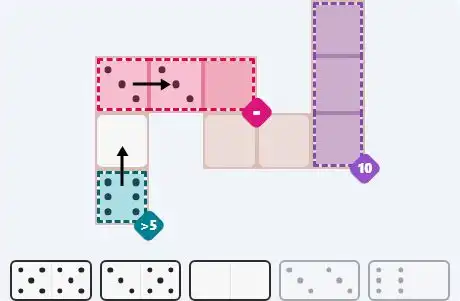
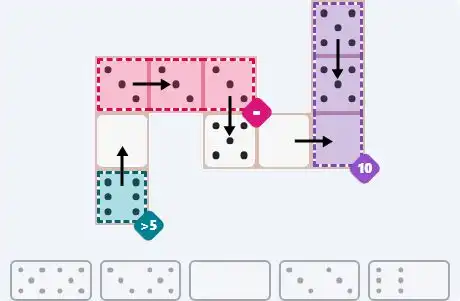
The bottom-left cell sits inside a greater-than region — its value must exceed 5. With pip counts capped at 6, only a 6 will work. Scan your five dominoes: [6–0] is the only one holding a 6. Place it vertically in column 0, rows 2–3, with the 6 facing down at row 3.
Placing [6–0] drops a 0 into row 2, column 0. Now look at the equals region stretching across row 1, columns 0–2. All three cells must share the same pip count. The domino [3–3] slots into columns 0–1 at row 1, giving both cells a 3. For the region to hold, column 2 must also show a 3 — that cell belongs to a different domino.
The only remaining domino with a 3 is [3–5]. Orient it vertically in column 2: the 3 goes at row 1 (satisfying the equals constraint) and the 5 lands at row 2. Three cells, three 3s — the equals region is satisfied.
Columns 0, 2 in row 2 are now occupied. Columns 3 and 4 are open and both fall outside any region constraint. The [0–0] domino fits perfectly here horizontally — place it across [2,3] and [2,4], both showing 0.
The right column (column 4) has a sum-10 constraint across rows 0–2. Row 2 already shows a 0 from [0–0]. That means rows 0 and 1 together need to sum to 10. The only domino left is [5–5]: drop it vertically into rows 0–1 of column 4. 5 + 5 + 0 = 10. Puzzle complete.
🔧 Step-by-Step Answer Walkthrough For Medium Level
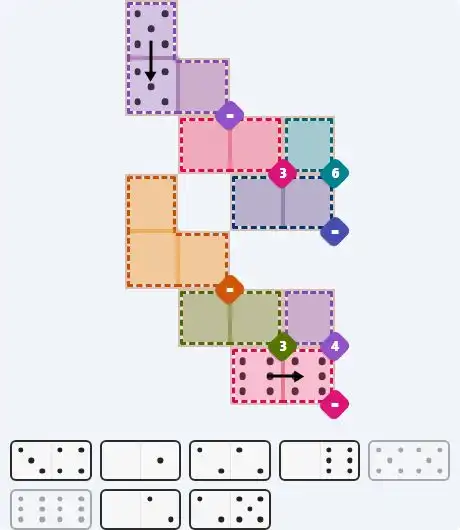
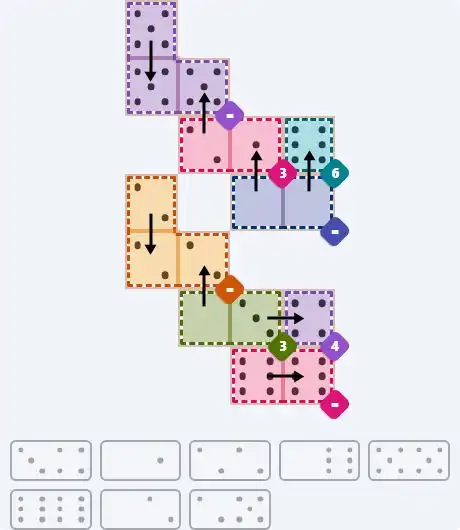
Spot the single-cell sum region in column 3, row 2 — its target is 6, so that cell's value is already decided: 6. Look through your dominoes for one that has a 6 and can reach that cell. The [0–6] domino fits: stand it vertically with 6 at row 2 and 0 dropping down to row 3, column 3.
That 0 at row 3, column 3 now falls inside an equals region covering [3,2] and [3,3]. Both cells must be equal, so [3,2] is also 0. The [0–1] domino handles column 2: 0 at row 3, 1 reaching up to row 2.
The sum-3 region at [2,1] and [2,2] now has its right cell known — [2,2]=1. The left cell needs to make up the rest: 3 − 1 = 2, so [2,1]=2. The [2–5] domino places 2 there and stretches up to leave 5 at row 1, column 1.
That 5 at [1,1] sits inside the equals region spanning [0,0], [1,0], and [1,1]. All three must be equal to 5. The [5–5] double domino drops vertically into column 0, rows 0–1. All three cells confirmed as 5.
Row 5, column 3 holds a lone sum region targeting 4 — that cell must be 4. The [3–4] domino places 3 at [5,2] and 4 at [5,3], running horizontally.
The sum-3 region at [5,1] and [5,2] now has its right cell resolved: [5,2]=3. So [5,1] needs to be 0. The [0–2] domino runs vertically: 0 at row 5 and 2 up at row 4, column 1.
That 2 at [4,1] belongs to the equals region covering [3,0], [4,0], and [4,1]. All three must be equal to 2. The [2–2] double domino slots into column 0, rows 3–4. Done.
One domino and one region remain: [6–6] and the equals region at the bottom, [6,2]–[6,3]. An equals constraint with a double-pip domino — both cells become 6. Puzzle complete.
🔧 Step-by-Step Answer Walkthrough For Hard Level
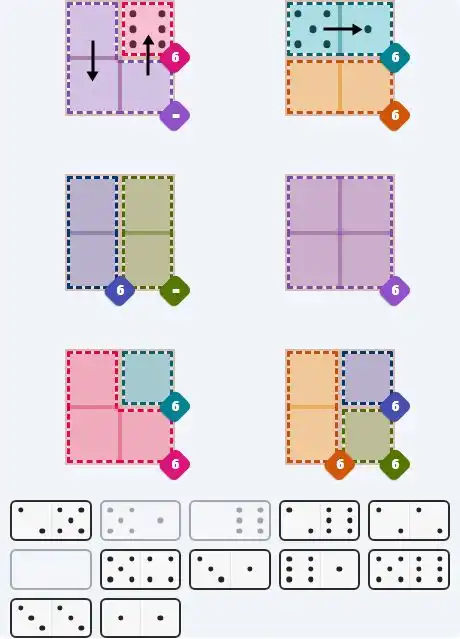
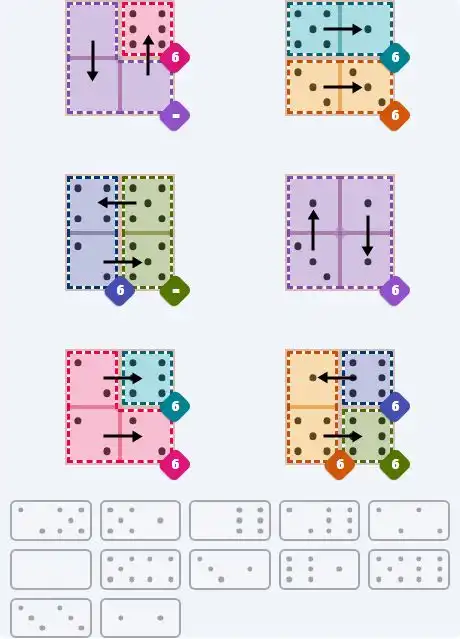
Unlike everything else in this grid, the top-left corner holds an equals constraint — cells [0,0], [1,0], and [1,1] must all share the same pip value. What single value could fill all three? The [0–0] domino covers [0,0] and [1,0], both showing 0. That forces [1,1]=0 as well.
Cell [0,1] is its own sum region with a target of 6, so it must hold a 6. The [0–6] domino connects [1,1] and [0,1]: its 0-end lands at [1,1] (already confirmed as 0) and its 6-end fills [0,1]. Clean fit.
Two sum-6 regions sit side by side in the top-right: [0,4]+[0,5] and [1,4]+[1,5]. The [5–1] domino gives 5+1=6 and covers row 0. The [3–3] domino gives 3+3=6 and covers row 1. Both regions satisfied in one move each.
In the middle section, columns 0 and 1 carry a sum-6 pair ([3,0]+[4,0]) and an equals pair ([3,1]+[4,1]) stacked side by side. The [5–4] domino runs horizontally: 5 at [3,1] and 4 at [3,0]. For the sum to reach 6, [4,0] must be 2 — the [2–5] domino delivers exactly that, placing 2 at [4,0] and 5 at [4,1]. The equals pair [3,1]=[4,1] checks out: both are 5.
The four-cell sum-6 region at [3,4],[3,5],[4,4],[4,5] needs to total 6 across two dominos. The [3–1] domino goes vertically in column 4: 1 at row 3 and 3 at row 4. The [1–1] domino goes vertically in column 5: 1 at row 3 and 1 at row 4. Total: 1+1+3+1=6. Both dominoes placed.
The sum-6 region at the bottom-left covers three cells: [6,0], [7,0], [7,1]. The adjacent single-cell sum=6 at [6,1] locks that cell to 6 immediately. The [2–6] domino connects [6,0]=2 and [6,1]=6 — the single-cell constraint is met. The [2–2] domino fills the remaining two cells: [7,0]=2 and [7,1]=2. Check: 2+2+2=6. ✓
Four cells remain, all in sum-6 regions. The [6–1] domino places 6 at [6,5] and 1 at [6,4] — matching the single-cell sum=6 at [6,5] and contributing 1 to the pair at [6,4]+[7,4]. The [5–6] domino places 5 at [7,4] and 6 at [7,5]: 1+5=6 for the column pair, and [7,5]=6 confirms its own single-cell region. Every constraint satisfied — puzzle complete.
💬 Community Discussion
Leave your comment