NYT Pips Hints & Answers for March 21, 2026

Mar 21, 2026

🚨 SPOILER WARNING

This page contains the final **answer** and the complete **solution** to today's NYT Pips puzzle. If you haven't attempted the puzzle yet and want to try solving it yourself first, now's your chance!

Click here to play today's official NYT Pips game first.

Want hints instead? Scroll down for progressive clues that won't spoil the fun.

🎲 Today's Puzzle Overview

March 21, 2026 brings another well-crafted trio of Pips puzzles from editor Ian Livengood. The easy and hard grids come from two different constructors, and each one wears its theme clearly — once you spot the hook, the logic snaps into place.

Ian Livengood handles the easy himself, and it opens with an unusually large sum: three cells in the top corner have to add up to 12. With pip values capped at 4 in this set, there's only one combination that can possibly work — and finding it unlocks the rest of the grid in a clean chain. Rodolfo Kurchan's medium is built around a four-cell equals region spanning an entire row. Every cell in it must share the same value, and the right domino makes that click immediately.

For the hard puzzle, Rodolfo Kurchan goes all in on five. Nearly every region in the grid is a sum-5 constraint — single cells, pairs, triples — plus one cell that must exceed 5, forcing an unusual pip count. The bottom row is full of locked cells that give you free information before you've placed anything. Start there, and the cascade follows naturally.

💡 Progressive Hints

Try these hints one at a time. Each hint becomes more specific to help you solve it yourself!

💡 One region demands unusually high pip counts
Find the sum constraint that requires the most from your dominoes. The target is high enough that only certain values can reach it — you won't be choosing from many options.
💡 Every cell in that top-corner region needs to be maxed out
The three-cell sum region near the top is so demanding that each cell has to carry the same heavy pip count. Think about what the highest value your available dominoes can offer — and whether three of them can share it.
💡 Full answer
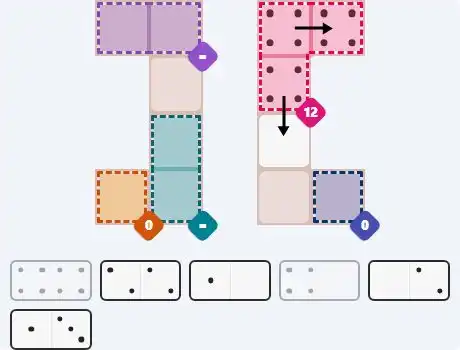
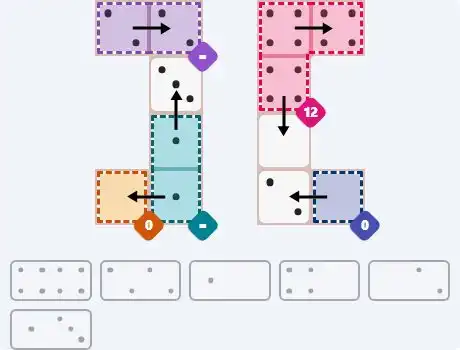
The three-cell sum-12 region [row 0 cols 3–4, row 1 col 3] forces each cell to hold a 4: place [4–4] across [0,3] and [0,4], then stand [4–0] vertically with 4 at [1,3] and 0 descending to [2,3]. Two isolated cells must be 0: [3,0] and [3,4]. The [1–0] domino runs horizontally in row 3 with 1 at col 1 and 0 at col 0. The [0–2] domino runs horizontally with 0 at col 4 and 2 at col 3. The equals region [2,1]–[3,1] now has [3,1]=1, so [2,1] must also be 1 — stand [1–3] vertically, 1 at row 2 and 3 at row 1. The only remaining domino is [2–2]: it fills the equals pair at [0,0] and [0,1].
💡 Four cells in a row all have to match
There's an equals region spanning an entire row of the grid. Every cell in it must hold the same pip count. Figure out which value makes that possible before placing anything else.
💡 One double-pip domino makes the equals row obvious
The value shared across that four-cell row is on the lower end. There's a domino in your set that puts the same pip on both of its cells — once you place it, two of the four equal cells are settled instantly.
💡 Full answer
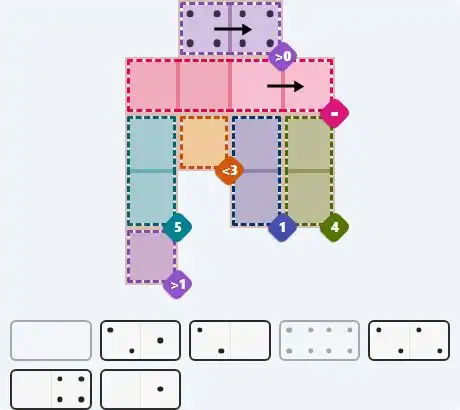
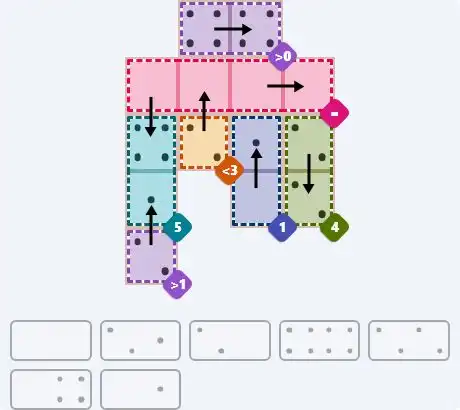
The four-cell equals region in row 1 must all share the same value. The [0–0] domino drops into [1,2] and [1,3], both showing 0, which commits the whole row to zero. [0–4] runs vertically with 0 at [1,0] and 4 at [2,0]. [2–0] runs vertically with 0 at [1,1] and 2 at [2,1] — the less-than constraint says [2,1] < 3, and 2 clears that. The sum-5 pair [2,0]+[3,0] has [2,0]=4, so [3,0]=1. The [2–1] domino covers [4,0] and [3,0]: 2 at [4,0] (satisfying the greater-than >1 constraint) and 1 at [3,0]. [4–4] fills the greater-than pair at [0,1] and [0,2]: 4 > 0 at both. [0–1] covers [3,2] and [2,2]: 0 at row 3 and 1 at row 2, giving a sum-1 pair of 1+0=1 ✓. [2–2] finishes the sum-4 pair [2,3]+[3,3]: 2+2=4 ✓.
💡 Several cells already know their value before you place anything
Look for sum regions that contain only a single cell. A target with nowhere to distribute means that cell's pip count is handed to you outright — collect those free values first.
💡 The bottom row is packed with forced cells
Most of the single-cell sum regions are bunched at the bottom. Once you know each cell's required value, the dominoes that can reach those values start to fall into place. Start from what's most constrained.
💡 One constraint is stricter than the others — only a 6 will do
Somewhere in the grid, a cell must be strictly greater than 5. With pip counts going up to 6, there's exactly one value that qualifies. Track down which domino in your set can deliver it.
💡 The bottom-right chain links four separate constraints
A single-cell constraint near the bottom-right connects through an equals region into a sum pair, which then feeds another sum pair. Trace the forced values step by step — each one locks the next.
💡 Full answer
Single-cell sum=5 constraints: [4,0]=5 and [4,1]=5 — place [5–5] horizontally there. [4,5]=5 with empty [4,4]: [5–0] runs horizontally, 5 at [4,5] and 0 at [4,4]. [4,6]=5: [1–5] runs horizontally, 1 at [4,7] and 5 at [4,6]. The equals pair [4,7]+[4,8] forces [4,8]=1: [1–4] runs vertically, 1 at [4,8] and 4 at [3,8]. Sum-5 pair [2,8]+[3,8] has [3,8]=4, so [2,8]=1: [1–6] runs vertically, 1 at [2,8] and 6 at [1,8], satisfying the greater-than >5 constraint. Single-cell [3,4]=5: [5–2] runs vertically, 5 at [3,4] and 2 at [2,4]. Sum-5 triple [2,4]+[2,5]+[2,6] has [2,4]=2, need 3 more: [2–1] runs horizontally, 2 at [2,5] and 1 at [2,6]. Cell [2,1] must be >5, so it's 6: [6–3] runs horizontally, 6 at [2,1] and 3 at [2,2]. Sum-5 triple [2,2]+[3,2]+[4,2] has [2,2]=3, need 2 more: [1–1] runs vertically, 1 at [3,2] and 1 at [4,2]. Sum-5 pair [0,0]+[0,1]: [3–2] runs horizontally, 3+2=5. Sum-5 triple [0,4]+[0,5]+[0,6]: [3–1] runs horizontally at [0,4] and [0,5] giving 3+1=4; [0–1] runs vertically placing 0 at [1,6] and 1 at [0,6], completing 3+1+1=5. Last domino [0–0] fills empty cells at [0,2] and [1,2]. All constraints satisfied.

🎨 Pips Solver

Mar 21, 2026

Click a domino to place it on the board. You can also click the board, and the correct domino will appear.

Final Answer & Complete Solution For Hard Level

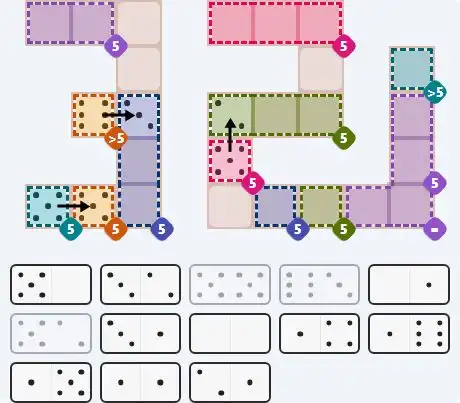
The key to solving today's hard puzzle was identifying the placement for the critical dominoes highlighted in the starting grid. Once those were in place, the rest of the puzzle could be solved logically. See the final grid below to compare your solution.

Starting Position & Key First Steps

Pips hint for March 21, 2026 – hard level puzzle grid with critical first placements and strategy

This image shows the initial puzzle grid for the hard level, with a few critical first placements highlighted.

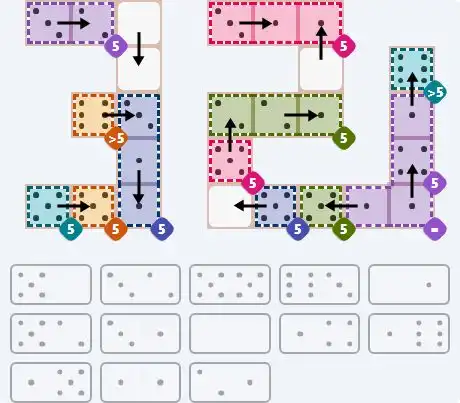
Final Answer: The Solved Grid for Hard Mode

NYT Pips March 21, 2026 hard puzzle full solution grid showing final answer with hints

Compare this final grid with your own solution to see the correct placement of all dominoes.

🔧 Step-by-Step Answer Walkthrough For Easy Level

1
Step 1: The sum-12 region is your entry point
Three cells in the top-right area share a sum-12 constraint. Your highest pip domino is [4–4], and no domino in this set goes above 4. The only way to reach 12 across three cells is if every one of them holds a 4. That's not a guess — it's the only arrangement that works.
2
Step 2: Place the two dominoes that fill the sum-12 region
Lay [4–4] horizontally across row 0, columns 3 and 4 — both cells show 4. The third cell in the region is row 1, column 3. Stand [4–0] vertically there: 4 at row 1 (completing the sum) and 0 descending to row 2, column 3.
3
Step 3: Two cells must hold exactly 0
Cells [3,0] and [3,4] are each isolated in their own sum-0 regions, meaning both must be 0. Two of your remaining dominoes carry a 0-end: [1–0] and [0–2]. Place [1–0] horizontally in row 3: the 1 at column 1 and the 0 at column 0 ✓. Place [0–2] horizontally: the 0 at column 4 and the 2 at column 3 ✓.
4
Step 4: Propagate through the equals region
The equals constraint covers cells [2,1] and [3,1]. You just placed [1–0] so [3,1]=1 — that means [2,1] must also be 1. Only one domino left with a 1-end: [1–3]. Stand it vertically with the 1 at row 2 and the 3 reaching up to row 1. The empty-region cell at [1,1] takes the 3 with no constraint.
5
Step 5: One domino, one region
The only domino remaining is [2–2], and the only unfilled region is the equals pair at [0,0]–[0,1]. A double-pip domino dropping into an equals region — both cells show 2, constraint satisfied. Puzzle complete.

🔧 Step-by-Step Answer Walkthrough For Medium Level

1
Step 1: Commit the equals row to zero
Row 1 holds a four-cell equals region: every cell must share the same pip value. The [0–0] domino is a natural fit — place it horizontally at [1,2] and [1,3]. With two cells already at 0, the entire equals constraint is committed: all four cells in row 1 must be 0.
2
Step 2: Fill the remaining cells in the equals row
Cells [1,0] and [1,1] must also show 0. The [0–4] domino handles [1,0]: orient it vertically with 0 at row 1 and 4 dropping down to [2,0]. The [2–0] domino handles [1,1]: orient it vertically with 0 at row 1 and 2 dropping to [2,1]. Both row-1 cells confirm as 0 ✓.
3
Step 3: Work downward from the filled row
Cell [2,1] just received a 2 from [2–0]. The less-than region says [2,1] < 3 — 2 satisfies that with room to spare. Now look at the sum-5 pair [2,0]+[3,0]: [2,0]=4 from [0–4], so [3,0] must be 1.
4
Step 4: Place the domino covering [3,0] and [4,0]
You need a 1 at [3,0] and some value at [4,0]. The [2–1] domino covers both vertically: 2 at [4,0] and 1 at [3,0] — which confirms the sum-5 pair (4+1=5 ✓). The greater-than constraint at [4,0] requires a value above 1, and 2 clears that easily.
5
Step 5: The top pair needs values above zero
The greater-than region at [0,1] and [0,2] demands both cells exceed 0. The [4–4] double domino is the cleanest fit: 4 > 0 at both positions. Drop it horizontally across those two cells.
6
Step 6: Resolve the sum-1 pair
The pair at [2,2]+[3,2] must sum to 1. The [0–1] domino handles it exactly: place it with 1 at [2,2] and 0 at [3,2]. One cell gets 1, the other gets 0, and 1+0=1 ✓.
7
Step 7: Close out the final pair
One domino and one region remain. The sum-4 pair at [2,3]+[3,3] takes [2–2]: both cells show 2, and 2+2=4 ✓. Every constraint confirmed — puzzle complete.

🔧 Step-by-Step Answer Walkthrough For Hard Level

1
Step 1: Claim the five forced cells in the bottom row
Cells [4,0], [4,1], [4,5], and [4,6] each sit in their own sum-5 region — single-cell constraints, so all four must be exactly 5. Cell [4,4] is an empty region with no restriction. Start by reading this row before placing anything.
2
Step 2: Place the double-five and the five-zero domino
Both [4,0] and [4,1] must be 5 — only the [5–5] double domino can cover them simultaneously. Lay it horizontally there. For [4,5]=5 with [4,4] unconstrained, the [5–0] domino fits: 5 at [4,5] and 0 at [4,4].
3
Step 3: Resolve the bottom-right cascade
Cell [4,6] must be 5. The [1–5] domino runs horizontally: 1 at [4,7] and 5 at [4,6]. The equals pair [4,7]+[4,8] forces [4,8]=1. The [1–4] domino runs vertically here: 1 at [4,8] and 4 at [3,8]. That feeds into the sum-5 pair [2,8]+[3,8]: with [3,8]=4, cell [2,8] must be 1.
4
Step 4: Handle the greater-than constraint on the right edge
Cell [2,8]=1 comes from the [1–6] domino placed vertically: 1 at [2,8] and 6 at [1,8]. The isolated constraint at [1,8] says the value must exceed 5 — 6 is the only pip count that qualifies, and it drops in perfectly.
5
Step 5: Work through the middle of the grid
Single-cell [3,4] must be 5. The [5–2] domino runs vertically: 5 at [3,4] and 2 at [2,4]. That starts the sum-5 triple [2,4]+[2,5]+[2,6]: [2,4]=2, so [2,5]+[2,6]=3. The [2–1] domino fills those cells horizontally: 2 at [2,5] and 1 at [2,6] (2+1=3 ✓).
6
Step 6: Satisfy the greater-than cell and its column constraint
Cell [2,1] carries a greater-than >5 constraint — it must be 6. The [6–3] domino runs horizontally: 6 at [2,1] and 3 at [2,2] ✓. The sum-5 triple [2,2]+[3,2]+[4,2] now has [2,2]=3, so [3,2]+[4,2]=2. The [1–1] domino runs vertically: 1 at each cell (3+1+1=5 ✓).
7
Step 7: Finish the top portion of the grid
Sum-5 pair [0,0]+[0,1]: the [3–2] domino runs horizontally, 3+2=5 ✓. Sum-5 triple [0,4]+[0,5]+[0,6]: the [3–1] domino covers the first two cells (3+1=4), and [0,6] must be 1. The [0–1] domino runs vertically at column 6: 0 at [1,6] (an empty-region cell, no constraint) and 1 at [0,6] — completing 3+1+1=5 ✓. The final domino [0–0] fills the two empty-region cells at [0,2] and [1,2]. Every constraint satisfied — puzzle complete.
💡 Pro Tips for Similar Puzzles

Start with Constraints
Always begin with the most constrained regions - sum regions with small numbers or tight spaces.
Use Equal Regions
Use "equal" regions as anchors - they eliminate many possibilities quickly.
Work Systematically
Let the rules guide your placement rather than guessing randomly.
Double-Check
Verify each region's rules are satisfied before moving to the next.

🎓 Keep Learning & Improve