🚨 SPOILER WARNING
This page contains the final answer and the complete solution to today's NYT Pips puzzle. If you haven't attempted the puzzle yet and want to try solving it yourself first, now's your chance!
Click here to play today's official NYT Pips game first.
Want hints instead? Scroll down for progressive clues that won't spoil the fun.
🎲 Today's Puzzle Overview
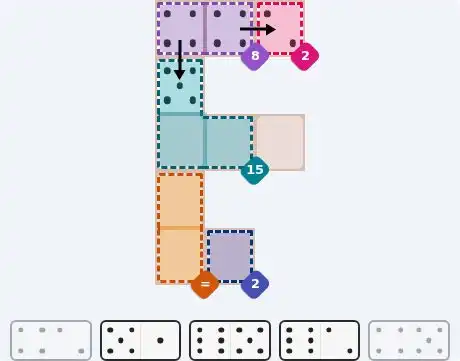
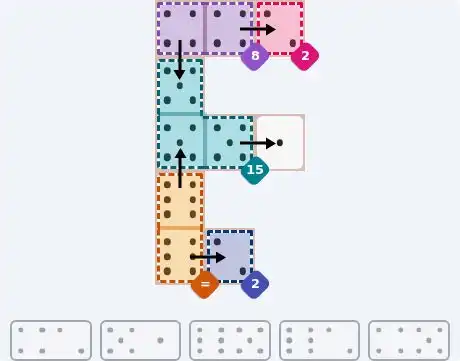
Ian Livengood's easy grid is a tight 5x3 layout where only ten cells are active, shaped by five dominoes. The solving graph starts at the single-cell sum-2 region at [0,2], which acts as an immutable root, forcing a specific domino and cascading upward into a sum-8 pair. The remainder of the deduction flows through a sum-15 triple along the left edge, which interacts with an equals pair to lock the final domino orientations. The entire chain is linear, with no branching—every constraint funnels into a single forced path.
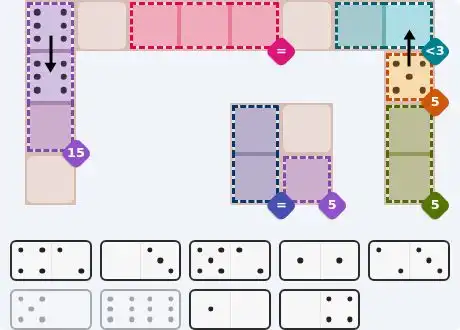
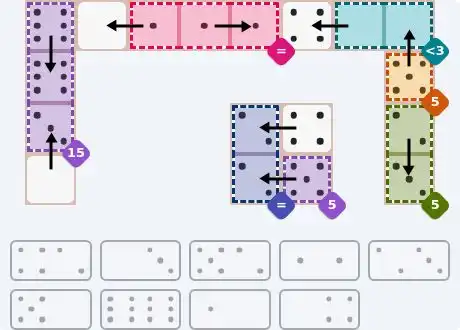
Rodolfo Kurchan's medium puzzle spreads across a sparse 4x8 strip, using isolated cells and small clusters. The deduction graph splits after an initial single-cell sum-5 anchor at [1,7] solves the lower-right corner. From there, the sum-15 vertical triple demands a 6+6 pairing, which in turn forces the remaining domino values through a series of equals and sum regions. The equals chain along the top row (cells [0,2]–[0,4]) and the sum-5 pair at [2,7]–[3,7] act as synchronizing points that resolve the grid's last ambiguities. This puzzle rewards solvers who trace connectivity, as many cells only touch one neighbor.
Kurchan's hard puzzle is a dense 9x9 field peppered with single-cell sum-1 and sum-0 regions—six such orphans in total. These instantaneously force six domino placements, scattering 1s and 0s across the board and seeding a rhythmic propagation. The greater-than-10 pair on the top row narrows to a single combination, while layered equals regions along the right and bottom edges form a nested cascade: solving row 4's equals block pushes values into the column-1 equals chain, which then feeds the bottom-right interconnected equals region. The result is a puzzle where every step is deterministic, yet the spatial layout makes the deduction feel like a domino avalanche. Today's NYT Pips hard exemplifies how a profusion of rigid constraints can create an elegant, unstoppable solve.
💡 Progressive Hints
Try these hints one at a time. Each hint becomes more specific to help you solve it yourself!
🎨 Pips Solver
Click a domino to place it on the board. You can also click the board, and the correct domino will appear.
✅ Final Answer & Complete Solution For Hard Level
The key to solving today's hard puzzle was identifying the placement for the critical dominoes highlighted in the starting grid. Once those were in place, the rest of the puzzle could be solved logically. See the final grid below to compare your solution.
Starting Position & Key First Steps
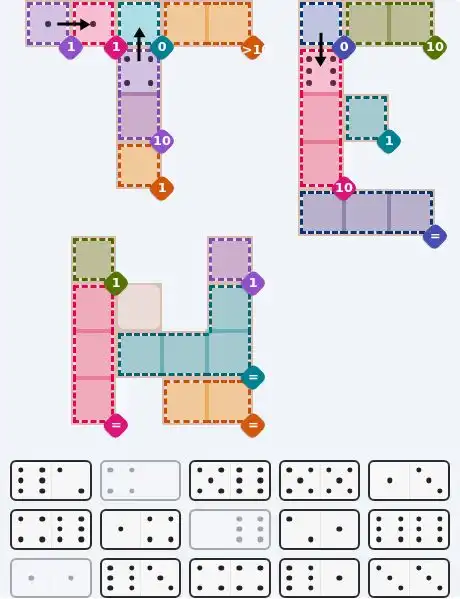
This image shows the initial puzzle grid for the hard level, with a few critical first placements highlighted.
Final Answer: The Solved Grid for Hard Mode
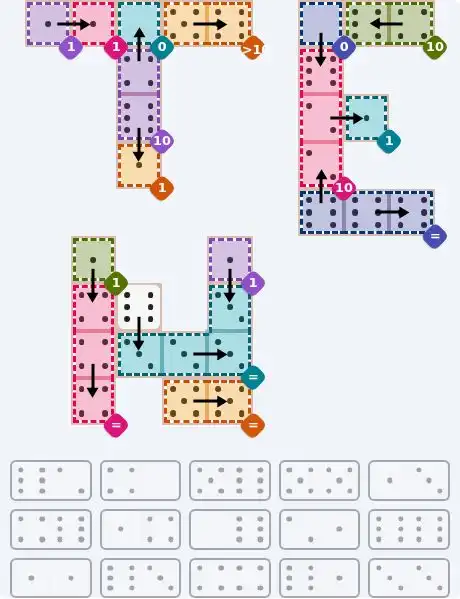
Compare this final grid with your own solution to see the correct placement of all dominoes.
💬 Community Discussion
Leave your comment