NYT Pips Hints & Answers for June 2, 2026

Jun 2, 2026

๐Ÿšจ SPOILER WARNING

This page contains the final **answer** and the complete **solution** to today's NYT Pips puzzle. If you haven't attempted the puzzle yet and want to try solving it yourself first, now's your chance!

Click here to play today's official NYT Pips game first.

Want hints instead? Scroll down for progressive clues that won't spoil the fun.

๐ŸŽฒ Today's Puzzle Overview

Ian Livengood constructs today's NYT Pips easy as a study in double-anchor simplicity. A large four-cell sum-8 region in the upper left immediately funnels the solver toward the only domino that can cover two of its cells, establishing a cascade of forced placements that resolve cleanly. The design feels like a warm-up that rewards pattern recognition.

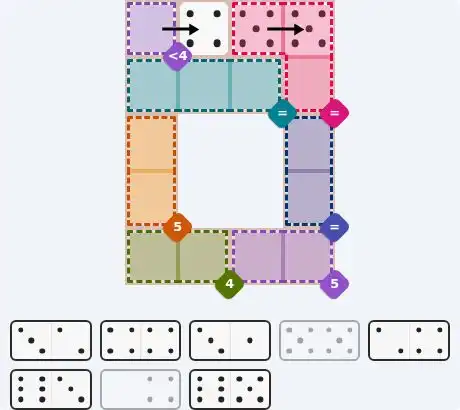
Rodolfo Kurchan's medium puzzle leans into the equals constraint with a meticulous chain of same-value regions. The top row houses a less-4 cell that dictates a zero, which in turn triggers a domino of equal high digits across two columnsโ€”a domino daisy-chain that locks the upper frame and then presses downward. The architecture demands that you trust the equality logic before committing to any number.

Kurchan's hard puzzle is a compact, constraint-dense grid that feels nearly combinatorial. Single-cell sum-2 cells scatter across the board and force exact pip values from the start, while a devious sum-0 two-cell region must be satisfied not by a double-zero dominoโ€”which doesn't exist in the setโ€”but by splitting two different dominoes that each supply a zero. This creates a tight mesh where every pip falls into place only after a precise sequence of interlocking deductions, showcasing Kurchan's talent for packing maximum pressure into a small space.

๐Ÿ’ก Progressive Hints

Try these hints one at a time. Each hint becomes more specific to help you solve it yourself!

๐Ÿ’ก Hint 1: Spot the restrictive anchors
Scan the grid for regions that drastically limit possible pip values. A large sum constraint and an equals pair work together to narrow your first placements.
๐Ÿ’ก Hint 2: The four-cell sum-8 zone
The L-shaped sum-8 region occupying (0,0), (0,1), (0,2), and (1,2) can only accommodate a domino that supplies two identical low numbers to avoid overshooting the total. That same double will dictate much of what follows.
๐Ÿ’ก Hint 3: Complete solve walkthrough
Place the [2,2] domino horizontally at (0,1)โ€“(0,2). Set [4,4] vertically at (4,0)โ€“(5,0) to nail the bottom sum-8. The lone cell (1,0) demands a 5, so put [5,2] with the 5 there and the 2 in (0,0). Lay [3,2] with 3 at (2,2) and 2 at (1,2) to finish the top sum-8 and set up the equals region. Finally, place [1,0] at (3,0)โ€“(2,0) and [3,6] at (3,2)โ€“(3,1) to satisfy the sum-7 and the equals requirement.
๐Ÿ’ก Hint 1: Follow the equals trail
Today's medium grid is dominated by equals regions. Focus on how a single restricted cell can hand you a precise number, then watch how that number ripples through a chain of identical-value cells.
๐Ÿ’ก Hint 2: Zero in the corner
The top-left cell (0,0) is a 'less than 4' region, which forces it to be 0, 1, 2, or 3. Only the [0,4] domino carries a 0, so it must sit there with the 0 in (0,0) and the 4 in (0,1). That 4 doesn't join any equals region, but the adjacent equals trio in columns 2โ€“3 demands a matching domino that can supply two high identical numbers.
๐Ÿ’ก Hint 3: Lock the equal chains
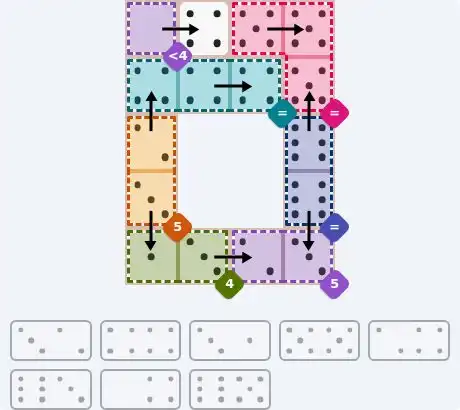
Place [0,4] horizontally at (0,0)โ€“(0,1). Set [5,5] horizontally at (0,2)โ€“(0,3) and [6,5] vertically with 5 in (1,3) and 6 in (2,3) to complete the top-right equals trio. The left-side equals region (1,0)โ€“(1,1)โ€“(1,2) needs all 4s, so put [4,4] at (1,1)โ€“(1,2) and [2,4] with 4 in (1,0) and 2 in (2,0). Use [3,1] at (3,0)โ€“(4,0) to satisfy the sum-5 column; then [3,2] and [6,3] fill the remaining bottom sums to match the equals at (2,3)โ€“(3,3).
๐Ÿ’ก Hint 1: Single-cell sums give free numbers
This hard puzzle is scattered with one-cell sum regions that directly announce the required pip. Identify all of them first, and note that a two-cell sum-0 region cannot be covered by a single domino from the setโ€”it has to be split across two different dominoes that each contribute a zero.
๐Ÿ’ก Hint 2: Pin down the twos
The single-cell sum-2 regions at (0,0), (0,4), (3,0), and (4,0) must all be exactly 2. That forces the [2,2] domino to occupy the adjacent pair (3,0)โ€“(4,0) vertically, while the other two cells will steal a 2 from other dominoes. The sum-6 region at (1,4) also gives a free 6 once its partner 2 is placed.
๐Ÿ’ก Hint 3: Zeros can't double up
The sum-0 region at (2,1)โ€“(2,2) needs a zero in each cell, but no double-0 exists. You'll have to use [0,5] to put a 0 into (2,1) and [6,0] to drop a 0 into (2,2). That decision then sets the pips for adjacent sum regions.
๐Ÿ’ก Hint 4: Equals emerge from the twos and sixes
Once [2,2] pins (3,0)โ€“(4,0) with 2s, the equals region at (3,2), (4,1), (4,2) must adopt the same value. Because (3,2) will receive a 6 from the [6,0] domino, all three cells must be 6. That forces the [6,6] double into (4,1)โ€“(4,2).
๐Ÿ’ก Hint 5: Final assembly
Place [2,1] at (0,0)โ€“(1,0) with 2 in (0,0) and 1 in (1,0). Place [2,6] at (0,4)โ€“(1,4) with 2 in (0,4) and 6 in (1,4). Set [2,2] vertically at (3,0)โ€“(4,0) for the lower 2s. Use [0,5] horizontally at (2,0)โ€“(2,1) giving 5 in (2,0) and 0 in (2,1). Set [6,0] vertically at (3,2)โ€“(2,2) with 6 in (3,2) and 0 in (2,2). Put [6,6] horizontally at (4,1)โ€“(4,2). Lay [3,4] vertically at (0,6)โ€“(1,6) for the greater constraint. Place [1,1] at (3,4)โ€“(4,4), [6,1] at (3,6)โ€“(3,5) with 6 in (3,6) and 1 in (3,5), [3,5] at (5,4)โ€“(5,5), [0,1] at (6,6)โ€“(5,6) with 0 in (6,6) and 1 in (5,6), [5,6] at (0,2)โ€“(0,1) with 5 in (0,2) and 6 in (0,1), [2,4] at (7,2)โ€“(6,2), [2,5] at (7,4)โ€“(6,4), [3,3] at (6,0)โ€“(7,0), and [4,6] at (7,5)โ€“(7,6) to fulfill all remaining sums and the final sum-0 cell.

๐ŸŽจ Pips Solver

Jun 2, 2026

Click a domino to place it on the board. You can also click the board, and the correct domino will appear.
โœ… Final Answer & Complete Solution For Hard Level

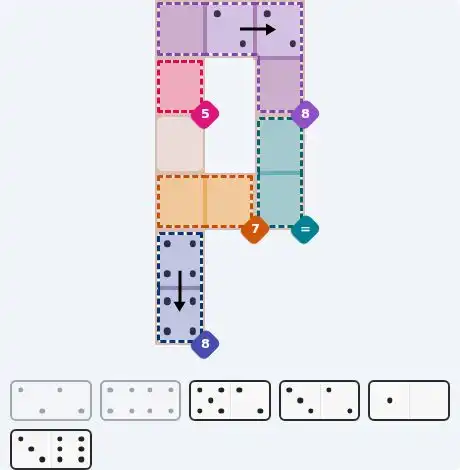
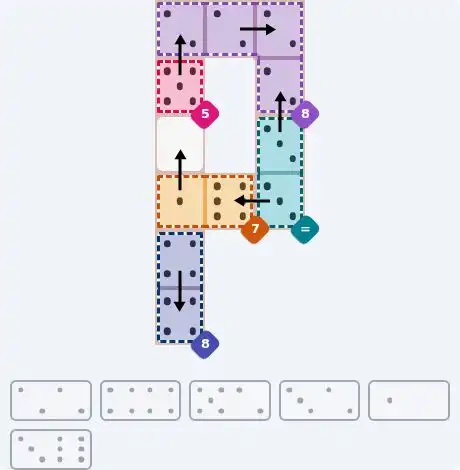
The key to solving today's hard puzzle was identifying the placement for the critical dominoes highlighted in the starting grid. Once those were in place, the rest of the puzzle could be solved logically. See the final grid below to compare your solution.

Starting Position & Key First Steps
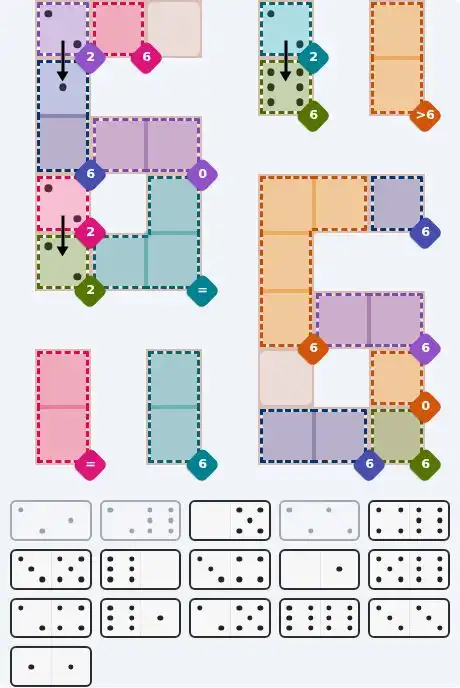
Pips hint for June 2, 2026 โ€“ hard level puzzle grid with critical first placements and strategy

This image shows the initial puzzle grid for the hard level, with a few critical first placements highlighted.

Final Answer: The Solved Grid for Hard Mode
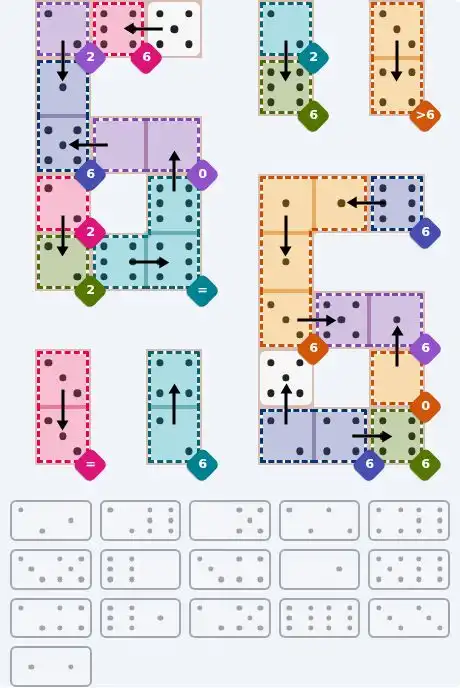
NYT Pips June 2, 2026 hard puzzle full solution grid showing final answer with hints

Compare this final grid with your own solution to see the correct placement of all dominoes.

๐Ÿ”ง Step-by-Step Answer Walkthrough For Easy Level

1
Step 1: Meet the top sum-8
The upper-left sum-8 region covers cells [0,0], [0,1], [0,2], and [1,2]. The only way to avoid immediately exceeding 8 is to place the [2,2] domino across two of these cells. Placing it horizontally at [0,1]โ€“[0,2] commits two 2s and leaves room for the remaining total of 4 across the other two cells.
2
Step 2: Anchor the bottom sum-8
The vertical sum-8 region at [4,0]โ€“[5,0] demands two identical high numbers. The [4,4] domino is the only double that sums to 8, so place it there vertically.
3
Step 3: Satisfy the lone sum-5
Cell [1,0] is a single-cell sum-5 region. The only domino that can supply a 5 where it's needed is [5,2]. Place it so that the 5 lands in [1,0] and the 2 occupies the adjacent [0,0], which conveniently contributes to the top sum-8.
4
Step 4: Complete the equals and sum-7
The equals region [2,2]โ€“[3,2] needs matching values. Place [3,2] with the 3 in [2,2] and the 2 in [1,2]โ€”this 2 finishes the top sum-8. Then [1,0] goes to [3,0]โ€“[2,0] to give 1 in [3,0] and 0 in [2,0]. Finally, [3,6] slots into [3,2]โ€“[3,1] with 3 in [3,2] (matching the equals region) and 6 in [3,1], creating the sum-7 with [3,0]'s 1.

๐Ÿ”ง Step-by-Step Answer Walkthrough For Medium Level

1
Step 1: Exploit the less-4 cell
Cell [0,0] is the only cell with a 'less than 4' restriction, forcing a 0, 1, 2, or 3. Among all dominoes, only [0,4] contains a 0. It must run from [0,0] to [0,1], giving 0 to [0,0] and placing a 4 in the empty-region cell [0,1].
2
Step 2: Lock the top-right equals chain
The equals region covering [0,2], [0,3], and [1,3] needs three identical pips. With [0,1] already a 4 and no other low equals possible, the highest-value double capable of covering two cells is [5,5]; place it horizontally at [0,2]โ€“[0,3]. Then [1,3] must also be 5, so orient [6,5] vertically with the 5 at [1,3] and the 6 at [2,3].
3
Step 3: Mirror the equals on the left
The equals region [1,0]โ€“[1,1]โ€“[1,2] requires all identical digits. The double [4,4] placed at [1,1]โ€“[1,2] provides two 4s. The remaining [1,0] must be 4, so [2,4] runs from [2,0] to [1,0] with 4 at [1,0] and 2 at [2,0].
4
Step 4: Resolve the left column sum-5
The sum-5 region [2,0]โ€“[3,0] now has a 2 at [2,0]. To reach 5, [3,0] must be 3. The [3,1] domino fits this perfectly when placed vertically at [3,0]โ€“[4,0], giving 3 to [3,0] and 1 to [4,0].
5
Step 5: Finish the bottom sums and the final equals
The sum-4 region [4,0]โ€“[4,1] has 1 at [4,0], so [4,1] must be 3; place [3,2] horizontally there with 3 at [4,1] and 2 at [4,2]. The sum-5 region [4,2]โ€“[4,3] now needs 3 at [4,3] to sum to 5 with the 2. Put [6,3] vertically at [3,3]โ€“[4,3], giving 3 to [4,3] and 6 to [3,3]โ€”matching the equals pair [2,3]โ€“[3,3] both at 6.

๐Ÿ”ง Step-by-Step Answer Walkthrough For Hard Level

1
Step 1: Anchor the forced 2s
Single-cell sum-2 regions at [0,0], [0,4], [3,0], and [4,0] each require exactly a 2. Cells [3,0] and [4,0] are vertically adjacent, so the [2,2] domino can cover them both, satisfying both regions at once. Place it vertically there.
2
Step 2: Supply the upper 2s and the rightmost 6
Cell [0,0] still needs a 2, and cell [1,0] is in a sum-6 region with [2,0]. Place [2,1] horizontally at [0,0]โ€“[1,0] to give 2 to [0,0] and 1 to [1,0]. Cell [0,4] needs a 2, while the single-cell sum-6 at [1,4] needs a 6. The [2,6] domino placed at [0,4]โ€“[1,4] puts a 2 in [0,4] and a 6 in [1,4], solving both.
3
Step 3: Split the sum-0 into two zeros
The sum-0 region [2,1]โ€“[2,2] demands a 0 in each cell. Since no double-0 exists, the zeros must come from different dominoes. Use [0,5] horizontally at [2,0]โ€“[2,1] so the 0 lands in [2,1] and 5 in [2,0] (completing the left sum-6: 1+5). Then place [6,0] vertically at [3,2]โ€“[2,2] so its 0 fills [2,2] and 6 occupies [3,2].
4
Step 4: Convert the 6 into an equals cascade
Now [3,2] is a 6, and it belongs to an equals region with [4,1] and [4,2]. Therefore all three must be 6. The [6,6] double easily covers [4,1]โ€“[4,2] horizontally.
5
Step 5: Address the greater constraint and the sum-6 group
The greater region [0,6]โ€“[1,6] needs values above a small threshold; the [3,4] domino placed vertically there gives 3 and 4, satisfying it. Cell [3,6] is a single-cell sum-6, so it must be 6. Place [6,1] horizontally at [3,6]โ€“[3,5] with 6 in [3,6] and 1 in [3,5]. The large sum-6 region spanning [3,4], [3,5], [4,4], and [5,4] currently has 1 at [3,5] from the previous placement. Use [1,1] at [3,4]โ€“[4,4] to assign 1s there, giving 1+1+1=3 so far. To reach the total of 6, [5,4] must be 3. The [3,5] domino placed at [5,4]โ€“[5,5] supplies that 3 and a 5.
6
Step 6: Fill the remaining empty and sum regions
With the core resolved, finish the right side. The sum-6 region [5,5]โ€“[5,6] now has a 5 at [5,5], so [5,6] must be 1; place [0,1] at [6,6]โ€“[5,6], putting 0 in [6,6] (satisfying that sum-0 cell) and 1 in [5,6]. The sum-6 cell [7,6] forces a 6 there; place [4,6] at [7,5]โ€“[7,6] with 6 in [7,6] and 4 in [7,5]. Sum-6 region [6,2]โ€“[7,2] needs a total of 6: use [2,4] at [7,2]โ€“[6,2] with 2 in [7,2] and 4 in [6,2]. For [7,4]โ€“[7,5] sum-6, insert [2,5] at [7,4]โ€“[6,4] placing 2 in [7,4] and 5 in [6,4] (with [6,4] an empty region). The equals region [6,0]โ€“[7,0] gets [3,3] placed there, giving both cells a 3. Finally, the empty [0,2] and sum-6 [0,1] are resolved: place [5,6] at [0,2]โ€“[0,1] to put 6 in [0,1] (sum-6) and 5 in [0,2].

๐Ÿ’ก Pro Tips for Similar Puzzles

Start with Constraints
Always begin with the most constrained regions - sum regions with small numbers or tight spaces.
Use Equal Regions
Use "equal" regions as anchors - they eliminate many possibilities quickly.
Work Systematically
Let the rules guide your placement rather than guessing randomly.
Double-Check
Verify each region's rules are satisfied before moving to the next.

๐ŸŽ“ Keep Learning & Improve