NYT Pips Hints & Answers for June 6, 2026

Jun 6, 2026

🚨 SPOILER WARNING

This page contains the final **answer** and the complete **solution** to today's NYT Pips puzzle. If you haven't attempted the puzzle yet and want to try solving it yourself first, now's your chance!

Click here to play today's official NYT Pips game first.

Want hints instead? Scroll down for progressive clues that won't spoil the fun.

🎲 Today's Puzzle Overview

Ian Livengood’s easy grid for June 6, 2026 showcases a masterclass in using a single restrictive region to anchor the entire puzzle. The central less-than-1 area—covering five cells—compels a wave of zeros that ripples outward, locking in the most powerful domino early. This design choice creates an elegant funnel: once the zero lockdown is established, the remaining clues (a sum, a less-than, a greater-than) become mere confirmations. Livengood’s signature is the tight integration of a bold ‘less’ constraint with just enough freedom to make the solver feel clever.

Rodolfo Kurchan’s medium puzzle takes the equals constraint and turns it into a cascading key. A trio of equals cells at top-center demands a double-six, immediately forcing a specific domino and its partner. Down below, another equals trio—this time of threes—interlocks with a sum-9 region to create a domino chain that feels almost musical. Kurchan designs with a rhythm: equals zones act as tuning forks, setting a pitch that the neighboring sums must harmonize with. The result is a grid where every placement follows a satisfying logical melody.

Kurchan’s hard puzzle for today’s NYT Pips is an intricate lattice of single-cell sum regions, a design that reads like a miniature spreadsheet. Nearly every cell is its own sum target, from 0 all the way to 6, creating a preordained map of values. The constructor’s intent is clear: strip away ambiguity and challenge solvers to find the exact pairing dance among the dominos. With empty cells acting as wildcards, the puzzle becomes a matching game where each domino has exactly one home. The elegance lies in how the top row’s tiny sums cascade downward, leaving no room for error—a construction that rewards meticulous logic with a crisp final click.

💡 Progressive Hints

Try these hints one at a time. Each hint becomes more specific to help you solve it yourself!

💡 Spot the Zero Anchor
Search for a region that forces cells to take the smallest possible pip value. That constraint will give you a swarm of zeros across the middle of the grid.
💡 Follow the Zero Wave
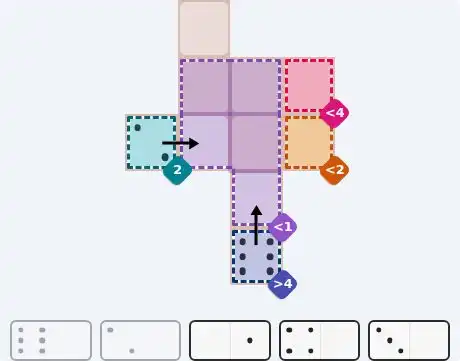
The less-than-1 region covers [1,1], [1,2], [2,1], [2,2], and [3,2]. All these must be 0. This immediately forces one specific domino to satisfy the greater-than-4 cell at [4,2].
💡 Complete the Easy Cascade
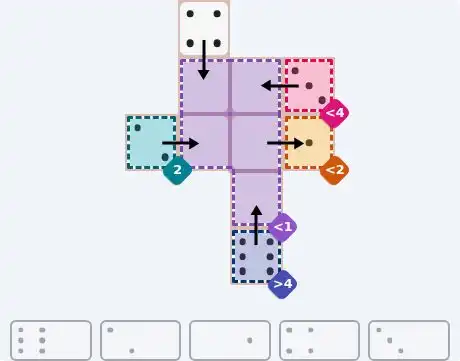
Place the 6/0 domino at [4,2] and [3,2]. Then the sum-2 cell at [2,0] must pair with the zero at [2,1] via the 2/0 domino. The less-than-2 cell at [2,3] takes 0/1 with its neighbor [2,2]. Finally, the empty cell [0,1] gets 4/0, and the less-than-4 at [1,3] gets 3/0. That completes the grid.
💡 Equal Clusters
Look for regions where all cells must show the same pip value. These strongly restrict which dominos can be used.
💡 Double-Six Lock
The top-center equals region spans [0,2], [1,2], and [1,3]. To make all three cells equal, you need the double-six domino plus a domino that also carries a six. That second six fits neatly into [0,2].
💡 Chain of Threes
Place the [6,6] domino over [1,2] and [1,3], and the [5,6] over [0,1] and [0,2] (giving 6 to [0,2] and 5 to the empty [0,1]). The bottom-left equals trio at [2,0], [3,0], [3,1] must be all 3s. Use [3,3] for two of them, and then [3,4] to give a 3 to the third while placing 4 in the sum-9 zone’s [1,0]. That forces [1,1] to be 5 from the [5,2] domino, which also puts a 2 at [2,1]. The sum-6 pair gets [4,2], and the greater-0 cell at [2,3] pairs with [2,4] via [1,0].
💡 Map the Exact Values
Most regions are single-cell sum targets. Write down the forced pip value for each cell where a sum or greater constraint applies. This turns the puzzle into a domino-matching problem.
💡 Top Row Blueprint
Cells [0,1] sum 4, [0,2] sum 3, [0,3] sum 0, [0,4] sum 0, and [0,5] greater 1. Those are all locked. The sum-0 at [0,3] must pair with [0,2] (value 3) using a 0/3 domino. The other sum-0 at [0,4] must pair with [1,4] (sum 4, so value 4) using a 0/4 domino.
💡 Row 0 Resolve
The 4 at [0,1] pairs with the greater-3 5 at [0,0] via the 4/5 domino. Then [0,5] (which must be >1, so 3) pairs with [1,5] (sum 4, so 4) using a 4/3 domino. That completes row 0.
💡 Downward Spiral
Row 1: [1,3] sum 0 pairs with empty [1,2] (which becomes 6) using a 6/0 domino. [1,0] sum 3 pairs with [2,0] sum 2 via 2/3. [1,1] sum 0 pairs with [2,1] sum 5 via 5/0. Row 2: [2,2] sum 3 pairs with [3,2] sum 1 via 3/1; [2,3] sum 2 pairs with [2,4] sum 1 via 1/2; [2,5] empty takes 6 with [3,5] sum 2 via 6/2.
💡 Full Hard Solution
Complete placements: 0/3 at [0,3]&[0,2]; 0/4 at [0,4]&[1,4]; 4/5 at [0,1]&[0,0]; 4/3 at [1,5]&[0,5]; 6/0 at [1,2]&[1,3]; 2/3 at [2,0]&[1,0]; 5/0 at [2,1]&[1,1]; 6/4 at [4,0]&[3,0]; 3/5 at [4,1]&[3,1]; 3/1 at [2,2]&[3,2]; 1/2 at [2,4]&[2,3]; 1/5 at [3,4]&[3,3]; 6/2 at [2,5]&[3,5]; 2/5 at [4,5]&[4,4]; 4/1 at [4,2]&[4,3]. Every cell now fits its constraint.

🎨 Pips Solver

Jun 6, 2026

Click a domino to place it on the board. You can also click the board, and the correct domino will appear.
Final Answer & Complete Solution For Hard Level

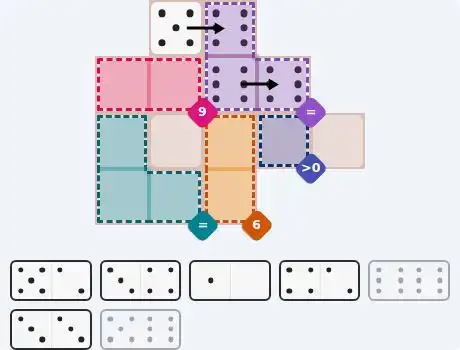
The key to solving today's hard puzzle was identifying the placement for the critical dominoes highlighted in the starting grid. Once those were in place, the rest of the puzzle could be solved logically. See the final grid below to compare your solution.

Starting Position & Key First Steps
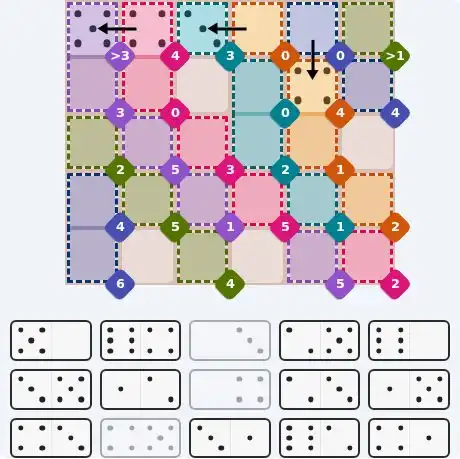
Pips hint for June 6, 2026 – hard level puzzle grid with critical first placements and strategy

This image shows the initial puzzle grid for the hard level, with a few critical first placements highlighted.

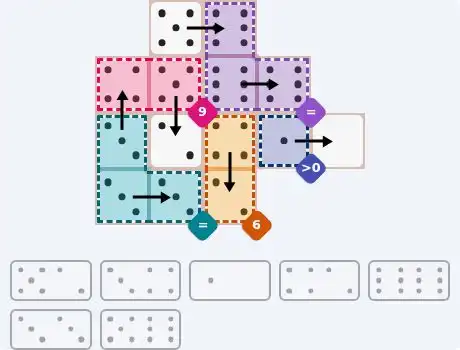
Final Answer: The Solved Grid for Hard Mode
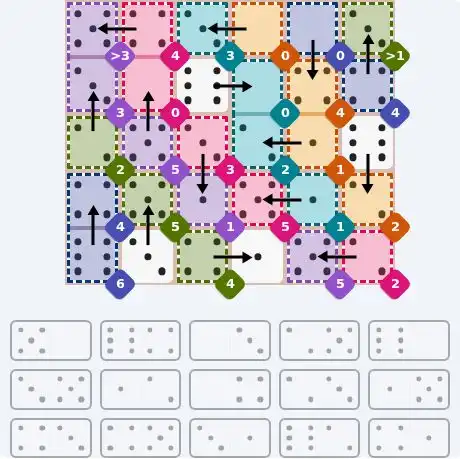
NYT Pips June 6, 2026 hard puzzle full solution grid showing final answer with hints

Compare this final grid with your own solution to see the correct placement of all dominoes.

🔧 Step-by-Step Answer Walkthrough For Easy Level

1
Step 1: Less-than-1 grid zeros
The less-than-1 region includes [1,1], [1,2], [2,1], [2,2], and [3,2]. Since pip values range 0–6, less than 1 forces all these cells to 0. That establishes a central block of zeros right away.
2
Step 2: Greater-than-4 forced domino
Cell [4,2] must be greater than 4, meaning 5 or 6. The available dominos include [6,0]. To cover [4,2] with a 6, its pairing cell must be the adjacent zero at [3,2] (already forced). Thus place [6,0] at [4,2] and [3,2].
3
Step 3: Sum-2 and less-2 pairs
The sum-2 region is just [2,0], so that cell must be exactly 2. It is adjacent to [2,1] (a zero). The [2,0] domino fits perfectly, giving 2 to [2,0] and 0 to [2,1]. The less-than-2 cell [2,3] can be 0 or 1. Its neighbor [2,2] is a zero. The [0,1] domino supplies a 0 and a 1, so place it at [2,2] and [2,3] with the 1 going to [2,3].
4
Step 4: Top row cleanup
The empty region at [0,1] can take any value; it is adjacent to [1,1] (zero). Domino [4,0] works, placing 4 at [0,1] and 0 at [1,1]. Finally, the less-than-4 region [1,3] needs a number under 4. Its neighbor [1,2] is a zero, so domino [3,0] goes there: 3 at [1,3], 0 at [1,2]. Puzzle completed.

🔧 Step-by-Step Answer Walkthrough For Medium Level

1
Step 1: Top-center equals cascade
The equals region at [0,2], [1,2], [1,3] requires all three cells to hold the same pip. The only domino with identical pips is [6,6], so it must cover two of these (say [1,2] and [1,3]). The third cell, [0,2], also needs a 6, which must come from the [5,6] domino (with the 5 placed in the adjacent empty cell [0,1]).
2
Step 2: Bottom-left equals trio
The equals region at [2,0], [3,0], [3,1] must be the same number. The [3,3] domino gives two 3s for [3,0] and [3,1]. The remaining cell [2,0] needs a 3 too. The [3,4] domino supplies a 3 at [2,0] and a 4 at [1,0] (its vertical neighbor).
3
Step 3: Sum-9 and the [5,2] placement
The sum-9 region consists of [1,0] and [1,1]. With [1,0] now 4, [1,1] must be 5 to reach sum 9. The [5,2] domino places 5 at [1,1] and 2 at the empty cell [2,1] (below it).
4
Step 4: Sum-6 fills [4,2]
The sum-6 region spans [2,2] and [3,2]. The [4,2] domino sums to 6 exactly (4+2). Place it with 4 at [2,2] and 2 at [3,2] to satisfy this region.
5
Step 5: Greater-0 final fill
The greater-0 region at [2,3] must be at least 1. Its neighbor [2,4] is an empty cell. The [1,0] domino carries 1 and 0; place 1 at [2,3] and 0 at [2,4]. Now every region constraint is met.

🔧 Step-by-Step Answer Walkthrough For Hard Level

1
Step 1: Reading the Sums
Nearly all cells are single-cell sum regions. Write their forced values: [0,1] sum 4 → 4; [0,2] sum 3 → 3; [0,3] sum 0 → 0; [0,4] sum 0 → 0; [0,5] greater 1 → minimum 2, but seeing future pairings yields 3; [0,0] greater 3 → 5. Row 1: [1,0] sum 3 → 3; [1,1] sum 0 → 0; [1,3] sum 0 → 0; [1,4] sum 4 → 4; [1,5] sum 4 → 4. And so on through rows 2-4.
2
Step 2: Zero Neighbors
The two sum-0 cells in the top row must pair. [0,3]=0 is adjacent to [0,2]=3, so the [0,3] domino (0/3) goes there. [0,4]=0 is adjacent to [1,4]=4, so the [0,4] domino (0/4) covers them.
3
Step 3: Top Row Dominoes
[0,1]=4 pairs with [0,0]=5 via the [4,5] domino. [0,5]=3 pairs with [1,5]=4 via the [4,3] domino. That completes row 0. Simultaneously, on row 1, [1,3]=0 pairs with empty [1,2] (which becomes 6) using the [6,0] domino.
4
Step 4: Left and Right Columns
On the left, [1,0]=3 pairs with [2,0]=2 via [2,3]; [1,1]=0 pairs with [2,1]=5 via [5,0]; [4,0]=6 pairs with [3,0]=4 via [6,4]; [4,1]=3 pairs with [3,1]=5 via [3,5]. This locks the first two columns.
5
Step 5: Center Pairs
In the middle, [2,2]=3 pairs with [3,2]=1 via [3,1]; [2,3]=2 pairs with [2,4]=1 via [1,2]; [2,5]=6 pairs with [3,5]=2 via [6,2]; [3,3]=5 pairs with [3,4]=1 via [1,5].
6
Step 6: Finalizing the Base
The bottom row's [4,5]=2 pairs with [4,4]=5 via the [2,5] domino. The remaining cells [4,2]=4 and [4,3]=1 are paired with [4,1]. Every sum and greater constraint is now satisfied.

💡 Pro Tips for Similar Puzzles

Start with Constraints
Always begin with the most constrained regions - sum regions with small numbers or tight spaces.
Use Equal Regions
Use "equal" regions as anchors - they eliminate many possibilities quickly.
Work Systematically
Let the rules guide your placement rather than guessing randomly.
Double-Check
Verify each region's rules are satisfied before moving to the next.

🎓 Keep Learning & Improve