NYT Pips Hints & Answers for July 2, 2026

Jul 2, 2026

🚨 SPOILER WARNING

This page contains the final **answer** and the complete **solution** to today's NYT Pips puzzle. If you haven't attempted the puzzle yet and want to try solving it yourself first, now's your chance!

Click here to play today's official NYT Pips game first.

Want hints instead? Scroll down for progressive clues that won't spoil the fun.

SEE ALSO:

🎲 Today's Puzzle Overview

Ian Livengood's easy puzzle centers on a sum-15 triple that acts as an immutable anchor. A double-5 and a split 1-5 are the only way to fill those three cells, creating a row of pure fives. This rigid constraint then funnels into a neighboring sum-7 that snaps a double-6 into place, leaving little else to decide. The design is a masterclass in forcing structure from a single demanding sum.

In the medium puzzle, Livengood plays with extremity: a less-than-1 column compels an entire column of zeroes, which in turn activates a chain of equals regions across the right half. The double-zero domino is the linchpin, and the designer carefully parcels out zero-bearing dominos so that every placement is squeezed into its only possible slot. The result is a puzzle that feels tightly interlocked, with the solver riding a single deduction from start to finish.

Rodolfo Kurchan's hard grid sprawls across a larger canvas, but his signature is the use of interlocking sum and equals constraints that drive cascades. A triple equals region forces three zeros, rippling outward into a sum-1 cell, a sum-10 pair, and a high-value sum-17 triangle. Kurchan disperses doubles and zeroes strategically, ensuring that no domino is wasted and the solver must navigate a landscape where every region seems to demand the same few digits. It's an elegant web that rewards systematic unpacking.

💡 Progressive Hints

Try these hints one at a time. Each hint becomes more specific to help you solve it yourself!

💡 Hint 1
Look for a region where the sum forces a very specific repeated digit — check your doubles and split-domino options carefully.
💡 Hint 2
The top row's three-cell sum-15 region can only be filled with fives. The double-5 gives you two of them, so first lock that double into those cells.
💡 Hint 3
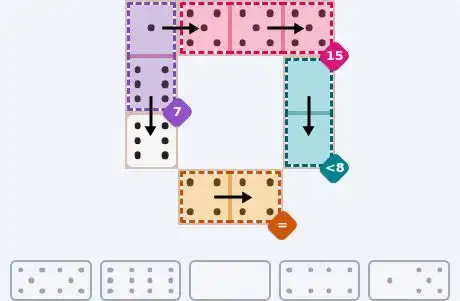
Place the double-5 horizontally at [0,2]-[0,3]. The 1-5 must give its 5 to [0,1] and its 1 to [0,0] to satisfy the sum-7. Then the double-6 covers [1,0] and the empty [2,0]. The 0-0 fits the less-8 region at [1,3]-[2,3], and the double-4 seals the equals at [3,1]-[3,2].
💡 Hint 1
Identify a column with a strict less-than constraint that leaves only one possible digit — that'll be your zero anchor.
💡 Hint 2
The leftmost column must be all zeroes because of its less-than-1 cap. The double-zero domino can cover two of those three cells; find a second 0-domino for the last cell.
💡 Hint 3
Plant the [0,0] vertically at [1,0]-[2,0]. The [0,2] domino places its 0 at [3,0] and 2 at [3,1]. Then the top equals region [0,2]-[1,2] forces both to 6: use [0,6] with 0 at [0,1] and 6 at [0,2], and [1,6] with 1 at [1,1] and 6 at [1,2]. The equals pair [1,1]-[2,1] forces [2,1]=1 via the [5,1] domino, putting 5 at [2,2]. The final equals triple [2,2],[2,3],[3,2] all become 5, using [3,5] (5 at [3,2], 3 at [3,3]) and [0,5] (0 at [1,3], 5 at [2,3]).
💡 Hint 1
A multi-cell equals region demands a string of zeros; track down the double-zero domino and its partner zero.
💡 Hint 2
The equals region at [3,6],[3,7],[4,6] forces all zeros. Place the [0,0] domino horizontally at [3,6] and [3,7]; then the [0,3] domino provides the third zero at [4,6] while planting a 3 at [5,6].
💡 Hint 3
With those zeroes locked, the single-cell sum-1 at [5,4] demands a 1. Only the [4,1] domino can deliver it, leaving a 4 in the empty cell above at [4,4].
💡 Hint 4
Now tend to the sum-10 region at [4,8]-[5,8] and the >3 cell at [3,8]. The [4,6] domino slots in vertically: 4 at [3,8] and 6 at [4,8]; then the [5,4] domino fills [5,7] (5) and [5,8] (4). Meanwhile, the sum-6 at [1,5]-[1,6] neatly takes the [0,6] domino.
💡 Hint 5
Unravel the sum-17 at [0,3],[1,3],[2,3] with the [6,1] domino (6 at [0,3], 1 at [0,2]) and the [6,5] domino (6 at [2,3], 5 at [1,3]). The sum-7 at [1,0]-[2,0] takes [3,4] (4+3). Bottom regions: sum-7 at [7,4],[7,5],[8,5] uses [2,3] at [7,5]-[7,4] (2+3) and [5,2] with 2 at [8,5] and 5 at [9,5] (>4). Equals at [7,1]-[7,2] use [1,1] double; sum-5 at [9,2] takes [1,5] with 1 at [9,1] and 5 at [9,2].

🎨 Pips Solver

Jul 2, 2026

Click a domino to place it on the board. You can also click the board, and the correct domino will appear.
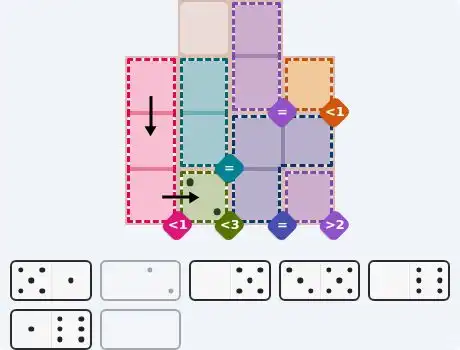
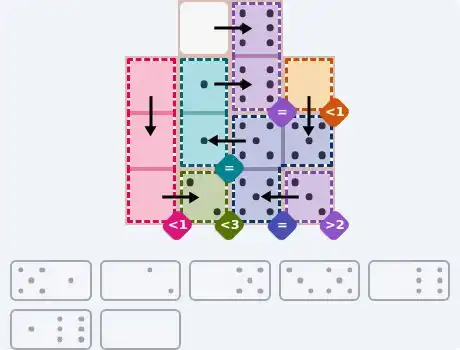
Final Answer & Complete Solution For Hard Level

The key to solving today's hard puzzle was identifying the placement for the critical dominoes highlighted in the starting grid. Once those were in place, the rest of the puzzle could be solved logically. See the final grid below to compare your solution.

Starting Position & Key First Steps
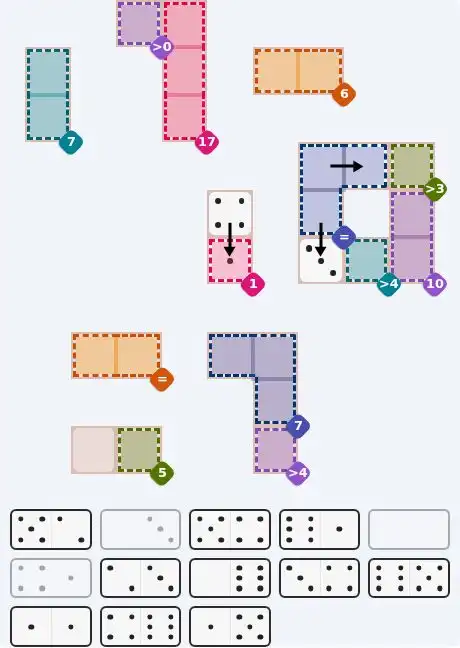
Pips hint for July 2, 2026 – hard level puzzle grid with critical first placements and strategy

This image shows the initial puzzle grid for the hard level, with a few critical first placements highlighted.

Final Answer: The Solved Grid for Hard Mode
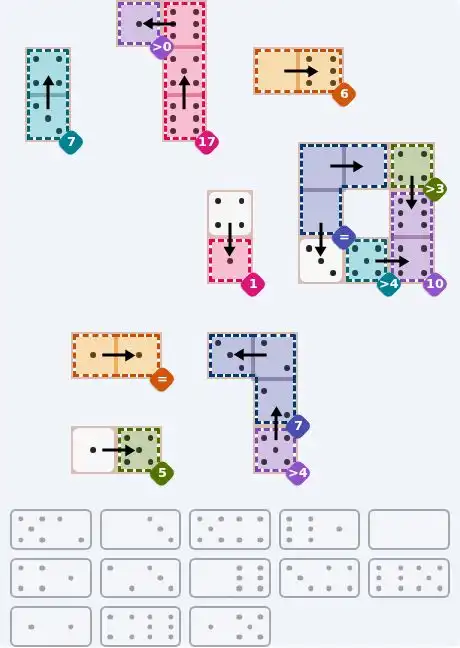
NYT Pips July 2, 2026 hard puzzle full solution grid showing final answer with hints

Compare this final grid with your own solution to see the correct placement of all dominoes.

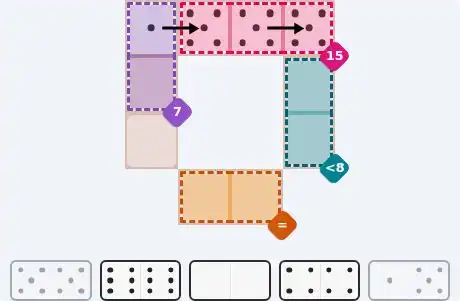
🔧 Step-by-Step Answer Walkthrough For Easy Level

1
Step 1: The Sum-15 Vault
The three-cell sum-15 region in row 0 (cols 1-3) can only be reached with three 5s, the highest repeatable digit within pip range (6+5+4=15 is also possible but with available dominos only a 5-5 and 1-5 can supply the needed digits). This forces a 5 in every cell of the region.
2
Step 2: Placing the Double-5
The only way to get two 5s adjacent is the double-5 domino. Place it so it occupies two of the region's cells; the solution sets it horizontally at [0,2] and [0,3]. Now both those cells are 5.
3
Step 3: The 1-5 Split
The remaining cell [0,1] must also be 5. The 1-5 domino can put its 5 there and its 1 in the adjacent sum-7 cell at [0,0]. That gives [0,0]=1, and the sum-7 needs [1,0]=6 to total seven. The double-6 is the only source of a 6; place it vertically covering [1,0] and the empty cell [2,0].
4
Step 4: Wrapping Up the Corners
With the major dominos placed, the less-than-8 cells [1,3] and [2,3] can take the 0-0 domino, satisfying <8. The equals region at [3,1]-[3,2] gets the remaining double-4, and the grid is complete.

🔧 Step-by-Step Answer Walkthrough For Medium Level

1
Step 1: Column of Zeros
The less-than-1 region covers the entire column at [1,0], [2,0], [3,0]. All three cells must be 0. Since no single domino covers three cells, you need two zero-bearing dominos. The double-zero [0,0] can cover two adjacent cells, so place it vertically at [1,0] and [2,0].
2
Step 2: A Third Zero from a Split
The remaining cell [3,0] still needs a 0. The [0,2] domino can provide it, placing 0 at [3,0] and its partner 2 at [3,1] (which satisfies the less-than-3 restriction there).
3
Step 3: The Equals Sextet at Top Right
The equals region at [0,2] and [1,2] demands identical values. The available 6s make these two cells both 6. Use the [0,6] domino with 0 at [0,1] (empty) and 6 at [0,2]; use the [1,6] domino with 1 at [1,1] and 6 at [1,2].
4
Step 4: The Next Equals Links In
Now the equals region at [1,1] and [2,1] forces a match. [1,1] is already 1, so [2,1] must be 1. The only remaining 1 is on the [5,1] domino, so place it with 1 at [2,1] and 5 at [2,2].
5
Step 5: A Triple Equals Finale
The three-cell equals region at [2,2], [2,3], [3,2] now all must be 5 (since [2,2]=5). Use the [3,5] domino to put 5 at [3,2] and 3 at [3,3] (>2). The [0,5] domino places 0 at [1,3] (less-1) and 5 at [2,3], satisfying all constraints.

🔧 Step-by-Step Answer Walkthrough For Hard Level

1
Step 1: Triple Zero Equals
The equals region at [3,6], [3,7], [4,6] compels all three cells to share the same value. Only a string of zeros can work because the only multi-zero source is the double-zero. Place [0,0] horizontally at [3,6] and [3,7] to cover two of them.
2
Step 2: The Third Zero and an Empty Cell
[4,6] must also be 0. The [0,3] domino has a 0 that can go there, with its 3 landing in the empty cell [5,6]. Place it vertically: 0 at [4,6], 3 at [5,6].
3
Step 3: The Sum-1 Singularity
A single-cell sum-1 region at [5,4] forces the value to be exactly 1. The [4,1] domino can give that 1, placing 1 at [5,4] and its 4 in the empty cell [4,4] above.
4
Step 4: A Sum-10 and a Greater-Than Bridge
The sum-10 region at [4,8] and [5,8] must total ten. The [4,6] domino, placed vertically, can give 4 to the >3 cell [3,8] and 6 to [4,8]. Then [5,8] still needs 4; the [5,4] domino fits with 5 at [5,7] (>4) and 4 at [5,8].
5
Step 5: Quick Sums: 6 and 17
The sum-6 pair at [1,5] and [1,6] is perfectly served by the [0,6] domino (0 and 6). For the sum-17 triple at [0,3],[1,3],[2,3], use the [6,1] domino: 6 at [0,3] and 1 at [0,2] (>0). Then use the [6,5] domino: 6 at [2,3] and 5 at [1,3]. The math hits 6+5+6=17.
6
Step 6: Remaining Sums and Equals
The sum-7 at [1,0]-[2,0] gets the [3,4] domino (4 at [1,0], 3 at [2,0]). For the sum-7 at [7,4],[7,5],[8,5], place [2,3] with 2 at [7,5] and 3 at [7,4]; then [5,2] puts 2 at [8,5] and 5 at [9,5] (>4). The equals pair [7,1]-[7,2] takes the [1,1] double. Lastly, sum-5 at [9,2] uses [1,5] with 1 at [9,1] (empty) and 5 at [9,2].

💡 Pro Tips for Similar Puzzles

Start with Constraints
Always begin with the most constrained regions - sum regions with small numbers or tight spaces.
Use Equal Regions
Use "equal" regions as anchors - they eliminate many possibilities quickly.
Work Systematically
Let the rules guide your placement rather than guessing randomly.
Double-Check
Verify each region's rules are satisfied before moving to the next.

🎓 Keep Learning & Improve