NYT Pips Hints & Answers for June 30, 2026

Jun 30, 2026

🚨 SPOILER WARNING

This page contains the final **answer** and the complete **solution** to today's NYT Pips puzzle. If you haven't attempted the puzzle yet and want to try solving it yourself first, now's your chance!

Click here to play today's official NYT Pips game first.

Want hints instead? Scroll down for progressive clues that won't spoil the fun.

SEE ALSO:

🎲 Today's Puzzle Overview

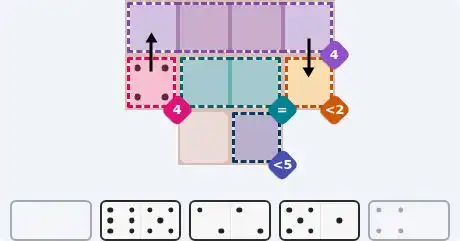
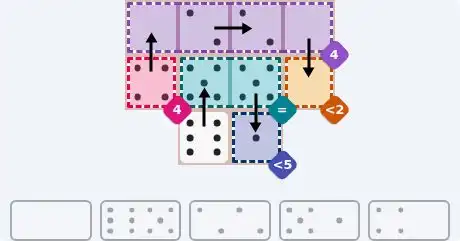
Ian Livengood's easy puzzle exhibits a crisp, architectural clarity—a single sum-4 row dominates the top of a compact grid, while a standalone sum-4 cell at [1,0] acts as an instant key, forcing a 4 and immediately tethering the vertical [4,0] domino. That lock, paired with an equals duo on the row below, resolves everything with a sense of clean inevitability.

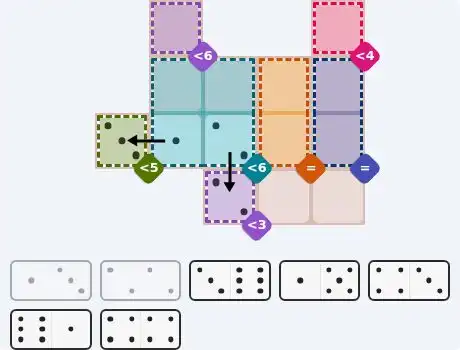
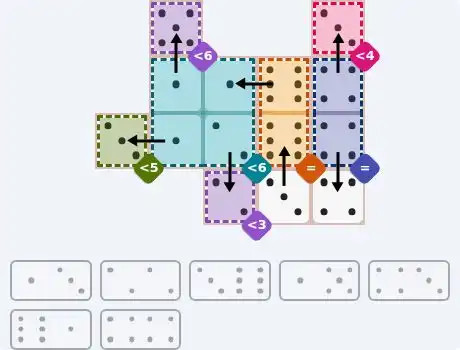
Rodolfo Kurchan's medium puzzle weaves a net of less-than restrictions across a slightly larger field, with a pivotal 2×2 less-6 region, a less-5 singleton, and a less-3 anchor that collectively funnel the solver toward a few candidate dominoes. The design's vertical equals pillars in the right half add a satisfying structural counterbalance, making the deduction feel like peeling layers from a carefully wrapped package.

Kurchan's hard is a dense lattice of interlocking constraints—three single-cell sum-4 regions serve as absolute anchors, sparking an equals cascade across a three-cell stretch in row 3 that spreads 4s like a chain reaction. This NYT Pips hard leans into its sum-4 singles and sum-15 triple to create a rhythmic, methodical solve where each placement unlocks the next, showcasing Kurchan's flair for tightly woven constraint puzzles.

💡 Progressive Hints

Try these hints one at a time. Each hint becomes more specific to help you solve it yourself!

💡 Spot the Instant Lock
Start by searching for a region that gives away a value immediately—look for a constraint type that dictates exactly what a single cell must be, no calculations required.
💡 Zero In on Row 1, Column 0
The sum-4 cell at [1,0] cannot be anything other than 4. That forces a specific domino to occupy the two cells vertically above it. Once placed, turn your attention to the less-2 region on the right edge and how it connects to the top row's sum-4.
💡 The Complete Picture
Place the [4,0] domino vertically in column 0 with 4 at [1,0] and 0 at [0,0]. The less-2 at [1,3] demands a 0 there, so the [0,0] domino must fill [0,3] and [1,3], both 0. Now the top-row sum-4 (0 + ? + ? + 0) forces the middle two to sum to 4, and the only way is the [2,2] domino placed horizontally at [0,1]=2, [0,2]=2. The equals pair [1,1]=[1,2] then mandates both be 5, so [6,5] goes vertically with 5 at [1,1] and 6 at [2,1]; finally [5,1] vertical with 5 at [1,2] and 1 at [2,2] satisfies the last less-5 constraint.
💡 Follow the Less-Than Trail
Many regions here restrict cells to small values. Identify which dominoes are forced into corners by the tightest less-than bounds—particularly a cell that must be less than 3.
💡 Anchor at Row 3, Column 2
The less-3 region at [3,2] permits only 0, 1, or 2. Because the only domino with two identical low numbers is [2,2], it becomes the natural candidate to fill that cell and its upward neighbor, [2,2]. That simultaneously helps satisfy the 2×2 less-6 block nearby.
💡 Full Grid Unlocked
Place the [2,2] domino vertically with 2 at [2,2] and 2 at [3,2]. The less-5 at [2,0] then allows the [1,3] domino vertically, giving 3 at [2,0] and 1 at [2,1], which respects the 2×2 less-6 zone (values 1,1,2,1 with [1,1] and [1,2] to be filled). The equals pair at [1,3]=[2,3] forces a 6; place [3,6] horizontally as 3 at [3,3] and 6 at [2,3], while the other equals [1,4]=[2,4] demands 4; place [4,3] horizontally for 4 at [1,4] and 3 at [0,4] (respecting less-4), then [4,4] fills [2,4]=4 and [3,4]=4. Finally [1,5] places vertically with 1 at [1,1] and 5 at [0,1] (under less-6), and [6,1] splits 6 at [1,3] and 1 at [1,2] to complete the 2×2 less-6 area.
💡 Find the Single-Cell Giveaways
Several regions contain just one cell with a sum target. Those cells must hold exactly that target value. Look for them—they are instant anchors.
💡 Lock the Sum-4 Trio
The single-cell sum‑4 regions at [3,5], [3,6], and [4,3] each demand a 4. That instantly pins three different dominoes into place: one filling [3,5] and its partner above, one filling [3,6] with a partner on its right, and one filling [4,3] with a partner below.
💡 Spread the Equals Cascade
With those 4s locked, notice the equals region spanning [3,1]–[3,3]—three cells in a row that must share the same value. Because 4 is already rampant nearby, it's a strong candidate. Place the [4,4] domino to cover two of them, then use a [3,4] domino to deliver the third 4 while its partner 3 lands in the row above.
💡 Settle the Column 0 Chain
Now examine the sum-4 vertical triple in column 0 across rows 3–5. With plenty of 4s allocated, only low numbers remain. The [1,1] domino (two 1s) fits perfectly at [4,0] and [5,0], then a [5,2] domino supplies the 2 at [3,0] and a 5 at [2,0], making the sum 4 (2+1+1) exact. The equals [1,0]=[2,0] then forces [1,0] to also be 5 via [5,6].
💡 Complete Hard Solution
Place [5,4] vertically (4 at [3,5], 5 at [4,5]); [4,6] horizontally (4 at [3,6], 6 at [3,7]); [1,4] vertically (4 at [4,3], 1 at [5,3] satisfying less-3). Row 3 equals: [4,4] horizontal at [3,1]=4, [3,2]=4, then [3,4] vertical with 4 at [3,3] and 3 at [2,3] (equals [1,3]=[2,3] so [1,3] gets 3 from [5,3] vertical with 5 at [0,3], 3 at [1,3]). Sum-4 triple: [1,1] vertical at [4,0]=1, [5,0]=1, and [5,2] vertical with 2 at [3,0], 5 at [2,0]. Top row equals [0,0]=[0,1]: [5,6] vertical at [1,0]=5, [0,0]=6 and [3,6] vertical at [0,2]=3, [0,1]=6 giving 6=6 and sum-8 (3+5). Sum-5 triple row 1: [2,2] horizontal at [1,5]=2, [1,6]=2; [6,1] vertical with 6 at [2,7], 1 at [1,7] (sum 2+2+1=5); sum-12 pair [2,7]=[3,7] already 6+6. Sum-15 triple: [5,5] horizontal at [5,5]=5, [5,6]=5 and [4,5] already 5; sum-5 pair [4,7]=[5,7]: [2,3] vertical with 3 at [4,7], 2 at [5,7].

🎨 Pips Solver

Jun 30, 2026

Click a domino to place it on the board. You can also click the board, and the correct domino will appear.
Final Answer & Complete Solution For Hard Level

The key to solving today's hard puzzle was identifying the placement for the critical dominoes highlighted in the starting grid. Once those were in place, the rest of the puzzle could be solved logically. See the final grid below to compare your solution.

Starting Position & Key First Steps
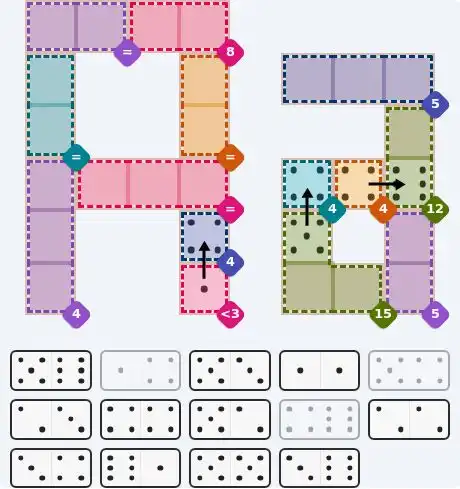
Pips hint for June 30, 2026 – hard level puzzle grid with critical first placements and strategy

This image shows the initial puzzle grid for the hard level, with a few critical first placements highlighted.

Final Answer: The Solved Grid for Hard Mode
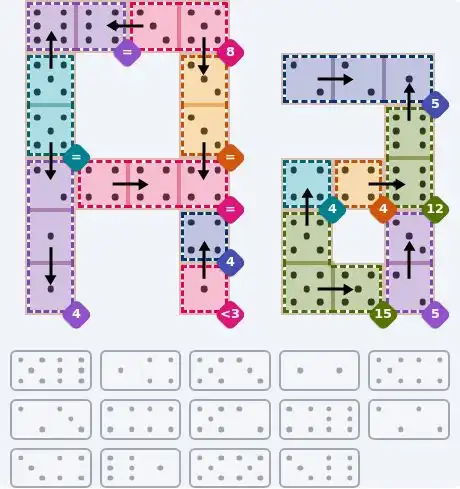
NYT Pips June 30, 2026 hard puzzle full solution grid showing final answer with hints

Compare this final grid with your own solution to see the correct placement of all dominoes.

🔧 Step-by-Step Answer Walkthrough For Easy Level

1
Step 1: The Single-Cell Sum-4
The cell at [1,0] sits in a region with target sum 4, and it's the only cell. Therefore [1,0] must be 4. The only domino containing a 4 is [4,0], so place it vertically with 4 at [1,0] and its partner 0 at [0,0].
2
Step 2: The Less-2 Corner
Region at [1,3] requires a value less than 2, so it can only be 0. The remaining [0,0] domino provides two zeros. Place it vertically to cover [1,3]=0 and [0,3]=0, satisfying the less-2 and adding a second zero to the top row.
3
Step 3: Completing the Top Row Sum
The top row now has [0,0]=0 and [0,3]=0, with a total sum target of 4. The remaining two cells [0,1] and [0,2] must sum to 4. The [2,2] domino supplies exactly 2 and 2; place it horizontally there, giving the required 0+2+2+0=4.
4
Step 4: Equals Pair Finale
The equals region [1,1]=[1,2] demands identical values. With [0,1] and [0,2] occupied, unattached cells are [1,1],[1,2],[2,1],[2,2]. The remaining dominoes are [6,5] and [5,1]. To achieve equality, place [6,5] vertically with 5 at [1,1] and 6 at [2,1], and [5,1] vertically with 5 at [1,2] and 1 at [2,2]. The 1 at [2,2] is under a less-5 constraint, valid, and all regions are satisfied.

🔧 Step-by-Step Answer Walkthrough For Medium Level

1
Step 1: The Less-3 Anchor
The single cell at [3,2] is in a less-3 region, so its value must be 0, 1, or 2. The only domino that fits without waste is [2,2], which provides two 2s. Place it vertically, putting 2 at [3,2] and 2 at [2,2] above it.
2
Step 2: Filling the 2×2 Less-6 Corner
The cell [2,0] has a less-5 restriction. The available domino [1,3] can supply a 3 there and a 1 at [2,1]; that 1 is under the 2×2 less-6 umbrella along with [2,2]'s 2. This placement (vertical [1,3]: 3 at [2,0], 1 at [2,1]) is forced because using the 1 elsewhere would break the low-value web.
3
Step 3: Vertical Equals Pillar
The equals region [1,3]=[2,3] forces identical values. Since [2,3] is adjacent to [2,2] (already 2) but not yet constrained by less-than, a 6 fits well here. Place domino [3,6] horizontally with 6 at [2,3] and 3 at [3,3] (empty). This gives the equals pair 6=6.
4
Step 4: Second Equals Pillar
Similarly, the equals [1,4]=[2,4] needs a matching number. The [4,3] domino can give 4 at [1,4] and 3 at [0,4] (valid under less-4). Then domino [4,4] fills [2,4]=4 and [3,4]=4 (both empty), completing the vertical 4s.
5
Step 5: Closing the Corners
All that remains are the top-left and the 2×2 less-6 area. Domino [1,5] fits vertically: 1 at [1,1] and 5 at [0,1] (less-6 ok). The [6,1] domino then fills the last cells: place it horizontally with 6 at [1,3] (already equals) and 1 at [1,2]; now the 2×2 less-6 region contains 1,1,1,2—all under 6. The less-3, less-5, and equals constraints are all satisfied.

🔧 Step-by-Step Answer Walkthrough For Hard Level

1
Step 1: Three Single-Cell Sum-4 Locks
The regions [3,5], [3,6], and [4,3] are each single cells with sum target 4, so each must hold exactly 4. Place domino [5,4] vertically: 4 at [3,5] and 5 at [4,5]. Place domino [4,6] horizontally: 4 at [3,6] and 6 at [3,7]. Place domino [1,4] vertically: 4 at [4,3] and 1 at [5,3] (satisfying less-3). These three 4s are the foundation.
2
Step 2: The Row 3 Equals Triple
Region [3,1]–[3,3] is an equals triple. The presence of a 4 at [3,5] and [3,6] suggests 4 as the most viable candidate. Place [4,4] horizontally across [3,1] and [3,2] giving 4 and 4. Then place [3,4] vertically with 4 at [3,3] and 3 at [2,3]. That puts 3 at [2,3], which links to the equals [1,3]=[2,3], forcing [1,3] to also be 3.
3
Step 3: Column 0 Sum-4 Triple
Region spanning [3,0], [4,0], [5,0] has sum target 4. With many high numbers already placed, the only low-value domino left for these cells is [1,1] (two 1s). Place it vertically at [4,0]=1, [5,0]=1. Then place [5,2] vertically with 2 at [3,0] and 5 at [2,0]; now 2+1+1=4. The equals [1,0]=[2,0] forces [1,0] to match the 5 at [2,0], so place [5,6] vertically with 5 at [1,0] and 6 at [0,0].
4
Step 4: Top Row Equals and Sum-8 Pair
Now [0,0]=6, and [0,1] must equal it due to the equals region [0,0]=[0,1]. Use domino [3,6] (the remaining 3 and 6) vertically: 6 at [0,1] and 3 at [0,2]. Then the sum-8 region [0,2]=3, [0,3] needs a complement. Place [5,3] vertically: 5 at [0,3] and 3 at [1,3] (matching the 3 already forced in step 2); 3+5=8.
5
Step 5: Right-Side Sum Chains
With [3,7] already 6 from step 1, the sum-12 pair [2,7]=[3,7] requires [2,7] to be 6. Place [6,1] vertically: 6 at [2,7] and 1 at [1,7]. The sum-5 triple [1,5]–[1,7] now has 1 at [1,7], needing 4 more. Place [2,2] horizontally: 2 at [1,5] and 2 at [1,6]; sum = 2+2+1=5. All that's left is the sum-15 triple [4,5]=5, [5,5], [5,6]. Place [5,5] horizontally: 5 at [5,5] and 5 at [5,6]; sum 5+5+5=15. Finally, the sum-5 pair [4,7]=[5,7] is filled by [2,3] vertically: 3 at [4,7] and 2 at [5,7]; 3+2=5. The grid is complete.

💡 Pro Tips for Similar Puzzles

Start with Constraints
Always begin with the most constrained regions - sum regions with small numbers or tight spaces.
Use Equal Regions
Use "equal" regions as anchors - they eliminate many possibilities quickly.
Work Systematically
Let the rules guide your placement rather than guessing randomly.
Double-Check
Verify each region's rules are satisfied before moving to the next.

🎓 Keep Learning & Improve