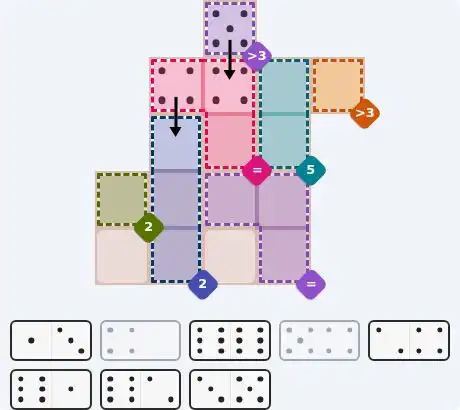
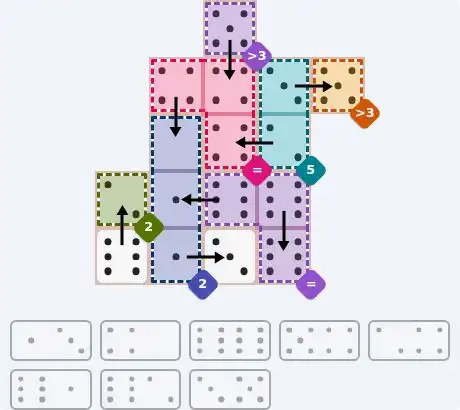
NYT Pips Hints & Answers for July 1, 2026

Jul 1, 2026

🚨 SPOILER WARNING

This page contains the final **answer** and the complete **solution** to today's NYT Pips puzzle. If you haven't attempted the puzzle yet and want to try solving it yourself first, now's your chance!

Click here to play today's official NYT Pips game first.

Want hints instead? Scroll down for progressive clues that won't spoil the fun.

SEE ALSO:

🎲 Today's Puzzle Overview

You'll open the easy puzzle and immediately feel the tug of a tiny sum-3 region paired with a gentle less-5 cell. Those two constraints conspire to force a single double-number domino, and from that fixed point the whole grid unwinds in a few satisfying clicks. Livengood keeps the easy grid airy, with just five dominos, so you can trust your first instincts.

Moving to the medium, a three-cell sum-2 column steals the show. You realize it must be 0,1,1, and the only zero-bearing domino also deposits a crucial 4 that triggers a sprawling equals region. Today's NYT Pips medium feels like a cascade—solve the sum-2, and the 4s spread across the top, dragging a sum-5 and a pair of 1s behind them. Livengood again builds a clean, interlocking structure that rewards step-by-step logic.

Rodolfo Kurchan's hard puzzle elevates the tension with sum-0 and sum-2 anchors at opposite corners, both spitting out zeros that ricochet into greater-than regions demanding maximum pips. A thick unequal chain along the bottom right adds a final layer of texture. You'll find yourself toggling between the left side's 6s and the right side's intricate small-number dance, each move tightening the net until the last domino clicks.

💡 Progressive Hints

Try these hints one at a time. Each hint becomes more specific to help you solve it yourself!

💡 A Tiny Anchor
Look for a region with a very small sum target and a nearby cell with a less-than restriction. Together they'll force a specific double-number domino.
💡 Column of Constraint
The vertical pair [1,1] and [2,1] ties the sum‑3 region to the less‑5 cell. Only a double‑pip can satisfy both with a single domino, so scouting your doubles is the key.
💡 The Full Chain
Place the [1|1] domino vertically from [1,1] to [2,1]. Then [1,0] must be 2 from the [2|6] domino (which sends 6 to [0,0]). The [5|4] domino covers [0,2] (4, >2) and [1,2] (5). Sum‑11 gets [6|6] at [1,3] (6) and [1,4] (5 from [0|5], with its 0 at [0,4]). [2,3] takes the extra 6 for the greater‑4 region.
💡 Sum to Two
Scan for a multi-cell columnar region that must sum to just 2. Its small total will force a 0 and two 1s, steering your first placement.
💡 Zero Leads the Way
That sum‑2 column at c1 forces a 0 in [2,1]. The only domino carrying a 0 also holds a 4 on its other half; that 4 jumps to [1,1] and instantly activates a large equals region across the top.
💡 Locking the Equals
Place [4|0] with 0 at [2,1] and 4 at [1,1]. The equals region at [1,1]/[1,2]/[2,2] all become 4. Use [5|4] (4 at [1,2], 5 at [0,2]) and [2|4] (4 at [2,2], 2 at [2,3]). Sum‑5 forces [1,3]=3 via [3|5] (5 at [1,4]). The sum‑2 column gets 1s from [1|3] at [4,1] and [6|1] at [3,1] (6 at [3,2]). [3,0] sum‑2 gets 2 from [6|2] (6 at [4,0]). Finally [6|6] fills the equals cluster at [3,3]/[4,3].
💡 Absolute Zero
There's a lone cell whose sum target is zero—find it. That cell is completely forced and will dictate your very first placement.
💡 Zero Twins
Cell [2,5] must be 0. The only double‑zero domino, [0|0], covers it and [3,5], giving you two anchored 0s early and opening the middle of the grid.
💡 Bottom Row Sum‑2
The sum‑2 region at the bottom left ([5,0]/[6,0]) needs a 2 and a 0. The [0|2] and [6|0] dominos combine to satisfy that while seeding the 6s demanded by the greater‑than constraints above them.
💡 Greater Demands
Rows 3‑4 contain greater‑than regions that force the highest possible pips. The [6|6] and [3|6] dominos will fill these, with the 3 helping the sum‑9 region on the left edge.
💡 Complete Roadmap
Start with [0|0] on [2,5]/[3,5]. Place [0|2] so [6,0]=2, [6,1]=0; then [6|0] gives [5,0]=0, [4,0]=6. Use [6|6] for [3,1]/[3,2] (both 6). [3|6] puts 3 at [2,0] and 6 at [3,0] to satisfy sum‑9 and greater. Sum‑9 needs 6 at [1,0] via [5|6] (5 at [0,0]). Sum‑8 at [0,0]/[0,1] takes 3 from [4|3] (4 at [0,2]). Equals [1,3]/[2,3] are both 2 via [2|2]. [4,5] gets 2 from [2|5] (5 at [4,6]). Sum‑2 at [4,3]/[5,3] uses [1|1] for 1s. The unequal bottom‑right region fills with [4|1] ([6,5]=4, [5,5]=1), [3|2] ([4,7]=3, [5,7]=2), and [1|6] ([6,7]=1, [6,6]=6).

🎨 Pips Solver

Jul 1, 2026

Click a domino to place it on the board. You can also click the board, and the correct domino will appear.
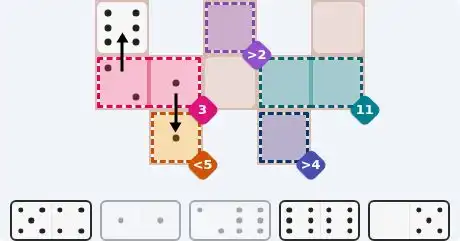
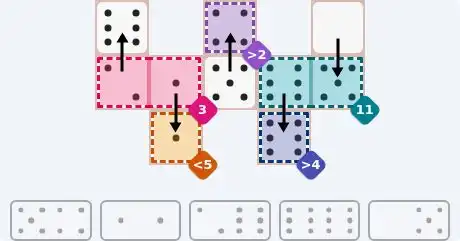
Final Answer & Complete Solution For Hard Level

The key to solving today's hard puzzle was identifying the placement for the critical dominoes highlighted in the starting grid. Once those were in place, the rest of the puzzle could be solved logically. See the final grid below to compare your solution.

Starting Position & Key First Steps
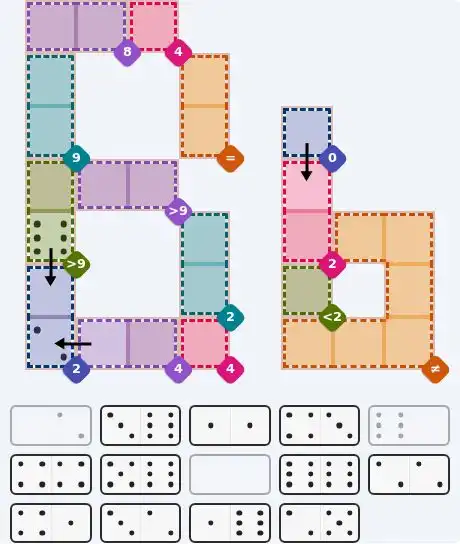
Pips hint for July 1, 2026 – hard level puzzle grid with critical first placements and strategy

This image shows the initial puzzle grid for the hard level, with a few critical first placements highlighted.

Final Answer: The Solved Grid for Hard Mode
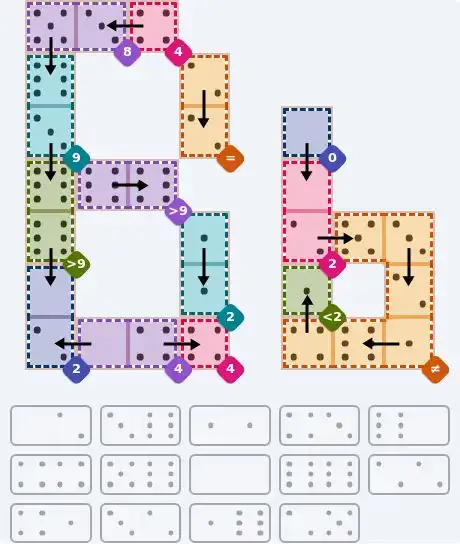
NYT Pips July 1, 2026 hard puzzle full solution grid showing final answer with hints

Compare this final grid with your own solution to see the correct placement of all dominoes.

🔧 Step-by-Step Answer Walkthrough For Easy Level

1
Step 1: Pin the Double-1
The sum‑3 region at [1,0][1,1] and the less‑5 cell at [2,1] share column 1. Since [2,1] must be <5 and [1,1] must help sum to 3 with [1,0], the only feasible value for [1,1] is 1, which also satisfies [2,1]. The domino [1|1] fits perfectly, placed vertically with 1 at [1,1] and 1 at [2,1].
2
Step 2: Complete Sum-3
With 1 at [1,1], [1,0] must be 2 to reach sum 3. The [2|6] domino supplies the 2, so place it with 2 at [1,0] and 6 at [0,0] (empty).
3
Step 3: Satisfy Greater-2 and Sum-11
Now [0,2] requires a pip >2. The [5|4] domino can give 4 there, so place it horizontally: 4 at [0,2] and 5 at [1,2] (empty). The sum‑11 region at [1,3][1,4] needs two pips totalling 11. 6 and 5 do it, so [6|6] puts 6 at [1,3] and 6 at [2,3] (greater‑4), and [0|5] puts 5 at [1,4] and its 0 at [0,4] (empty).
4
Step 4: Final Checks
All dominos are placed. [2,3] becomes 6 (>4), all constraints satisfied.

🔧 Step-by-Step Answer Walkthrough For Medium Level

1
Step 1: Zero from the Sum-2 Column
The three-cell sum‑2 region at [2,1], [3,1], [4,1] forces the triple to be 0,1,1. The 0 must come from the [4|0] domino, so place it with 0 at [2,1] and its companion 4 at [1,1].
2
Step 2: Propagate the Equals 4
The equals region at [1,1], [1,2], [2,2] all now must be 4. So [1,2] needs a 4—the [5|4] domino provides it, placing 4 at [1,2] and 5 at [0,2] (which satisfies >3). [2,2] gets its 4 from the [2|4] domino, leaving 2 at [2,3] for the sum‑5 region.
3
Step 3: Sum‑5 and the 5 Over
The sum‑5 region at [1,3][2,3] has 2 already, so [1,3] must be 3. The [3|5] domino places 3 at [1,3] and 5 at [1,4] (>3).
4
Step 4: Fill the Remaining 1s
Back in the sum‑2 column, [3,1] and [4,1] still need 1s. The [6|1] domino covers [3,2] (6) and [3,1] (1). The [1|3] domino gives 1 at [4,1] and 3 at [4,2] (empty).
5
Step 5: Clean Up the Bottom Row
[3,0] must sum to 2 alone—[6|2] fits with 2 at [3,0] and 6 at [4,0] (empty). Finally, the equals cluster at [3,2],[3,3],[4,3] needs three 6s; the [6|6] domino covers [3,3] and [4,3], matching the already‑placed 6 at [3,2].

🔧 Step-by-Step Answer Walkthrough For Hard Level

1
Step 1: Sum‑0 Locks in Zeros
Region at [2,5] has sum target 0, so that cell must be 0. Place the [0|0] domino with 0 at [2,5] and 0 at [3,5] (part of a later sum‑2).
2
Step 2: Bottom‑Left Sum‑2
The sum‑2 region at [5,0][6,0] needs a 0 and 2. The [0|2] domino fits with 2 at [6,0] and 0 at [6,1] (which feeds the sum‑4 region with [6,2]). The companion [6|0] domino gives 0 at [5,0] and 6 at [4,0], satisfying the greater‑than constraint on those rows.
3
Step 3: Greater‑than Forces 6s
Rows 3‑4 have greater‑than constraints demanding max pips. The [6|6] domino goes to [3,1] and [3,2] (both 6). The [3|6] domino sends 3 to [2,0] and 6 to [3,0], meeting the sum‑9 and greater‑than requirements.
4
Step 4: Sum‑9 and Sum‑8
With 3 at [2,0], the sum‑9 region at [1,0][2,0] needs 6 at [1,0]. Place the [5|6] domino with 6 at [1,0] and 5 at [0,0]. Next, the sum‑8 region at [0,0][0,1] has 5, so [0,1] must be 3. The [4|3] domino fits: 3 at [0,1] and 4 at [0,2] (sum‑4).
5
Step 5: Equals and the Remaining Sum‑2s
The equals region at [1,3][2,3] gets both 2 from the [2|2] domino. Then [4,5] needs 2 (sum‑2 with [3,5]=0), supplied by [2|5] with 5 at [4,6]. The sum‑2 at [4,3][5,3] uses [1|1] for two 1s.
6
Step 6: Unequal Finale
The unequal region on the bottom right fills with the remaining dominos: [4|1] gives 4 at [6,5] and 1 at [5,5] (<2), [3|2] gives 3 at [4,7] and 2 at [5,7], and [1|6] finishes with 1 at [6,7] and 6 at [6,6]. All constraints fulfilled.

💡 Pro Tips for Similar Puzzles

Start with Constraints
Always begin with the most constrained regions - sum regions with small numbers or tight spaces.
Use Equal Regions
Use "equal" regions as anchors - they eliminate many possibilities quickly.
Work Systematically
Let the rules guide your placement rather than guessing randomly.
Double-Check
Verify each region's rules are satisfied before moving to the next.

🎓 Keep Learning & Improve