NYT Pips Hints & Answers for September 25, 2026

Sep 25, 2026

🚨 SPOILER WARNING

This page contains the final answer and the complete solution to today's NYT Pips puzzle. If you haven't attempted the puzzle yet and want to try solving it yourself first, now's your chance!

Click here to play today's official NYT Pips game first.

Want hints instead? Scroll down for progressive clues that won't spoil the fun.

SEE ALSO:

🎲 Today's Puzzle Overview

The easy board greets you with two single-cell comparison regions and three equals regions, and the whole solve hangs off the first one you read. Pick the cell that has to beat the higher number: it has exactly one legal value, and because it shares an edge with an equals pair, that value instantly colours its neighbour too. After that it is a matter of feeding the two doubles into the two equals blocks still standing — a gentle warm-up where almost nothing ever feels stuck.

The medium grid is a pure sums board, and this NYT Pips medium asks you to juggle four regions that all want the same total of seven, plus two lonely single cells that announce their values outright. What keeps it from being routine is the tray: one pip value goes missing entirely today, which kills off whole families of pairings inside the two-cell regions before you have placed a single tile. Work the top-left corner first, then let each adjoining region's leftover arithmetic nudge you down the board.

Kurchan's hard is a different animal — seventeen regions, five of them demanding a total of zero, so the zeros in the tray are shared out across the whole grid. Start with the region that can only be met at the game's maximum, then let the zero-sum singles and pairs collapse the outer ring before you go anywhere near the middle. The last few tiles snap in together along the bottom, which is exactly the kind of finish that keeps you coming back to Pips.

💡 Progressive Hints

Try these hints one at a time. Each hint becomes more specific to help you solve it yourself!

💡 Find the constrained cells first
Two regions here are single cells carrying comparison rules — one wants a value above a number, one wants a value below it — and three more are equals regions where every cell must match. Begin with the comparison cells: a lone cell with a hard floor or ceiling has almost nowhere to go.
💡 Squeeze the pink corner
The pink less 6 cell in the top-right corner is the narrowest door on the board — filter the tray for values under six and only three candidates survive. Whatever lands there must also fill a cell of the purple equals pair to its left, and just one of those three candidates keeps that pair legal.
💡 Complete layout
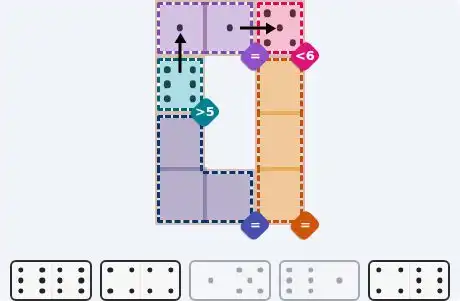
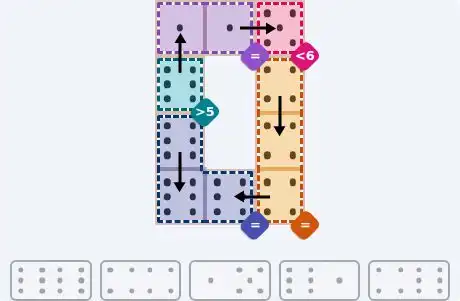
Teal greater 5 on the left edge can only be 6, and its only neighbour is the purple pair's left cell, so the 6/1 tile stands vertically — 6 below in teal, 1 above in purple. Purple then matches at 1, so the 1/5 tile lies flat across the top, 1 in purple, 5 in the pink corner. The 6/6 double stands vertically in the blue equals block, 6 in its top-left cell and 6 in its bottom-left cell. Blue's last cell takes the 6 of the 4/6 tile lying flat — 6 left in blue, 4 right in the orange column's bottom cell — and the 4/4 double stands vertically in orange's top two cells, 4 up and 4 down.
💡 Sums, and two of them stand alone
Everything on this grid is a sum constraint. Two of those sums sit in single cells — one in the top-left corner, one partway down the left-hand column — and a single-cell sum tells you its value outright with no arithmetic at all. That is your launch point.
💡 The corner and the left column
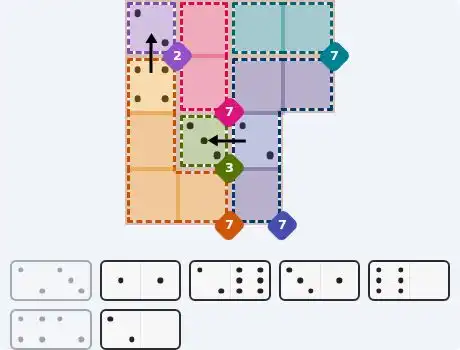
The purple sum 2 in the top-left corner has only one neighbour, the orange block's top-left cell, so its tile must stand vertically and drop its partner straight into orange. The green sum 3 further down the left side is the second pin, handing a partner into the blue block. Both give you a value for free before you count anything.
💡 Complete layout
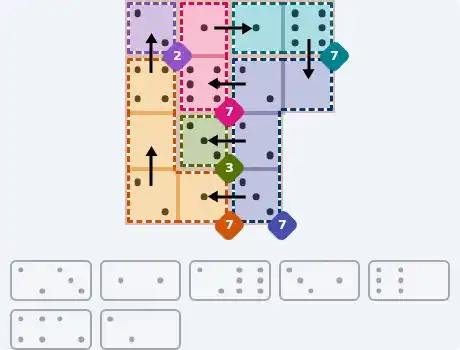
Purple sum 2 takes the top of the 4/2 tile, which stands vertically with 4 below in the orange block's top-left cell. Green sum 3 takes the 3 of the 2/3 tile lying flat, its 2 slipping into blue's middle-left cell. Pink's vertical pair must reach 7 and the tray holds no 5, so the 1/1 double lies flat across the top: 1 in pink's upper cell, 1 in the teal pair's left cell. Pink's lower cell then takes the 6 of the 2/6 tile, whose 2 goes into blue's top-left cell. Teal's right cell takes the 6 of the 6/0 tile, 0 dropping into blue's top-right cell. Blue's bottom-left cell takes the 3 of the 3/1 tile lying flat, 1 going left into orange's bottom-right cell, and the 2/0 tile stands vertically in orange — 0 in the middle-left cell, 2 below in the bottom-left cell.
💡 Read the constraint types first
Almost every region today is a sum, with a couple of comparison cells mixed in — and the zero targets are the loudest thing on the board. A region asking for 0 never has more than one answer, so hunt those down first, then find the sum that can only be met one way.
💡 The column that can only be sixes
The teal sum 18 column on the upper-left side is your anchor: three cells, and 18 is the highest total the game allows, so every one of them has to be 6. Once that column is settled the board opens up — the blue equals pair in the bottom-right corner and the green sum 0 pair nearby both take matching values.
💡 The zero corner and the top run
The purple sum 0 in the top-left corner reads 0, and the tile that leaves it lies flat — its partner, a 2, becomes the leftmost cell of the pink sum 14 run along the top. Pink now needs 12 more over three cells; two of them are the tray's double 5s lying flat at the run's right end, so the cell between them is a 2 as well, arriving from the tile that stands vertically down into the teal column.
💡 Both top columns close
Teal's 18 completes with the 6/6 double standing vertically through its middle and bottom cells, while the top-right corner gives you the blue sum 1 cell as a 1: the 1/6 tile lies flat, 1 right in blue and 6 left as the top cell of the orange sum 14 column, which then finishes with the 4/4 double standing vertically below.
💡 Complete layout
Top-left purple sum 0 is 0, with the 2/0 tile lying flat — 0 left, 2 right in the pink run's leftmost cell. Pink's run reads 2, 2, 5, 5: the middle cell's 2 comes from the 2/6 tile standing vertically (its 6 drops into teal), and the 5/5 double lies flat across the run's two rightmost cells. Teal sum 18: 6 at the top from the 2/6 tile, then the 6/6 double standing vertically through the middle and bottom cells. Orange sum 14 on the right: 6 at the top from the 1/6 tile (lying flat, 1 into the blue sum 1 cell beside it), then the 4/4 double standing vertically through its middle and bottom cells. Green sum 12 run: the 4/6 tile stands vertically, 6 up in its left cell and 4 down in the teal sum 4 cell below, while the 3/3 double lies flat across its middle and right cells. Purple less 3 on the left edge reads 2, the upper half of the 5/2 tile, which stands vertically with 5 below as the top cell of the orange sum 9 pair; the 4/0 tile stands vertically under it — 4 in the pair's lower cell, 0 down in the left cell of the pink sum 0 pair at the bottom-left, whose right cell takes the 0 from the 5/0 tile lying flat (5 into the teal sum 10 pair). The pink sum 0 cell in the centre of the board is 0, upper half of the 0/3 tile standing vertically, which puts 3 in the top cell of the blue sum 6 pair; the 5/3 tile stands vertically with 3 in that pair's lower cell and 5 in the right cell of the teal sum 10 pair. The green sum 0 pair takes the 0/0 double standing vertically, 0 up and 0 down, and the 0/1 tile lies flat with 0 in the pair's upper cell and 1 in the purple greater 0 cell to the right. The orange sum 0 cell at the bottom-right is 0, and the blue equals pair takes the 2/2 double lying flat, 2 in each cell.

🎨 Pips Solver

Sep 25, 2026

Click a domino to place it on the board. You can also click the board, and the correct domino will appear.
Final Answer & Complete Solution For Hard Level

The key to solving today's hard puzzle was identifying the placement for the critical dominoes highlighted in the starting grid. Once those were in place, the rest of the puzzle could be solved logically. See the final grid below to compare your solution.

Starting Position & Key First Steps
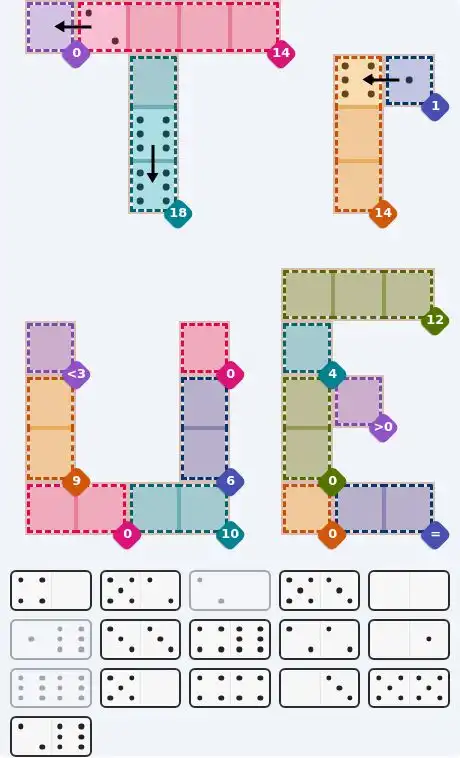
Pips hint for Sept 25, 2026 – hard level puzzle grid with critical first placements and strategy

This image shows the initial puzzle grid for the hard level, with a few critical first placements highlighted.

Final Answer: The Solved Grid for Hard Mode
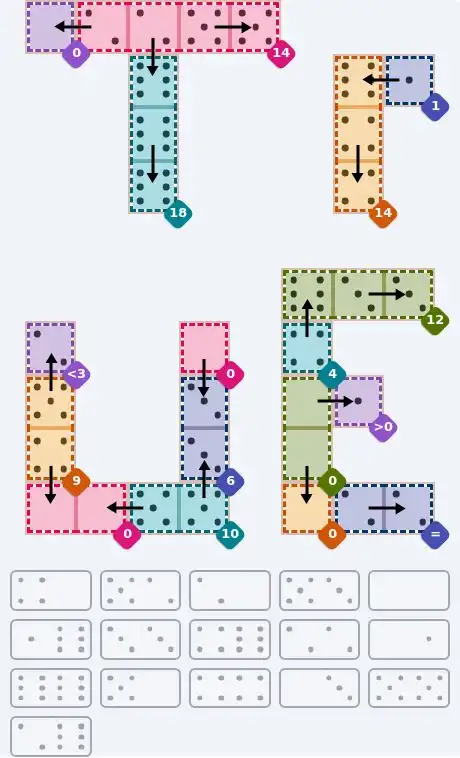
NYT Pips Sept 25, 2026 hard puzzle full solution grid showing final answer with hints

Compare this final grid with your own solution to see the correct placement of all dominoes.

🔧 Step-by-Step Answer Walkthrough For Easy Level

1
Step 1: Teal's floor becomes a ceiling
The teal greater 5 cell on the left edge must hold a value above 5, and 6 is the only one the game allows. Teal's only neighbour is the purple pair's left cell, so the 6/1 tile stands vertically there: 6 below in teal, 1 above in purple.
2
Step 2: Purple matches, pink gets capped
Purple is an equals region, so with one cell reading 1 the other must too. The tile that reaches purple's right cell also covers the pink cell beside it, and pink has to stay under 6. The 6/1 tile is already used, so the only tile that can carry a 1 into purple is the 1/5: it lies flat, 1 in purple, 5 in the pink corner.
3
Step 3: Blue takes the double sixes
Blue is an equals block of three cells, and only two tiles left in the tray carry matching values. The 6/6 double stands vertically in blue's left column — 6 in the top-left cell, 6 in the bottom-left cell — which leaves blue's third cell still wanting a 6.
4
Step 4: Orange closes with matching fours
The 4/6 tile is the only one that can finish blue's third cell, so it lies flat: 6 into blue's bottom-right cell, 4 right into the bottom cell of the orange column. Orange is an equals region too, so its top two cells must both read 4 — the 4/4 double stands vertically through them, 4 up and 4 down, and the grid is complete.

🔧 Step-by-Step Answer Walkthrough For Medium Level

1
Step 1: The purple corner gives itself away
A single-cell sum of 2 in the top-left corner reads 2 with no work at all. That corner cell has only one neighbour, the orange block's top-left cell, so the tile there must stand vertically — the 4/2 tile, 2 up in purple and 4 down in orange.
2
Step 2: Green pins the blue block
The green sum 3 down the left side is a single cell, so it reads 3. The 2/3 tile lies flat across the boundary between the green cell and the blue block: 3 in green, 2 in the blue block's middle-left cell.
3
Step 3: No fives, so the pairs are 1 and 6
Pink's vertical pair and teal's horizontal pair both have to total 7, and the tray contains no 5 at all — so each pair is a 1 joined to a 6. The 1/1 double lies flat across the top edge, 1 in pink's upper cell and 1 in the teal pair's left cell, and pink's lower cell then takes the 6 from the 2/6 tile, whose 2 slips into blue's top-left cell.
4
Step 4: Teal completes at seven
Teal already holds a 1, so its right cell needs a 6. The 6/0 tile stands vertically there: 6 in teal's right cell, 0 dropping down into blue's top-right cell.
5
Step 5: The last two tiles finish both blocks
Blue is sitting on 4 with one cell left, so the 3/1 tile lies flat beneath it: 3 in blue's bottom-left cell to complete the 7, 1 left in orange's bottom-right cell. Orange then needs 0 and 2 from its two remaining cells, and the 2/0 tile stands vertically in that column — 0 in the middle-left cell, 2 below in the bottom-left cell — bringing orange to exactly 7.

🔧 Step-by-Step Answer Walkthrough For Hard Level

1
Step 1: The 18 column
The teal sum 18 column in the upper-left area is the tightest thing on the board: three cells, and 18 is the largest total three pips can produce, so every cell is a 6. Two of them arrive as the 6/6 double standing vertically through the middle and bottom cells; the top cell's 6 comes from the 2/6 tile standing vertically, with its 2 landing in the pink run above.
2
Step 2: The zero corner and the top run
The purple sum 0 in the top-left corner is a 0, and the tile leaving it lies flat: the 2/0 gives 0 in purple and 2 as the leftmost cell of the pink sum 14 run. Pink needs 12 more across three cells, and the 5/5 double lies flat across the run's two rightmost cells, so the cell between them is the 2 already promised by the 2/6 tile.
3
Step 3: Both top columns close
The top-right corner is where the blue sum 1 cell sits, so it reads 1 — the 1/6 tile lies flat, 1 in blue and 6 as the top cell of the orange sum 14 column. Orange needs 8 from its middle and bottom cells, and the 4/4 double standing vertically supplies exactly that, 4 up and 4 down.
4
Step 4: The green run and the teal single
The green sum 12 run on the right needs three cells to total 12, and the 3/3 double lies flat across its middle and right cells — which leaves its left cell as a 6, supplied by the 4/6 tile standing vertically with 4 dropping into the teal sum 4 cell below.
5
Step 5: The left edge and the centre
The purple less 3 cell on the left edge reads 2, the upper half of the 5/2 tile, which stands vertically with 5 below as the top cell of the orange sum 9 pair. The 4/0 tile stands vertically under it: 4 in the pair's lower cell to finish the 9, 0 down in the left cell of the pink sum 0 pair at the bottom-left. In the middle of the board the pink sum 0 cell is 0, the upper half of the 0/3 tile standing vertically, which places a 3 in the top cell of the blue sum 6 pair below.
6
Step 6: The whole bottom band
The blue sum 6 pair finishes with the 3 upper half of the 5/3 tile in its lower cell, 5 going down into the right cell of the teal sum 10 pair. The pink sum 0 pair at the bottom-left takes its second 0 from the 5/0 tile lying flat, 5 going right into the teal pair's left cell so that both cells of the teal pair read 5. The green sum 0 pair takes the 0/0 double standing vertically, 0 up and 0 down, and the 0/1 tile lies flat with 0 in the pair's upper cell and 1 in the purple greater 0 cell to its right. The orange sum 0 cell in the bottom-right is 0, and the blue equals pair takes the 2/2 double lying flat, 2 in each cell.

💡 Pro Tips for Similar Puzzles

Start with Constraints
Always begin with the most constrained regions - sum regions with small numbers or tight spaces.
Use Equal Regions
Use "equal" regions as anchors - they eliminate many possibilities quickly.
Work Systematically
Let the rules guide your placement rather than guessing randomly.
Double-Check
Verify each region's rules are satisfied before moving to the next.

🎓 Keep Learning & Improve