NYT Pips Hints & Answers for May 11, 2026

May 11, 2026

🚨 SPOILER WARNING

This page contains the final **answer** and the complete **solution** to today's NYT Pips puzzle. If you haven't attempted the puzzle yet and want to try solving it yourself first, now's your chance!

Click here to play today's official NYT Pips game first.

Want hints instead? Scroll down for progressive clues that won't spoil the fun.

🎲 Today's Puzzle Overview

In today's NYT Pips, editor Ian Livengood serves a trio that builds from a breezy miniature up to a rich constraint web. Each difficulty has a distinct bottleneck, and knowing where to focus will save you time.

Easy – constructor Ian Livengood delivers a compact warm-up with only four dominoes on a tiny grid. Two isolated empty cells and a less‑10 region (which is never a problem with pips maxing at 6) leave just two tight sum regions to crack. Expect clean, linear deductions with no branching; the bottleneck is the sum‑4 at the bottom‑left.

Medium – Livengood expands the grid and sprinkles in a less‑1 cell that instantly calls for a zero. The real test is a three‑cell sum‑4 region spanning two rows, which forces a cascade through overlapping sums. Once that zero is placed and the sum‑4 web is untangled, the remaining equals and sum‑4 pairs fall easily. This one feels like a gentle but rewarding knot.

Hard – Rodolfo Kurchan constructs a rich field of equals regions, with a five‑cell block, a four‑cell block, and a central five‑cell strip all demanding identical values – forcing early placement of the [3,3], [4,4], and [5,5] doubles. The true wildcard is a rare six‑cell unequal region in the lower right that requires all values be distinct, chaining back into the rest of the board. It’s a tricky but beautifully interconnected solve; the bottleneck is correctly anchoring the equals groups before the unequal region constrains everything else.

💡 Progressive Hints

Try these hints one at a time. Each hint becomes more specific to help you solve it yourself!

💡 Follow the Sums
This tiny grid has only two number‑based restrictions: a sum‑4 and a sum‑10. Start by asking which domino halves can add up to those totals.
💡 Zero in on the Bottom-Left
The sum‑4 region at [1,0] and [2,0] must use a 4 and a 0. Because [1,0] is the upper cell of a vertical pair, it needs the 4, forcing the 0 below.
💡 Full Easy Walkthrough
Place the [3,4] domino vertically in column 0: 3 at [0,0], 4 at [1,0]. That puts the 4 needed for the sum‑4. Next, lay the [0,4] domino horizontally across [2,0] (0) and [2,1] (4) to complete that sum‑4. Now the sum‑10 region at [2,1]–[2,2] already has 4, so [2,2] must be 6; place the [6,6] double vertically in column 2 with 6s at [1,2] and [2,2]. Finally, tuck the [5,2] domino into the top row: 5 at [0,1], 2 at [0,2]. The less‑10 region is effortlessly satisfied.
💡 Where’s the Zero?
A ‘less than 1’ constraint appears – that cell can only be a 0. Find which domino supplies that zero and lock it in.
💡 Anchor the Large Sum-4
The zero at [1,3] forces the [0,6] domino upright into [1,3]=0, [2,3]=6. Then look at the three‑cell sum‑4 (1,0;2,0;2,1); it will need a 1 and a 0 to reach the total.
💡 Complete the Medium Grid
Place the [0,6] domino vertically: [1,3]=0, [2,3]=6. Next, use the [1,0] domino vertically in column 0: [3,0]=1, [2,0]=0. That sets the sum‑4 trio to need a 1 at [1,0] and a 3 at [2,1]. The [2,1] domino goes vertically [1,1]=2, [1,0]=1, then the [3,5] domino fills [2,1]=3, [2,2]=5. The row‑1 sum‑4 pair [1,1],[1,2] already has 2, so [1,2] must be 2; place [4,2] horizontally [0,2]=4, [1,2]=2. Finish the bottom: the equals pair [3,2],[3,3] both become 2. Put the [3,2] domino at [3,1]=3, [3,2]=2, and the [2,0] domino at [3,3]=2, [3,4]=0. All regions resolved.
💡 Embrace the Equals
The board is dominated by large equals regions — each forces every cell inside it to share the same digit. That means only dominoes with two identical pips can fill them. The top‑left five‑cell block is your entry point.
💡 Anchor the Top-Left Block
The equals region covering [0,2],[1,2],[1,3],[1,4],[2,2] must all be the same number. The only double that fits is [3,3]; place it vertically so that 3s sit in [0,2] and [1,2].
💡 Sum‑2 Neighbor Forces Ones
With 3 in the equals block, the adjacent sum‑2 region ([0,3] and [0,4]) is forced to be 1+1. Use the [1,3] domino upright: 1 at [0,3], 3 at [1,3] (satisfying the equals continuation). Then place [1,2] horizontally for [0,4]=1 and [0,5]=2, completing the top ribbon.
💡 Central Five‑Cell Equals
The long central equals strip — cells [2,3],[3,2],[3,3],[4,3],[5,3] — calls for a constant 4. The [4,4] double goes in vertically at [2,3] and [3,3]; that sets all five cells to 4.
💡 Full Hard Cascade
Place the [3,3] domino vertically covering [0,2] and [1,2] (3,3). Next, set the [1,3] domino upright: [0,3]=1, [1,3]=3. The [1,2] domino goes horizontally across [0,4]=1, [0,5]=2. For the central equals, put [4,4] vertical at [2,3],[3,3] (4,4). Now the lower equals block ([4,0],[4,1],[4,2],[5,0]) gets 5s: the [5,5] double covers [4,0],[4,1]; then [5,4] places 5 at [4,2] and 4 at [4,3]; [5,1] gives 5 to [5,0] and 1 to [5,1]. The sum‑3 below ([5,1],[5,2],[6,1]) already has 1, so [5,2] and [6,1] together need 2; use [1,4] for [5,2]=1, [5,3]=4, and [1,6] for [6,1]=1, [6,0]=6 — matching the equals pair [6,0],[7,0] both 6 via the [6,2] domino (6 at [7,0], 2 at [7,1]). Finally, the unequal region demands distinct values: place [6,0] vertically [6,6]=6, [5,6]=0; [4,2] horizontally [4,7]=4, [4,6]=2; [5,3] vertically [6,5]=5, [7,5]=3. Every constraint sings.

🎨 Pips Solver

May 11, 2026

Click a domino to place it on the board. You can also click the board, and the correct domino will appear.
Final Answer & Complete Solution For Hard Level

The key to solving today's hard puzzle was identifying the placement for the critical dominoes highlighted in the starting grid. Once those were in place, the rest of the puzzle could be solved logically. See the final grid below to compare your solution.

Starting Position & Key First Steps
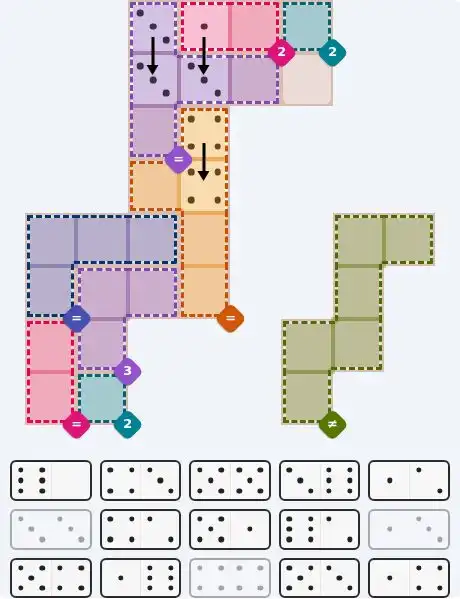
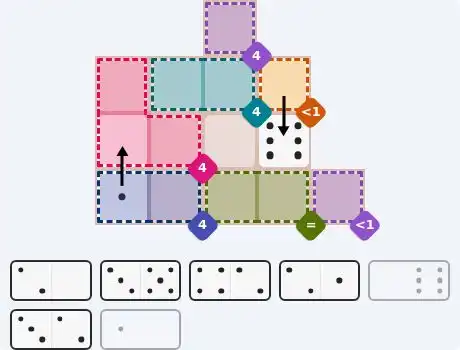
Pips hint for May 11, 2026 – hard level puzzle grid with critical first placements and strategy

This image shows the initial puzzle grid for the hard level, with a few critical first placements highlighted.

Final Answer: The Solved Grid for Hard Mode
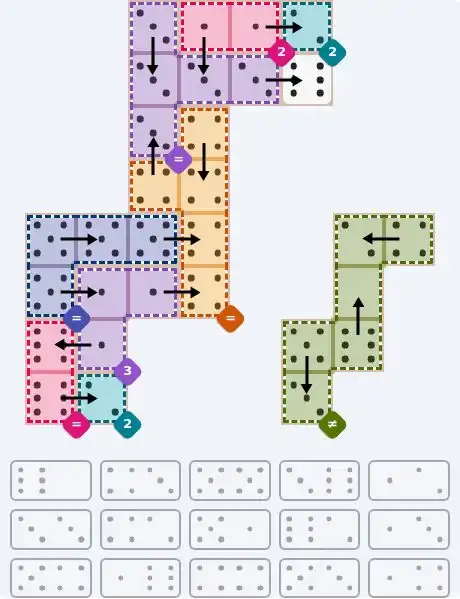
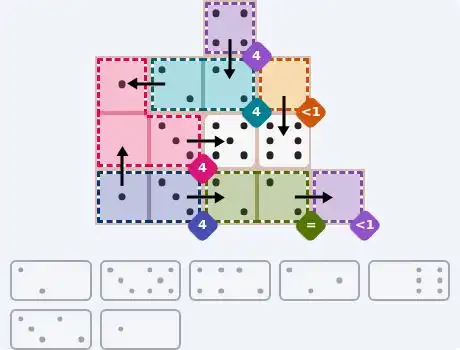
NYT Pips May 11, 2026 hard puzzle full solution grid showing final answer with hints

Compare this final grid with your own solution to see the correct placement of all dominoes.

🔧 Step-by-Step Answer Walkthrough For Easy Level

1
Step 1: Pin Down the Sum-4
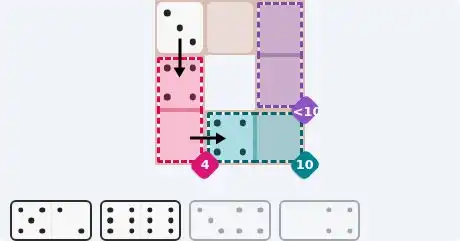
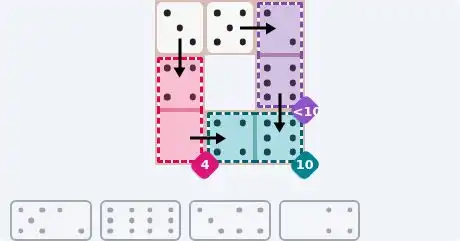
The sum‑4 region at [1,0] and [2,0] can only be made from 4+0, 3+1, or 2+2. Given the available dominoes, the only way to supply a 4 to the upper cell [1,0] is by placing the [3,4] domino vertically so that its 4 half touches [1,0] and its 3 half occupies [0,0].
2
Step 2: Complete the Sum-4 with Zero
With [1,0]=4, [2,0] must be 0. The [0,4] domino is the only source of a second zero‑ish number; place it horizontally covering [2,0] as 0 and [2,1] as 4. Now the sum‑4 is satisfied and [2,1]=4 is set.
3
Step 3: Hit the Sum-10
The sum‑10 region holds [2,1] (already 4) and [2,2]. To reach 10, [2,2] must be 6. The [6,6] double fits perfectly; place it vertically so that 6s land in [1,2] and [2,2].
4
Step 4: Tidy the Top Row
The only remaining cells are [0,1] and [0,2], and the last domino is [5,2]. Place it horizontally: 5 at [0,1] and 2 at [0,2]. All constraints, including the less‑10 region (2 and 6), are effortlessly met.

🔧 Step-by-Step Answer Walkthrough For Medium Level

1
Step 1: Force the Zero Cell
The ‘less than 1’ region at [1,3] leaves no choice — it must be 0. The domino with a 0 and a 6, [0,6], is the natural fit. Place it vertically so that [1,3]=0 and the 6 goes to [2,3].
2
Step 2: Start the Large Sum-4
The three‑cell sum‑4 covering [1,0], [2,0], and [2,1] needs a low total. Use the [1,0] domino vertically in column 0: put the 1 at [3,0] and the 0 at [2,0]. Now we have [2,0]=0, and the sum‑4 still demands [1,0]+[2,1]=4.
3
Step 3: Resolve the Sum-4 Trio
[1,0] must be 1 and [2,1] must be 3 to hit the sum‑4. The [2,1] domino (pips 2 and 1) placed vertically gives [1,1]=2 and [1,0]=1. Then the [3,5] domino, placed horizontally, fills [2,1]=3 and [2,2]=5, satisfying the sum‑4.
4
Step 4: Pair the Row‑1 Sum-4
The sum‑4 region at [1,1] and [1,2] already has [1,1]=2, so [1,2] must also be 2. The [4,2] domino goes horizontally from the lone top cell [0,2]=4 to [1,2]=2, completing that constraint.
5
Step 5: Finish the Bottom Tier
The equals pair [3,2] and [3,3] must match. The [3,2] domino placed horizontally sets [3,1]=3 and [3,2]=2, so [3,3] needs a 2. Use the [2,0] domino horizontally for [3,3]=2 and [3,4]=0. The sum‑4 region [3,0]+[3,1] (1+3) works perfectly, and the grid is complete.

🔧 Step-by-Step Answer Walkthrough For Hard Level

1
Step 1: Anchor the Top‑Left Equals
The five‑cell equals region (cells [0,2],[1,2],[1,3],[1,4],[2,2]) requires all cells to hold the same number. The only double that can supply this is [3,3]. Place it vertically, setting [0,2]=3 and [1,2]=3; now all those cells are locked at 3.
2
Step 2: Satisfy the Neighboring Sum‑2
The sum‑2 region next door ([0,3] and [0,4]) must total 2. With 3 already used, the only combination that fits is 1+1. The [1,3] domino, containing a 1 and a 3, goes upright: 1 at [0,3] and 3 at [1,3], extending the equals region and fulfilling the sum‑2.
3
Step 3: Finish the Top Row
The isolated sum‑2 cell [0,5] must be exactly 2. The [1,2] domino provides that 2 and also supplies the needed 1 for [0,4] — place it horizontally across [0,4]=1 and [0,5]=2. The top ribbon is now fully determined.
4
Step 4: Set the Central Equals Strip
A second large equals region spans [2,3],[3,2],[3,3],[4,3],[5,3]. It demands a constant value; the double [4,4] fits. Place it vertically with 4 at [2,3] and [3,3], turning all five cells to 4.
5
Step 5: Build the Lower Equals Block
The four‑cell equals block ([4,0],[4,1],[4,2],[5,0]) gets locked to 5. Use the [5,5] double to cover [4,0] and [4,1]; then the [5,4] domino puts 5 at [4,2] and 4 at [4,3]; the [5,1] domino gives [5,0]=5 and [5,1]=1. The sum‑3 region ([5,1],[5,2],[6,1]) then forces [5,2] and [6,1] to sum to 2, so place [1,4] for [5,2]=1,[5,3]=4, and [1,6] for [6,1]=1,[6,0]=6. The equals pair [6,0],[7,0] both need 6 — use the [6,2] domino to give [7,0]=6 and [7,1]=2 (the sum‑2 cell at [7,1] automatically becomes 2).
6
Step 6: Resolve the Unequal Region
The six‑cell unequal region [4,6],[4,7],[5,6],[6,5],[6,6],[7,5] requires all distinct digits. The remaining numbers are 0,2,4,5,6,3. Place [6,0] vertically: [6,6]=6, [5,6]=0. Then [4,2] horizontally: [4,7]=4, [4,6]=2. Finally, [5,3] vertically: [6,5]=5, [7,5]=3. All cells are now distinct, and the puzzle collapses into place.

💡 Pro Tips for Similar Puzzles

Start with Constraints
Always begin with the most constrained regions - sum regions with small numbers or tight spaces.
Use Equal Regions
Use "equal" regions as anchors - they eliminate many possibilities quickly.
Work Systematically
Let the rules guide your placement rather than guessing randomly.
Double-Check
Verify each region's rules are satisfied before moving to the next.

🎓 Keep Learning & Improve