NYT Pips Hints & Answers for May 14, 2026

May 14, 2026

🚨 SPOILER WARNING

This page contains the final **answer** and the complete **solution** to today's NYT Pips puzzle. If you haven't attempted the puzzle yet and want to try solving it yourself first, now's your chance!

Click here to play today's official NYT Pips game first.

Want hints instead? Scroll down for progressive clues that won't spoil the fun.

🎲 Today's Puzzle Overview

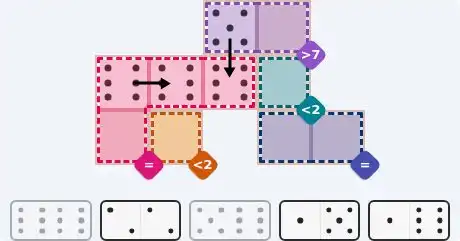
Ian Livengood designs today's easy puzzle with a compact, interlocking architecture. The grid is a tight 3×5 canvas where a four‑cell equals region immediately demands a large supply of matching pips. The only way to satisfy it is by deploying every available six across three different dominos, creating a satisfying lock that then cascades outward. Combined with a greater‑than‑7 sum constraint and two strict less‑2 cells, the solve becomes a precise dance of elimination—vintage Livengood.

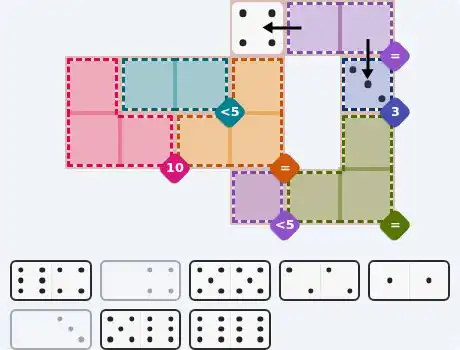
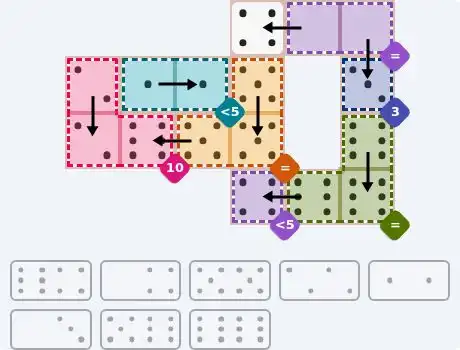
In the medium, Livengood expands the canvas and explores constraint interplay with a lighter touch. The top‑right corner houses an equals pair that forces a zero across both cells, neatly tying into a sum‑3 singleton directly below. Around that anchor, a sum‑10 region on the left side and a less‑5 pair in the middle push solvers to partition the remaining high‑value dominos with care. The structural elegance lies in how the empty cell at [0,3] acts as a buffer, enabling multiple constraints to resolve simultaneously without contradiction.

Rodolfo Kurchan's hard puzzle transforms tonight's NYT Pips into a constraints‑dense arena. His signature move is the sum‑1 single‑cell region at the top right, which fixes an entire domino the instant you spot it. From there, sum‑10, greater‑than‑10, and equals regions radiate across the grid in a domino effect that feels less like guessing and more like reading a blueprint. Kurchan leverages single‑cell sum‑6 and sum‑1 constraints in the lower half to lock the bottom row early, showcasing how a few well‑placed atomic regions can tame a sprawling layout.

💡 Progressive Hints

Try these hints one at a time. Each hint becomes more specific to help you solve it yourself!

💡 Hint 1: Equal footing
Scan the board for the largest region where every cell must show the same pip value. What available domino could supply that many identical numbers?
💡 Hint 2: Six appeal
The four‑cell equals region occupies [1,0], [1,1], [1,2], and [2,0]. Only the pip value 6 appears enough times across your dominos to fill it. You'll need the double‑six and both remaining six‑bearing pieces.
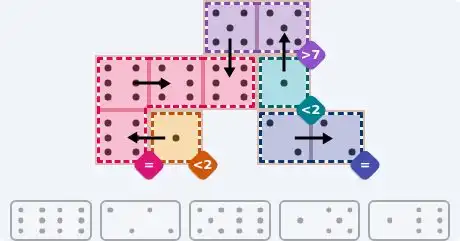
💡 Hint 3: Final placements
Place [6,6] on [1,0]-[1,1]; then [5,6] on [0,2]-[1,2] (satisfying the greater‑7 region on [0,2]-[0,3] with a 5+5 sum); next [1,6] on [2,1]-[2,0] fills the last equals cell and gives [2,1]=1. The double‑2 [2,2] goes to [2,3]-[2,4] for the other equals region, and the remaining [1,5] covers [1,3]-[0,3] to wrap the less‑2 singletons.
💡 Hint 1: Equal zeros
Search for a region that forces two cells to match exactly, located near the top‑right corner. Its domino will pull double duty with a tiny sum constraint just below.
💡 Hint 2: The 0-club
The equals region on [0,4] and [0,5] needs two zeros. Place the [0,4] domino at [0,4]-[0,3] to give [0,4]=0 and the empty cell a 4. Then the [0,3] domino must run vertically from [0,5] to [1,5], setting [0,5]=0 and [1,5]=3—the latter satisfies the sum‑3 single‑cell region on the same spot.
💡 Hint 3: Complete the solve
Now lock the left side: the sum‑10 region [1,0],[2,0],[2,1] needs a total of 10—use [2,2] at [1,0]-[2,0] for two 2s, then [5,6] horizontally at [2,2]-[2,1] with 5 at [2,2] and 6 at [2,1] (sum=10). The less‑5 pair [1,1]-[1,2] takes [1,1] for two 1s. The equals region [1,3],[2,2],[2,3] must all be 5; you already have 5 at [2,2], so place [5,5] vertically at [1,3]-[2,3]. Finish with [6,4] at [3,4]-[3,3] (6,4) and [6,6] vertically at [2,5]-[3,5] for the final equals region.
💡 Hint 1: The loneliest sum
Your starting point is a region that contains only one cell and demands a sum of exactly 1. That cell must be a 1, and the domino covering it will define the right edge.
💡 Hint 2: Right side anchor
Cell [0,6] is the sum‑1 region. The only way to cover it with a 1 while keeping the grid connected is to use the [5,1] domino placed horizontally over [0,6]-[1,6]. This puts a 5 at [1,6], which triggers the adjacent sum‑10 region.
💡 Hint 3: Sum‑10 and empty
The sum‑10 region [1,6],[2,6] now holds a 5; it needs another 5 to hit 10. Place the [6,5] domino vertically from [3,6] (empty region) to [2,6], setting [3,6]=6 and [2,6]=5. The right‑side structure is now stable.
💡 Hint 4: Equals on row 2
Shift to the middle left: the equals region at [2,3]-[2,4] needs two identical pips. The only double remaining that fits is [4,4]; place it horizontally. Then tackle the sum‑1 at [4,1] with [6,1] vertical ([3,1]-[4,1]), giving [4,1]=1 and [3,1]=6, which fulfills the greater‑10 region with [2,1] needing 5.
💡 Hint 5: Full solve
Continue: [5,4] horizontally at [2,1]-[1,1] (5,4) completes greater‑10 and sum‑7 on [0,1]-[1,1]. The less‑3 [0,0] gets 1 from [1,3] at [0,0]-[0,1] (1,3) to make sum‑7 work. The equals pair [6,4]-[7,4] is satisfied by [2,0] at [5,4]-[6,4] (2,0) and [0,5] at [7,4]-[7,5] (0,5) with the 5 feeding sum‑10 below. Then [5,5] at [8,4]-[9,4] for the last sum‑10, [3,5] at [8,6]-[7,6] for equals, and [2,6] at [6,2]-[6,1] (2,6) to fix sum‑6 and less‑3. Finish with [4,3] at [8,1]-[8,2] (4,3) sum‑7 and the remaining placements.

🎨 Pips Solver

May 14, 2026

Click a domino to place it on the board. You can also click the board, and the correct domino will appear.
Final Answer & Complete Solution For Hard Level

The key to solving today's hard puzzle was identifying the placement for the critical dominoes highlighted in the starting grid. Once those were in place, the rest of the puzzle could be solved logically. See the final grid below to compare your solution.

Starting Position & Key First Steps
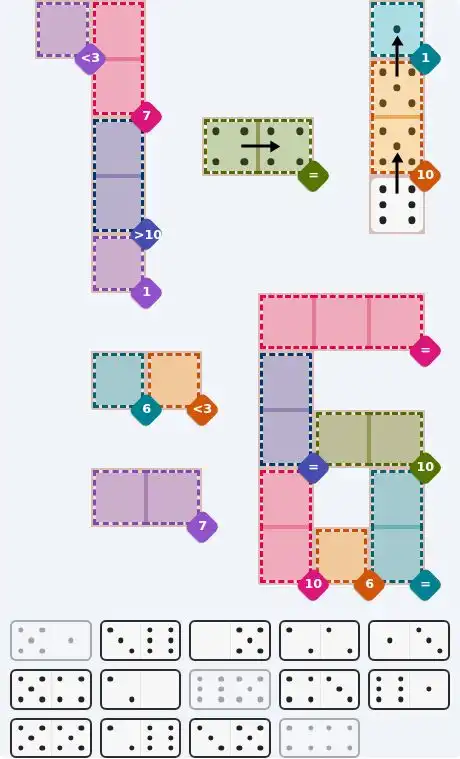
Pips hint for May 14, 2026 – hard level puzzle grid with critical first placements and strategy

This image shows the initial puzzle grid for the hard level, with a few critical first placements highlighted.

Final Answer: The Solved Grid for Hard Mode
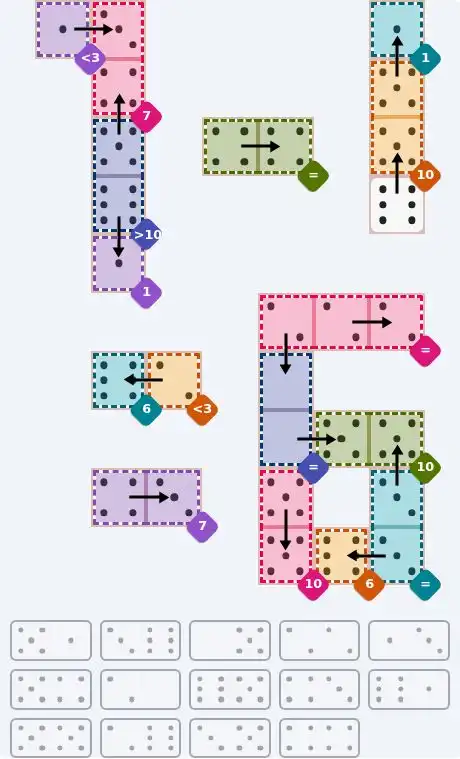
NYT Pips May 14, 2026 hard puzzle full solution grid showing final answer with hints

Compare this final grid with your own solution to see the correct placement of all dominoes.

🔧 Step-by-Step Answer Walkthrough For Easy Level

1
Step 1: The big equals
The four‑cell equals region spanning [1,0], [1,1], [1,2], and [2,0] must all display the same number. Look at your five dominos: only the pip 6 appears enough times—you own a double‑six and two other pieces containing a 6. Thus every cell in this region must be a 6. Place the double‑six [6,6] on the two cells [1,0] and [1,1] to start.
2
Step 2: Supply the remaining sixes
To fill the other two equals cells you need a 6 in [1,2] and a 6 in [2,0]. The domino [5,6] is the only way to put a 6 in [1,2]; set it horizontally at [0,2]-[1,2] with the 6 on [1,2] and the 5 on [0,2]. Then the [1,6] domino goes over [2,1]-[2,0] with the 6 on [2,0] and the 1 on [2,1], which automatically satisfies the less‑2 constraint on [2,1] (1 < 2).
3
Step 3: Greater‑7 and the remaining less‑2
The greater‑7 region consists of [0,2] (already 5) and [0,3]. To exceed a sum of 7, [0,3] must be at least 3, but the only remaining domino with a 5 is [1,5] (the double‑2 is your other unused). Place [1,5] vertically at [1,3]-[0,3]; this sets [0,3]=5 giving a sum of 10 > 7, and [1,3]=1, which satisfies the less‑2 region on [1,3].
4
Step 4: Clean up with doubles
The only cells left are [2,3] and [2,4] in an equals region. The unused [2,2] double‑two domino fits perfectly, completing the puzzle with two 2s.

🔧 Step-by-Step Answer Walkthrough For Medium Level

1
Step 1: Corner equals forces zeros
The equals region on [0,4] and [0,5] requires both cells to be identical. The [0,4] domino, which carries a 0 and a 4, must be placed with its 0 on [0,4]; put it horizontally at [0,4]-[0,3], giving [0,3]=4 in an empty region and [0,4]=0. Now [0,5] must also be 0. The only remaining domino with a 0 is [0,3], so place it vertically from [0,5] to [1,5], setting [0,5]=0 and [1,5]=3.
2
Step 2: Sum‑3 checklist
Cell [1,5] is a sum‑3 region all by itself, and it now holds a 3—constraint satisfied. This vertical domino has locked the top‑right corner, and the 0‑equals is resolved.
3
Step 3: The sum‑10 lumberyard
Turn to the left side. The sum‑10 region covers [1,0], [2,0], and [2,1]. Place the [2,2] double‑two vertically at [1,0]-[2,0] to give two 2s (sum 4 so far). Then the [5,6] domino fits horizontally at [2,2]-[2,1] with its 6 on [2,1] and 5 on [2,2]; now the region totals 2+2+6=10 exactly.
4
Step 4: Less‑5 and the equals‑5 chain
The less‑5 region on [1,1]-[1,2] can only accept numbers under 5. The [1,1] double‑one domino is perfect, placed horizontally to set both cells to 1. Now examine the equals region [1,3], [2,2], [2,3]. You already have a 5 at [2,2] from the previous step. Thus all three must be 5; take the [5,5] double‑five and place it vertically at [1,3]-[2,3] to extend the 5s.
5
Step 5: Right‑side finals
Two regions remain. The equals region [2,5], [3,4], [3,5] will be all 6s. Place [6,6] vertically at [2,5]-[3,5] for two 6s, then [6,4] horizontally at [3,4]-[3,3] (with 6 on [3,4] and 4 on [3,3])—the [3,3] cell is in a less‑5 region, and 4 fits. Puzzle complete.

🔧 Step-by-Step Answer Walkthrough For Hard Level

1
Step 1: Single‑cell sum‑1
Cell [0,6] is a sum‑1 region, meaning its pip must be exactly 1. The only available domino with a 1 that can cover [0,6] while fitting the adjacent cell [1,6] is [5,1]. Place it horizontally with 1 at [0,6] and 5 at [1,6]. Now [1,6] becomes part of the sum‑10 region below.
2
Step 2: Fulfilling sum‑10 on column 6
The sum‑10 region consists of [1,6] (currently 5) and [2,6]. To reach 10, [2,6] must also be 5. The [6,5] domino can supply a 5; place it vertically with 5 at [2,6] and 6 at the empty region cell [3,6]. The right‑most column is now complete.
3
Step 3: Equals pair on row 2
The equals region at [2,3] and [2,4] needs two identical numbers. The only unused double is [4,4]; place it horizontally to give both cells 4. This stabilizes the middle of the board.
4
Step 4: Atomic singles ignite the left
Cell [4,1] is a sum‑1 region and must be a 1. Use the [6,1] domino vertically with 1 at [4,1] and 6 at [3,1]. Immediately, the greater‑10 region on [2,1]-[3,1] is activated: with [3,1]=6, [2,1] must be at least 5 (sum >10). The [5,4] domino placed horizontally at [2,1]-[1,1] gives [2,1]=5 and [1,1]=4, which also satisfies the sum‑7 region on [0,1]-[1,1] because [0,1] will need to be 3.
5
Step 5: Top‑left resolution
The less‑3 cell [0,0] and the need for 3 at [0,1] are solved together. Place [1,3] horizontally at [0,0]-[0,1] with 1 at [0,0] (1<3) and 3 at [0,1]. Now the sum‑7 region [0,1]+[1,1] hits 3+4=7, and the top row's left side is done.
6
Step 6: Bottom‑row propagation
The equals region [6,4]-[7,4] demands two zeros. Use [2,0] horizontally at [5,4]-[6,4] to put 2 on [5,4] and 0 on [6,4]. Then place [0,5] horizontally at [7,4]-[7,5] to put 0 on [7,4] (joining the equals) and 5 on [7,5]. The sum‑10 region [7,5]-[7,6] now has a 5; add [3,5] vertically at [8,6]-[7,6] with 5 at [7,6] and 3 at [8,6]—the [8,6]-[9,6] equals region then forces [9,6]=3 from the same piece? Wait, [9,6] must match [8,6], so use [3,6] for that: place [3,6] vertically at [9,6]-[9,5] to put 3 at [9,6] and 6 at [9,5], satisfying the sum‑6 region on [9,5]. Final steps: [5,5] goes to [8,4]-[9,4] (sum‑10 with 5+5), [2,6] to [6,2]-[6,1] (2 on [6,2] for less‑3, 6 on [6,1] for sum‑6), and [4,3] to [8,1]-[8,2] (4+3 sum‑7). All constraints met.

💡 Pro Tips for Similar Puzzles

Start with Constraints
Always begin with the most constrained regions - sum regions with small numbers or tight spaces.
Use Equal Regions
Use "equal" regions as anchors - they eliminate many possibilities quickly.
Work Systematically
Let the rules guide your placement rather than guessing randomly.
Double-Check
Verify each region's rules are satisfied before moving to the next.

🎓 Keep Learning & Improve