NYT Pips Hints & Answers for June 26, 2026

Jun 26, 2026

๐Ÿšจ SPOILER WARNING

This page contains the final **answer** and the complete **solution** to today's NYT Pips puzzle. If you haven't attempted the puzzle yet and want to try solving it yourself first, now's your chance!

Click here to play today's official NYT Pips game first.

Want hints instead? Scroll down for progressive clues that won't spoil the fun.

SEE ALSO:

๐ŸŽฒ Today's Puzzle Overview

Today's NYT Pips easy, crafted by Ian Livengood, is a study in constraint economy. With only six dominoes and a compact grid, Livengood deploys two equals regions and a pair of less-than-2 strictures to lock every placement into a tight logical chain. The design gracefully avoids any red herrings; each domino's orientation is forced by a single-cell sum or the need to satisfy an equality group. The double-equals anchor at the top-right and a mirrored pair at the bottom make the puzzle feel symmetrical and elegant, guiding solvers with a rhythmic, deductive flow.

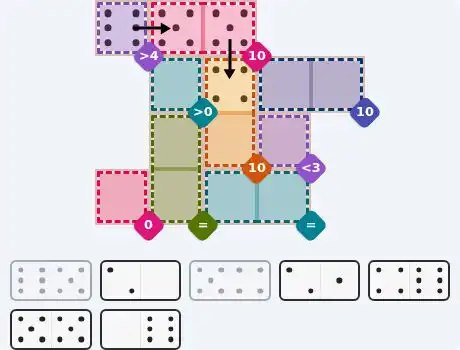
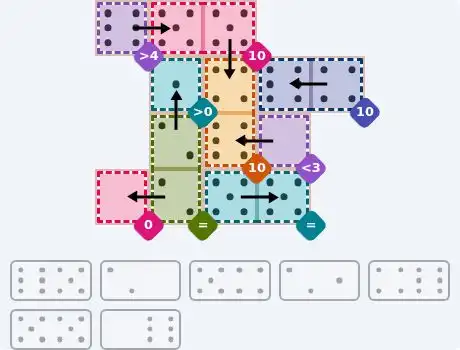
Rodolfo Kurchan's medium offering raises the complexity with overlapping sum-10 regions that weave through the center of the grid. The puzzle opens with a greater-than-4 cell that immediately claims the [6,5] domino, setting off a cascade of sum-10 requirements that pull in the [5,4] and [4,6] dominoes. Kurchan's signature lies in how he uses an equals pair at [3,2]/[3,3] to force a double-five domino, cleverly decoupling the sum groups. The result is a puzzle that feels expansive yet tightly interlocked, rewarding solvers who trace the numeric dependencies from corner to center.

For the hard puzzle, Kurchan scales up to a larger grid with a rich web of sum, greater-than, and less-than constraints. The stand-out feature is a triple-equals region on the far right that mandates three cells to hold the identical valueโ€”ultimately zeroโ€”anchoring an entire column. Above, a sum-15 chain across three rows combines with a sum-13 triplet to define the upper-right quadrant. Kurchan artfully nestles a sum-2 pair and a sum-7 pair amid a forest of less-than caps, creating a solve path that rewards systematic region scanning. The design demonstrates how a few broad-stroke constraints can orchestrate a full-grid domino ballet.

๐Ÿ’ก Progressive Hints

Try these hints one at a time. Each hint becomes more specific to help you solve it yourself!

๐Ÿ’ก Hint 1: Spot the equalizers
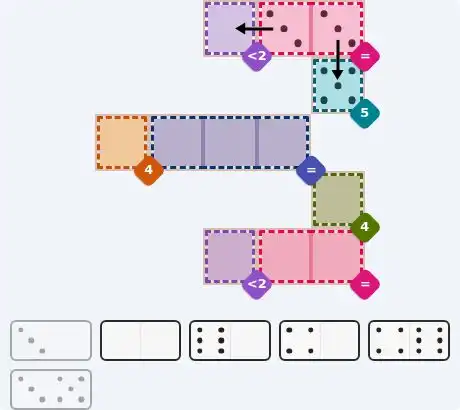
Start by scanning for equals regionsโ€”these require all cells in the group to hold the same value. Also note the two less-than-2 cells, which severely restrict what can appear there.
๐Ÿ’ก Hint 2: Focus on the top-right sum and equals
The sum-4 cell at [2,0] pairs with the equals group at [2,1]-[2,3] to force a specific domino placement. Similarly, the equals pair at [0,3]/[0,4] interacts with the sum-5 at [1,4].
๐Ÿ’ก Hint 3: Complete solution
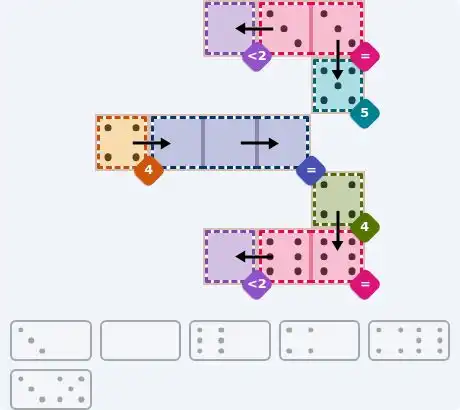
Place the [3,0] domino with 3 at [0,3] and 0 at the less-than-2 [0,2]. The [0,0] domino fills the equals region [2,2]/[2,3] as 0 and 0. Use [4,0] to put 4 in sum-4 [2,0] and 0 at [2,1]. The [6,0] domino gives 6 at [4,3] (equal to [4,4]) and 0 at [4,2] (less than 2). Then [4,6] places 4 in sum-4 [3,4] and 6 in [4,4]. Finally, [3,5] splits with 3 at [0,4] and 5 at sum-5 [1,4].
๐Ÿ’ก Hint 1: Chase the large sums
Focus on sum-10 regions and the greater-than-4 starter. These high-sum groups often demand the largest available dominoes.
๐Ÿ’ก Hint 2: Pin down the opening corner
The greater-than-4 cell at [0,0] must be 5 or 6, and the adjacent sum-10 region at [0,1]/[0,2] will consume two numbers that add to 10. Also, check the equals pair at [3,1] and the less-than-3 at [2,3] for restrictions.
๐Ÿ’ก Hint 3: Complete solution
Place [6,5] as 6 at [0,0], 5 at [0,1] (sum 10 with [0,2]=5 from [5,4] placed as 5 at [0,2], 4 at [1,2]). Use [2,1] domino for 2 at [2,1] (equals [3,1]=2) and 1 at [1,1] (>0). Place [2,0] as 2 at [3,1], 0 at sum-0 [3,0]. The [5,5] domino fits the equals [3,2]/[3,3] with 5 and 5. Use [4,6] for 4 at [1,4] and 6 at [1,3] (sum 10 with 4+6). Finally, [0,6] places 0 at less-than-3 [2,3] and 6 at [2,2] (completing sum 10 with [1,2]=4).
๐Ÿ’ก Hint 1: Zero in on the anchors
Look for the sum-0 cellsโ€”they force the value 0 immediately. Also, the large sum-15 and sum-13 groups will demand the highest numbers, while the triple-equals region on the right will lock down an entire column.
๐Ÿ’ก Hint 2: Corner forces and zero clusters
The sum-0 at [3,2] and [3,4] both require zeros. The sum-1 at [0,6] forces a domino with a 1 in that cell. The greater-than-4 at [3,0] and greater-than-3 at [2,0] strongly suggest the [4,6] domino for that column.
๐Ÿ’ก Hint 3: Build the right-side chains
Place [1,1] domino at [0,6]/[1,6] to satisfy sum-1 and kick off sum-13. The [4,6] domino goes to [2,0]/[3,0] (4>3, 6>4). Now [0,0] domino fills two cells of the triple-equals at [4,7]/[5,7] (both 0). Next, the sum-0 at [3,2] takes the 0 from [0,1] domino, placing 0 at [3,2] and 1 at [2,2] (part of sum-7).
๐Ÿ’ก Hint 4: Tackle the top-left and lower sums
The [2,3] domino places 2 at [0,0] (>1) and 3 at [1,0] (>2). The [5,2] domino splits 5 at [7,3] (>4) and 2 at [6,3] (sum-2 with 0 from [0,3] later). The [0,3] domino gives 0 at [5,3] and 3 at [4,3] (>2). For the sum-15 column, [5,4] puts 5 at [0,4], 4 at [1,4], then [0,6] places 0 at [3,4] (sum-0) and 6 at [2,4] completing 15.
๐Ÿ’ก Hint 5: Full layout revealed
Final placements: [0] [1,1] โ†’ [0,6]=1, [1,6]=1. [1] [4,6] โ†’ [2,0]=4, [3,0]=6. [2] [0,0] โ†’ [4,7]=0, [5,7]=0. [3] [2,3] โ†’ [0,0]=2, [1,0]=3. [4] [0,1] โ†’ [3,2]=0, [2,2]=1. [5] [5,2] โ†’ [7,3]=5, [6,3]=2. [6] [0,3] โ†’ [5,3]=0, [4,3]=3. [7] [5,4] โ†’ [0,4]=5, [1,4]=4. [8] [2,0] โ†’ [5,1]=2, [4,1]=0. [9] [4,1] โ†’ [6,5]=4, [7,5]=1. [10] [6,6] โ†’ [2,6]=6, [3,6]=6. [11] [4,3] โ†’ [4,5]=4, [5,5]=3. [12] [0,6] โ†’ [3,4]=0, [2,4]=6. [13] [2,2] โ†’ [6,1]=2, [7,1]=2. [14] [5,1] โ†’ [0,2]=5, [1,2]=1. [15] [0,4] โ†’ [6,7]=0, [7,7]=4.

๐ŸŽจ Pips Solver

Jun 26, 2026

Click a domino to place it on the board. You can also click the board, and the correct domino will appear.
โœ… Final Answer & Complete Solution For Hard Level

The key to solving today's hard puzzle was identifying the placement for the critical dominoes highlighted in the starting grid. Once those were in place, the rest of the puzzle could be solved logically. See the final grid below to compare your solution.

Starting Position & Key First Steps
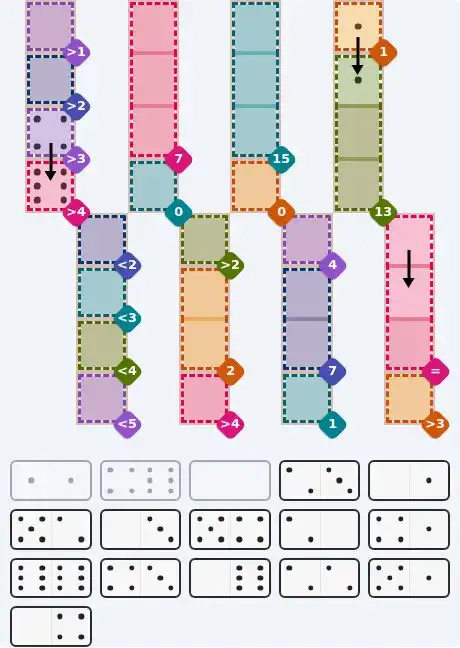
Pips hint for June 26, 2026 โ€“ hard level puzzle grid with critical first placements and strategy

This image shows the initial puzzle grid for the hard level, with a few critical first placements highlighted.

Final Answer: The Solved Grid for Hard Mode
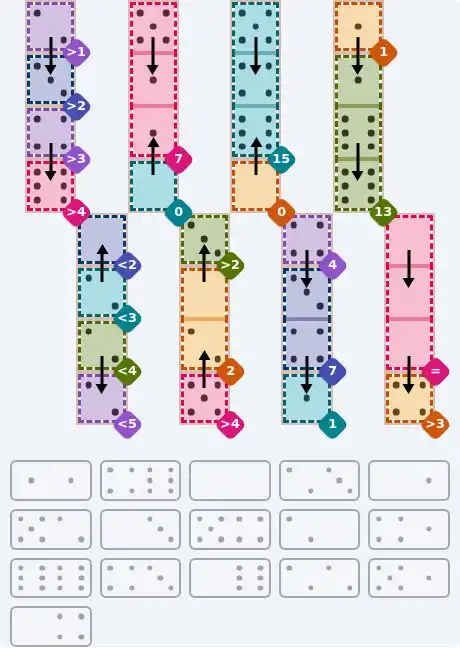
NYT Pips June 26, 2026 hard puzzle full solution grid showing final answer with hints

Compare this final grid with your own solution to see the correct placement of all dominoes.

๐Ÿ”ง Step-by-Step Answer Walkthrough For Easy Level

1
Step 1: Top-right equals and sum-5
The equals region [0,3]/[0,4] requires identical pips. The sum-5 at [1,4] must be exactly 5, so the domino covering [1,4] must contain 5. The only domino with a 5 is [3,5]. Placing it with 5 at [1,4] leaves 3 at [0,4], forcing [0,3] also to be 3 by equals. That matches the [3,0] domino, so place 3 at [0,3] and 0 at the less-than-2 [0,2].
2
Step 2: Central triple equals and sum-4
The equals region [2,1]/[2,2]/[2,3] demands three identical values. The sum-4 at [2,0] needs 4, so the [4,0] domino goes there, placing 4 at [2,0] and 0 at [2,1]. Now [2,2] and [2,3] can both be 0 via the [0,0] domino, completing the triple equals.
3
Step 3: Bottom equals and final sum-4
The equals pair [4,3]/[4,4] needs equal values. The sum-4 at [3,4] requires 4. The [6,0] domino supplies 6 at [4,3] and 0 at the less-than-2 [4,2]. Then [4,6] places 4 at [3,4] and 6 at [4,4], making both bottom equals cells 6.
4
Step 4: Verify all constraints
Less-than-2 cells are 0; sum-5 is 5; sum-4 cells are 4; equals triples are 0; equals bottom are 6. All six dominoes are placed exactly as forced.

๐Ÿ”ง Step-by-Step Answer Walkthrough For Medium Level

1
Step 1: Greater-than-4 start
Cell [0,0] requires >4, so it must be 5 or 6. The [6,5] domino is the only one containing both. Place 6 at [0,0] and 5 at [0,1]. The sum-10 region [0,1]/[0,2] now needs [0,2]=5. The [5,4] domino provides that, with 5 at [0,2] and 4 at [1,2].
2
Step 2: Sum-10 continuation
Region [1,2]/[2,2] sums to 10; [1,2]=4 so [2,2] must be 6. The less-than-3 cell at [2,3] limits that cell to 0โ€“2. The [0,6] domino places 6 at [2,2] and 0 at [2,3], satisfying both.
3
Step 3: Equals and sum-0 column
Equals region [2,1]/[3,1] forces equal values. The [2,1] domino gives 2 at [2,1] and 1 at [1,1] (>0). The sum-0 at [3,0] requires 0, so the [2,0] domino places 2 at [3,1] (matching equals) and 0 at [3,0].
4
Step 4: Right-side sum-10
Region [1,3]/[1,4] must sum to 10. The remaining [4,6] domino fits perfectly: 6 at [1,3] and 4 at [1,4].
5
Step 5: Double-five finish
The equals pair [3,2]/[3,3] requires identical numbers. The only unused domino with a pair is [5,5], giving 5 at both cells. All constraints satisfied.

๐Ÿ”ง Step-by-Step Answer Walkthrough For Hard Level

1
Step 1: Sum-1 and sum-13 seeding
The sum-1 region at [0,6] forces a 1. The [1,1] domino provides that 1 and places the second 1 at [1,6], which joins the sum-13 region that will later receive 6 and 6 from the [6,6] domino.
2
Step 2: Greater-than column on the left
Cell [2,0] requires >3, and [3,0] requires >4. The [4,6] domino supplies 4 and 6, with 4 at [2,0] (>3) and 6 at [3,0] (>4), exactly meeting both.
3
Step 3: Zero clusters and triple-equals start
Sum-0 at [3,2] mandates a 0. The [0,1] domino places 0 there and 1 at [2,2], joining the sum-7 group. The triple-equals [4,7]/[5,7]/[6,7] gets its first two zeros from the [0,0] domino at [4,7] and [5,7].
4
Step 4: Top-left and lower greater/less sorting
Cell [0,0] (>1) and [1,0] (>2) accept 2 and 3 from the [2,3] domino. The sum-2 pair [5,3]/[6,3] gets 0 at [5,3] from [0,3] and 2 at [6,3] from [5,2], which also puts 5 at [7,3] (>4). The [0,3]'s 3 lands at [4,3] (>2).
5
Step 5: Sum-15 column and sum-0 on the right
Sum-15 [0,4]/[1,4]/[2,4] needs 5+4+6. Place [5,4] as 5 at [0,4], 4 at [1,4]; then [0,6] puts 0 at sum-0 [3,4] and 6 at [2,4], completing 15.
6
Step 6: Lower sums, less-than caps, and final triple-equals
Sum-7 pair [5,5]/[6,5] takes 3+4: [4,3] gives 4 at [4,5] (sum-4) and 3 at [5,5]; [4,1] gives 4 at [6,5] and 1 at [7,5] (sum-1). Less-than cells: [2,0] fills [5,1]=2 (<3) and [4,1]=0 (<2). [2,2] covers [6,1] and [7,1] with 2 each. The triple-equals gets its final zero at [6,7] from [0,4], which also puts 4 at [7,7] (>3). All placed.

๐Ÿ’ก Pro Tips for Similar Puzzles

Start with Constraints
Always begin with the most constrained regions - sum regions with small numbers or tight spaces.
Use Equal Regions
Use "equal" regions as anchors - they eliminate many possibilities quickly.
Work Systematically
Let the rules guide your placement rather than guessing randomly.
Double-Check
Verify each region's rules are satisfied before moving to the next.

๐ŸŽ“ Keep Learning & Improve