NYT Pips Hints & Answers for May 30, 2026

May 30, 2026

๐Ÿšจ SPOILER WARNING

This page contains the final **answer** and the complete **solution** to today's NYT Pips puzzle. If you haven't attempted the puzzle yet and want to try solving it yourself first, now's your chance!

Click here to play today's official NYT Pips game first.

Want hints instead? Scroll down for progressive clues that won't spoil the fun.

๐ŸŽฒ Today's Puzzle Overview

Ian Livengood designs today's NYT Pips easy around a striking vertical equals region that demands a specific high-pip domino. The rest of the grid is compartmentalized into a sum-6 pair, a two-cell high-threshold zone, and an equals double, making placement logic linear and satisfying. Livengood uses the [6,6] domino as an anchor, from which the other pips ripple outward with little ambiguity.

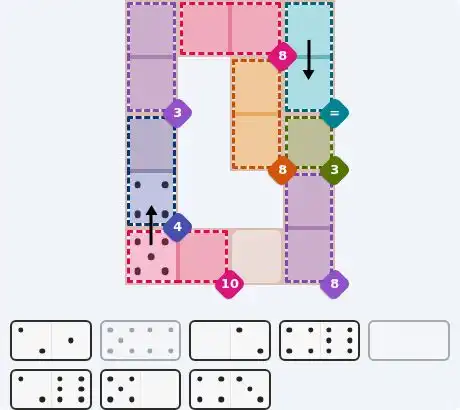
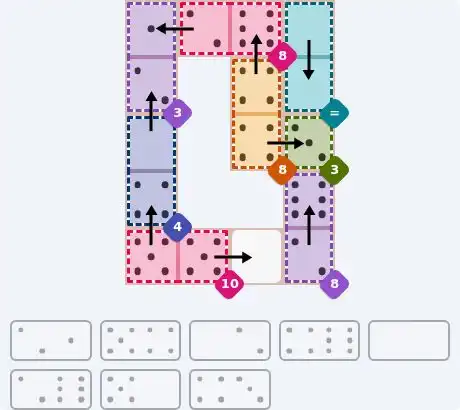
Rodolfo Kurchan's medium puzzle is a masterclass in sum region balancing. Nearly every cell belongs to a small sum constraintโ€”sum 3, sum 8, sum 4, sum 10โ€”with a single equals region providing a stable foothold. The domino set is tightly curated, forcing careful pairings like [5,4] and [2,6] that must fit together like puzzle pieces around the [0,0] double-zero anchor.

Kurchan's hard puzzle elevates the sum-restraint theme into a dense thicket of sum-5 regions, equals clusters, and greater/less gates. A lattice of single-cell and multi-cell sum-5 targets creates a cascade effect where solving one region propagates values across the board. The equals-0 trio in the top-left and the equals-2 wedge on the left edge act as pilings that stabilize the entire structure, while the greater-5 and less-5 cells act as directional valves.

๐Ÿ’ก Progressive Hints

Try these hints one at a time. Each hint becomes more specific to help you solve it yourself!

๐Ÿ’ก Seek the matching-pip necessity
Look for a region that forces multiple cells to share the same valueโ€”this will demand a domino that has identical pips on both halves.
๐Ÿ’ก Zero in on the central column
The tall equals region in the middle (cells (0,1), (1,1), (2,1)) cannot be filled without [6,6] and [0,6]. Notice how the [4,4] domino fits perfectly into the exclusive two-cell zone below it.
๐Ÿ’ก Full solution walkthrough
Place [4,4] at (3,0)-(3,1) to satisfy the high-threshold pair (4s). Place [6,6] down the column at (1,1)-(2,1), and [0,6] vertically at (0,1)-(0,2) with 6 at the top. The sum-6 region (0,4)-(1,4) takes [1,3] at (0,3)-(0,4) for 1+3 and [2,5] at (1,4)-(2,4) for 5+2. Finally, [2,0] at (3,4)-(3,5) gives the equal 2s for the last equals region.
๐Ÿ’ก Hunt the double-pip anchor
Identify the only region that requires two identical cellsโ€”this will lock in the domino with matching numbers and dictate a corner.
๐Ÿ’ก Activate the top-right zero corner
The equals region at (0,3)-(1,3) is solved by [0,0]. That zero anchor forces the sum-3 and sum-8 regions in the top row, so look for [2,1] and [4,6] next.
๐Ÿ’ก Complete medium answer
[0,0] at (0,3)-(1,3); then [2,1] at (0,0)-(0,1) makes 1+2 for sum-3; [0,2] at (1,0)-(2,0) gives 2+0 for sum-4; [4,6] at (0,2)-(1,2) puts 6+4 to satisfy two sum-8 regions; [4,3] at (2,2)-(2,3) completes sum-8 and the lone sum-3 cell; [2,6] at (3,3)-(4,3) finishes sum-8 with 6+2; [5,4] at (3,0)-(4,0) yields 4+5; [5,0] at (4,1)-(4,2) delivers 5+0 for sum-10 and the empty cell.
๐Ÿ’ก Follow the sum-5 breadcrumbs
Search for regions that must sum to exactly 5. Those small totals severely restrict which pip combinations can appear, especially in multi-cell regions.
๐Ÿ’ก Anchor the zero and two clusters
The equals-0 trio at (0,2)-(0,3)-(1,2) forces [0,0] at (0,2)-(1,2) and a zero from another domino. Simultaneously, the left-edge equals-2 cluster (6,0)-(7,0)-(7,1) demands [2,2] and a 2 from a mixed domino.
๐Ÿ’ก Untangle the central sum-5 trio
The three-cell sum-5 region at (2,2)-(2,3)-(3,2) can only be 2+1+2. That pulls in [2,1] for the two cells and [5,2] for the single cell, which cascades into the sum-5 cell at (4,2) and then [4,5] at (9,2).
๐Ÿ’ก Crack the right-side gates
The equals-1 region (6,4)-(7,3)-(7,4) forces [1,1] and [1,4]. The greater-5 cell (7,6) and less-5 (7,7) force [3,6] there, while the sum-5 at (5,6)-(6,6) uses [5,5]. The sum-5 singles at (0,6) and (5,6) link via [3,5] and [0,3].
๐Ÿ’ก Full hard solution
[5,2] at (3,2)-(4,2); [1,1] at (6,4)-(7,4); [4,5] at (8,2)-(9,2); [0,3] at (2,6)-(3,6); [4,6] at (8,6)-(9,6); [2,1] at (2,2)-(2,3); [3,6] at (7,6)-(7,7); [5,5] at (5,6)-(6,6); [3,2] at (5,7)-(5,8); [0,0] at (0,2)-(1,2); [3,5] at (0,6)-(1,6); [2,2] at (6,0)-(7,0); [5,1] at (9,7)-(9,8); [2,6] at (7,1)-(8,1); [1,4] at (7,3)-(8,3); [5,0] at (0,3)-(0,4).

๐ŸŽจ Pips Solver

May 30, 2026

Click a domino to place it on the board. You can also click the board, and the correct domino will appear.
โœ… Final Answer & Complete Solution For Hard Level

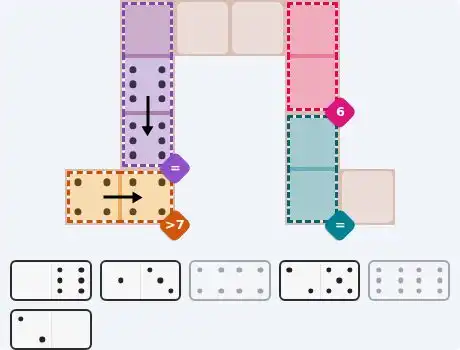
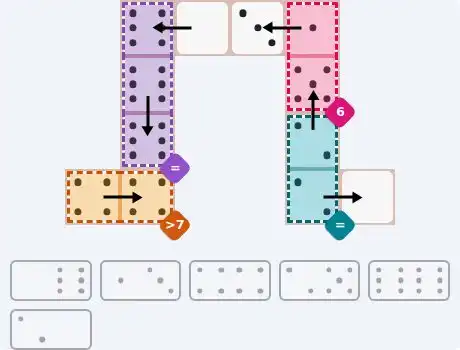
The key to solving today's hard puzzle was identifying the placement for the critical dominoes highlighted in the starting grid. Once those were in place, the rest of the puzzle could be solved logically. See the final grid below to compare your solution.

Starting Position & Key First Steps
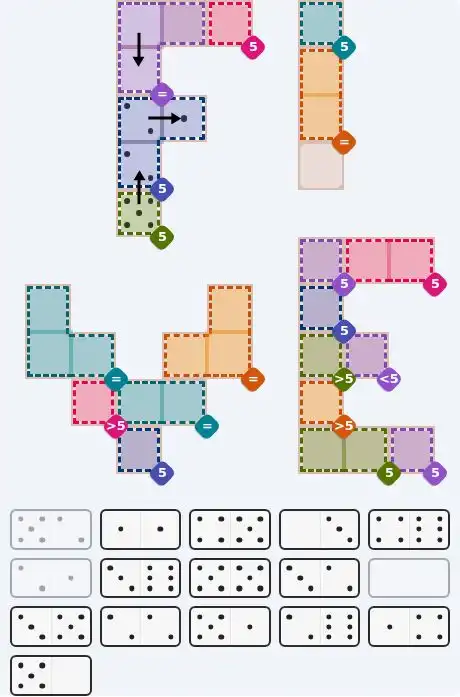
Pips hint for May 30, 2026 โ€“ hard level puzzle grid with critical first placements and strategy

This image shows the initial puzzle grid for the hard level, with a few critical first placements highlighted.

Final Answer: The Solved Grid for Hard Mode
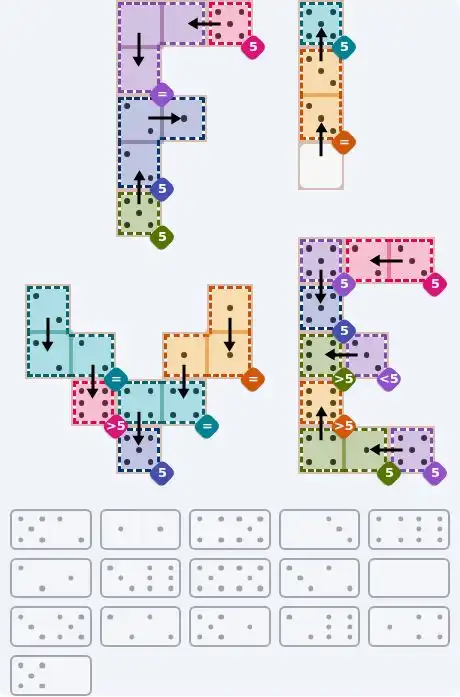
NYT Pips May 30, 2026 hard puzzle full solution grid showing final answer with hints

Compare this final grid with your own solution to see the correct placement of all dominoes.

๐Ÿ”ง Step-by-Step Answer Walkthrough For Easy Level

1
Step 1: Resolve the central equals column
Cells (0,1), (1,1), (2,1) must all be equal. The only dominant matching pip domino is [6,6]; meanwhile, [4,4] fits snugly into the two-cell high-threshold zone at (3,0)-(3,1). Place [4,4] there, fixing both cells as 4, then place [6,6] down the column at (1,1)-(2,1) to set two of the equals cells to 6.
2
Step 2: Supply the third six
The remaining equals cell (0,1) must be 6, so the [0,6] domino is the only option. Place it vertically with the 6 at (0,1) and the 0 at (0,2). This completes the equals region and fills the empty (0,2).
3
Step 3: Sum-6 and the top-row pair
The sum-6 region at (0,4)-(1,4) needs two numbers adding to 6. The [1,3] domino is perfect: place 1 at (0,4) and 3 at the empty (0,3). Then (1,4) must receive a 5, which is provided by [2,5] at (1,4)-(2,4).
4
Step 4: Finish the equals double
The equals region at (2,4)-(3,4) demands identical values. The 2 from [2,5] fills (2,4), and the last domino [2,0] slides into (3,4)-(3,5) giving a 2 at (3,4) and 0 at (3,5), satisfying the constraint and completing the grid.

๐Ÿ”ง Step-by-Step Answer Walkthrough For Medium Level

1
Step 1: Plant the zero equals anchor
The equals region at (0,3)-(1,3) requires two identical pips. The only domino with a matching pair is [0,0]. Place it there, setting both cells to 0. This blocks those positions and gives a foothold for neighboring sums.
2
Step 2: Lock in the sum-10 region
The sum-10 region at (4,0)-(4,1) must be two numbers that sum to 10; with pips 0โ€“6, only 5+5 works. The [5,4] domino provides one 5 at (4,0) and a 4 at (3,0). The [5,0] domino provides the other 5 at (4,1) and a 0 at (4,2), satisfying the empty cell.
3
Step 3: Solve the left-column sums
With (3,0)=4 from [5,4], the sum-4 region (2,0)-(3,0) forces (2,0)=0. The [0,2] domino fits at (1,0)-(2,0) giving (1,0)=2 and (2,0)=0. Then the sum-3 region (0,0)-(1,0) has (1,0)=2, so (0,0) must be 1โ€”solved by [2,1] at (0,0)-(0,1) with 1 and 2.
4
Step 4: Propagate the top sum-8
The sum-8 region at (0,1)-(0,2) now has (0,1)=2 from [2,1], so (0,2) needs 6. Place [4,6] at (0,2)-(1,2) giving 6 and 4. The adjacent sum-8 region (1,2)-(2,2) gets 4 from (1,2), so (2,2) must be 4. Place [4,3] at (2,2)-(2,3) with 4 and 3, satisfying the single sum-3 cell at (2,3).
5
Step 5: Close the bottom sum-8
The sum-8 region (3,3)-(4,3) now needs a total of 8. The [2,6] domino fits perfectly: 6 at (3,3) and 2 at (4,3), completing the puzzle.

๐Ÿ”ง Step-by-Step Answer Walkthrough For Hard Level

1
Step 1: Anchor the triple-zero equals
The equals region at (0,2), (0,3), (1,2) demands three zeros. Place [0,0] vertically at (0,2)-(1,2), securing two zeros. The third zero will later come from [5,0] at (0,3)-(0,4), but this already forces the upper-left corner.
2
Step 2: Unlock the central sum-5 chain
The three-cell sum-5 region at (2,2)-(2,3)-(3,2) can only be 2+1+2. Place [2,1] horizontally at (2,2)-(2,3) for 2 and 1, leaving (3,2) needing a 2. This forces [5,2] at (3,2)-(4,2) with 2 and 5, setting (4,2)=5. The sum-5 single at (9,2) then demands a 5, pulling in [4,5] at (8,2)-(9,2) with 4 and 5.
3
Step 3: Build the left-edge equals-2 cluster
The equals-2 region (6,0),(7,0),(7,1) requires three 2s. Place [2,2] horizontally at (6,0)-(7,0) for two 2s, and [2,6] vertically at (7,1)-(8,1) to supply the third 2 at (7,1) and a 6 at (8,1) for its greater-5 constraint. The equals region (8,2)-(8,3) then pairs with [4,5] already giving (8,2)=4, so (8,3) must be 4โ€”satisfied by [1,4] later.
4
Step 4: Activate the equals-1 region
The region (6,4),(7,3),(7,4) must all be 1. Place [1,1] at (6,4)-(7,4) for two 1s. Then [1,4] goes at (7,3)-(8,3), giving (7,3)=1 and (8,3)=4, which harmonizes with the equals-4 region (8,2)-(8,3).
5
Step 5: Resolve right-side sum-5 and gates
The single sum-5 cells at (0,6) and (5,6) and (6,6) interact with equals and greater/less gates. The equals region (1,6)-(2,6) forces [0,3] at (2,6)-(3,6) with 3 and 0. Then [3,5] at (0,6)-(1,6) gives 5 and 3. The greater-5 cell (7,6) and less-5 (7,7) force [3,6] there with 6 and 3. The sum-5 at (5,6)-(6,6) takes [5,5] for 5+5.
6
Step 6: Complete the remaining regions
The sum-5 region (5,7)-(5,8) requires 2+3; use [3,2] there. The sum-5 pair (9,6)-(9,7) must be 4+1; place [5,1] at (9,7)-(9,8) giving 1 and 5, and [4,6] at (9,6)-(8,6) for 4 and 6 (also satisfying greater-5 at (8,6)). The grid resolves fully.

๐Ÿ’ก Pro Tips for Similar Puzzles

Start with Constraints
Always begin with the most constrained regions - sum regions with small numbers or tight spaces.
Use Equal Regions
Use "equal" regions as anchors - they eliminate many possibilities quickly.
Work Systematically
Let the rules guide your placement rather than guessing randomly.
Double-Check
Verify each region's rules are satisfied before moving to the next.

๐ŸŽ“ Keep Learning & Improve