NYT Pips Hints & Answers for July 6, 2026

Jul 6, 2026

๐Ÿšจ SPOILER WARNING

This page contains the final **answer** and the complete **solution** to today's NYT Pips puzzle. If you haven't attempted the puzzle yet and want to try solving it yourself first, now's your chance!

Click here to play today's official NYT Pips game first.

Want hints instead? Scroll down for progressive clues that won't spoil the fun.

SEE ALSO:

๐ŸŽฒ Today's Puzzle Overview

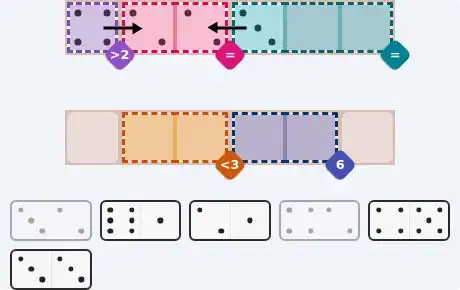
Ian Livengood sculpts today's easy puzzle as a concise two-row exercise in constraint flow. The tiny grid is anchored by a solitary greater-than-2 cell that acts like a keystone; its value ripples into an adjoining equals pair, which then feeds a triple-equals finale. The bottom row's less-than and sum regions tidy up the remaining values with almost mechanical precision. It's a gem of minimalism where each region dovetails perfectly into the next.

Rodolfo Kurchan's medium grid takes a more vertical approach, with a showstopping sum-15 column that spans the full height of the right side. Hitting that total requires a daring commitmentโ€”two 6s and a 3โ€”which immediately dictates the placement of three high-value dominoes. The rest of the grid then organizes around an equals trio that locks in 5s, and a chain of tiny sum regions that fall like dominoes in the traditional sense. In today's NYT Pips medium, Kurchan demonstrates how a single outsized target can orchestrate the entire solve.

Rodolfo Kurchan's hard puzzle is an 8x4 labyrinth where almost every cell is governed by a small sum constraint, and the number zero becomes the dominant currency. The domino bank is heavily stocked with zero-paired tiles, and the challenge is deploying them without conflict. Kurchan weaves a network where sum-0 and sum-1 regions force a careful routing of zeros, leaving the non-zero pips to fill the gaps. It's a masterful design that flips the usual pip hierarchy, turning the lowly blank into the most fought-over resource on the board.

๐Ÿ’ก Progressive Hints

Try these hints one at a time. Each hint becomes more specific to help you solve it yourself!

๐Ÿ’ก Hint 1: Spot the outlier
Scan for a single-cell region that demands a value above two. That isolated rule will be your first move.
๐Ÿ’ก Hint 2: Follow the equality chain
That greater-than-2 cell sits at the top-left corner. The equals region to its right (two cells) must share the same pipโ€”so the domino you place across those cells has to coordinate with the anchor cellโ€™s neighbor.
๐Ÿ’ก Hint 3: The full placement
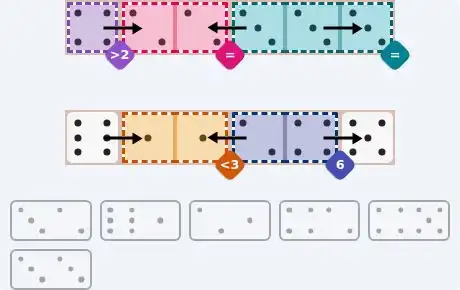
Place the [4,2] domino horizontally at top left: [0,0]=4 (satisfying greater-2) and [0,1]=2. Next, [3,2] horizontally at [0,2]=2, [0,3]=3, completing the equals pair with 2s. The triple-equals on the right gets the double [3,3] placed at [0,4]=3, [0,5]=3. Below: [6,1] at [2,0]=6, [2,1]=1; [2,1] at [2,3]=2, [2,2]=1 (both <3); and [4,5] at [2,4]=4, [2,5]=5 to sum to 6.
๐Ÿ’ก Hint 1: Find the big sum
Search for a column that asks for a sum of 15. That outsized target is the puzzleโ€™s backbone.
๐Ÿ’ก Hint 2: Column and its echo
The sum-15 column occupies cells [0,4], [1,4], [2,4]. Hitting 15 forces the use of the highest pips available, including two 6s. Just below that column, an equals region of three cells will lock onto the value that repeats from that column.
๐Ÿ’ก Hint 3: Full chain
Place [2,6] vertically at [0,3]=2, [0,4]=6. Place [6,5] vertically at [2,4]=6, [2,3]=5. Then [3,4] horizontally at [1,4]=3, [1,5]=4 completes the sum-15 as 6+3+6. The equals region [1,3],[2,2],[2,3] must all be 5: so [5,0] horizontally at [2,2]=5, [2,1]=0, and [3,5] horizontally at [1,2]=3, [1,3]=5. Then [4,6] at [1,0]=4, [1,1]=6 satisfies the sum-6 region (6+0) and sum-4 at [1,0]. The equals pair at [0,1]-[0,2] gets the double [4,4] horizontally.
๐Ÿ’ก Hint 1: Zero is the hero
The grid is saturated with tiny sum targetsโ€”many demanding 0 or 1. Look for the sum-0 and sum-1 regions; they consume dominoes with a 0 pip first.
๐Ÿ’ก Hint 2: Top-left genesis
The top-left cell [0,0] is a sum-3 region, and directly below it is an empty cell. Above that, a sum-0 at [0,1] demands a zero. The initial placements will radiate from this corner.
๐Ÿ’ก Hint 3: Zero cascade on row 2
Once you fix [0,0]=3 with the [3,6] domino, the sum-0 at [0,1] forces [0,1]=0 paired with [0,2]=2 via [0,2]. The sum-1 at [1,1] and sum-5 at [1,2] then pull two zero-bearing dominoes onto row 2, filling cells [2,1] and [2,2] with zeros.
๐Ÿ’ก Hint 4: The left column falls
Cell [2,0] remains empty but must be 0. Use [0,4] to place 0 at [2,0] and 4 at [3,0] (sum-4). Below it, [4,0] sum-0 gets 0 from [0,3] with 3 at [5,0]. The middle section then locks into place with [1,2], [1,3], and others.
๐Ÿ’ก Hint 5: Complete solution map
Full placements: [3,6] at [0,0]=3,[1,0]=6. [0,2] h at [0,1]=0,[0,2]=2. [0,1] v at [2,1]=0,[1,1]=1; [0,5] v at [2,2]=0,[1,2]=5. [0,4] v at [2,0]=0,[3,0]=4. [0,3] v at [4,0]=0,[5,0]=3. Then [1,2] h at [1,3]=1,[0,3]=2; [1,3] v at [2,3]=1,[3,3]=3; [2,3] v at [4,1]=2,[5,1]=3; [3,4] h at [3,1]=3,[3,2]=4; [4,5] h at [4,2]=4,[4,3]=5; [1,4] h at [5,3]=1,[5,2]=4; [1,5] v at [6,0]=1,[7,0]=5; [2,4] h at [6,1]=2,[6,2]=4; [2,5] h at [7,3]=2,[6,3]=5; [3,5] h at [7,2]=3,[7,1]=5.

๐ŸŽจ Pips Solver

Jul 6, 2026

Click a domino to place it on the board. You can also click the board, and the correct domino will appear.
โœ… Final Answer & Complete Solution For Hard Level

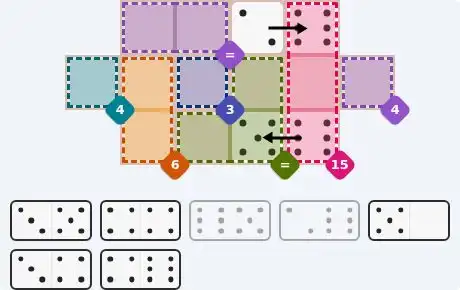
The key to solving today's hard puzzle was identifying the placement for the critical dominoes highlighted in the starting grid. Once those were in place, the rest of the puzzle could be solved logically. See the final grid below to compare your solution.

Starting Position & Key First Steps
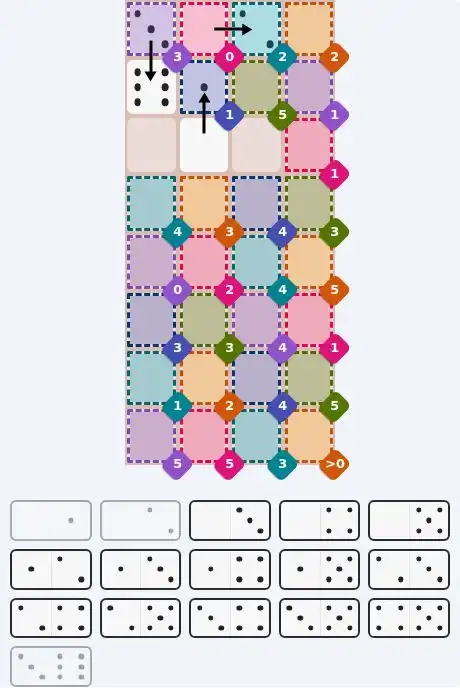
Pips hint for July 6, 2026 โ€“ hard level puzzle grid with critical first placements and strategy

This image shows the initial puzzle grid for the hard level, with a few critical first placements highlighted.

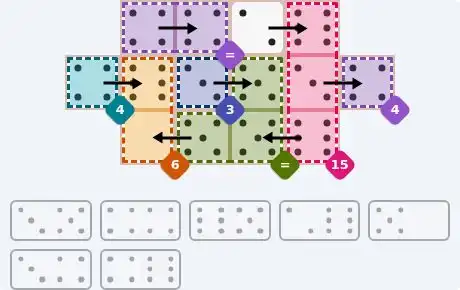
Final Answer: The Solved Grid for Hard Mode
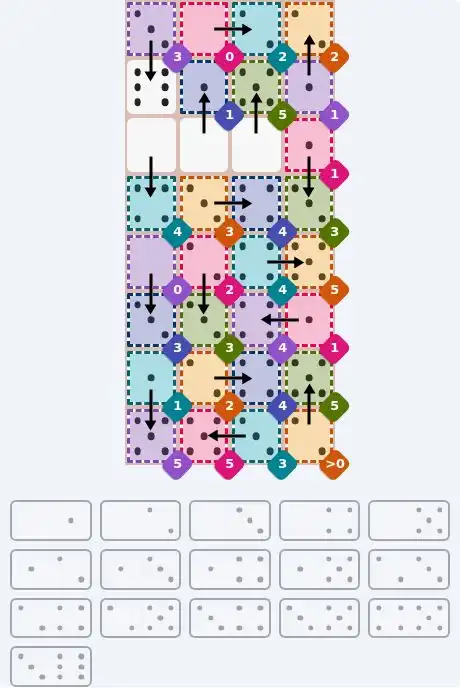
NYT Pips July 6, 2026 hard puzzle full solution grid showing final answer with hints

Compare this final grid with your own solution to see the correct placement of all dominoes.

๐Ÿ”ง Step-by-Step Answer Walkthrough For Easy Level

1
Step 1: The greater-2 anchor
The single cell at [0,0] must be greater than 2. It shares a domino with the cell to its right, which is part of an equals region with [0,2]. This means the right-side pip of that domino must also appear in the cell [0,2] from another domino. The only way to satisfy both restrictions with the available tiles is to place the [4,2] domino at [0,0]-[0,1], making [0,0]=4 and [0,1]=2.
2
Step 2: Completing the equals pair
The equals region [0,1]-[0,2] now requires [0,2] to be 2. The domino [3,2] placed at [0,2]-[0,3] gives [0,2]=2 and [0,3]=3, fulfilling the equals region. The triple-equals region [0,3]-[0,5] must now all be 3. Since [0,3] is already 3, the double [3,3] can be placed at [0,4]-[0,5] to set those two cells to 3.
3
Step 3: Setting the bottom row left
The bottom row has an empty cell at [2,0] and a less-than-3 region at [2,1]-[2,2]. The domino [6,1] placed vertically at [2,0]-[2,1] puts a 6 in the empty cell and a 1 at [2,1] (which is <3). Then the other cell [2,2] needs a value <3; the domino [2,1] placed at [2,3]-[2,2] orientation gives [2,2]=1 (since 1 is <3) and [2,3]=2.
4
Step 4: The final sum
The region [2,3]-[2,4] must sum to 6. With [2,3]=2, the required value for [2,4] is 4. The domino [4,5] placed at [2,4]-[2,5] provides 4 at [2,4] and 5 at the empty [2,5]. All constraints are now met.

๐Ÿ”ง Step-by-Step Answer Walkthrough For Medium Level

1
Step 1: The mighty sum-15 column
The column at [0,4], [1,4], [2,4] must sum to 15. The largest available pips are 6, 6, 5, 4, etc. The only feasible combination with the dominoes is two 6s and a 3 (6+6+3=15). The domino [2,6] provides a 6 and a 2; it must be placed so that the 6 goes into the column. So place [2,6] vertically at [0,3]-[0,4] with 2 at [0,3] and 6 at [0,4].
2
Step 2: Another 6 for the column
The second 6 can come from the [6,5] domino. Place it vertically at [2,4]-[2,3] with 6 at [2,4] and 5 at [2,3]. Now the column has 6 at top and 6 at bottom, so the middle [1,4] must be 3. The domino [3,4] has a 3 and a 4; place it horizontally at [1,4]-[1,5] with 3 at [1,4] and 4 at [1,5], satisfying the sum-4 region at [1,5].
3
Step 3: The equals trio locks in 5s
The equals region covering [1,3], [2,2], [2,3] must have identical values. We already have [2,3]=5 from the [6,5] placement. Therefore all three must be 5. The domino [5,0] placed at [2,2]-[2,1] with 5 at [2,2] and 0 at [2,1] fulfills the sum-6 region at [1,1]-[2,1] (since 0 leaves 6 for [1,1]). Then [3,5] placed at [1,2]-[1,3] with 3 at [1,2] (sum-3) and 5 at [1,3] completes the trio.
4
Step 4: Tying up the left side
The sum-6 region [1,1]-[2,1] now has [2,1]=0, so [1,1] must be 6. Domino [4,6] placed at [1,0]-[1,1] sets [1,0]=4 (sum-4) and [1,1]=6. The equals pair [0,1]-[0,2] then gets the double [4,4] placed horizontally, making both cells 4.
5
Step 5: Verify the remaining regions
Check the empty cell [0,3]โ€”it already holds 2 from [2,6] earlier, and it's an empty region, so no conflict. The sum-3 at [1,2] is 3 from [3,5]. All constraints are satisfied, and no dominoes remain unused.

๐Ÿ”ง Step-by-Step Answer Walkthrough For Hard Level

1
Step 1: Cornerstone 3 and 6
The top-left cell [0,0] is a sum-3 single region, so its value must be 3. The only domino containing a 3 that can place a pip in the empty cell below ([1,0]) is [3,6]. Place it vertically: [0,0]=3, [1,0]=6. The empty region at [1,0] is satisfied.
2
Step 2: Top row zero and two
Cell [0,1] is a sum-0 region, requiring 0. Adjacent [0,2] is sum-2. The domino [0,2] fits perfectly: place it horizontally at [0,1]=0, [0,2]=2. This also resolves the sum-2 region.
3
Step 3: Zero alley on row 2
The sum-1 region at [1,1] and sum-5 at [1,2] need 1 and 5. They must pair with zeros because the only unused dominoes with 1 or 5 also have zeros. Place [0,1] vertically at [2,1]=0, [1,1]=1; and [0,5] vertically at [2,2]=0, [1,2]=5. The empty cells [2,1] and [2,2] are now zero, and [2,0] will follow.
4
Step 4: Left column filled
Cell [2,0] is empty and must receive a zero; the domino [0,4] placed vertically at [2,0]=0, [3,0]=4 satisfies the sum-4 region at [3,0]. Then the sum-0 at [4,0] needs 0 and the sum-3 at [5,0] needs 3; use [0,3] vertically at [4,0]=0, [5,0]=3. The left side is complete.
5
Step 5: Middle and right side resolution
Now handle the central region: sum-1 at [1,3] uses [1,2] horizontally at [1,3]=1, [0,3]=2 (sum-2). Sum-1 at [2,3] uses [1,3] vertically at [2,3]=1, [3,3]=3 (sum-3). For [3,1] sum-3 and [3,2] sum-4, place [3,4] horizontally at [3,1]=3, [3,2]=4. The sum-2 at [4,1] and sum-3 at [5,1] use [2,3] vertically at [4,1]=2, [5,1]=3. The sum-4 at [4,2] and sum-5 at [4,3] use [4,5] horizontally at [4,2]=4, [4,3]=5. Then sum-1 at [5,3] and sum-4 at [5,2] take [1,4] horizontally at [5,3]=1, [5,2]=4. Bottom rows: sum-1 at [6,0] and sum-5 at [7,0] with [1,5] vertically at [6,0]=1, [7,0]=5. Sum-2 at [6,1] and sum-4 at [6,2] with [2,4] horizontally at [6,1]=2, [6,2]=4. Sum-5 at [6,3] and greater-0 at [7,3] with [2,5] horizontally at [7,3]=2, [6,3]=5. Finally, sum-3 at [7,2] and sum-5 at [7,1] via [3,5] horizontally at [7,2]=3, [7,1]=5.

๐Ÿ’ก Pro Tips for Similar Puzzles

Start with Constraints
Always begin with the most constrained regions - sum regions with small numbers or tight spaces.
Use Equal Regions
Use "equal" regions as anchors - they eliminate many possibilities quickly.
Work Systematically
Let the rules guide your placement rather than guessing randomly.
Double-Check
Verify each region's rules are satisfied before moving to the next.

๐ŸŽ“ Keep Learning & Improve