NYT Pips Hints & Answers for August 19, 2026

Aug 19, 2026

๐Ÿšจ SPOILER WARNING

This page contains the final **answer** and the complete **solution** to today's NYT Pips puzzle. If you haven't attempted the puzzle yet and want to try solving it yourself first, now's your chance!

Click here to play today's official NYT Pips game first.

Want hints instead? Scroll down for progressive clues that won't spoil the fun.

SEE ALSO:

๐ŸŽฒ Today's Puzzle Overview

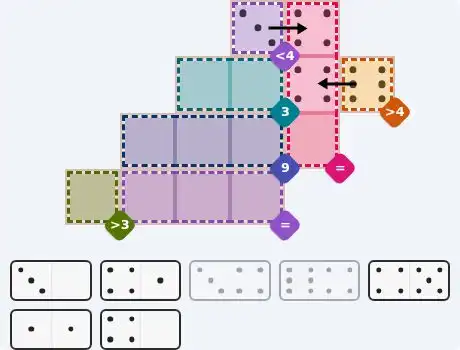
Easy is a confidence-builder from Ian Livengood: two single-cell sum regions and a chain of equals pairs do nearly all the work. There is no fork in the roadโ€”once you place the first top-right domino, the rest of the grid cascades cleanly through matching pairs.

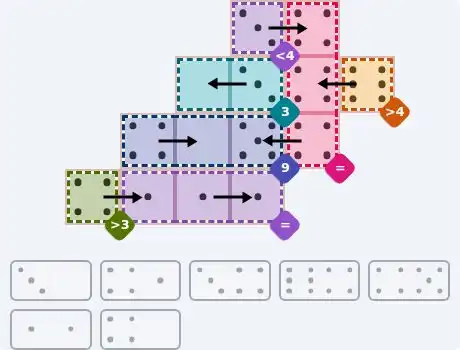
Medium, also by Livengood, changes the rhythm. The upper-right corner is the bottleneck: a strict less-than cell sits directly beside a long vertical equals strip, and that little corner determines a surprising amount of the board. Expect a quick start if you spot the hinge, then a smooth unwind through a 9-sum bar and a bottom equals trio.

Hard, from Rodolfo Kurchan, is the day's heavy lift. A six-cell unequal column on the right is the standout constraintโ€”it behaves like a self-contained puzzle before you touch the left side. The solve then weaves through a top sum, a large equals cluster, a bottom <2 strip, and a pair of left-side inequality regions. This NYT Pips hard will feel very tight early but opens in big chunks once the first block is set.

๐Ÿ’ก Progressive Hints

Try these hints one at a time. Each hint becomes more specific to help you solve it yourself!

๐Ÿ’ก Hold the fixed singles
Look for the single-cell sum regions firstโ€”they are the most constrained because their domino orientation must put one specific value on that exact cell.
๐Ÿ’ก Anchor at [0,1]
The top single sum at [0,1] fixes a high domino that also lands in the equals pair [1,1]/[1,0]. Let that equality dictate the next vertical domino.
๐Ÿ’ก Full easy chain
Place [6,5] vertically with 5 at [0,1] and 6 at [1,1]. The equals pair [1,1]/[1,0] forces [1,0]=6, so place [6,1] vertically with 6 at [1,0] and 1 at [2,0]. The equals pair [2,0]/[2,1] forces [2,1]=1: place [1,3] horizontally with 1 at [2,1] and 3 at [2,2]. Then [1,2] must equal [2,2], so place [3,4] horizontally with 3 at [1,2] and 4 at [1,3]. Finish with [5,0] horizontally at [3,3]=5 and [3,2]=0.
๐Ÿ’ก Find the capped corner
Focus on the strict less-than cell and the adjacent long equals strip in the upper rightโ€”they form a tight hinge that narrows the opening placement dramatically.
๐Ÿ’ก Crack [0,3] and the vertical strip
The cell at [0,3] must stay below its cap, but it shares a domino with [0,4], which starts a three-cell equals column. The only clean fit determines both the corner domino and the strip's shared value.
๐Ÿ’ก Full medium chain
Place [3,4] horizontally with 3 at [0,3] and 4 at [0,4]. That sets the vertical equals strip [0,4]/[1,4]/[2,4] to 4. Put [6,4] horizontally with 6 at [1,5] and 4 at [1,4]; then [4,5] horizontally with 4 at [2,4] and 5 at [2,3]. The sum-9 bar [2,1]/[2,2]/[2,3] now forces [2,1]=4 and [2,2]=0, so place [4,0] horizontally with 4 at [2,1] and 0 at [2,2]. The sum-3 pair [1,2]/[1,3] takes [3,0] horizontally with 0 at [1,2] and 3 at [1,3]. The >3 cell [3,0] takes [4,1] horizontally with 4 at [3,0] and 1 at [3,1]; finish with [1,1] horizontally at [3,2]=1 and [3,3]=1.
๐Ÿ’ก Spot the restrictive shapes
Look for the long vertical unequal region and the bottom strip with a tiny upper capโ€”they are the most constrained parts of this hard puzzle.
๐Ÿ’ก Unlock the unequal column
Start in the six-cell column at col 5. Because its cells are isolated vertically, they must form three dominoes and no pip may repeat. Pair [2,5] with [3,5], [4,5] with [5,5], and [6,5] with [7,5] to see the required domino set.
๐Ÿ’ก Follow the top sum downward
After the unequal column, work the top sum region [0,0]/[0,1] and the equals pair [1,1]/[2,1]. That will feed the larger equals cluster at [3,1]/[4,1]/[5,1]/[6,1]/[6,2].
๐Ÿ’ก Let the big equals cluster spread
The large equals cluster shares one value, which forces the long vertical domino at [4,1]/[5,1], the horizontal at [6,1]/[6,0], and the vertical at [6,2]/[7,2]. Then the sum-7 region [6,0]/[7,0] and the bottom <2 strip unlock the bottom-right.
๐Ÿ’ก Full hard chain
Place the six-cell unequal column first: [2,3] vertically with 2 at [2,5] and 3 at [3,5]; [5,6] vertically with 5 at [4,5] and 6 at [5,5]; [4,1] vertically with 4 at [6,5] and 1 at [7,5]. Top sum 10 uses [4,5] vertically with 5 at [0,0] and 4 at [1,0], and [3,5] vertically with 5 at [0,1] and 3 at [1,1]; the equals pair then sets [2,1]=3 via [6,3] vertically with 6 at [3,1] and 3 at [2,1]. The large equals cluster all becomes 6: [6,6] vertically at [4,1]/[5,1] with 6s, [6,4] horizontally at [6,1]=6 and [6,0]=4, and [6,1] vertically at [6,2]=6 and [7,2]=1. Sum-7 gives [7,0]=3, so [0,3] horizontally at [7,1]=0 and [7,0]=3. The <2 band finishes [5,0] vertically at [6,3]=5 and [7,3]=0. Left side: [2,4] vertically at [2,0]=2 and [3,0]=4; [3,3] vertically at [4,0]=3 and [5,0]=3.

๐ŸŽจ Pips Solver

Aug 19, 2026

Click a domino to place it on the board. You can also click the board, and the correct domino will appear.
โœ… Final Answer & Complete Solution For Hard Level

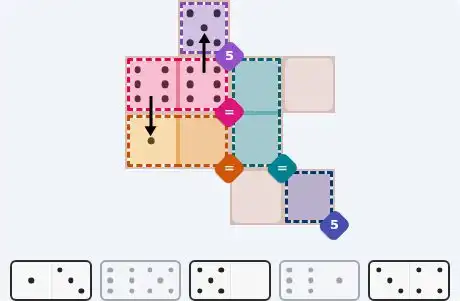
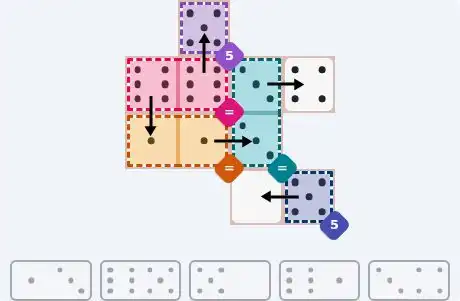
The key to solving today's hard puzzle was identifying the placement for the critical dominoes highlighted in the starting grid. Once those were in place, the rest of the puzzle could be solved logically. See the final grid below to compare your solution.

Starting Position & Key First Steps
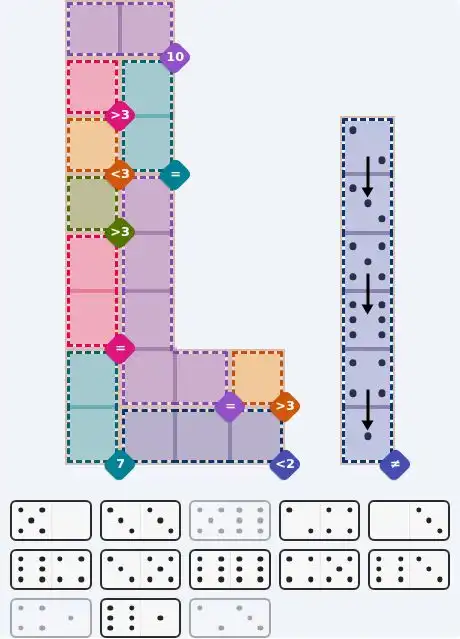
Pips hint for August 19, 2026 โ€“ hard level puzzle grid with critical first placements and strategy

This image shows the initial puzzle grid for the hard level, with a few critical first placements highlighted.

Final Answer: The Solved Grid for Hard Mode
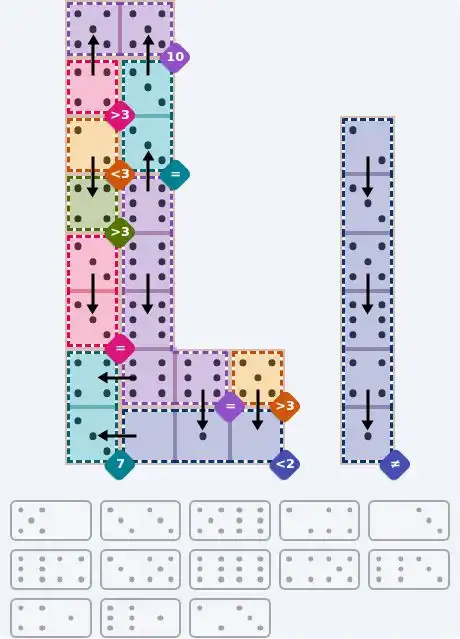
NYT Pips August 19, 2026 hard puzzle full solution grid showing final answer with hints

Compare this final grid with your own solution to see the correct placement of all dominoes.

๐Ÿ”ง Step-by-Step Answer Walkthrough For Easy Level

1
Step 1: Lock the top sum cell
The single-cell sum region at [0,1] forces a domino with 5 on that cell. Place [6,5] vertically with 5 at [0,1] and 6 at [1,1].
2
Step 2: Satisfy the first equals pair
Since [1,0] must equal [1,1], it also has to be 6. Place [6,1] vertically with 6 at [1,0] and 1 at [2,0].
3
Step 3: Continue the equals chain
The region [2,0]/[2,1] is also an equals pair, so [2,1] must match the 1 already at [2,0]. Place [1,3] horizontally with 1 at [2,1] and 3 at [2,2].
4
Step 4: Finish through the last equals pair
Now [1,2] must equal [2,2], so [1,2] is 3. Place [3,4] horizontally with 3 at [1,2] and 4 at [1,3]. The leftover bottom region uses [5,0] horizontally with 5 at [3,3] and 0 at [3,2], satisfying the final sum-5.

๐Ÿ”ง Step-by-Step Answer Walkthrough For Medium Level

1
Step 1: Open the upper-right hinge
The strict less-than cell at [0,3] and the vertical equals strip starting at [0,4] force the corner domino. Place [3,4] horizontally with 3 at [0,3] and 4 at [0,4].
2
Step 2: Fill the vertical equals strip
Because [0,4], [1,4], and [2,4] all must be equal, the shared value is 4. Place [6,4] horizontally with 6 at [1,5] and 4 at [1,4]; then place [4,5] horizontally with 4 at [2,4] and 5 at [2,3].
3
Step 3: Use the 9-sum bar
With [2,3] already 5, the sum-9 region [2,1]/[2,2]/[2,3] needs its other two cells to total 4. Place [4,0] horizontally with 4 at [2,1] and 0 at [2,2].
4
Step 4: Resolve the small sum pair
The region [1,2]/[1,3] must sum to 3, so the remaining clean split is 0 and 3. Place [3,0] horizontally with 0 at [1,2] and 3 at [1,3].
5
Step 5: Finish the bottom equals trio
The greater-than cell at [3,0] forces a 4, so place [4,1] horizontally with 4 at [3,0] and 1 at [3,1]. Then the equals trio [3,1]/[3,2]/[3,3] all becomes 1, using [1,1] horizontally at [3,2]=1 and [3,3]=1.

๐Ÿ”ง Step-by-Step Answer Walkthrough For Hard Level

1
Step 1: Split the unequal column
The six-cell vertical unequal region must use three dominoes and six distinct pips. Place [2,3] vertically with 2 at [2,5] and 3 at [3,5]; place [5,6] vertically with 5 at [4,5] and 6 at [5,5]; and place [4,1] vertically with 4 at [6,5] and 1 at [7,5].
2
Step 2: Top sum seeds the equals chain
The sum-10 region [0,0]/[0,1] requires both top cells to be 5. Place [4,5] vertically with 5 at [0,0] and 4 at [1,0], and [3,5] vertically with 5 at [0,1] and 3 at [1,1]. The equals pair [1,1]/[2,1] then forces [2,1]=3, so place [6,3] vertically with 6 at [3,1] and 3 at [2,1].
3
Step 3: Fill the big equals cluster
With [3,1] set to 6, the entire cluster [3,1]/[4,1]/[5,1]/[6,1]/[6,2] must all be 6. Place [6,6] vertically at [4,1]/[5,1] with 6s, [6,4] horizontally at [6,1]=6 and [6,0]=4, and [6,1] vertically at [6,2]=6 and [7,2]=1.
4
Step 4: Bottom sum and the <2 strip
The sum-7 region [6,0]/[7,0] now has [6,0]=4, so [7,0] must be 3. Place [0,3] horizontally with 0 at [7,1] and 3 at [7,0]. The <2 strip then forces [7,3]=0, so place [5,0] vertically with 5 at [6,3] and 0 at [7,3].
5
Step 5: Left-side inequalities and finish
The left side resolves through its paired less-than and greater-than cells: place [2,4] vertically with 2 at [2,0] and 4 at [3,0], then place [3,3] vertically with 3 at [4,0] and 3 at [5,0] to satisfy the final equals pair.

๐Ÿ’ก Pro Tips for Similar Puzzles

Start with Constraints
Always begin with the most constrained regions - sum regions with small numbers or tight spaces.
Use Equal Regions
Use "equal" regions as anchors - they eliminate many possibilities quickly.
Work Systematically
Let the rules guide your placement rather than guessing randomly.
Double-Check
Verify each region's rules are satisfied before moving to the next.

๐ŸŽ“ Keep Learning & Improve