NYT Pips Hints & Answers for July 30, 2026

Jul 30, 2026

🚨 SPOILER WARNING

This page contains the final **answer** and the complete **solution** to today's NYT Pips puzzle. If you haven't attempted the puzzle yet and want to try solving it yourself first, now's your chance!

Click here to play today's official NYT Pips game first.

Want hints instead? Scroll down for progressive clues that won't spoil the fun.

SEE ALSO:

🎲 Today's Puzzle Overview

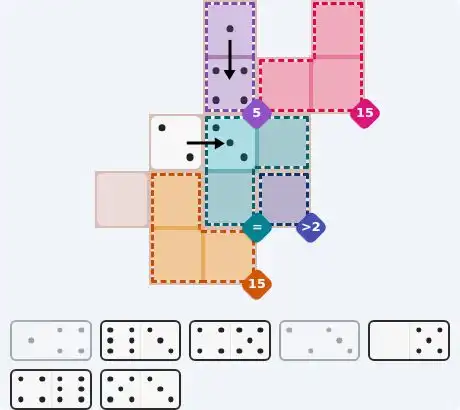
Ian Livengood’s easy puzzle is a masterclass in economy, with a tiny 4x4 grid and just five dominoes. The design anchors on a sum‑10 pair at the bottom that leaves only one possible domino, a double‑5, locking the lower row instantly. From there, a few well‑placed equals and single‑digit sum constraints ripple upward, solving almost automatically. It’s a satisfying, quick win that showcases how a single tightly constrained region can drive a whole board.

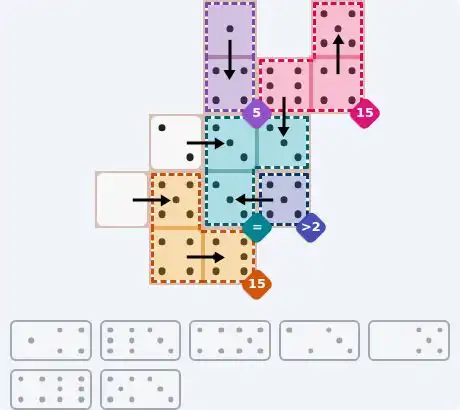
Rodolfo Kurchan’s medium expands to a 5x5 grid and introduces his signature love of interlocking equals chains. Here a triple‑equals region occupies the board’s heart, forcing three cells to share a value that in turn dictates the surrounding sum‑15 and sum‑5 zones. The domino choices are wider, but the interplay between the equality group and the large‑sum region narrows the path elegantly. This NYT Pips puzzle feels architectural, with the constructor carefully balancing multiple constraints to create a single resolution.

Kurchan’s hard puzzle is a tour de force of minimalism, sprinkling single‑cell sums across an 8x4 canvas—many as tiny as zero, one, or two. Alongside two triple‑equals blocks, these micro‑constraints force an elaborate cascade of zero‑bearing dominoes. The board appears sparse, but the design is stringent: almost every cell reports a precise pip before you’ve placed half the tiles. It’s a beautiful exercise in deductive dependency, where the hardest part is simply believing that such small numbers can lock a grid so completely.

💡 Progressive Hints

Try these hints one at a time. Each hint becomes more specific to help you solve it yourself!

💡 Start With the Anchors
Look for a sum region that has a very limited set of dominoes that can satisfy it, and an equals region that will force matching values. Today’s easy uses a sum‑10 pair and a single‑cell sum to create an immediate foothold.
💡 Lock the Bottom Row
The sum‑10 region at [3,0]‑[3,1] demands a domino whose pips add to exactly 10. With the available set, only the double‑five will work. Place it there, then note the single‑cell sum‑5 region at [0,2] must be a pip of 5, so the [5,6] domino fits vertically above it. This triggers the equals region in column 2, setting [1,2] and [2,2] both to 6.
💡 Complete the Grid
Once the double‑five anchors the bottom and the [5,6] domino straddles [0,2] and [1,2], the other pieces fall into place. The [1,6] domino goes to [2,1] and [2,2], making [2,2]=6 to match the equals constraint, and [2,1]=1, which in turn forces the equals region at [1,1] to be 1. The less‑than‑4 cell at [2,3] becomes 1, so the [5,1] domino fills [3,3]=5 and [2,3]=1. Finally the [4,1] domino fills [1,0]=4 and [1,1]=1. The board resolves cleanly.
💡 Think in Threes
Focus on the triple‑equals region—three cells that must share the same pip. Which value can appear three times and still work with nearby sum‑5 and sum‑15 regions? Also check the single greater‑than‑2 cell.
💡 Zero In on the Equals
The equals region spans [2,2], [2,3], and [3,2]. The sum‑5 region directly above at [0,2]‑[1,2] needs a 1‑4 or 2‑3 pair. Since the triple must be a value that can sit aside a sum‑15 triple (which includes [0,4], [1,3], [1,4]), you’ll find that the equal value is 3. That forces the domino [2,3] into place at [2,2] and [2,1] (with a 2 above), while [6,3] fills [1,3] and [2,3].
💡 Complete the Medium
With the triple set as 3, the sum‑5 region takes a 1‑4 domino ([1,4]) at [0,2]‑[1,2]. The sum‑15 region above gets the [6,3] domino at [1,3]‑[2,3] and the [4,5] domino at [1,4]‑[0,4]. The bottom sum‑15 uses [0,5] at [3,0]‑[3,1] and [4,6] at [4,1]‑[4,2], plus [5,3] at [3,3]‑[3,2] completing the equals block. The greater‑2 single at [3,3] ends up 5, satisfying all.
💡 Embrace the Zeros
Many single‑cell sum constraints have tiny targets—0, 1, 2. This forces a parade of zero‑pip dominoes. Start by scanning for any cell that must be zero, and consider which domino can deliver that zero while satisfying a neighboring region.
💡 Row 4’s Zero Triggers
The sum‑0 cell at [4,2] must be 0. The only way to satisfy it while respecting the adjacent equals block at row 5 (which later demands three 1s) is to use a [0,1] domino vertically at [4,2]‑[5,2], placing the 1 in the equals region. This immediately forces [5,0] and [5,1] to also be 1.
💡 Zeros Procreate
With one zero placed, the sum‑0 at [6,1] also forces a zero. That cell must pair with [6,2], so a [0,3] domino goes there, making [6,2]=3. That enlists the equals region [6,2]‑[6,3]‑[7,2], so all three become 3. Next, the row‑1 equals region ([1,1]‑[1,2]‑[1,3]) must all be the same; because [1,0] is a sum‑1 single, it must be 1, and the only way to fill the equals with zeros is via [0,2] dominoes: [0,2] at [1,2]‑[2,2], [0,4] at [1,1]‑[0,1], and [0,5] at [1,3]‑[2,3].
💡 Chain Down the Left Column
After the row‑1 zeros, [0,0] is a sum‑3 cell, so it must be 3, provided by a [1,3] domino with [1,0]=1. The sum‑10 pair [2,0]‑[3,0] then forces two 5s, satisfied by [2,5] and [4,5] dominos working through adjacent 4s and 2s. The other single sums fill in, leaving only a few spaces.
💡 Full Hard Solution
Domino [0,1] at [4,2]‑[5,2]; [0,2] at [1,2]‑[2,2]; [0,3] at [6,1]‑[6,2]; [0,4] at [1,1]‑[0,1]; [0,5] at [1,3]‑[2,3]; [1,2] at [5,1]‑[4,1]; [1,3] at [1,0]‑[0,0]; [1,4] at [3,3]‑[4,3]; [1,5] at [5,0]‑[6,0]; [2,3] at [7,1]‑[7,0]; [2,4] at [3,2]‑[3,1]; [2,5] at [4,0]‑[3,0]; [3,4] at [0,2]‑[0,3]; [3,5] at [7,2]‑[7,3]; [4,5] at [2,1]‑[2,0]; [3,6] at [6,3]‑[5,3].

🎨 Pips Solver

Jul 30, 2026

Click a domino to place it on the board. You can also click the board, and the correct domino will appear.
Final Answer & Complete Solution For Hard Level

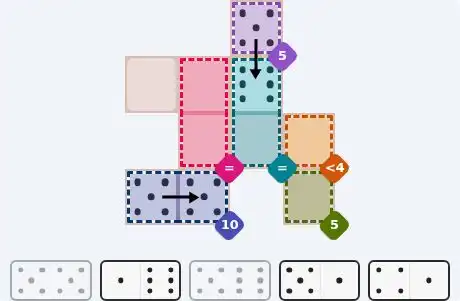
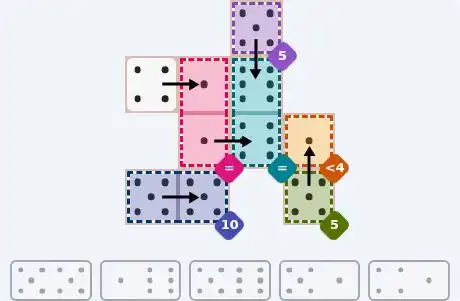
The key to solving today's hard puzzle was identifying the placement for the critical dominoes highlighted in the starting grid. Once those were in place, the rest of the puzzle could be solved logically. See the final grid below to compare your solution.

Starting Position & Key First Steps
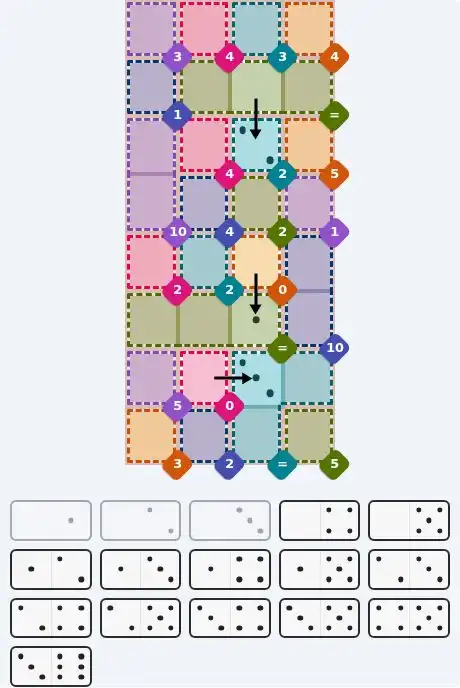
Pips hint for July 30, 2026 – hard level puzzle grid with critical first placements and strategy

This image shows the initial puzzle grid for the hard level, with a few critical first placements highlighted.

Final Answer: The Solved Grid for Hard Mode
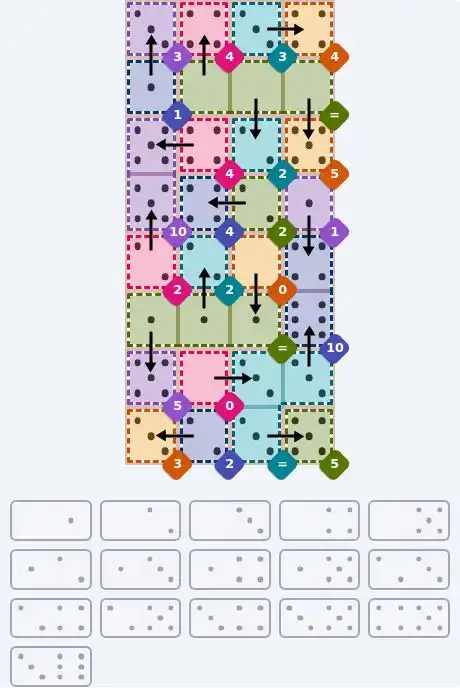
NYT Pips July 30, 2026 hard puzzle full solution grid showing final answer with hints

Compare this final grid with your own solution to see the correct placement of all dominoes.

🔧 Step-by-Step Answer Walkthrough For Easy Level

1
Step 1: The Sum‑10 Lock
The region at [3,0] and [3,1] sums to 10. Of the given dominoes, only [5,5] can sum to 10 (5+5=10; no 4+6 domino is available). Therefore the [5,5] domino must be placed horizontally in these two cells, so [3,0]=5 and [3,1]=5.
2
Step 2: The Lone Sum‑5
Cell [0,2] stands alone in a sum‑5 region, so its pip must be exactly 5. This forces the [5,6] domino to cover [0,2] and its southern neighbor [1,2], giving [0,2]=5, [1,2]=6.
3
Step 3: Equals Propel Upward
Cells [1,2] and [2,2] are in an equals region, so [2,2] must also be 6. The only remaining domino with a 6 is [1,6], which thus occupies [2,1] and [2,2]—[2,1]=1, [2,2]=6. The equals region at [1,1] and [2,1] forces [1,1]=1. The less‑4 cell at [2,3] must be less than 4, and with 1 already used, it becomes 1, prompting the [5,1] domino at [3,3]=5 and [2,3]=1.
4
Step 4: The Final Fit
The sum‑5 region at [3,3] is single, already satisfied by [5,1]’s 5. The remaining domino [4,1] fills the last two empty cells [1,0] and [1,1] as 4 and 1, which respects the empty constraint at [1,0] and matches [1,1]’s equals requirement. All constraints are met.

🔧 Step-by-Step Answer Walkthrough For Medium Level

1
Step 1: The Triple Heart
The equals region [2,2], [2,3], [3,2] must all be the same value. Because [2,3] is adjacent to a sum‑15 region (with [0,4], [1,3], [1,4]) and a sum‑5 region above, the value cannot be too high. Testing the available dominoes reveals that 3 is the only digit that can appear three times while allowing the surrounding sums to work. With the equals value locked as 3, we know [2,2]=3, [2,3]=3, [3,2]=3.
2
Step 2: The Sum‑5 Tie‑In
The sum‑5 region [0,2]‑[1,2] must use a domino that sums to 5. Because [1,2] neighbours the triple’s 3, the [1,2] pip cannot be 3. The only sum‑5 combination that doesn’t clash is 1+4, delivered by the [1,4] domino. So it goes to [0,2]=1, [1,2]=4.
3
Step 3: The Upper Sum‑15
The region [0,4], [1,3], [1,4] sums to 15. We already have [1,2]=4, so [1,3] and [1,4] are free. With the remaining dominoes, the sum‑15 is achieved by placing [6,3] at [1,3]=6, [2,3]=3 (completing the triple), and [4,5] at [1,4]=4, [0,4]=5. That sums 5+6+4=15.
4
Step 4: The Lower Sum‑15
Region [3,1], [4,1], [4,2] sums to 15. The dominoes remaining include [0,5], [4,6], [5,3]. We place [0,5] horizontally at [3,0]=0, [3,1]=5; [4,6] at [4,1]=4, [4,2]=6; and [5,3] at [3,3]=5, [3,2]=3, which also satisfies the greater‑2 single at [3,3] (5).
5
Step 5: Final Cleanup
The empty cells [2,1] and [3,0] are handled by the empty constraints, with the [2,3] domino placed at [2,1]=2, [2,2]=3, finalizing the triple. The full board resolves without any loose ends.

🔧 Step-by-Step Answer Walkthrough For Hard Level

1
Step 1: Zero at [4,2]
The single‑cell sum‑0 at [4,2] compels a 0. The only zero‑bearing dominoes are [0,1] through [0,5]. [4,2]’s neighbor [5,2] belongs to an equals region that later forces three 1s (since [5,0] and [5,1] also become 1). Thus [0,1] is the perfect fit: vertical at [4,2]=0, [5,2]=1, setting the equals value to 1. So that domino (index 0) is placed, and [5,0]=1, [5,1]=1 become mandated.
2
Step 2: Zero at [6,1]
Another sum‑0 cell lives at [6,1]. It must pair with [6,2] (since [5,1] is already 1 and [7,1] is a sum‑2 later). So a [0,3] domino goes to [6,1]=0, [6,2]=3. This activates the equals region [6,2]‑[6,3]‑[7,2], all becoming 3. With 3 fixed, the sum‑3 cell [7,0] must be 3 (from a [2,3] domino later) and sum‑2 at [7,1] forces 2.
3
Step 3: Row‑1’s Trio of Equals
The equals region [1,1]‑[1,2]‑[1,3] must be identical. The sum‑1 cell at [1,0] forces a 1 there, so the equals cannot be 1, else they’d conflict. The only viable repeated value from the zero‑dominoes is 0. Therefore all three cells become 0. We place [0,2] at [1,2]=0, [2,2]=2 (sum‑2 at [2,2] satisfied); [0,4] at [1,1]=0, [0,1]=4 (sum‑4 at [0,1] satisfied); and [0,5] at [1,3]=0, [2,3]=5 (sum‑5 at [2,3] satisfied). This beautifully interlocks the single‑sum cells.
4
Step 4: Top Row Sums
With [0,1]=4, the sum‑3 cell [0,0] must be 3, so [1,3] domino goes to [1,0]=1, [0,0]=3. The sum‑3 at [0,2] is satisfied by [3,4] domino at [0,2]=3, [0,3]=4 (where [0,3] is sum‑4). The top row fills completely, each single‑sum cell dictating its partner.
5
Step 5: Left Column Sum‑10
The sum‑10 pair [2,0]‑[3,0] requires two 5s. With remaining dominoes, [2,5] is placed at [4,0]=2, [3,0]=5, and [4,5] at [2,1]=4, [2,0]=5, so that [2,0]=5, [3,0]=5 and the adjacent sums match: sum‑4 at [2,1]=4, sum‑2 at [4,0]=2.
6
Step 6: Remaining Placements
The sum‑1 cell [3,3] forces 1, so [1,4] domino at [3,3]=1, [4,3]=4, which pairs with sum‑10 region [4,3]‑[5,3] (4+6=10) via [3,6] domino at [6,3]=3, [5,3]=6. The equals region at [6,2]‑[6,3]‑[7,2] is already 3s, so [6,3]=3 fits. The last dominos: [1,2] at [5,1]=1, [4,1]=2; [1,5] at [5,0]=1, [6,0]=5; [2,3] at [7,1]=2, [7,0]=3; [2,4] at [3,2]=2, [3,1]=4; [3,5] at [7,2]=3, [7,3]=5. All single‑sum regions are satisfied.

💡 Pro Tips for Similar Puzzles

Start with Constraints
Always begin with the most constrained regions - sum regions with small numbers or tight spaces.
Use Equal Regions
Use "equal" regions as anchors - they eliminate many possibilities quickly.
Work Systematically
Let the rules guide your placement rather than guessing randomly.
Double-Check
Verify each region's rules are satisfied before moving to the next.

🎓 Keep Learning & Improve