NYT Pips Hints & Answers for July 28, 2026

Jul 28, 2026

๐Ÿšจ SPOILER WARNING

This page contains the final **answer** and the complete **solution** to today's NYT Pips puzzle. If you haven't attempted the puzzle yet and want to try solving it yourself first, now's your chance!

Click here to play today's official NYT Pips game first.

Want hints instead? Scroll down for progressive clues that won't spoil the fun.

SEE ALSO:

๐ŸŽฒ Today's Puzzle Overview

Ian Livengood's easy grid deploys two equals regions that lock identical pip values across adjacent cells, bounded by less-than and greater-than constraints. The less-3 and less-1 regions cut the possible values, while the greater-5 forces a single high pip. The available domino setโ€”all containing a zero except one doubleโ€”interacts with these constraints to produce a short, deterministic chain: resolve the inequality extremes, then populate the equals clusters.

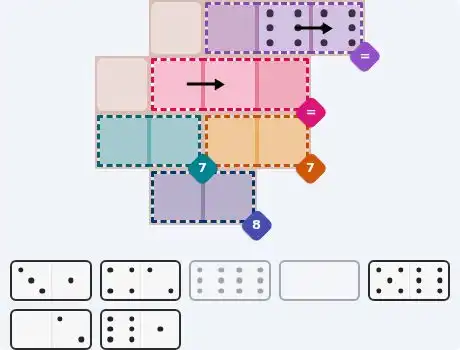
Rodolfo Kurchan's medium puzzle escalates with chained sum targets: two sum-7 regions sit side by side, adjacent to a sum-8, and are flanked by two three-cell equals regions. The equals zones impose uniform values that immediately claim the only matching dominoesโ€”[6,6] and [0,0]. Once those are placed, the sum constraints resolve via a cascade: the remaining pips partition cleanly into the sum targets, with the domino [4,2] acting as a bridge between the sum-7 and sum-8 regions.

Kurchan's hard grid reads like a preseeded number puzzle: 32 single-cell sum targets dictate exact pip values for almost every position, leaving only a few empty and greater-0 cells as slack. The domino set is tailored to this latticeโ€”each required value must be paired with a 0 or another specific number from a neighboring cell. Solving becomes an exercise in matching domino halves to fixed sum demands, with the empty cells absorbing the 0 halves from the low-value sum targets. This tightly orchestrated design makes the NYT Pips hard puzzle a pure logic of placement.

๐Ÿ’ก Progressive Hints

Try these hints one at a time. Each hint becomes more specific to help you solve it yourself!

๐Ÿ’ก Hint 1: Spot the boundaries
Look at the constraint types: the grid has two equals regions that force neighboring cells to share the same pip, plus less-than and greater-than limits on single cells. The extreme bounds (less than 1, greater than 5) will give away the first firm numbers.
๐Ÿ’ก Hint 2: Pin the extremes
The cell at [3,2] must be greater than 5, so it can only be 6. That forces the [0,6] domino into that column. Meanwhile, [2,4] must be less than 1, so it is 0โ€”which drags a 1 into the adjacent equals region at [2,3].
๐Ÿ’ก Hint 3: Full layout
Place the [0,6] domino vertically at [3,3] (0) and [3,2] (6). The [0,1] domino goes horizontally at [2,4] (0) and [2,3] (1). The [0,2] domino covers [2,0]=2 and [2,1]=0, pairing with the equals region. The [1,1] double fills [1,2]=1 and [1,3]=1, completing the other equals cluster. Finally, [0,5] lands vertically at [1,1]=0 and [0,1]=5.
๐Ÿ’ก Hint 1: Equal footing
The medium puzzle leans on two broad equals regions and three sum targets. Start by identifying the only dominos that can supply triple-identical pips for those equals clusters.
๐Ÿ’ก Hint 2: Identity crisis
The three-cell equals region in row 0 must be all the same number. The only domino with identical pip values in the set is [6,6], so that region forces two of its cells to 6, and the third must also be 6 from a neighboring placement. Similarly, the row-1 equals region demands [0,0].
๐Ÿ’ก Hint 3: Full layout
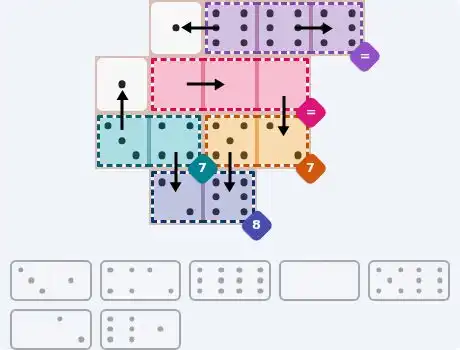
Place [6,6] horizontally at [0,3] and [0,4], then the third cell [0,2] gets 6 from the [6,1] domino (with 1 in [0,1]). The row-1 equals region gets [0,0] at [1,1] and [1,2], and the remaining cell [1,3] receives 0 via [0,2] domino. The sum-7 region at [2,0]-[2,1] must be 3+4, using [3,1] vertically. The adjacent sum-7 at [2,2]-[2,3] is 5+2, using [5,6] and [0,2]. The sum-8 at [3,1]-[3,2] gets 2+6 from [4,2].
๐Ÿ’ก Hint 1: Read the singles
Concentrate on the single-cell sum regions. When a region contains just one cell with a sum target, that cell's pip value is fixed. Scan the grid for these forced numbers.
๐Ÿ’ก Hint 2: Values on lockdown
The sum-1 cells (e.g., [1,0], [1,1], [3,2], [5,1], [6,0]) must contain a 1. Several sum-2, sum-3, sum-4, sum-5 cells similarly demand their exact values. The empty cells and greater-0 regions provide flexibility to absorb the domino halves that don't match a fixed sum.
๐Ÿ’ก Hint 3: Bottom-up approach
The lower half of the grid features many empty cells paired with fixed sum cells. For example, [5,1] (sum-1) is adjacent horizontally to the empty [5,2]. That invites the [0,1] domino: place 1 in [5,1] and 0 in [5,2]. Similarly, [4,1] (sum-2) and empty [3,1] call for the [0,2] domino.
๐Ÿ’ก Hint 4: Chain the pairs
Continue pairing sum cells with empties using the 0-x dominos: [0,3] for [4,3] (sum-3) and [5,3] empty; [0,4] for [4,0] (sum-4) and [5,0] empty. The upper rows then resolve by pairing sum cells together: [0,0] (sum-5) with [1,0] (sum-1) via [1,5]; [0,1] (sum-2) with [1,1] (sum-1) via [1,2]; and so on.
๐Ÿ’ก Hint 5: Full layout
Final placements: Use [0,1] at [5,2]/[5,1] (0/1); [0,2] at [3,1]/[4,1] (0/2); [0,3] at [5,3]/[4,3] (0/3); [0,4] at [5,0]/[4,0] (0/4); [0,5] at [6,2]/[6,1] (0/5). For the top: [1,2] at [1,1]/[0,1] (1/2); [1,3] at [3,2]/[4,2] (1/3); [1,4] at [6,0]/[7,0] (1/4); [1,5] at [1,0]/[0,0] (1/5). Then [2,3] at [2,3]/[3,3] (2/3); [2,4] at [2,0]/[3,0] (2/4); [2,5] at [0,3]/[0,2] (2/5); [3,4] at [7,3]/[6,3] (3/4); [3,5] at [7,2]/[7,1] (3/5); [4,5] at [2,2]/[2,1] (4/5); and [3,6] at [1,2]/[1,3] (3/6). Each placement exactly satisfies the fixed sum of its covered cells.

๐ŸŽจ Pips Solver

Jul 28, 2026

Click a domino to place it on the board. You can also click the board, and the correct domino will appear.
โœ… Final Answer & Complete Solution For Hard Level

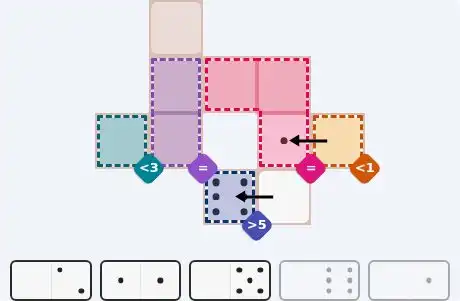
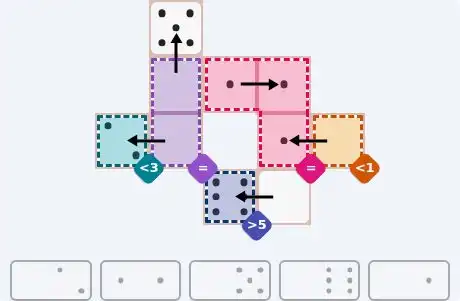
The key to solving today's hard puzzle was identifying the placement for the critical dominoes highlighted in the starting grid. Once those were in place, the rest of the puzzle could be solved logically. See the final grid below to compare your solution.

Starting Position & Key First Steps
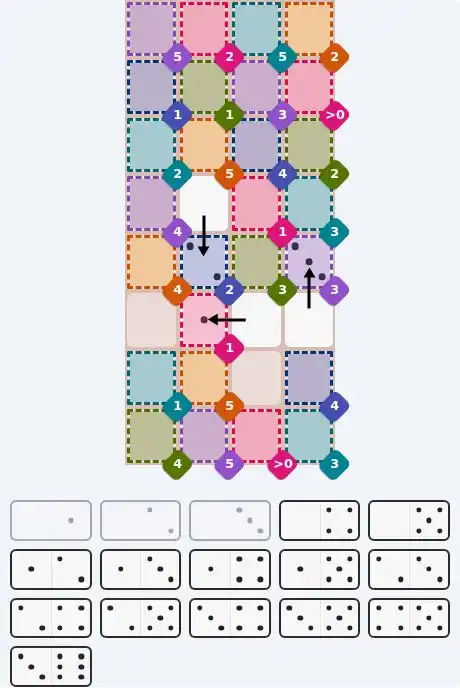
Pips hint for July 28, 2026 โ€“ hard level puzzle grid with critical first placements and strategy

This image shows the initial puzzle grid for the hard level, with a few critical first placements highlighted.

Final Answer: The Solved Grid for Hard Mode
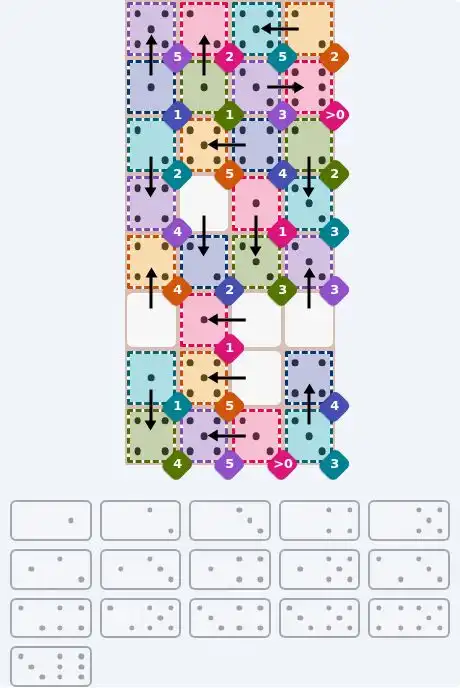
NYT Pips July 28, 2026 hard puzzle full solution grid showing final answer with hints

Compare this final grid with your own solution to see the correct placement of all dominoes.

๐Ÿ”ง Step-by-Step Answer Walkthrough For Easy Level

1
Step 1: Isolate inequality bounds
Cell [3,2] is >5, so its pip must be 6; cell [2,4] is <1, forcing 0; cell [2,0] is <3, narrowing its options to 0,1,2.
2
Step 2: Place the 6
The only domino containing a 6 is [0,6]. It must cover [3,2], placing 6 there and the 0 in [3,3] (the only adjacent empty cell). This satisfies the greater-5 constraint.
3
Step 3: Place the 0 for less-1
The less-1 cell [2,4] demands a 0. Domino [0,1] can place 0 in [2,4] and 1 in [2,3]. Conveniently, [2,3] belongs to the equals region with [1,2] and [1,3] that all require the same value. So they must all become 1. That forces the double [1,1] into [1,2] and [1,3].
4
Step 4: Resolve remaining equals
With [1,1] and [1,3] set to 1, the equals region at [1,1] and [2,1] must be equal. The less-3 cell [2,0] cannot be 0 or 1 (already used), so it takes 2 via [0,2] domino, placing 2 in [2,0] and 0 in [2,1]. Then [1,1] gets 0 from the remaining [0,5] domino, leaving the 5 in [0,1] (empty).

๐Ÿ”ง Step-by-Step Answer Walkthrough For Medium Level

1
Step 1: Lock the top equals
The row-0 three-cell equals region demands identical pips; the only domino with a matching pair is [6,6]โ€”place it horizontally over [0,3] and [0,4], setting them to 6.
2
Step 2: Lock the row-1 equals
The row-1 three-cell equals region forces a uniform value; the domino [0,0] is the sole source of two zeros, so place it at [1,1] and [1,2] (value 0).
3
Step 3: Complete the equals chains
Now the remaining cells in those equals regions must be resolved. [1,3] needs 0, supplied by the [0,2] domino, which puts 0 in [1,3] and 2 in [2,3] (part of a sum-7). [0,2] needs 6, fulfilled by the [6,1] domino, placing 6 in [0,2] and 1 in [0,1] (empty).
4
Step 4: Break the left sum-7
The left sum-7 at [2,0]-[2,1] receives 3 from [3,1] (with 1 going to the empty [1,0]) and 4 from [4,2] (with 2 placed in [3,1], starting the sum-8).
5
Step 5: Finish the right sum-7 and sum-8
The right sum-7 at [2,2]-[2,3] already holds 2 in [2,3]; [2,2] needs 5, so use [5,6] placing 5 there and 6 in [3,2]. This finishes the sum-8 with 2+6, and the grid is complete.

๐Ÿ”ง Step-by-Step Answer Walkthrough For Hard Level

1
Step 1: Translate the single-cell sums
Every region with one cell and a sum target forces that cell's exact pip: sum-1 โ†’ 1, sum-2 โ†’ 2, sum-3 โ†’ 3, sum-4 โ†’ 4, sum-5 โ†’ 5. The few empty/greater-0 cells absorb leftover domino halves.
2
Step 2: Fill the bottom empties
Address the bottom rows where empties lie adjacent to fixed sum cells. [5,1] (sum-1) pairs with empty [5,2] via [0,1] (0/1). [4,1] (sum-2) and empty [3,1] use [0,2] (0/2). [4,3] (sum-3) and empty [5,3] use [0,3] (0/3). [4,0] (sum-4) and empty [5,0] use [0,4] (0/4). [6,1] (sum-5) and empty [6,2] use [0,5] (0/5).
3
Step 3: Pair upper sum cells
Shift to the upper rows, where fixed sum cells sit cheek-by-jowl. [0,0] (sum-5) and [1,0] (sum-1) share a column; the [1,5] domino (pips 1,5) fits exactly, placing 5 in [0,0] and 1 in [1,0]. Similarly, [0,1] (sum-2) and [1,1] (sum-1) align for [1,2] (1/2) with 1 in [1,1] and 2 in [0,1].
4
Step 4: Continue pairing 1s with other sums
[3,2] (sum-1) and [4,2] (sum-3) demand 1 and 3โ€”satisfied by [1,3] vertical. [6,0] (sum-1) and [7,0] (sum-4) take [1,4] with 1 at [6,0], 4 at [7,0].
5
Step 5: Resolve 2/4 and 2/3 clusters
[2,0] (sum-2) and [3,0] (sum-4) share the [2,4] domino (2/4). [2,3] (sum-2) and [3,3] (sum-3) take [2,3] (2/3). [0,2] (sum-5) and [0,3] (sum-2) pair via [2,5] (2/5), placing 5 at [0,2] and 2 at [0,3].
6
Step 6: Finish the higher pairs
[2,1] (sum-5) and [2,2] (sum-4) take [4,5] (4/5). [7,1] (sum-5) and [7,2] (greater-0) use [3,5] (3/5) with 5 in [7,1] and 3 in [7,2] (satisfying >0). [6,3] (sum-4) and [7,3] (sum-3) get [3,4] (3/4). Finally, [1,2] (sum-3) and the greater-0 cell [1,3] become 3 and 6 via [3,6].

๐Ÿ’ก Pro Tips for Similar Puzzles

Start with Constraints
Always begin with the most constrained regions - sum regions with small numbers or tight spaces.
Use Equal Regions
Use "equal" regions as anchors - they eliminate many possibilities quickly.
Work Systematically
Let the rules guide your placement rather than guessing randomly.
Double-Check
Verify each region's rules are satisfied before moving to the next.

๐ŸŽ“ Keep Learning & Improve