NYT Pips Hints & Answers for July 29, 2026

Jul 29, 2026

๐Ÿšจ SPOILER WARNING

This page contains the final **answer** and the complete **solution** to today's NYT Pips puzzle. If you haven't attempted the puzzle yet and want to try solving it yourself first, now's your chance!

Click here to play today's official NYT Pips game first.

Want hints instead? Scroll down for progressive clues that won't spoil the fun.

SEE ALSO:

๐ŸŽฒ Today's Puzzle Overview

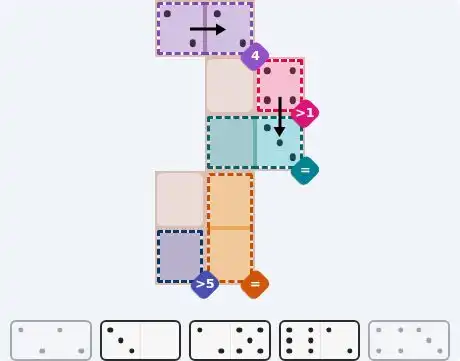
When you open Ian Livengood's easy NYT Pips grid, the first thing you notice is a sum-4 region cradled in the top-left cornerโ€”two cells that must total just 4. That instantly narrows the field to one double-number domino, and from there the dominoes cascade with a pleasant rhythm. An equals region in the middle row teams up with a greater-than cell above it, forming a tight little logic lock that resolves without guesswork.

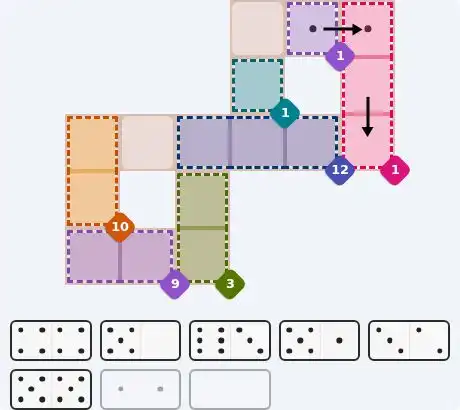
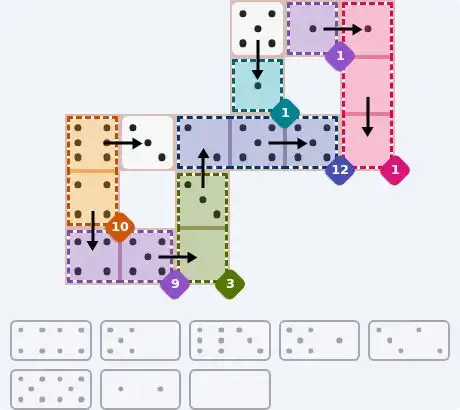
Livengood's medium puzzle raises the stakes with a web of sum-1 regions. These tiny targets force a cluster of zeros and ones that spreads across the right side, pulling in single-cell and multi-cell sum-1 zones. The solver has to juggle a 10-sum column and a 12-sum longitudinal stretch, but the initial sum-1 anchors provide the needed early momentum.

Then Rodolfo Kurchanโ€™s hard puzzle arrives like a domino sudoku. The board is divided into many small sum regions, including a chain of sum-3 demands that force precise combosโ€”1+1+1 in a three-cell vertical column, 1+2 pairs elsewhere. The crescendo is a jaw-dropping sum-24 region in the bottom-right corner: four cells that must each be a 6. Solving it feels like cracking a safe, with every domino clicking into place as the sum-24 monster feeds on the pips above it.

๐Ÿ’ก Progressive Hints

Try these hints one at a time. Each hint becomes more specific to help you solve it yourself!

๐Ÿ’ก First Glance
Start with the smallest target sum you can find. There's a region that asks for a total of just 4 across two adjacent cells. Only one domino in the set can meet that demand, and it forces both cells to share the same number.
๐Ÿ’ก Equal Footing
With that double placed, an equals region in the middle becomes the next tight lock. It links a cell in row 2 to another cell that also participates in a greater-than constraint above it. The only way to satisfy the greater-than-1 requirement and the equals constraint is to give the top cell the higher of the two pips on the domino that reaches there.
๐Ÿ’ก Full Solution
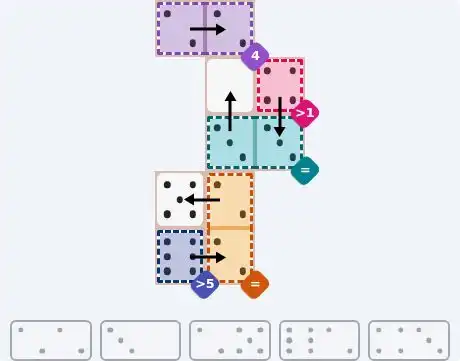
Place the [2,2] domino horizontally at [0,0] and [0,1] (both 2). Then place the [4,3] domino so that [1,2]=4 and [2,2]=3, fulfilling the greater-1 and equals region. That forces [2,1]=3, so the [3,0] domino goes vertically with [1,1]=0 and [2,1]=3. Next, the equals region at [3,1] and [4,1] forces them to be 2; the [6,2] domino covers [4,0]=6 and [4,1]=2 (satisfying greater-5 at [4,0]). Finally, the [2,5] domino fills [3,0]=5 and [3,1]=2.
๐Ÿ’ก Tiny Targets
The grid is dominated by sum-1 regions. These tiny targets force many zeros and ones. Identify the dominoes whose pips can add up to 1 across their two halvesโ€”they become the anchors.
๐Ÿ’ก Right-Edge Nudge
The three-cell sum-1 region in the rightmost column is especially telling. It needs three numbers that sum to 1, which is only possible with a single 1 and two 0s. The [0,0] domino can supply the 0s, while the [1,1] domino locks in the 1 together with an adjacent single-cell sum-1 region.
๐Ÿ’ก Full Solution
Place [0,0] domino at [1,5]=0 and [2,5]=0. Place [1,1] domino at [0,4]=1 and [0,5]=1, satisfying the single-cell sum-1 at [0,4] and providing the 1 for the three-cell region. The single-cell sum-1 at [1,3] gets 1 from the [5,1] domino placed at [0,3]=5 and [1,3]=1. Then the sum-10 region at rows 2-3 col0 uses [4,4] domino at [3,0]=4 and [4,0]=4 and the remaining 6 from the [6,3] domino placed at [2,0]=6 and [2,1]=3. Next, the sum-12 region spanning row 2 cols 2-4 sums to 2+5+5; the [5,5] domino fills [2,3]=5 and [2,4]=5, while the [3,2] domino goes [3,2]=3 and [2,2]=2. Finally, the sum-3 region at [3,2],[4,2] gets 3+0 from [5,0] domino placed at [4,1]=5 and [4,2]=0, completing the sum-9 region at [4,0]=4 and [4,1]=5.
๐Ÿ’ก Sum Minimums
Look for the sum-regions with the smallest targetsโ€”several demand a total of just 3. These will dictate the early placements because only a very limited set of pip combinations can achieve such a low sum.
๐Ÿ’ก Column of Ones
The vertical three-cell sum-3 region in column 2 (rows 3โ€“5) is the key. With three cells, the only way to sum to 3 without repeating a domino constraint is 1+1+1, which forces the use of the [1,1] domino for two of them and the [0,1] domino for the third.
๐Ÿ’ก Pairs that Sum to 3
Next, the sum-3 region at rows 4โ€“5 and columns 5โ€“6 is two cells, so it must be 1+2. Your available [1,2] domino fits perfectly, leaving a 1 and a 2. Meanwhile, a horizontal sum-3 at [5,4]-[6,4] needs two cells sum to 3, which means 2+1โ€”the [2,2] domino's 2 and the [1,4] domino's 1 meet that once you pair them with the larger structure to the right.
๐Ÿ’ก The 24-Point Feast
Now turn to the monster sum-24 region occupying the bottom-right four cells. With values capped at 6, the only way to reach 24 is four 6s. That forces the [6,6] domino into [7,4]=6 and [7,5]=6, and pulls in high dominoes like [5,6] and [4,6] to finish the 6-cluster.
๐Ÿ’ก Full Solution
Start with domino [0,1] at [6,2]=0 and [5,2]=1; then [1,1] at [3,2]=1 and [4,2]=1, completing the sum-3 column. Next, [1,2] at [4,5]=1 and [4,6]=2 (sum 3). Place [2,2] domino at [5,4]=2 and [5,5]=2, then [1,4] at [6,4]=1 and [6,5]=4. The sum-12 at left requires [2,6] at [1,0]=2, [1,1]=6 and [3,6] at [0,2]=3, [0,1]=6; then sum-11 gets [4,4] at [1,2]=4, [2,2]=4. Sum-3 at [6,2][6,3] needs 0+3, so [3,3] at [6,3]=3, [7,3]=3. Sum-5 at [5,5][5,6] uses [3,4] at [5,6]=3, [5,7]=4. Sum-8 at [5,7][6,7] gets [4,6] at [6,7]=4, [7,7]=6. Sum-10 at [6,8][7,8] gets [5,5] at [6,8]=5, [7,8]=5. Sum-9 at [6,5][6,6] receives [5,6] at [6,6]=5, [7,6]=6. Finally, sum-24 fills [6,6] at [7,4]=6, [7,5]=6, plus the 6s already placed at [7,6] and [7,7].

๐ŸŽจ Pips Solver

Jul 29, 2026

Click a domino to place it on the board. You can also click the board, and the correct domino will appear.
โœ… Final Answer & Complete Solution For Hard Level

The key to solving today's hard puzzle was identifying the placement for the critical dominoes highlighted in the starting grid. Once those were in place, the rest of the puzzle could be solved logically. See the final grid below to compare your solution.

Starting Position & Key First Steps
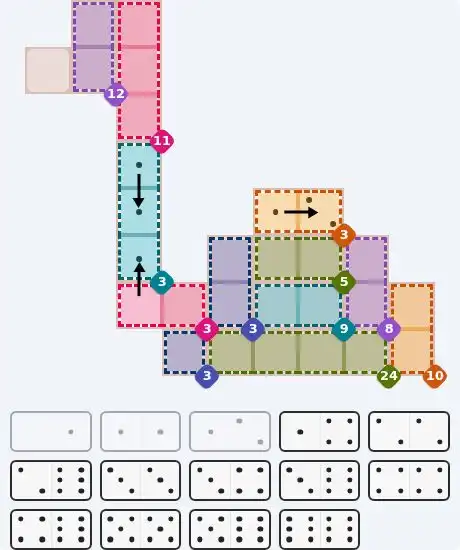
Pips hint for July 29, 2026 โ€“ hard level puzzle grid with critical first placements and strategy

This image shows the initial puzzle grid for the hard level, with a few critical first placements highlighted.

Final Answer: The Solved Grid for Hard Mode
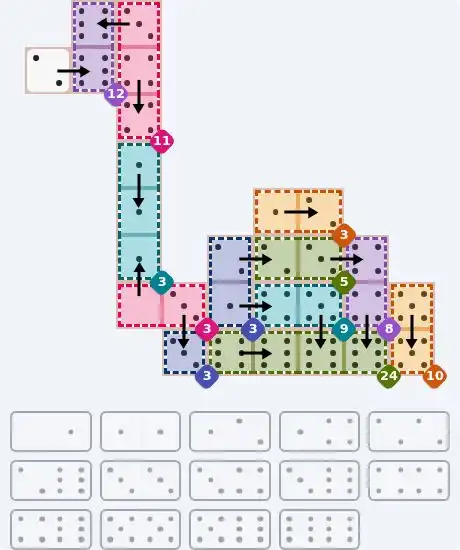
NYT Pips July 29, 2026 hard puzzle full solution grid showing final answer with hints

Compare this final grid with your own solution to see the correct placement of all dominoes.

๐Ÿ”ง Step-by-Step Answer Walkthrough For Easy Level

1
Step 1: Lock the Sum-4
The region at [0,0] and [0,1] must sum to 4. The only domino that can do that is [2,2], since 2+2=4. Place it horizontally with [0,0]=2 and [0,1]=2.
2
Step 2: Equalize the Middle
The equals region at [2,1] and [2,2] means those cells are identical. The cell [2,2] is part of a domino that also covers [1,2], which has a greater-than-1 constraint. The only domino among [4,3] that has a pip >1 is the 4, so [1,2]=4 and [2,2]=3. That forces [2,1]=3. Then the [3,0] domino goes vertically, placing [1,1]=0 and [2,1]=3.
3
Step 3: Greater-Than and Equals
Now the equals region at [3,1] and [4,1] requires those cells to match. The remaining dominoes are [2,5] and [6,2]. The cell [4,0] must be >5, so it must get the 6 from [6,2]. That gives [4,0]=6 and [4,1]=2. Thus [3,1]=2 to satisfy the equals region. The [2,5] domino then fills [3,0]=5 and [3,1]=2 perfectly.
4
Step 4: Review
All constraints are met: sum-4 (2+2), equals in row 2 (3,3), empty cell [1,1]=0, greater-1 at [1,2]=4, greater-5 at [4,0]=6, equals in column 1 (2,2), and empty [3,0]=5.

๐Ÿ”ง Step-by-Step Answer Walkthrough For Medium Level

1
Step 1: Anchor the Sum-1s
The three-cell sum-1 region at [0,5][1,5][2,5] can only sum to 1 with a 1 and two 0s. Place the [0,0] domino at [1,5]=0 and [2,5]=0. The adjacent single-cell sum-1 at [0,4] must be 1, so the [1,1] domino goes horizontally at [0,4]=1 and [0,5]=1, supplying the needed 1 for the three-cell region.
2
Step 2: The Other Sum-1 Corral
The single-cell sum-1 at [1,3] requires a 1. The [5,1] domino can provide that by placing 5 above it at [0,3]=5 (empty region) and 1 at [1,3]=1.
3
Step 3: The 10-Sum Column
The sum-10 region at [2,0][3,0] needs two numbers that sum to 10. The [4,4] domino supplies 4 and 4, so place it at [3,0]=4 and [4,0]=4. Then [2,0] must be 6. The [6,3] domino places 6 at [2,0] and the accompanying 3 goes into the empty cell [2,1]=3.
4
Step 4: The 12-Sum Stretch
Row 2 columns 2โ€“4 must sum to 12. The [3,2] domino is used to satisfy the sum-3 region at [3,2][4,2] later, but first its 2 goes into [2,2]=2. The remaining two cells need 10 more, so the [5,5] domino fills [2,3]=5 and [2,4]=5. Now the sum-3 region at [3,2][4,2] already has 3 at [3,2] from the [3,2] domino (since [2,2]=2, the partner is 3 at [3,2]). To reach sum 3, [4,2] must be 0. The [5,0] domino puts 5 at [4,1] and 0 at [4,2], satisfying sum-3 and also the sum-9 region at [4,0][4,1] (4+5=9).
5
Step 5: Verify
Check all regions: the right-side sum-1s total 1, left column sums to 10, the long row to 12, and the bottom regions hold. Every domino is placed without conflict.

๐Ÿ”ง Step-by-Step Answer Walkthrough For Hard Level

1
Step 1: The Vertical Sum-3 Column
The three-cell region at [3,2][4,2][5,2] must sum to 3. The only feasible combination with available dominoes is 1+1+1. Place the [0,1] domino vertically at [6,2]=0 and [5,2]=1, and the [1,1] domino at [3,2]=1 and [4,2]=1, leaving [5,2]=1 to complete the column.
2
Step 2: The Two-Cell Sum-3 Duos
The region [4,5][4,6] sums to 3, forcing 1+2. The [1,2] domino fits: [4,5]=1, [4,6]=2. Similarly, the region [5,4][6,4] sums to 3, needing 2+1. Place the [2,2] domino at [5,4]=2 and [5,5]=2, and the [1,4] domino at [6,4]=1 and [6,5]=4.
3
Step 3: Left Side Sums
The sum-12 region [0,1][1,1] requires 6+6. The [2,6] domino places 2 at [1,0] and 6 at [1,1]; the [3,6] domino places 3 at [0,2] and 6 at [0,1]. That satisfies sum-12 and begins the sum-11 region [0,2][1,2][2,2] which now has 3 at [0,2]. The remaining 8 must be 4+4, so place [4,4] at [1,2]=4 and [2,2]=4.
4
Step 4: Middle Row Sums
The sum-3 region [6,2][6,3] needs 0+3. With [6,2] already 0, place [3,3] at [6,3]=3 and [7,3]=3. For sum-5 at [5,5][5,6], [5,5] is already 2; the partner must be 3, so place [3,4] at [5,6]=3 and [5,7]=4. This fills part of sum-8 at [5,7][6,7].
5
Step 5: The 24-Point Finale
The sum-24 region at [7,4][7,5][7,6][7,7] demands four 6s. Place [6,6] at [7,4]=6 and [7,5]=6. Then sum-9 at [6,5][6,6] already has [6,5]=4, so [6,6] must be 5. Use [5,6] at [6,6]=5 and [7,6]=6, giving the third 6. Finally, sum-8 needs [6,7]=4, so place [4,6] at [6,7]=4 and [7,7]=6, completing the quartet. Sum-10 at [6,8][7,8] receives [5,5] at [6,8]=5 and [7,8]=5. All regions are resolved.

๐Ÿ’ก Pro Tips for Similar Puzzles

Start with Constraints
Always begin with the most constrained regions - sum regions with small numbers or tight spaces.
Use Equal Regions
Use "equal" regions as anchors - they eliminate many possibilities quickly.
Work Systematically
Let the rules guide your placement rather than guessing randomly.
Double-Check
Verify each region's rules are satisfied before moving to the next.

๐ŸŽ“ Keep Learning & Improve