NYT Pips Hints & Answers for July 26, 2026

Jul 26, 2026

🚨 SPOILER WARNING

This page contains the final **answer** and the complete **solution** to today's NYT Pips puzzle. If you haven't attempted the puzzle yet and want to try solving it yourself first, now's your chance!

Click here to play today's official NYT Pips game first.

Want hints instead? Scroll down for progressive clues that won't spoil the fun.

SEE ALSO:

🎲 Today's Puzzle Overview

In today’s NYT Pips easy, Ian Livengood crafts a compact 10-cell grid that feels like a puzzle whisper: every constraint is a taut string. A sum-8, sum-11, sum-4, an equals pair, and a less-than-2 cell—none can wobble without the whole thing unraveling. Livengood’s signature is the elegant intertwined sums that force a precise domino ordering, leaving no wasted space.

Rodolfo Kurchan’s medium puzzle reads like a manifesto on equality. Four distinct equals regions—three of them triples and one a pair—span the grid, demanding that dominoes marry into seamless chains. Kurchan deploys doubles (4,4 and 5,5 and 2,2) as load-bearing beams, while a single empty cell and a greater-than-2 spot provide the necessary relief. The result is a structurally immaculate design where the solver’s eye shifts from column to column like stepping stones.

Kurchan’s hard puzzle is a labyrinth of tiny sum cells and a rare unequal 2×2 region—a constraint that insists on four different pip values. A four-cell equals column of zeros, a sum-0 singleton, and an intricate network of sums (some as small as one cell) create a puzzle that is as much about precision as pattern recognition. Kurchan’s design intent shines: the unequal block acts as a fulcrum, balancing the surrounding sums and equalities into a single solution that feels both surprising and inevitable.

💡 Progressive Hints

Try these hints one at a time. Each hint becomes more specific to help you solve it yourself!

💡 Eye the Extremes
The grid includes a 'less than' constraint, a few sums, and an equals pair. Start by considering the cell that is restricted to being less than 2 — it has only two possible values, but the available dominoes make one impossible.
💡 Zero In on [3,3]
The cell at [3,3] can only be 0 or 1. Look at the domino containing a 0: it’s [0,4]. If you place the 0 at [3,3], its partner 4 must go to [2,3], which is an empty cell that gladly accepts it. That move locks in the first domino.
💡 Full Solution Unlocked
Place domino [0,4] with 0 at [3,3] and 4 at [2,3]. The sum‑11 pair [0,2]–[1,2] must be 6+5, so [0,2]=6, [1,2]=5 using domino [3,5] vertically (5 at [1,2], 3 at [2,2]). The equals pair [2,1]–[2,2] now forces [2,1]=3; place domino [1,3] as [2,0]=1, [2,1]=3. The sum‑4 column [1,0]–[2,0] then needs [1,0]=3, so domino [2,3] fills [0,0]=2, [1,0]=3. Finally, the double‑6 domino [6,6] occupies [0,1]–[0,2] horizontally, satisfying the sum‑8 region and completing the grid.
💡 Follow the Equals
This grid is dominated by equals regions—columns where every cell shares the same pip. Identify which domino doubles can anchor these columns, because a triple‑equals column requires at least one double to supply two of the identical values.
💡 Lock the Central Columns
The triple‑equals column spanning [0,1]–[2,1] must all be 4; the double‑4 domino covers [0,1] and [1,1], and the third 4 comes from a horizontal domino linking [2,1] to [2,0]. Similarly, the triple‑equals column [1,2]–[3,2] must all be 5, launched by the double‑5 domino.
💡 Complete Chain Reaction
Place the [4,4] domino vertically at [0,1]–[1,1]. To give [2,1] a 4, use the [4,5] domino horizontally at [2,1]–[2,0] (4 and 5). The double‑5 goes to [1,2]–[2,2], and then [3,2] gets its 5 from the [5,3] domino placed as [3,2]–[4,2] (5 and 3). The equals pair [2,0]–[3,0] both 5: [2,0] is already 5, so [3,0] must be 5 from the [0,5] domino (0 at [3,1], 5 at [3,0]). The triple‑equals [2,3]–[4,3] all 2: use the [2,2] domino at [2,3]–[3,3], then the [2,1] domino at [4,3]–[4,4] (2 and 1). The greater‑than‑2 cell [4,2] gets a compliant 3 from the already‑placed [5,3] domino.
💡 Rare Unequal Territory
Seek out the 'unequal' region—a 2×2 block where no two cells may share a pip. Also keep an eye on a long column of four equals cells and a tiny sum‑0 cell that dictates an immediate value.
💡 Zero Sum, Zero Escape
The sum‑0 cell at [5,8] forces a 0 there, and its domino partner 2 must go to [4,8] (part of a sum‑3 pair). Meanwhile, the four‑cell equals column at [3,3]–[6,3] can only be filled with zeros—look for dominoes that provide 0 in multiple places: the double‑[0,0], the [0,3], and the [6,0].
💡 Top‑Left Sums Cascade
With the zero column anchored, the sum‑2 singleton at [0,2] forces a 2, pulling the [2,3] domino into place (2 at [0,2], 3 at [1,2]). The sum‑5 pair [1,1]‑[1,2] then needs [1,1]=2, which the [2,1] domino supplies by placing 2 at [1,1] and 1 at [1,0]. The sum‑2 pair [1,0]‑[2,0] finishes with [2,0]=1, delivered by the [3,1] domino at [2,1]‑[2,0] (3 and 1).
💡 The Unequal Pivot
The unequal 2×2 covers [3,4]‑[3,5] and [4,4]‑[4,5]. You already have [3,4]=3 (from [0,3]) and [3,5]=0 (from [5,0]). To keep all four distinct, [4,4] and [4,5] must be two unused values—the double‑2 domino gives [4,4]=2, and the [1,6] domino places 1 at [4,5] and 6 at [5,5] (satisfying the sum‑6 at [5,5]). The sum‑2 at [5,4] is met by the 2 from the double‑2.
💡 Final Right‑Side Assembly
The sum‑10 pair [3,6]‑[3,7] gets [3,6]=5 (already from [5,0]) and [3,7]=5 via the [5,1] domino (5 at [3,7], 1 at [3,8], completing the sum‑3 with [4,8]=2). The sum‑7 pair [5,6]‑[6,6] is satisfied by domino [3,4] placed as [4,6]=3, [5,6]=4, and domino [3,5] at [6,6]=3, [7,6]=5 (which also matches the lone sum‑5 at [7,6]). All pieces click.

🎨 Pips Solver

Jul 26, 2026

Click a domino to place it on the board. You can also click the board, and the correct domino will appear.
Final Answer & Complete Solution For Hard Level

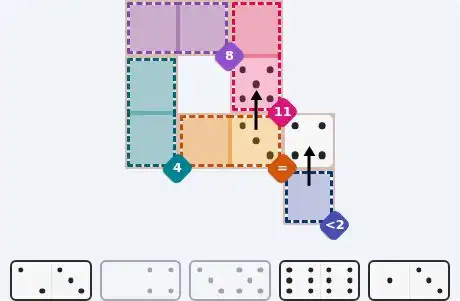
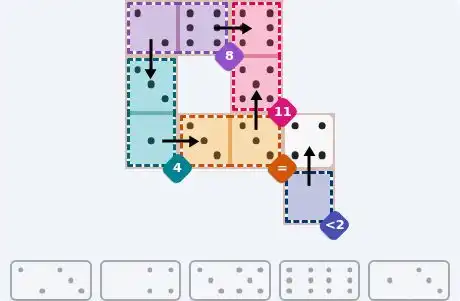
The key to solving today's hard puzzle was identifying the placement for the critical dominoes highlighted in the starting grid. Once those were in place, the rest of the puzzle could be solved logically. See the final grid below to compare your solution.

Starting Position & Key First Steps
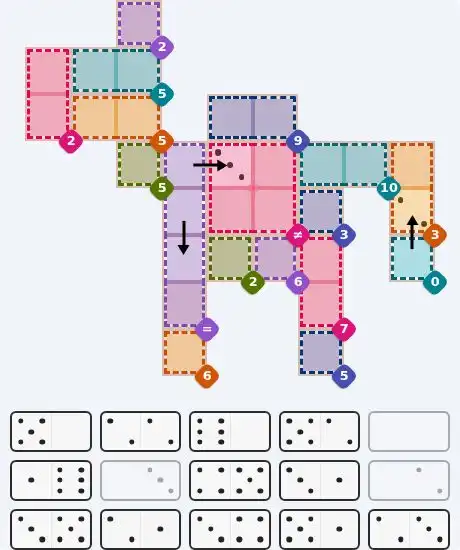
Pips hint for July 26, 2026 – hard level puzzle grid with critical first placements and strategy

This image shows the initial puzzle grid for the hard level, with a few critical first placements highlighted.

Final Answer: The Solved Grid for Hard Mode
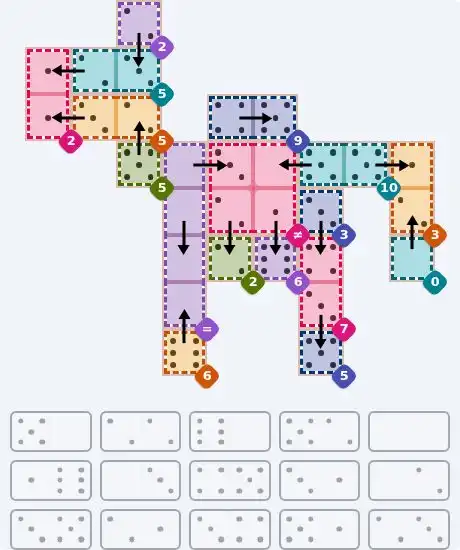
NYT Pips July 26, 2026 hard puzzle full solution grid showing final answer with hints

Compare this final grid with your own solution to see the correct placement of all dominoes.

🔧 Step-by-Step Answer Walkthrough For Easy Level

1
Step 1: Forced Zero from Less‑Than
The less‑than‑2 cell at [3,3] can be 0 or 1, but the only domino containing a 0 is [0,4]. Placing 0 at [3,3] forces [2,3]=4, satisfying the empty cell. Otherwise, reserving the 0 elsewhere would strand the less‑than cell with no valid partner, so this is logically forced.
2
Step 2: Sum‑11 Locks a Double‑5 Route
The sum‑11 region [0,2] and [1,2] needs 6+5, the only possible pairing. Domino [3,5] has 3 and 5; placing it vertically with 5 at [1,2] and 3 at [2,2] satisfies the sum and sets [2,2]=3. This will later trigger the equals region.
3
Step 3: Equals Chain Solves Sum‑4
Because [2,2]=3, the equals pair [2,1]‑[2,2] demands [2,1]=3. Domino [1,3] (1 and 3) fits perfectly in the vertical span [2,0]‑[2,1] with 1 at [2,0] and 3 at [2,1]. The sum‑4 region [1,0]+[2,0] then needs [1,0]=3 to reach 1+3=4. The domino [2,3] (2 and 3) can be placed vertically at [0,0]‑[1,0] with 2 at [0,0] and 3 at [1,0].
4
Step 4: Double‑6 Caps the Grid
The sum‑8 region [0,0]‑[0,1] already has [0,0]=2, so [0,1] must be 6. The remaining domino [6,6] fits horizontally across [0,1]‑[0,2] — note [0,2] already received 6 from step 2, confirming the double‑6 lands exactly there, completing the puzzle.

🔧 Step-by-Step Answer Walkthrough For Medium Level

1
Step 1: Anchor the 4‑Equals Column
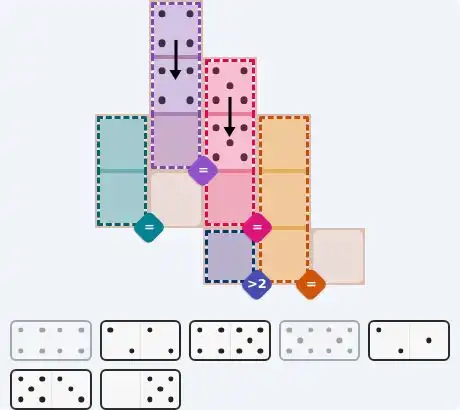
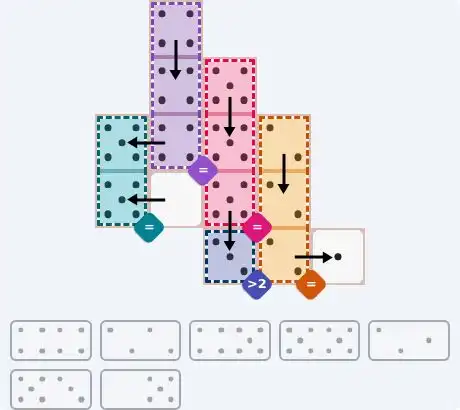
The equals region covering [0,1], [1,1], and [2,1] requires all three cells to be identical. The double‑4 domino [4,4] can cover two of them, placed vertically at [0,1]‑[1,1]. To give [2,1] a 4, the [4,5] domino must be placed horizontally with 4 at [2,1] and 5 at [2,0].
2
Step 2: Establish the 5‑Equals Column
The triple‑equals [1,2]‑[3,2] demands all 5s. The double‑5 domino [5,5] covers [1,2]‑[2,2] vertically. The third cell [3,2] will later receive its 5 from the [5,3] domino — but its placement hinges on the adjacent greater‑than cell.
3
Step 3: Satisfy the Pair of 5s
The equals pair [2,0]‑[3,0] must both be 5. [2,0] already has 5 from step 1. That forces [3,0] to be 5, which can only come from the [0,5] domino, placed with 5 at [3,0] and 0 at [3,1] (the empty cell). This simultaneously resolves the empty region.
4
Step 4: Build the 2‑Equals Column
The triple‑equals [2,3]‑[4,3] all need to be 2. Deploy the double‑2 [2,2] vertically at [2,3]‑[3,3]. The remaining [4,3] gets its 2 from the [2,1] domino, placed as [4,3]=2 and [4,4]=1 (another empty cell). That leaves the greater‑than‑2 cell [4,2] still needing a value >2.
5
Step 5: Place the 5‑3 Domino
The [5,3] domino is the only domino left that can supply a 5 to [3,2] (to finish the 5‑equals column) and a compliant 3 to [4,2] (>2). Place it vertically with 5 at [3,2] and 3 at [4,2]. All constraints are satisfied.

🔧 Step-by-Step Answer Walkthrough For Hard Level

1
Step 1: Sum‑0 Dictates a Placement
The singe‑cell sum‑0 at [5,8] must contain 0. The only domino with a 0 low enough to fit is [0,2]; place it with 0 at [5,8] and 2 at [4,8]. This also triggers the sum‑3 pair [3,8]‑[4,8] — later, [3,8] will need to be 1.
2
Step 2: Equals Column of Zeros
The four‑cell equals region [3,3]–[6,3] must be all zeros. Three dominoes supply these: the double‑0 [0,0] covers [4,3]‑[5,3]; the [0,3] domino covers [3,3] with 0 and [3,4] with 3; and the [6,0] domino covers [6,3] with 0 and [7,3] with 6 (satisfying the distinct sum‑6 at [7,3]).
3
Step 3: Top‑Left Sums Resolve
The sum‑2 at [0,2] forces 2, so the [2,3] domino is placed with 2 at [0,2] and 3 at [1,2]. Now sum‑5 [1,1]‑[1,2] gives [1,1]=2, delivered by the [2,1] domino (2 at [1,1], 1 at [1,0]). Sum‑2 [1,0]‑[2,0] then forces [2,0]=1, which the [3,1] domino provides by placing 3 at [2,1] and 1 at [2,0] — note [2,1] later helps sum‑5 [2,1]‑[2,2] as we'll see.
4
Step 4: The Unequal Block Completed
The unequal 2×2 spans [3,4]‑[3,5] and [4,4]‑[4,5]. Already [3,4]=3 (step 2) and [3,5]=0 via the [5,0] domino placed at [3,6]‑[3,5] (5 and 0). To keep the four cells distinct, [4,4] and [4,5] must be two unused numbers. The double‑2 [2,2] gives [4,4]=2 (and also [5,4]=2, fitting sum‑2 there). The [1,6] domino places 1 at [4,5] and 6 at [5,5], satisfying sum‑6 at [5,5]. The inequality holds: 3,0,2,1 are all different.
5
Step 5: Finishing Sums on the Right
Sum‑10 [3,6]‑[3,7] gets [3,6]=5 (from the [5,0] domino) and [3,7]=5 via the [5,1] domino (5 at [3,7], 1 at [3,8] — completing sum‑3 with [4,8]=2). Sum‑7 [5,6]‑[6,6] is met by domino [3,4] at [4,6]=3, [5,6]=4, and domino [3,5] at [6,6]=3, [7,6]=5 (the sum‑5 at [7,6] is also satisfied). The puzzle snaps shut.

💡 Pro Tips for Similar Puzzles

Start with Constraints
Always begin with the most constrained regions - sum regions with small numbers or tight spaces.
Use Equal Regions
Use "equal" regions as anchors - they eliminate many possibilities quickly.
Work Systematically
Let the rules guide your placement rather than guessing randomly.
Double-Check
Verify each region's rules are satisfied before moving to the next.

🎓 Keep Learning & Improve