NYT Pips Hints & Answers for July 17, 2026

Jul 17, 2026

🚨 SPOILER WARNING

This page contains the final **answer** and the complete **solution** to today's NYT Pips puzzle. If you haven't attempted the puzzle yet and want to try solving it yourself first, now's your chance!

Click here to play today's official NYT Pips game first.

Want hints instead? Scroll down for progressive clues that won't spoil the fun.

SEE ALSO:

🎲 Today's Puzzle Overview

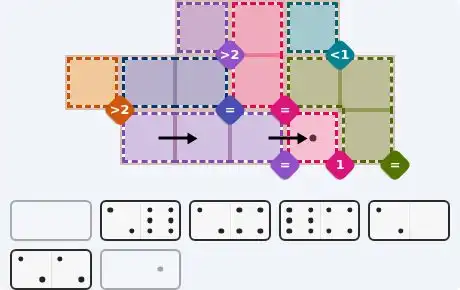
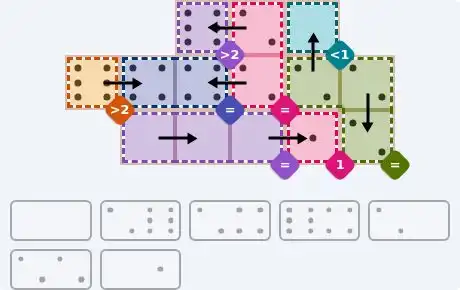
Today's NYT Pips easy, by Ian Livengood, almost solves itself. You get two single-cell constraints right on the top row — one says “less than 3,” the other “greater than 3” — and they immediately push you toward specific numbers. The equals region in the middle then demands a pair of identical faces, and the only double in the set slips right in. From there, a lone sum-5 cell in the bottom row forces a domino orientation that spills upward, locking the whole grid together.

That same airy logic drifts into the medium, also by Livengood. Here a single-cell sum-1 in the opposite corner whispers a 1, which drags along a domino carrying a 0, and suddenly a chain of equals regions across three cells forces an all-zero line. A “less than 1” on the edge then yanks a second domino into place, and the puzzle collapses region by region, each constraint tapping the next like dominoes falling.

Rodolfo Kurchan’s hard puzzle demands more sweat. You start with a pair of isolated single-cell sums — a 5 here, a 6 there — that fire fixed numbers into the matrix. Immediately an equals pair inherits a zero, which compels a precise domino straddling two rows. A sum-10 duo then splits a 4 and a 6, and soon a cascade of sum-5, sum-7, and a long vertical equals chain of 1s tumbles down the right side. By the end you’ve danced through every corner before the bottom-right run of ones clicks into place.

💡 Progressive Hints

Try these hints one at a time. Each hint becomes more specific to help you solve it yourself!

💡 Look for the single-cell sum
A region containing just one cell and demanding a fixed sum is the key. That cell’s value is completely determined without needing anything else.
💡 The bottom-row anchor
Turn to row 2, column 1 — that cell has a sum‑5 requirement. It forces a 5 there, and the only domino with a 5 must place its other pip in the adjacent cell, settling the equals region below.
💡 Complete placement
Place the [5,1] domino vertically with 5 in [2,1] and 1 in [2,0]. That makes [1,0] match via the equals region, so the [1,2] domino fits horizontally from [0,0] to [1,0] with 2 and 1 (satisfying ‘less 3’). The top-right ‘greater 3’ cell takes a 4 from the [4,6] domino, placed with 4 at [0,5] and 6 at [1,5]; the final equals pair then claims the [6,5] domino with 6 at [2,5] and 5 at [2,4], completing the grid.
💡 Hunt the tiny sum
A one-cell sum constraint with a target of 1 is the unlock. Since it forces an exact pip, it dictates both sides of the domino that covers that cell.
💡 Bottom-right zero chain
The sum-1 cell at [2,4] gets a 1, spilling a 0 into [2,3]. That 0 then forces the three-cell equals region at [2,1]–[2,3] to all be 0, which in turn pins the [0,0] double into place.
💡 Full solution outline
Place [0,1] vertically at [2,3]–[2,4] with 0 and 1. Then [0,0] at [2,1]–[2,2] for the zeros. The ‘less 1’ at [0,4] forces a 0, so [2,0] goes horizontally with 0 at [0,4] and 2 at [1,4]; that 2 spreads to [1,5] and [2,5] via the equals chain, so [2,2] fills there. The remaining high-value cells use [2,6] (6 at [0,2] and 2 at [0,3]) and [6,4] (6 at [1,0] and 4 at [1,1]), satisfying the greater‑2 singles and the equal pairs.
💡 Single-cell sums first
Two standalone cells demand exact numbers: one asks for 5, another for 6. These are your launch pads — each forces a specific domino and its neighbor’s value.
💡 Upper right and lower left fireworks
Look at the cell at [4,5] (sum 5) and the cell at [5,0] (sum 6). The first forces a domino containing a 5 and a 0; the second forces a domino with a 6 and a 5. Placing those spills zeros and fixes numbers in those regions.
💡 An equals cascade begins
With [4,4] now 0, the equals pair [3,4]–[4,4] forces a 0 in [3,4]. That cell sits in a sum‑10 region with [1,4] and [2,4], so you need a domino that gives 0 at [3,4] and leaves a 6 above, which then demands a 4 from the other sum‑10 partner.
💡 Pivoting to the left column
The top‑row sum‑5 at [0,4]–[0,5] and sum‑7 at [0,0]–[0,2] now take shape. With a 3 already locked in [0,4], the adjacent cell [0,5] must be 2, pulling in a [3,2] domino. That 2 then helps narrow the [0,6]–[1,6] sum‑5, while the sum‑7 group quickly resolves with a double‑3 and a 6‑1.
💡 Full solve walkthrough
Place [0,5] at [4,4]‑[4,5] (0,5). Place [5,6] at [5,0]‑[5,1] (6,5). [3,4] must be 0, so place [6,0] vertically with 0 at [3,4] and 6 at [2,4]. Then sum‑10 [1,4]‑[2,4] forces 4 at [1,4], so [3,4] goes horizontally at [0,4]‑[1,4] (3,4). Sum‑5 at [0,4]‑[0,5] forces 2 at [0,5]; place [3,2] at [0,6]‑[0,5] (3,2). Sum‑7 at [0,0]‑[0,2] uses [3,3] at [0,1]‑[0,2] and [6,1] at [1,0]‑[0,0] (6,1). The bottom‑row equals chain for ones: [4,1] goes from [5,7] to [6,7] (4,1), then [1,1] at [7,7]‑[8,7] and [1,2] at [9,7]‑[9,8] (1,2) with 1 at [9,7] and 2 to satisfy the sum‑2 at [9,8]. Remaining: [2,4] at [3,2]‑[2,2] (2,4), [4,6] at [2,0]‑[2,1] (4,6), [6,6] at [3,6]‑[4,6] (6,6), [6,2] at [2,6]‑[1,6] (6,2).

🎨 Pips Solver

Jul 17, 2026

Click a domino to place it on the board. You can also click the board, and the correct domino will appear.
Final Answer & Complete Solution For Hard Level

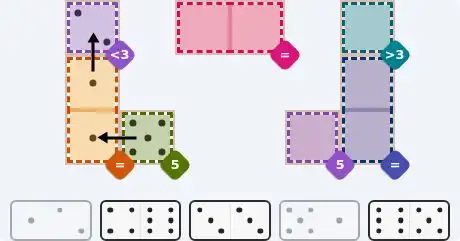
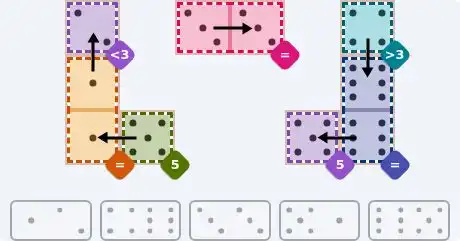
The key to solving today's hard puzzle was identifying the placement for the critical dominoes highlighted in the starting grid. Once those were in place, the rest of the puzzle could be solved logically. See the final grid below to compare your solution.

Starting Position & Key First Steps
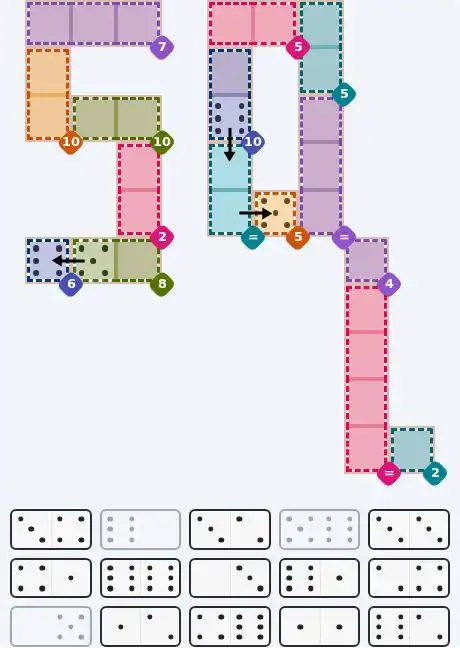
Pips hint for July 17, 2026 – hard level puzzle grid with critical first placements and strategy

This image shows the initial puzzle grid for the hard level, with a few critical first placements highlighted.

Final Answer: The Solved Grid for Hard Mode
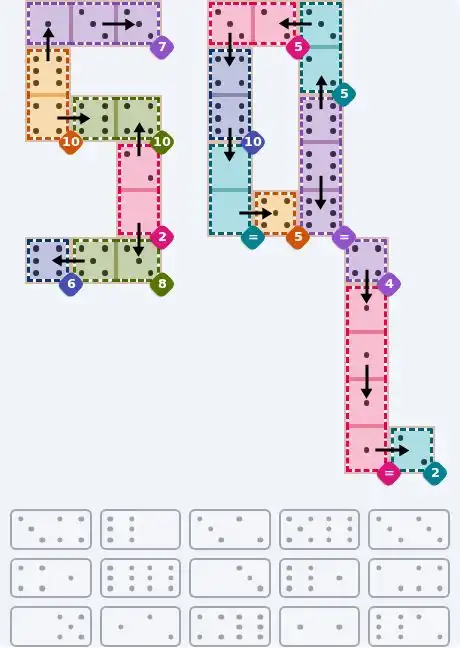
NYT Pips July 17, 2026 hard puzzle full solution grid showing final answer with hints

Compare this final grid with your own solution to see the correct placement of all dominoes.

🔧 Step-by-Step Answer Walkthrough For Easy Level

1
Step 1: Sum-5 cell dictates the first domino
The single-cell sum region at [2,1] forces it to be exactly 5. The only domino that contains a 5 is [5,1], so place it vertically with the 5 at [2,1] and the 1 at [2,0]. This sets [2,0]=1.
2
Step 2: Equals region forces the next move
The equals region linking [1,0] and [2,0] now requires [1,0]=1. The only remaining domino with a 1 is [1,2]; place it horizontally with the 1 at [1,0] and the 2 at [0,0]. The ‘less 3’ constraint on [0,0] is satisfied by the 2.
3
Step 3: Top-right greater-3 demands a high pip
Cell [0,5] must be greater than 3, so it needs 4,5, or 6. The domino [4,6] has both a 4 and a 6. To later satisfy the equals pair at [1,5] and [2,5], we can't use the 6 at [0,5] without disrupting things, so place [4,6] horizontally with 4 at [0,5] and 6 at [1,5].
4
Step 4: Final equals pair and sum-5 resolve
The equals region now forces [2,5]=6, so the last domino [6,5] must be placed vertically with 6 at [2,5] and 5 at [2,4]. The single-cell sum‑5 at [2,4] is satisfied by the 5, completing the grid.

🔧 Step-by-Step Answer Walkthrough For Medium Level

1
Step 1: Sum-1 lock at bottom right
Cell [2,4] is a single‑cell sum region needing 1. The only domino with a 1 is [0,1]. To cover [2,4], it must be placed vertically with 1 at [2,4] and 0 at [2,3] (since horizontal would put 0 at [1,4] or [2,5], but the neighboring equals region later forces 0 anyway). Thus [2,4]=1, [2,3]=0.
2
Step 2: Triple equal forces a string of zeros
The equals region covering [2,1], [2,2], [2,3] now demands all three be 0. The domino [0,0] fits cleanly across [2,1] and [2,2], placing 0s there and locking that bottom row.
3
Step 3: Less-than-1 demands another 0
Cell [0,4] has a ‘less 1’ constraint, so it must be 0. The domino [2,0] can cover it, with the 0 at [0,4] and the 2 at [1,4] (vertical placement would put 2 at [2,4] but that cell is already 1, so horizontal from [0,4] to [1,4] is correct). This gives [0,4]=0, [1,4]=2.
4
Step 4: The big equals chain clones a 2
The equals region linking [1,4], [1,5], [2,5] now forces [1,5]=2 and [2,5]=2. Domino [2,2] has two 2s; place it vertically at [1,5] and [2,5] to satisfy both cells.
5
Step 5: High-value singles close the board
The remaining constraints are the greater‑2 cells at [0,2] and [1,0]. [0,2] needs a value >2, and the equals pair at [0,3] and [1,3] must match. The [2,6] domino fits: place 6 at [0,2] and 2 at [0,3]; then [1,3] must be 2, so the [2,4] domino goes horizontally at [1,3]‑[1,2] with 2 and 4. Finally, [1,0] >2, and the equals [1,1]‑[1,2] is already half‑set with 4 at [1,2], so [1,1] must be 4; the [6,4] domino fits horizontally at [1,0]‑[1,1] with 6 and 4, satisfying all.

🔧 Step-by-Step Answer Walkthrough For Hard Level

1
Step 1: Two single‑cell sums fire off
The cell [4,5] requires a sum of 5, so it must be exactly 5. The domino [0,5] contains a 5; place it with the 5 at [4,5] and the 0 at [4,4] (the only adjacent cell). Simultaneously, [5,0] demands a sum of 6, so it gets a 6; the domino [5,6] is the only one with a 6 that fits, so place it with 6 at [5,0] and 5 at [5,1].
2
Step 2: Equals pair begets a zero
Now [4,4]=0, and the equals region [3,4]–[4,4] forces [3,4]=0. That cell sits under [2,4], which is part of a sum‑10 region with [1,4]. The domino [6,0] contains a 0; placing it vertically with 0 at [3,4] and 6 at [2,4] satisfies the zero and gives a 6 to the sum‑10 pair.
3
Step 3: Sum‑10 dictates a 4
The sum‑10 region at [1,4] and [2,4] now has 6 at [2,4], so [1,4] must be 4. The domino [3,4] provides a 4; place it horizontally with 4 at [1,4] and 3 at [0,4].
4
Step 4: Top‑row sum‑5 snaps in
The sum‑5 region at [0,4] and [0,5] has 3 at [0,4], so [0,5] must be 2. The domino [3,2] fits exactly; place it with 3 at [0,6] and 2 at [0,5]. This also seeds the sum‑5 at [0,6]–[1,6] (3+?=5), forcing [1,6] to be 2 later.
5
Step 5: Left‑side sum‑7 resolves
The sum‑7 region at [0,0]–[0,2] now has only a few possible combinations. The double‑3 domino [3,3] goes into [0,1]‑[0,2], giving a sum of 6 so far; thus [0,0] must be 1 to total 7. The domino [6,1] provides 1, so place it with 1 at [0,0] and 6 at [1,0] (the adjacent cell in the sum‑10 [1,0]‑[2,0] which now gets 6, needing a 4 at [2,0] later).
6
Step 6: The right‑side equals cascade and final sums
The equals region at [2,6]‑[3,6]‑[4,6] requires all 6s, so [6,6] fills there. The sum‑2 at [3,2]‑[4,2] forces 2 and 0; [2,4] places 2 at [3,2] and 4 at [2,2], solving the sum‑10 at [2,1]‑[2,2] with [4,6] at [2,0]‑[2,1] providing 6 and 4. The long vertical equals chain of 1s at column 7: [4,1] gives a 1 at [6,7], then [1,1] spreads 1s upward, and [1,2] ends with 1 at [9,7] and the required 2 at [9,8]. Finally, [6,2] at [2,6]‑[1,6] (6 and 2) completes the sum‑5 at [0,6]‑[1,6].

💡 Pro Tips for Similar Puzzles

Start with Constraints
Always begin with the most constrained regions - sum regions with small numbers or tight spaces.
Use Equal Regions
Use "equal" regions as anchors - they eliminate many possibilities quickly.
Work Systematically
Let the rules guide your placement rather than guessing randomly.
Double-Check
Verify each region's rules are satisfied before moving to the next.

🎓 Keep Learning & Improve