NYT Pips Hints & Answers for July 15, 2026

Jul 15, 2026

🚨 SPOILER WARNING

This page contains the final **answer** and the complete **solution** to today's NYT Pips puzzle. If you haven't attempted the puzzle yet and want to try solving it yourself first, now's your chance!

Click here to play today's official NYT Pips game first.

Want hints instead? Scroll down for progressive clues that won't spoil the fun.

SEE ALSO:

🎲 Today's Puzzle Overview

Today's NYT Pips easy, by Ian Livengood, is a confidence-builder — a single less‑than‑1 cell nails down a zero, which then chains through a sum‑8 pair. The bottleneck is recognizing which domino supplies that crucial 0. Medium, also from Livengood, turns up the dial with equals regions and greater‑than constraints; once the three‑cell equals group is placed, the rest falls cleanly into line. Hard, constructed by Rodolfo Kurchan, is a genuine brain‑tickler. Multiple sum‑0 regions force a skeleton of zeros, and a web of intersecting sums creates a tight bottleneck that will keep you double‑checking until the final domino locks in.

💡 Progressive Hints

Try these hints one at a time. Each hint becomes more specific to help you solve it yourself!

💡 Hint 1
Look for a region that forces a cell to hold the smallest possible pip value — it’s the key that unlocks the whole grid.
💡 Hint 2
The less‑1 region at [3,1] demands a pip below 1, so it must be 0. That zero can only come from a domino that also hooks into the neighboring sum‑8 region.
💡 Hint 3
Place [3,0] vertically to give [2,1]=3 and [3,1]=0. Then the sum‑8 region forces [2,2]=5, so [3,5] covers [2,2]‑[2,3] (5‑3). The sum‑5 pair [1,3]‑[2,3] now gets [2,0] (2‑0) placed [1,3]‑[0,3]. Wrap up with [4,3] on [0,1]‑[0,2] and [1,4] on [1,0]‑[1,1].
💡 Hint 1
Start by finding the region that forces all of its cells to display the same pip number — that tight restriction will anchor the entire solve.
💡 Hint 2
The three‑cell equals region on the right forces every cell there to be 2. This demands the [2,2] domino on [0,4] and [1,4], and the leftover cell [1,3] gets its 2 from the [3,2] domino.
💡 Hint 3
Place [2,2] on [0,4]‑[1,4] (2‑2) and [3,2] horizontally on [2,3]‑[1,3] (3‑2). The greater‑9 pair [1,0]‑[1,1] needs a sum above 9, so [5,5] fits (5‑5). Then the sum‑9 row [2,3]‑[2,5] takes [5,1] for 5‑1, [2,5] fills [1,2]‑[2,2], and [3,3] handles [2,1]‑[3,1]. Finish with [3,6] on [3,2]‑[3,3].
💡 Hint 1
Concentrate on the regions that demand a total sum of zero — the only way to reach a zero sum is with all zero pips.
💡 Hint 2
The two‑cell sum‑0 at [1,1]‑[2,1] forces both cells to 0, and the sum‑0 at [3,2]‑[3,3] requires two more zeros. Together, four cells must become 0.
💡 Hint 3
The [0,0] domino naturally covers [3,2]‑[3,3] vertically. The [0,1] domino then covers [2,1]‑[3,1] with 0‑1, satisfying the first zero pair and preparing a sum‑2 with [4,1].
💡 Hint 4
Now the top‑left interactions tighten: [0,2] covers [1,1]‑[0,1] (0‑2), [5,3] goes on [1,0]‑[0,0] (5‑3), and [5,4] fills [3,0]‑[2,0] (5‑4) to complete the sum‑9 column. The equals region [0,6]‑[0,7] takes [2,2].
💡 Hint 5
Full chain: [0,0] at [3,2]‑[3,3]; [0,1] at [2,1]‑[3,1]; [0,2] at [1,1]‑[0,1]; [5,3] at [1,0]‑[0,0]; [5,4] at [3,0]‑[2,0]; [5,1] at [4,0]‑[4,1]; [2,2] at [0,6]‑[0,7]; [0,4] at [1,5]‑[0,5]; [4,4] at [1,7]‑[2,7]; [1,3] at [3,5]‑[4,5]; [5,5] at [2,5]‑[2,6]; [5,2] at [4,3]‑[4,2]; [6,3] at [3,7]‑[4,7].

🎨 Pips Solver

Jul 15, 2026

Click a domino to place it on the board. You can also click the board, and the correct domino will appear.
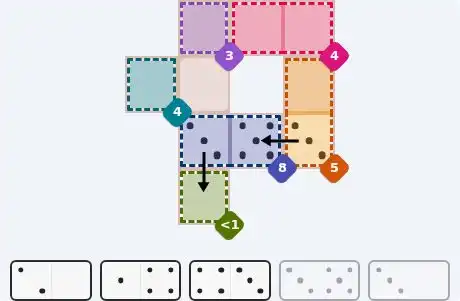
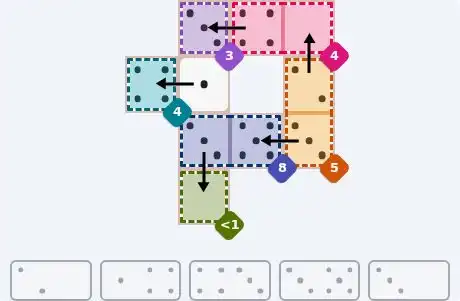
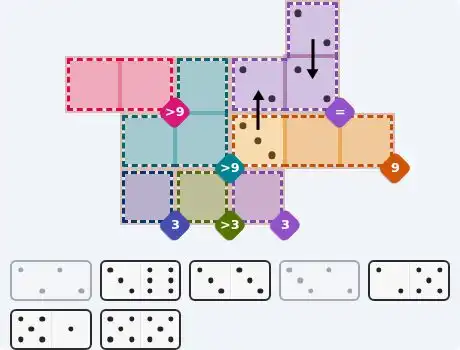
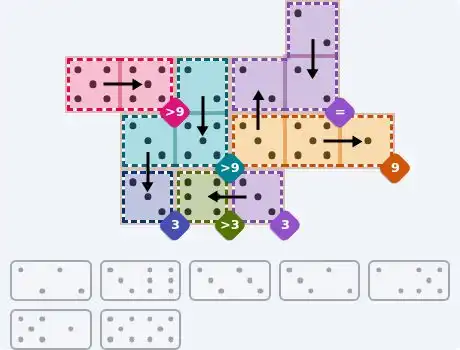
Final Answer & Complete Solution For Hard Level

The key to solving today's hard puzzle was identifying the placement for the critical dominoes highlighted in the starting grid. Once those were in place, the rest of the puzzle could be solved logically. See the final grid below to compare your solution.

Starting Position & Key First Steps
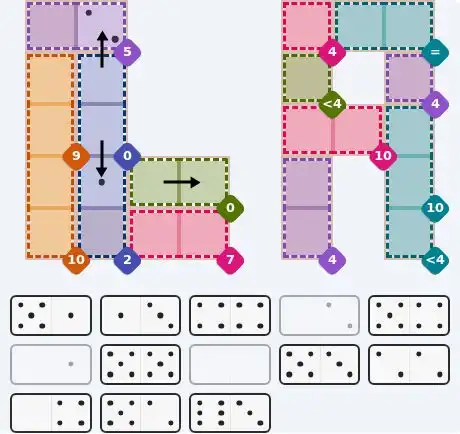
Pips hint for July 15, 2026 – hard level puzzle grid with critical first placements and strategy

This image shows the initial puzzle grid for the hard level, with a few critical first placements highlighted.

Final Answer: The Solved Grid for Hard Mode
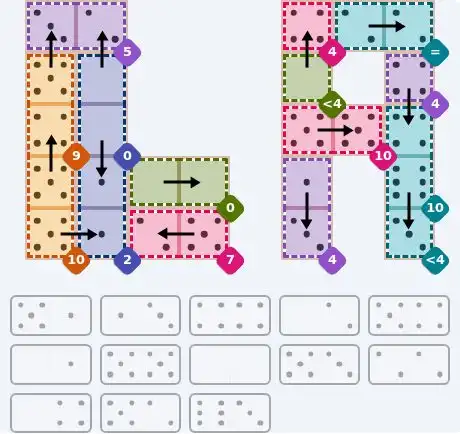
NYT Pips July 15, 2026 hard puzzle full solution grid showing final answer with hints

Compare this final grid with your own solution to see the correct placement of all dominoes.

🔧 Step-by-Step Answer Walkthrough For Easy Level

1
Step 1: Zero from less‑1
The less‑1 cell at [3,1] must hold a pip strictly below 1 — only a 0 fits. This forces a domino with a 0 to occupy [3,1] and an adjacent cell.
2
Step 2: Sum‑8 and the [3,0] domino
The adjacent sum‑8 region at [2,1]‑[2,2] needs a pair that adds to 8. The only workable combination uses the [3,0] domino vertically: [2,1]=3 and [3,1]=0. Then [2,2] must be 5 to reach the sum, dictating the [3,5] domino across [2,2] and [2,3] (5‑3).
3
Step 3: Sum‑5 and the [2,0] domino
The sum‑5 region [1,3]‑[2,3] now has [2,3]=3, so [1,3] must be 2. The [2,0] domino, placed vertically [1,3]‑[0,3], supplies 2 and 0. This 0 at [0,3] partners with the sum‑4 region [0,2]‑[0,3] to demand a 4 in [0,2].
4
Step 4: Finishing the corners
The [4,3] domino covers [0,1]=3 (satisfying its singleton sum‑3) and [0,2]=4. Finally, the single‑cell sum‑4 at [1,0] forces a 4, so [1,4] is placed on [1,0]=4 and [1,1]=1, completing the easy puzzle.

🔧 Step-by-Step Answer Walkthrough For Medium Level

1
Step 1: The equals bottleneck
The three‑cell equals region at [0,4], [1,3], [1,4] forces all three cells to share the same pip. The only domino that can cover two of them with a matching pair is [2,2]; place it on [0,4] and [1,4], both 2.
2
Step 2: Extending the equals chain
Since [1,3] must also be 2, the [3,2] domino (pips 3 and 2) fits perfectly in a horizontal placement on [2,3] and [1,3] — 3 at [2,3], 2 at [1,3]. This satisfies the equals constraint and begins linking adjacent regions.
3
Step 3: Greater‑than‑9 pair
The greater‑than‑9 region at [1,0]‑[1,1] needs a sum above 9. The only viable candidate is the [5,5] domino, giving 5+5=10. Place it on [1,0]‑[1,1].
4
Step 4: Row 2 sum‑9
The sum‑9 region across [2,3], [2,4], [2,5] already holds a 3 at [2,3]. To total 9, the [5,1] domino is placed on [2,4]‑[2,5] (5+1). That yields 3+5+1=9. The [2,5] domino then covers [1,2]=2 and [2,2]=5, and [3,3] anchors [2,1]‑[3,1] with 3‑3.
5
Step 5: Final detail cells
The remaining greater‑3 single cell [3,2] takes 6, and the sum‑3 cell [3,3] requires 3, so the [3,6] domino finishes the job on [3,2]‑[3,3] (6‑3). The grid is complete.

🔧 Step-by-Step Answer Walkthrough For Hard Level

1
Step 1: Zero‑sum regions dictate the shape
Two sum‑0 regions appear: [1,1]‑[2,1] and [3,2]‑[3,3]. Summing to zero forces every cell involved to be 0. The [0,0] domino is the only one that can provide two zeros in adjacent cells, so place it vertically on [3,2] and [3,3].
2
Step 2: First zero pair and a sum‑2 ramp
For [1,1]‑[2,1], the [0,1] domino is the key. Place it on [2,1]=0 and [3,1]=1 — satisfying the sum‑0 and setting a 1 in [3,1]. The sum‑2 region [3,1]‑[4,1] now needs a second 1, which the [5,1] domino will later provide at [4,1].
3
Step 3: Top‑left interplay
The [0,2] domino covers [1,1]=0 and [0,1]=2, so the sum‑5 region [0,0]‑[0,1] now requires a 3 in [0,0]. The [5,3] domino fits [1,0]=5 and [0,0]=3. Then the sum‑9 column [1,0]‑[2,0] is satisfied by placing [5,4] on [3,0]=5 and [2,0]=4 (5+4=9).
4
Step 4: Right‑side equals and sum‑4 cells
The equals region [0,6]‑[0,7] calls for the [2,2] domino (both 2). The less‑4 cell [1,5] forces a 0, so [0,4] is placed on [1,5]=0 and [0,5]=4 (sum‑4 at [0,5]). Then [4,4] satisfies the sum‑4 at [1,7] by covering [1,7]‑[2,7] with 4‑4.
5
Step 5: Sum‑10 duos
The sum‑10 region [2,5]‑[2,6] takes [5,5] (5+5=10). The other sum‑10, [2,7]‑[3,7], already has 4 at [2,7] from [4,4]; the [6,3] domino finishes it with [3,7]=6 and [4,7]=3. The sum‑4 region [3,5]‑[4,5] now uses [1,3] (1‑3) to reach 4.
6
Step 6: Closing the loop
The sum‑7 region [4,2]‑[4,3] demands 5+2, so [5,2] is placed accordingly. Finally, the less‑4 cell [4,7] is already satisfied with the 3 from [6,3], leaving the hard puzzle fully solved.

💡 Pro Tips for Similar Puzzles

Start with Constraints
Always begin with the most constrained regions - sum regions with small numbers or tight spaces.
Use Equal Regions
Use "equal" regions as anchors - they eliminate many possibilities quickly.
Work Systematically
Let the rules guide your placement rather than guessing randomly.
Double-Check
Verify each region's rules are satisfied before moving to the next.

🎓 Keep Learning & Improve