NYT Pips Hints & Answers for July 16, 2026

Jul 16, 2026

🚨 SPOILER WARNING

This page contains the final **answer** and the complete **solution** to today's NYT Pips puzzle. If you haven't attempted the puzzle yet and want to try solving it yourself first, now's your chance!

Click here to play today's official NYT Pips game first.

Want hints instead? Scroll down for progressive clues that won't spoil the fun.

SEE ALSO:

🎲 Today's Puzzle Overview

For Ian Livengood’s introductory grid, the deduction graph is sparse but sharply directed. A single greater‑5 cell at [0,0] immediately forces the double‑6 domino, which then cascades into the row‑2 sum‑16 region to demand the double‑5. This top‑left anchor sets a chain reaction where the sum‑1 region below greedily consumes the double‑0, leaving a [4,1] split for the remaining empty cell. The sum‑6 pair at the top is then trivially filled by the leftover double‑3, making the solve a straight line from the 6 to the 3.

Rodolfo Kurchan’s medium puzzle layers equals and sum‑10 constraints into a web that forces an early choice between the two double pip dominos. The three‑cell equals region at the centre‑right can only be satisfied by the double‑3, once the top sum‑10 pair locks the double‑5 in place. That equal‑3 cluster then feeds a 3 into an adjacent sum‑10 region, splitting a [3,6] domino across the right edge and pulling a 4 into a linked sum‑10 triple on the left. The solve proceeds as a careful domino‑routing problem, with each placement narrowing the path for the remaining digits.

The day’s hardest, also by Kurchan, is built around an imposing five‑cell equals region that must be entirely zero. This zero‑cascade forces the double‑zero early, and then the solver must weave six different zero‑bearing dominos through the grid to cover the remaining zero cells while simultaneously satisfying three equal‑pip clusters (1s, 3s, and 4s) and a handful of less/greater and single‑cell sum constraints. A sum‑1 cell picks out the [0,1] domino, a less‑3 column forces a [0,2] split, and a greater‑4 cell demands a [0,5] placement, each interlocking with the equals groups to produce a dense, rewarding deduction graph. This NYT Pips hard is a masterclass in propagating a single value—zero—across a board already brimming with aliased pip clusters.

💡 Progressive Hints

Try these hints one at a time. Each hint becomes more specific to help you solve it yourself!

💡 Start with the extremes
Look for regions with very tight limits, like a single cell that must be above a certain value, or a sum of 1 over multiple cells.
💡 Anchor the 6
The greater‑5 cell at the top‑left corner can only hold a 6. That forces a domino that also covers the cell directly below, cementing the first digit of the bordering sum‑16 region.
💡 Finish the chain
With the double‑6 placed vertically at [0,0] and [1,0], the sum‑16 region’s remaining two cells must both be 5, so place the double‑5 horizontally at [1,1] and [1,2]. The sum‑1 region then takes the double‑0 in [0,4] and [1,4], making [1,5] a 1; the last domino [4,1] covers [1,5] with 1 and [1,6] with 4. The sum‑6 pair at the top gets the double‑3.
💡 Spot the doubles
The puzzle has two doubles (3 and 5) and several sum‑10 regions. The three‑cell equals group can only be a 3 or a 5, so deciding which double goes where unlocks the grid.
💡 Top‑left sum‑10 breaks the tie
The [0,0]–[0,1] sum‑10 region practically shouts for a double‑5. That leaves the double‑3 for the equals group on [1,1], [1,2], and [2,2].
💡 Complete the sum chain
Place the double‑5 across the top. Put the double‑3 vertically at [1,1]–[1,2], fixing [2,2] at 3. The sum‑10 below takes [1,5] (1 at [1,0], 5 at [2,0]) and [4,5] (4 at [3,1], 5 at [2,1]). A [3,6] domino spans [2,2]–[2,3] with the 3 already there, so [2,3] becomes 6, then [1,4] (1‑4) fills the remaining sum‑10 with 1 at [3,4] and 4 at [3,3]. Finally, [0,6] finishes the last sum‑10 triple with 0 at [4,2] and 6 at [3,2].
💡 Find the zero stronghold
A massive five‑cell equals region in the bottom‑right demands that five cells share the same value. Scan the available dominos for the only pair that can cover two of those cells with the same number.
💡 The double‑zero entry
The only way to fill two cells of that zero‑equals region with one domino is the double‑zero, placed at [4,7] and [5,7]. Right next to it, a single sum‑1 cell forces a [0,1] domino with the 1 at [5,4] and 0 at [4,4].
💡 Route the remaining zeros
With the double‑zero and [0,1] anchored, the other zero‑equals cells must each receive a zero via a domino that carries a companion number. The cell at [2,7] pairs with [2,6] (part of an equals‑3 cluster) via [0,3]; [3,7] pairs with the sum‑6 cell [3,6] via [0,6]; and [5,6] pairs with [4,6] via [0,4].
💡 Left column and greater‑4
The left column’s less‑3 region and the greater‑4 cell at [2,0] combine to force a [0,5] domino (0 at [3,0], 5 at [2,0]) and a [0,2] domino (0 at [5,0], 2 at [4,0]). The equals‑1 group on the top left then calls in the [1,1] and [1,4] dominos.
💡 Finish the equals clusters
To complete the puzzle, place the [1,1] double‑1 at [0,0]–[1,0], and the [1,4] domino with 1 at [1,1] and 4 at [2,1]. The equals‑3 clusters are satisfied by the [3,3] double‑3 at [0,4]–[1,4], the [2,3] domino at [3,4]=2–[2,4]=3, and the [3,5] at [1,6]=3–[1,7]=5. The four‑cell equals‑4 region takes the [4,4] double‑4 at [2,2]–[3,2] and the 4 from [2,3] via a [2,4] domino at [1,3]=2–[2,3]=4. Every pip lands exactly where the constraints demand.

🎨 Pips Solver

Jul 16, 2026

Click a domino to place it on the board. You can also click the board, and the correct domino will appear.
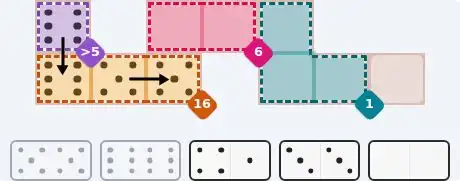
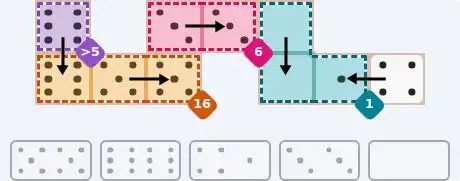
Final Answer & Complete Solution For Hard Level

The key to solving today's hard puzzle was identifying the placement for the critical dominoes highlighted in the starting grid. Once those were in place, the rest of the puzzle could be solved logically. See the final grid below to compare your solution.

Starting Position & Key First Steps
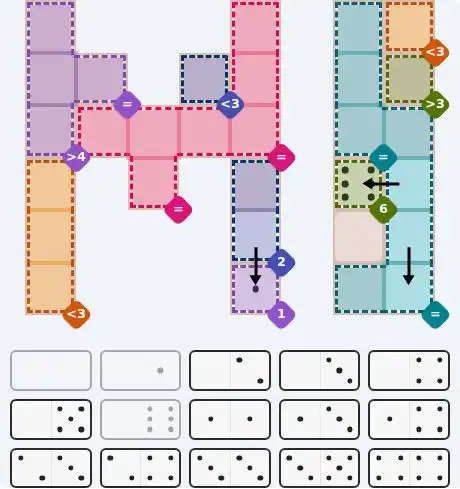
Pips hint for July 16, 2026 – hard level puzzle grid with critical first placements and strategy

This image shows the initial puzzle grid for the hard level, with a few critical first placements highlighted.

Final Answer: The Solved Grid for Hard Mode
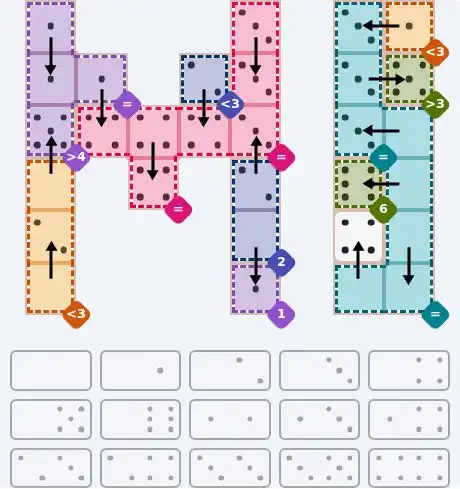
NYT Pips July 16, 2026 hard puzzle full solution grid showing final answer with hints

Compare this final grid with your own solution to see the correct placement of all dominoes.

🔧 Step-by-Step Answer Walkthrough For Easy Level

1
Step 1: Greater-5 forces the 6
The region at cell [0,0] is a ‘greater 5’ constraint, meaning its value must be >5. The only pip value on a domino that satisfies this is 6. Since the only domino containing a 6 is the double‑6, it must be placed covering [0,0] and its adjacent cell below, [1,0].
2
Step 2: Sum-16 locks the 5s
The sum-16 region includes the newly placed 6 at [1,0] along with [1,1] and [1,2]. To reach a total of 16, these two cells must sum to 10, which forces them both to be 5. The double‑5 domino fits perfectly horizontally at [1,1] and [1,2].
3
Step 3: Sum-1 assigns zeros and a 1
The sum-1 region covers [0,4], [1,4], and [1,5]. The remaining unused low dominoes are the double‑0 and the [4,1]. To sum to 1, the two cells in the left column of this region must be 0 and 0, so the double‑0 is placed vertically at [0,4] and [1,4]. That leaves [1,5] as the sole 1, so the [4,1] domino will later place its 1 in that cell and its 4 in the empty [1,6].
4
Step 4: Sum-6 takes the double-3
The sum-6 region at the top right consists of [0,2] and [0,3]. The only remaining domino is the double‑3, which when placed horizontally gives a perfect 3+3=6, completing the puzzle.

🔧 Step-by-Step Answer Walkthrough For Medium Level

1
Step 1: Top sum-10 chooses the double-5
The sum-10 region at [0,0] and [0,1] needs a total of 10. Among the available dominos, the double‑5 (5+5) exactly fits that sum, so place it horizontally covering those two cells.
2
Step 2: Equals region takes the double-3
The equals region on [1,1], [1,2], and [2,2] forces all three cells to the same value. With the double‑5 already used, the only remaining domino with two equal pips is the double‑3. Place it vertically at [1,1] and [1,2], automatically setting [2,2] to 3 as well.
3
Step 3: Lower sum-10 splits with 1‑5 and 4‑5
The sum-10 region at [2,0] and [2,1] needs two numbers summing to 10. The only dominos left that contain a 5 are [1,5] and [4,5]. Place [1,5] vertically with its 1 in the empty cell [1,0] and the 5 in [2,0]. Then place [4,5] vertically with its 5 in [2,1] and the 4 in [3,1].
4
Step 4: Right-side sum-10 uses 3‑6 and 1‑4
The sum-10 region at [2,3] and [3,3] must sum to 10. Cell [2,2] is already 3, so the [3,6] domino is placed horizontally covering [2,2] and [2,3], giving [2,3]=6. Then the [1,4] domino covers [3,4] (empty) and [3,3], placing 1 at [3,4] and 4 at [3,3] to reach 10.
5
Step 5: Last sum-10 triple fills with 0‑6
The sum-10 region on [3,1], [3,2], and [4,2] now has [3,1]=4 from Step 3, so the remaining 6 must come from [3,2] and [4,2]. The [0,6] domino placed vertically with 0 at [4,2] and 6 at [3,2] completes the sum, leaving no cells unfilled.

🔧 Step-by-Step Answer Walkthrough For Hard Level

1
Step 1: Zero-equals stronghold
The five-cell equals region at [2,7], [3,7], [4,7], [5,6], [5,7] must be all the same value. The only domino with two identical pips that can cover two of these cells is the [0,0] double-zero. Place it covering [4,7] and [5,7], establishing zero as the region’s value.
2
Step 2: Sum-1 picks the 0‑1 domino
The single-cell sum-1 region at [5,4] demands a value of 1. That 1 must pair with a 0, and the only [0,1] domino is available. Place it vertically with 0 at [4,4] and 1 at [5,4].
3
Step 3: Weave zeros through the equals‑3 and sum‑6 constraints
The remaining zero-equals cells need zeros. The cell [2,7] can pair with [2,6] (which belongs to an equals‑3 cluster) via the [0,3] domino, giving [2,7]=0 and [2,6]=3. The cell [3,7] pairs with the sum‑6 cell [3,6] (which must be 6) via the [0,6] domino, giving [3,7]=0 and [3,6]=6. The cell [5,6] receives its zero from the [0,4] domino paired with the empty cell [4,6] (which will become 4), so place [0,4] with 0 at [5,6] and 4 at [4,6].
4
Step 4: Left column less‑3 and greater‑4
The less‑3 region at [3,0], [4,0], [5,0] allows only 0, 1, or 2. The greater‑4 cell at [2,0] demands a 5 or 6. A [0,5] domino fits perfectly, placing 0 at [3,0] and 5 at [2,0]. The remaining cells [4,0] and [5,0] must be 2 and 0 respectively, handled by the [0,2] domino with 2 at [4,0] and 0 at [5,0].
5
Step 5: Equals‑1 and equals‑4 clusters
The equals‑1 region at [0,0], [1,0], [1,1] forces three 1s. The [1,1] double‑1 placed vertically at [0,0] and [1,0] provides two 1s. The [1,1] cell must also be 1, so the [1,4] domino covers it with the 1, placing the 4 in the adjacent [2,1]. This feeds the equals‑4 region spanning [2,1], [2,2], [2,3], [3,2]. Place the [4,4] double‑4 horizontally at [2,2] and [3,2] for two more 4s. The final 4 in [2,3] comes from the [2,4] domino, placing its 4 there and its 2 in the less‑3 cell [1,3].
6
Step 6: Finish the equals‑3 groups
The first equals‑3 cluster [0,4], [1,4], [2,4] gets the double‑3 [3,3] placed vertically at [0,4]–[1,4], and its third cell [2,4] receives a 3 from the [2,3] domino (2 at [3,4] in the sum‑2 region, 3 at [2,4]). The second equals‑3 cluster [0,6], [1,6], [2,6] already has [2,6]=3; the [3,5] domino places its 3 at [1,6] and its 5 at [1,7] (a greater‑3 cell), completing all constraints.

💡 Pro Tips for Similar Puzzles

Start with Constraints
Always begin with the most constrained regions - sum regions with small numbers or tight spaces.
Use Equal Regions
Use "equal" regions as anchors - they eliminate many possibilities quickly.
Work Systematically
Let the rules guide your placement rather than guessing randomly.
Double-Check
Verify each region's rules are satisfied before moving to the next.

🎓 Keep Learning & Improve