🔧 Step-by-Step Answer Walkthrough For Easy Level
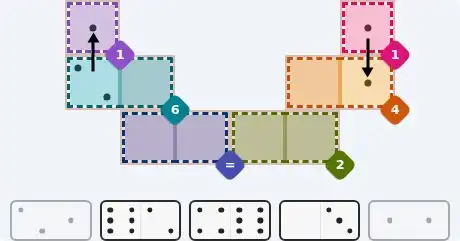
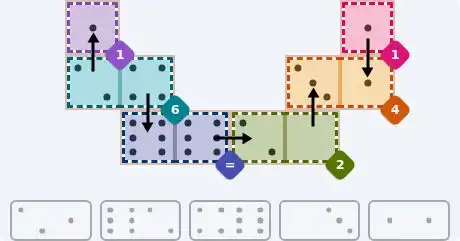
The two isolated sum-1 cells at [0,0] and [0,5] each need exactly 1. Among available dominos, only [1,1] and [2,1] contain a 1. The [1,1] double can satisfy one of them, but since it covers two adjacent cells, it must be placed vertically on the right, covering [0,5] and [1,5] both as 1. The left sum-1 [0,0] then must use the [2,1] domino, placed vertically with the 1 at [0,0] and the 2 at [1,0].
The region comprising [1,0] and [1,1] must sum to 6. With [1,0]=2 already from the previous step, [1,1] must be 4. The only remaining domino with a 4 is [4,6], so place it vertically covering [1,1] (4) and [2,1] (6).
The equals region at [2,1] and [2,2] requires identical values. We now have [2,1]=6, so [2,2] must also be 6. The [6,2] domino can supply a 6 and a 2; place it horizontally on [2,2]-[2,3] with the 6 in [2,2] and 2 in [2,3].
The sum-2 region at [2,3]-[2,4] needs a total of 2. With [2,3]=2, [2,4] must be 0. The [0,3] domino fits perfectly placed horizontally with 0 at [2,4] and 3 at [1,4]. Then the sum-4 region at [1,4]-[1,5] with [1,4]=3 and [1,5]=1 (already from [1,1]) completes the grid.
🔧 Step-by-Step Answer Walkthrough For Medium Level
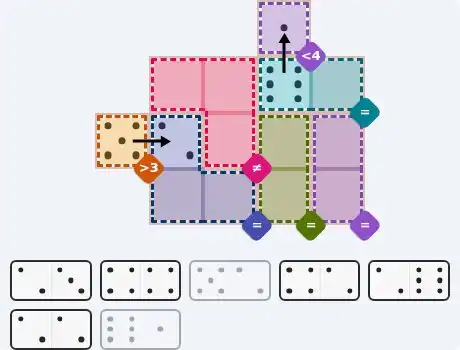
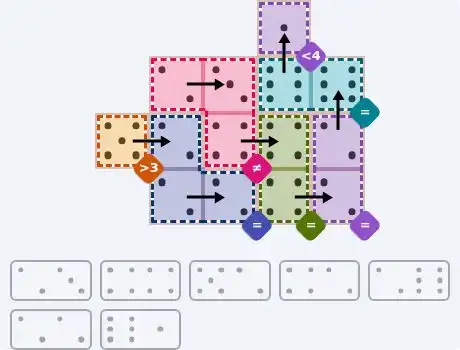
The cell [0,3] must be less than 4. It only connects downward to [1,3]. Trying the [2,3] domino would place a 2 or 3 at [0,3] but would force [1,3] to match the equals region at [1,4] with no available 3. Thus the only viable option is the [6,1] domino placed vertically: [0,3]=1, [1,3]=6, which then forces [1,4]=6 via the equals constraint.
The single cell [2,0] needs a pip greater than 3. Only the [5,2] domino can supply a 5 here, placed horizontally covering [2,0]=5 and [2,1]=2. This immediately sets the equals chain below: [2,1],[3,1],[3,2] must all be 2, so the [2,2] double domino is placed horizontally at [3,1]-[3,2].
The region [1,1],[1,2],[2,2] demands all three values be distinct. With the [2,3] domino placed horizontally at [1,1]-[1,2], we supply 2 and 3. The remaining cell [2,2] will later receive a 4 from the [4,4] double, making the trio 2,3,4 — all distinct.
Place the [4,4] double vertically covering [2,2] and [2,3] with 4s, fulfilling the unequal requirement and satisfying the equals region at [2,3]-[3,3]. Then place the [4,2] domino horizontally at [3,3]-[3,4] with 4 and 2, meeting both the equals region for [3,3] and the equals region for [3,4].
The only remaining gap is at [2,4]. Place the [2,6] domino horizontally covering [2,4]-[1,4] with 2 and 6, locking in [2,4]=2 (matching its equals partner [3,4]) and [1,4]=6 (already set). The puzzle is complete.
🔧 Step-by-Step Answer Walkthrough For Hard Level
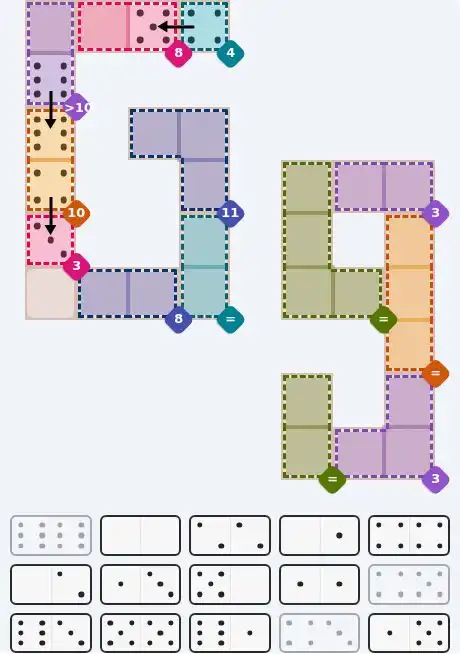
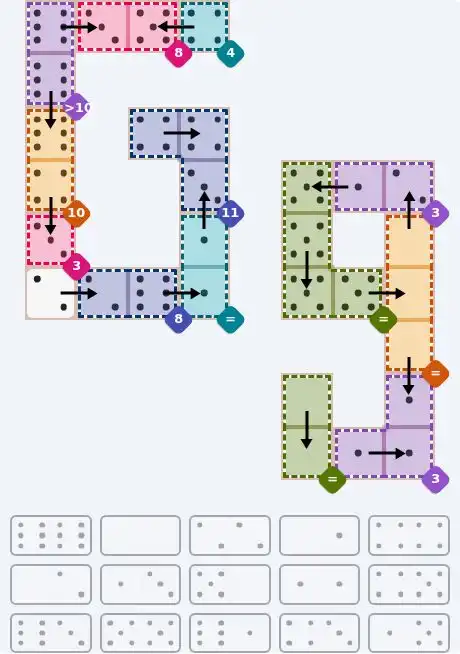
The region [0,0],[1,0] requires sum >10, so both pips must be high (at least one 6). The sum-10 region [2,0],[3,0] shares the column. The only way to give [1,0] a 6 while also providing [2,0] a value that pairs with [3,0] to sum 10 is to use the [6,6] double. Placing it vertically at [1,0]-[2,0] sets both to 6, satisfying the greater-10 region's need for a high pip in [1,0] and giving [2,0]=6. Consequently, [3,0] must be 4 to reach sum 10.
Cell [4,0] is a sum-3 single, so it must be 3. To connect [3,0]=4 and [4,0]=3, the only domino is [4,3], placed vertically at that spot. This locks in the left column values.
The isolated sum-4 cell at [0,3] forces a 4 there. The only domino that can supply a 4 to [0,3] while also feeding the neighboring sum-8 region [0,1]-[0,2] is [4,5], placed horizontally with the 5 at [0,2] and 4 at [0,3]. This pushes the sum-8 region: with [0,2]=5, then [0,1] must be 3.
With [0,1]=3 required, and the greater-10 region still needing a high pip in [0,0], the [6,3] domino is the perfect fit horizontally across [0,0]-[0,1], giving [0,0]=6 and [0,1]=3. Now the top row is complete, and the greater-10 region finds its full 12 sum.
The three-cell sum-11 region at [2,2],[2,3],[3,3] demands total 11. The [4,4] double placed horizontally at [2,2]-[2,3] gives two 4s, forcing [3,3]=3. The [1,3] domino then drops vertically at [3,3]-[4,3] with 3 and 1, setting [4,3]=1 and aligning with the equals region [4,3],[5,3] (so [5,3] will be 1). The four-cell equals group [3,5],[4,5],[5,5],[5,6] all must be identical; the [5,5] double placed vertically at [4,5]-[5,5] establishes the value 5, and the [1,5] domino at [3,5]-[3,6] adds another 5, while [5,0] placed at [5,6]-[5,7] provides the fourth 5. This chain forces surrounding sums.
With [5,3]=1 secured by the equals region, the sum-8 region at [5,1]-[5,2] needs an 8; placing [6,1] horizontally at [5,2]-[5,3] gives [5,2]=6 and [5,3]=1, so [5,1] must be 2. The [2,2] domino then fits horizontally at [5,0]-[5,1] with 2,2. The right-side sum-3 region [3,6]-[3,7] with [3,6]=1 forces [3,7]=2 via the [0,2] domino placed vertically at [3,7]-[4,7] (2,0), which in turn sets off the equals column in 7 making [4,7],[5,7],[6,7] all 0. Lower right finishes with [0,1] at [6,7]-[7,7] (0,1), [0,0] at [7,5]-[8,5] (0,0), and [1,1] at [8,6]-[8,7] (1,1), exactly satisfying the final sum-3 region.
💬 Community Discussion
Leave your comment