NYT Pips Hints & Answers for April 22, 2026

Apr 22, 2026

🚨 SPOILER WARNING

This page contains the final **answer** and the complete **solution** to today's NYT Pips puzzle. If you haven't attempted the puzzle yet and want to try solving it yourself first, now's your chance!

Click here to play today's official NYT Pips game first.

Want hints instead? Scroll down for progressive clues that won't spoil the fun.

🎲 Today's Puzzle Overview

Ian Livengood engineers today's easy around a single forced entry — a sum=1 constraint that admits no ambiguity. From that anchor, the grid resolves by equals propagation followed by a pure arithmetic squeeze: three cells must each contribute 5 to a sum-20 region, leaving zero degrees of freedom. It's a textbook demonstration of how one small constraint, placed right, can make a 4×5 grid feel inevitable rather than combinatorial.

Rodolfo Kurchan takes the reins for both medium and hard, and the contrast in approach is immediate. The medium is a tight 3×4 chain where a corner cell with a strict lower bound eliminates all but one domino and sets off a cascade through four consecutive equals constraints. The architecture is almost crystalline — every cell locked by its neighbor, no branch points.

The hard exposes Kurchan's preference for hidden symmetry. The less-than-2 region is the skeleton: two cells forced to 0 create a 6, and that 6 propagates through a rare three-cell equals region that branches in two directions simultaneously. Solvers who find that spine early will feel the rest of the grid click into place with unusual speed; those who start elsewhere may feel like they have no footholds at all.

💡 Progressive Hints

Try these hints one at a time. Each hint becomes more specific to help you solve it yourself!

💡 One constraint does all the work
One cell has a sum constraint with a very small target — small enough that it tells you the exact pip count without any cross-checking. Find it and you have your first domino placed.
💡 Follow the equals chain
The placed domino's second value connects to an equals region. That equals link reaches across and pins the next domino — look for where the same value must appear one row down.
💡 Full answer: Easy
The sum=1 cell must hold 1, placing the [1–2] domino (1 at bottom, 2 above it). The equals constraint copies that 2 one row down, fixing the [2–5] domino with 5 entering the sum-20 region. The remaining three cells in that region must sum to 15 — the only way is all three equal 5. The [5–1] domino contributes 5 to the sum region and 1 to the unconstrained cell. The [3–5] domino contributes 5 to the sum and 3 below, satisfying the greater-than-2 constraint. The [4–5] domino closes the sum region with 5, and 4 satisfies the greater-than-3 cell at the top.
💡 One corner cell narrows the field
A greater-than constraint in one corner eliminates nearly every domino — only one in the set can provide that value. Place it first and the cascade begins.
💡 Two sum regions share momentum
Once the corner domino is down, its second value feeds a sum-4 region. That region's answer crosses the grid to unlock a second sum-4 group — follow the chain rather than guessing.
💡 Full answer: Medium
The greater-than-4 cell must hold 5 — only [5–3] can deliver that. 3 enters the adjacent sum-4 region, forcing the partner cell to 1. The [1–4] domino places 1 there, and 4 connects to an equals constraint one row up, forcing the cell above to also be 4. The [4–0] domino places 4 and 0 into the top equals region, where 0 locks its neighbor to 0 as well. The [2–0] domino places 0 in the top equals cell and 2 into the bottom sum-4 region, forcing the remaining cell there to 2. The [2–1] domino places 2 in the sum region and 1 in the less-than-3 cell (1 < 3 ✓). The final [4–4] double closes the top-left equals pair.
💡 Two cells share an invisible ceiling
A less-than-2 constraint covers two cells — each must hold 0 or 1. Scan the domino set and you'll find only one piece that can satisfy this without conflicting with the rest of the grid.
💡 A three-cell equals region is your backbone
Once the constrained domino is placed, one of its values lands in a region where three cells must all hold the same number. That shared value is large enough to stand out — and it branches in two directions at once.
💡 The triple equals locks two more regions
Each branch of the triple equals connects to a two-cell equals group. Both of those groups fix their own dominoes, and those dominoes' second values extend further into the grid — you're building a chain, not guessing.
💡 Greater-than cells fill in from the edges
With the equals chains resolved, three cells with greater-than-2 constraints have limited options. Two of them share a single domino — check which orientation satisfies both at once.
💡 Full answer: Hard
The less-than-2 region forces 0 into both cells — the [6–0] domino places 6 in the adjacent cell. That 6 anchors a three-cell equals region: all three must hold 6, fixing the [4–6] domino (4 below the first 6) and [1–6] domino (1 at the far end). The [1–6] domino's 1 triggers a two-cell equals at the top, forcing 1 next door — the [0–1] domino places 0 beside it. That 0 connects to a vertical equals pair: the cell below must also be 0, so [0–2] places 0 there and 2 in the unconstrained adjacent cell. The second less-than-2 cell gets 0 from [3–0] with 3 extending into an equals pair below, confirmed by [3–4] placing 3 in both cells (second 3 then equals 4 below via [3–5], with 5 satisfying its greater-than-2 constraint). The right-column triple equals closes with [2–2] placing 2 in two cells, and [2–3] placing 2 in the third and 3 in the remaining greater-than-2 cell.

🎨 Pips Solver

Apr 22, 2026

Click a domino to place it on the board. You can also click the board, and the correct domino will appear.
Final Answer & Complete Solution For Hard Level

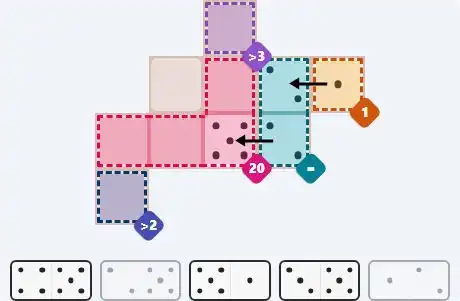
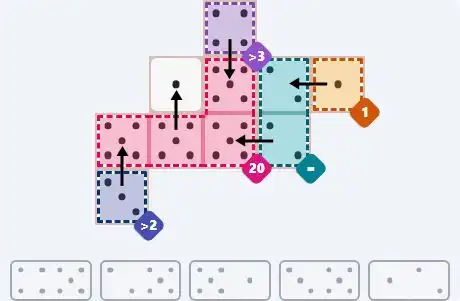
The key to solving today's hard puzzle was identifying the placement for the critical dominoes highlighted in the starting grid. Once those were in place, the rest of the puzzle could be solved logically. See the final grid below to compare your solution.

Starting Position & Key First Steps
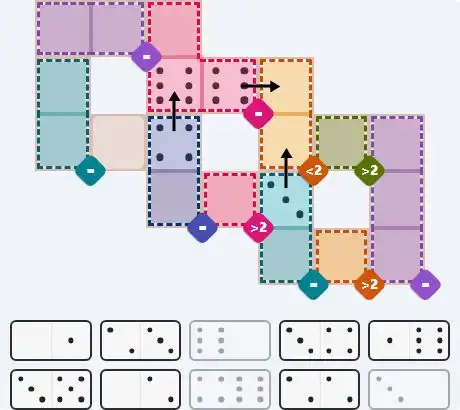
Pips hint for April 22, 2026 – hard level puzzle grid with critical first placements and strategy

This image shows the initial puzzle grid for the hard level, with a few critical first placements highlighted.

Final Answer: The Solved Grid for Hard Mode
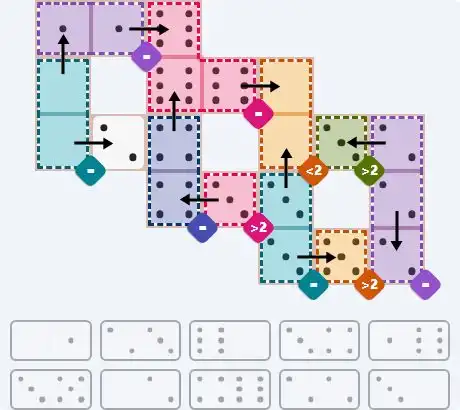
NYT Pips April 22, 2026 hard puzzle full solution grid showing final answer with hints

Compare this final grid with your own solution to see the correct placement of all dominoes.

🔧 Step-by-Step Answer Walkthrough For Easy Level

1
Step 1: The forced entry
The sum=1 constraint covers a single cell — the only value that works is 1. No other option satisfies a one-cell sum of 1. This immediately tells you which domino goes there and pins its position.
2
Step 2: Equals propagation
The [1–2] domino is placed with 1 in the sum=1 cell and 2 in the cell above it. That cell with 2 belongs to a two-cell equals region — the cell directly below (one row down) must also hold 2. The [2–5] domino is the only piece with a 2 that can reach that position.
3
Step 3: The sum-20 region takes shape
The [2–5] domino places 2 in the equals cell and 5 in the adjacent cell, which is part of the four-cell sum-20 region. One cell is now known (5), leaving three cells that must sum to 15.
4
Step 4: The only arithmetic that works
Three cells summing to 15 with domino pip values available: the only solution is 5 + 5 + 5. This is forced — no other combination of available pip values reaches exactly 15 for these three positions.
5
Step 5: Remaining placements
Each of the three remaining dominoes contributes a 5 to the sum region. [5–1] places 5 in the sum region and 1 in the unconstrained cell beside it. [3–5] places 5 in the sum region and 3 in the cell below, satisfying the greater-than-2 constraint (3 > 2 ✓). [4–5] places 5 in the final sum-region cell and 4 in the top cell, satisfying greater-than-3 (4 > 3 ✓).

🔧 Step-by-Step Answer Walkthrough For Medium Level

1
Step 1: Greater-than-4 has one answer
The cell with a greater-than-4 constraint must hold 5 or 6. Looking at the available dominoes, only [5–3] contains a 5 or 6 that fits this cell's position in the grid. Place [5–3] with 5 in the constrained cell and 3 in the adjacent cell.
2
Step 2: First sum-4 region
The cell holding 3 is part of a two-cell sum-4 region. Since 4 − 3 = 1, the partner cell must hold 1. The [1–4] domino provides the 1 — place it with 1 in the sum region and 4 extending upward.
3
Step 3: Equals chain, first link
The 4 from [1–4] sits in a two-cell equals region running vertically. The cell directly above must also hold 4. The [4–0] domino places 4 there and 0 in the adjacent cell to its left.
4
Step 4: Equals chain, second link
The 0 from [4–0] lands in a two-cell equals region at the top of the grid. Its partner cell must also hold 0. The [2–0] domino fills that equals cell with 0, and its other end (2) extends downward into the remaining sum-4 region.
5
Step 5: Second sum-4 region
The sum-4 region now has 2 from [2–0]. The partner cell needs 4 − 2 = 2 as well. The [2–1] domino places 2 in the sum region and 1 in the adjacent cell, which carries a less-than-3 constraint — 1 < 3 ✓.
6
Step 6: Final domino
The only remaining domino is [4–4]. The top-left equals region requires both cells to share the same value — [4–4] is a perfect match, placing 4 in both cells and closing the puzzle.

🔧 Step-by-Step Answer Walkthrough For Hard Level

1
Step 1: Less-than-2 pins the first domino
Two cells carry a less-than-2 constraint — each must hold 0 or 1. The [6–0] domino is the only piece whose valid placement puts 0 in one of these constrained cells. Place it with 0 in the constrained cell and 6 in the adjacent cell. (The second less-than-2 cell will be resolved later.)
2
Step 2: The six anchors a triple equals
The 6 from [6–0] sits in a three-cell equals region — all three cells must hold 6. This is a rare constraint that reaches across two domino placements at once. The [4–6] domino must place 6 in one of those cells (with 4 below it), and [1–6] must place 6 in another (with 1 extending in the opposite direction).
3
Step 3: The 1 triggers a top-row equals pair
The 1 from [1–6] lands in a two-cell equals region along the top edge. The adjacent cell must also hold 1. The [0–1] domino places 1 there and 0 in the cell beside it.
4
Step 4: The 0 cascades into a vertical equals pair
The 0 from [0–1] enters a two-cell equals region running vertically — the cell directly below must also be 0. The [0–2] domino places 0 in the equals cell and 2 in the unconstrained adjacent cell, satisfying the 'empty' region with no constraint needed.
5
Step 5: Second less-than-2 cell and its equals chain
The remaining less-than-2 cell must hold 0 or 1. The [3–0] domino places 0 there and 3 in the cell extending below. That 3 connects to a two-cell equals region: the adjacent cell must also hold 3. The [3–4] domino fits here, placing 3 in the equals pair and 4 in the cell below — which sits in a second two-cell equals region requiring 4 from both.
6
Step 6: Bottom-row dominoes close the greater-than-2 cells
The [3–5] domino places 3 in one equals cell and 5 in the bottom cell beside it — 5 > 2 ✓, satisfying the greater-than-2 constraint there. The middle greater-than-2 cell gets 3 from [3–4], which was placed in Step 5 (3 > 2 ✓).
7
Step 7: Right column closes the final equals trio and greater-than-2
The three-cell equals region along the right column must all share the same value. The [2–2] double places 2 in two of those cells. The [2–3] domino places 2 in the third equals cell and 3 in the remaining greater-than-2 position — 3 > 2 ✓. The puzzle is complete.

💡 Pro Tips for Similar Puzzles

Start with Constraints
Always begin with the most constrained regions - sum regions with small numbers or tight spaces.
Use Equal Regions
Use "equal" regions as anchors - they eliminate many possibilities quickly.
Work Systematically
Let the rules guide your placement rather than guessing randomly.
Double-Check
Verify each region's rules are satisfied before moving to the next.

🎓 Keep Learning & Improve