🔧 Step-by-Step Answer Walkthrough For Easy Level
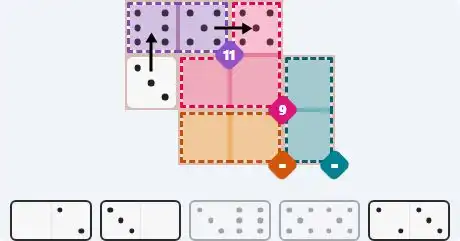
The two top-left cells are in a region targeting 11. Check the domino set — no single piece has pips that add up to 11, so two different dominoes must each contribute one cell here. With 6 as the max pip, the only way two cells sum to 11 is if one shows 6 and the other shows 5. That completely determines what values go in those spots.
[3-6] is the only domino carrying a 6. Place it vertically in the top-left column: the 6-end faces up into the sum-11 region, and the 3-end drops to the cell below. That lower cell has an 'empty' label — no constraint — so either orientation is allowed, but the 6-at-top arrangement is the one that satisfies the sum.
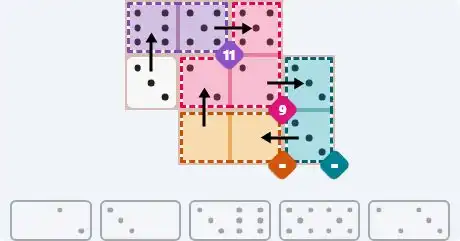
With 6 in the top-left cell, the adjacent cell in the sum-11 region must be 5. [5-5] is the only remaining domino with a 5. Lay it horizontally across the top-center and top-right cells — both become 5. Now the sum-9 region comes into focus: it covers the top-right cell (5) plus two cells in the row below, so those two cells need to sum to 4.
From the three remaining dominoes — [0-2], [3-0], [2-3] — find the pair whose values sum to 4. [2-3] contributes a 2, and [0-2] also contributes a 2: place [2-3] horizontally in the middle row (2 on the left, 3 on the right), then [0-2] vertically below the left cell of [5-5] (2 at top feeding the sum-9 region, 0 at bottom).
The last piece, [3-0], fills the bottom-right corner. Place it with 3 on the right and 0 in the center-bottom. Both bottom cells are now 0 — the equals region there confirms ✓. The right-side equals region also checks out: the middle-row rightmost cell (3 from [2-3]) matches the bottom-right cell (3 from [3-0]) ✓.
🔧 Step-by-Step Answer Walkthrough For Medium Level
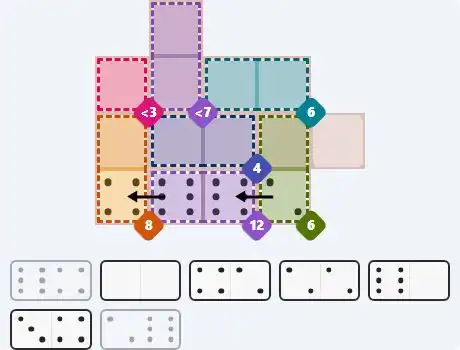
Scan all constraints. The bottom row has a sum region targeting 12. Since the maximum pip is 6, the only way two cells reach 12 is 6+6. Both cells must be exactly 6 — this is forced with no alternatives to consider.
[6-4] and [2-6] are the only dominoes each carrying a 6. [6-4] runs left in the bottom row: 6 on the left side of the sum-12 region, 4 extending further left. [2-6] runs right: 6 on the left side of the sum-12 region, 2 extending further right. The bottom row now reads 4, 6, 6, 2 from left to right.
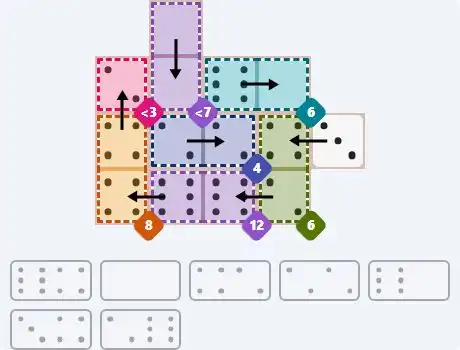
The rightmost bottom cell is 2 (from [2-6]). The region spanning it and the cell above targets 6: 2 + ? = 6, so the upper cell must be 4. [3-4] placed horizontally covers that cell with its 4-end pointing left into the region and 3 extending outward to the right.
The leftmost bottom cell is 4 (from [6-4]). The region spanning it and the cell above targets 8: 4 + ? = 8, so the upper cell is also 4. [4-2] placed vertically does exactly that — 4 at the bottom, 2 above. The 2 satisfies the less-than-3 constraint on that cell: 2 < 3 ✓.
The center sum-4 region takes [2-2]: both cells equal 2, and 2+2=4 ✓. The middle sum-6 region takes [6-0]: 6+0=6 ✓. The double [0-0] finishes the top, placed vertically: both the single top cell and the middle-row cell beside it show 0, each comfortably below 7 ✓.
🔧 Step-by-Step Answer Walkthrough For Hard Level
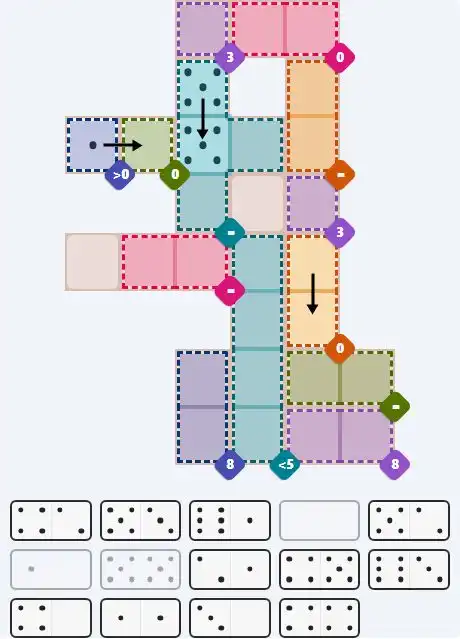
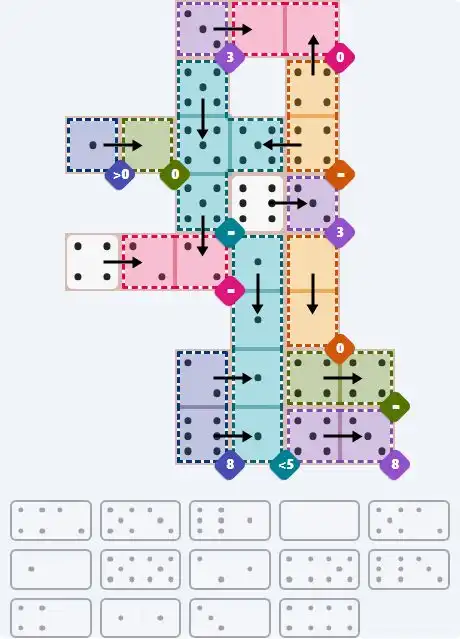
A region summing to zero forces every pip in it to be zero — no math needed, just placement. There are three such regions in this puzzle: one single-cell, one two-cell spanning the middle-right area, and one two-cell at the top. Locate all three before making any moves. These six cells are your unconditional starting positions.
The single-cell sum-0 region forces that pip to 0. The cell immediately beside it is in a greater-than-0 region, meaning it must be at least 1. [1-0] placed horizontally covers both at once: 1 on the greater-than-0 side, 0 on the sum-0 side. No other domino with a 0 can satisfy both constraints in the same move.
The two-cell sum-0 region in the middle-right area needs both cells to be 0. [0-0] is the only double-zero domino in the set. It slots in vertically here — completely forced, no orientation choice.
The two-cell sum-0 at the top forces both cells to 0. The lone cell immediately to their left is in a sum-3 region — it must be 3. [3-0] covers both: 3 on the left, 0 on the right ✓. The cell directly below the rightmost top-zero is in an equals region. [4-0] placed vertically fills those two cells: 0 at top (matching the sum-0 constraint above it) and 4 below, entering the equals region.
Four cells scattered through the center belong to the same equals region — all four must share one pip value. [5-5] is a double and can span two of those cells vertically, giving both a value of 5. That immediately locks the common value for all four cells at 5. The remaining two cells in the equals region must also show 5.
[4-5] placed horizontally puts a 5 into one of the remaining equals cells, with 4 extending outward — and that 4 aligns with the cell above from [4-0], satisfying a side equals region ✓. [5-2] placed vertically fills the last equals cell with 5 at the top and 2 below.
The 2 from [5-2] falls into a two-cell equals region — its neighbor must also be 2. [4-2] placed horizontally satisfies this: 2 on the equals side, 4 extending to the outer column. That outer column now has its top cell pinned at 4. The sum-3 single-cell region in the adjacent area confirms the 3-end of a nearby domino ✓, and the empty regions place no additional burden.
A four-cell column through the center must all be below 5. [1-1] fills the top two cells of that column (both 1 < 5 ✓). [2-1] runs horizontally at the next level with its 1-end facing the column (1 < 5 ✓), its 2-end extending outward. [6-1] runs horizontally at the bottom level with its 1-end in the column (1 < 5 ✓), its 6-end extending outward. The 2 and 6 together satisfy the adjacent sum-8 region: 2+6=8 ✓. [5-3] closes the bottom-right sum-8: 5+3=8 ✓. [4-4] fills the final equals region: both cells equal 4 ✓.
💬 Community Discussion
Leave your comment