🔧 Step-by-Step Answer Walkthrough For Easy Level
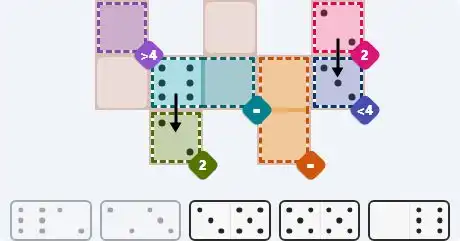
The cell at top-right (row 0, col 4) has a sum=2 constraint — it can only hold the value 2. Separately, the cell at row 2, col 1 also has sum=2, so it holds value 2 as well. Both of these are single-cell constraints, so no cross-checking is needed; the values are immediately determined. You now know where two of the five dominoes go.
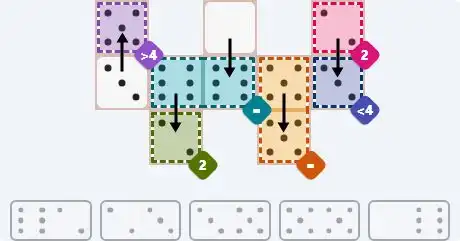
The cell at row 0 col 4 is value 2. This is part of domino [2-3]. The grid only allows it to sit vertically, placing 2 at top and 3 in the cell below (row 1 col 4). That 3 satisfies the less-than-4 constraint on row 1 col 4. The cell at row 2 col 1 is value 2, part of domino [6-2]. It sits vertically with 6 above at row 1 col 1, and 2 below at row 2 col 1.
The equals constraint says row 1 col 1 and row 1 col 2 must have the same value. Row 1 col 1 is now 6 (from the previous step), so row 1 col 2 must also be 6. The only unplaced domino with a 6 half is [0-6]. It sits vertically in col 2 with 0 at the top (row 0 col 2) and 6 at row 1 col 2.
The equals constraint on rows 1–2 in col 3 means both cells must have the same value. Looking at the remaining unplaced dominoes — [3-5] and [5-5] — only [5-5] has two equal halves. It must go here, sitting vertically with 5 at both row 1 col 3 and row 2 col 3.
Only [3-5] remains. It must fill col 0 vertically: row 0 col 0 and row 1 col 0. The greater-than-4 constraint on row 0 col 0 means it must hold a value above 4 — either 5 or 6. With 5 and 3 as the two halves of [3-5], placing 5 at row 0 and 3 at row 1 satisfies the constraint. Puzzle complete.
🔧 Step-by-Step Answer Walkthrough For Medium Level
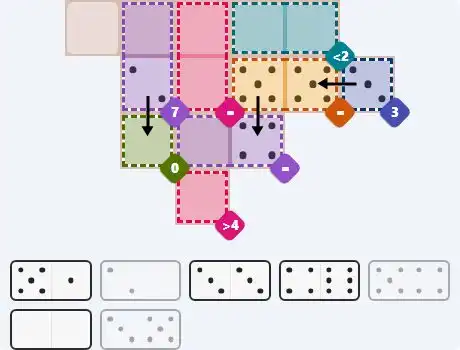
Row 2, col 1 has a sum=0 constraint — the only pip value that equals zero is 0, so that cell is determined immediately. Separately, row 1, col 5 has sum=3, placing the value 3 there. Two anchors, no deduction required.
Cell row 2 col 1 = 0 is part of domino [2-0]. The grid forces it to sit vertically: 2 at row 1 col 1, 0 at row 2 col 1. That 0 satisfies the sum=0 region. Row 1 col 1 is now known to be 2.
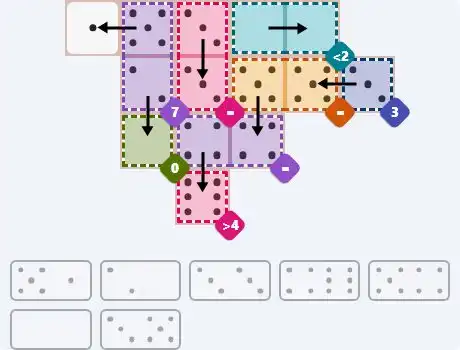
The two-cell sum region covering row 0 col 1 and row 1 col 1 must equal 7. Row 1 col 1 = 2, so row 0 col 1 must be 5. Domino [5-1] sits horizontally, placing 5 at row 0 col 1 and 1 at row 0 col 0.
Row 1 col 5 = 3 is part of domino [3-5]. It sits horizontally leftward, placing 5 at row 1 col 4. The equals pair at row 1 cols 3–4 forces row 1 col 3 = 5 as well. That 5 is part of domino [5-4], which sits vertically, placing 4 at row 2 col 3.
The equals region covering row 2 cols 2–3 forces row 2 col 2 to also be 4. Domino [4-6] sits vertically, placing 4 at row 2 col 2 and 6 at row 3 col 2. That 6 satisfies the greater-than-4 constraint on row 3 col 2.
The equals pair at row 0 col 2 and row 1 col 2 forces both to the same value. The only remaining domino with two equal halves is [3-3], so both cells = 3. Finally, domino [0-0] fills row 0 cols 3–4 horizontally — both halves are 0, and their sum is 0, which satisfies the less-than-2 constraint. Puzzle complete.
🔧 Step-by-Step Answer Walkthrough For Hard Level
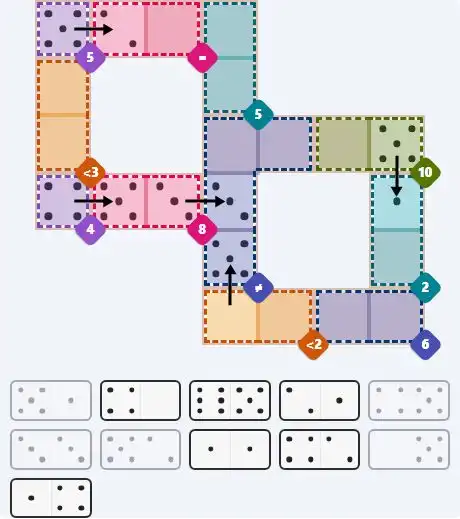
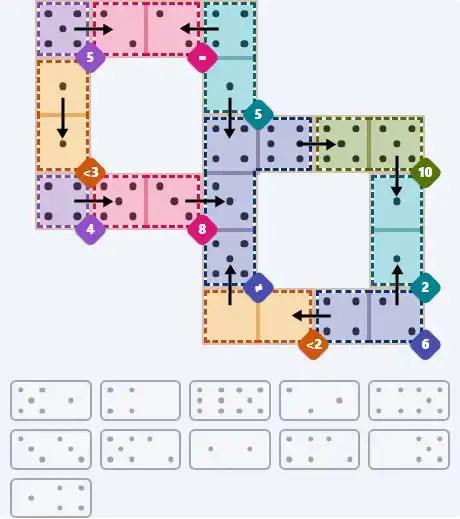
Row 0, col 0 has a sum=5 constraint — value 5 is placed immediately. Row 3, col 0 has sum=4 — value 4 placed immediately. These two cells are independent anchors and kick off separate chains.
Cell (0,0) = 5 is part of domino [5-2], placed horizontally: (0,0)=5, (0,1)=2. The equals pair at row 0 cols 1–2 forces (0,2) = 2. Domino [4-2] sits horizontally placing 4 at (0,3) and 2 at (0,2). The two-cell sum at rows 0–1 col 3 must equal 5; with (0,3)=4, row 1 col 3 must be 1. Domino [1-4] sits vertically: (1,3)=1, (2,3)=4.
Cell (3,0) = 4 is part of domino [4-5], placed horizontally: (3,0)=4, (3,1)=5. The two-cell sum at row 3 cols 1–2 must equal 8; with (3,1)=5, (3,2) must be 3. Domino [3-3] sits horizontally: (3,2)=3, (3,3)=3.
The two-cell sum at row 2 cols 5–6 must equal 10 — the only way to reach 10 with pip values is 5+5 or 6+4. Domino [6-5] placed horizontally fills row 2 cols 4–5: (2,4)=6, (2,5)=5. Domino [5-1] placed vertically in col 6 fills (2,6)=5 and (3,6)=1 — making the sum 5+5=10. Rows 3–4 col 6 must sum to 2; (3,6)=1, so (4,6)=1. Domino [2-1] vertical places (5,6)=2 and (4,6)=1.
The unequal region (rows 2–4, col 3–4) requires all four cells to have different values. Known so far: (2,3)=4, (2,4)=6, (3,3)=3. The fourth cell (4,3) must differ from 4, 6, and 3. Domino [0-5] placed vertically: (5,3)=0, (4,3)=5 — satisfies the unequal constraint (values: 4, 6, 3, 5, all different). Row 5 cols 3–4 must sum to less than 2; (5,3)=0, so (5,4) must be 0 or 1. Domino [4-0] horizontal places (5,5)=4 and (5,4)=0 — sum 0+0=0, confirmed less than 2. Row 5 cols 5–6 must sum to 6: 4+2=6 ✓. Last, domino [1-1] vertical fills col 0 rows 1–2: (1,0)=1, (2,0)=1 — sum 1+1=2, satisfying the less-than-3 constraint. Puzzle complete.
💬 Community Discussion
Leave your comment