NYT Pips Hints & Answers for April 16, 2026

Apr 16, 2026

🚨 SPOILER WARNING

This page contains the final **answer** and the complete **solution** to today's NYT Pips puzzle. If you haven't attempted the puzzle yet and want to try solving it yourself first, now's your chance!

Click here to play today's official NYT Pips game first.

Want hints instead? Scroll down for progressive clues that won't spoil the fun.

🎲 Today's Puzzle Overview

Ian Livengood's easy grid for April 16th opens on two independent footholds: single-cell sum constraints at (2,0) and (3,1) each name a pip outright without requiring any cross-referencing. That double entry point — rare in easy grids — makes the first placement feel inevitable, and the two equals pairs chained to those anchors carry the solve forward in a single unbroken pass. The sum=6 region at the top edge ties the final loose end after the equals chains have done their work.

Rodolfo Kurchan's medium for April 16th is driven by a single-cell sum on the left edge that fixes a pip value immediately and seeds a three-cell equals chain extending into the board's midsection. That chain does the structural work: it propagates a value rightward and unlocks a sum=10 constraint that would otherwise face two unknowns. Two sum=6 columns at the top converge from opposite sides once the equals chain supplies one input each, and the greater-than cell and a lone free placement close the board.

Kurchan's hard for April 16th is an interlocking equals puzzle built around three independent equals regions that span different axes of the board. The only unconditional entry is a single-cell sum in the second row; from it, a four-cell equals row sweeps across the top and a five-cell equals column descends the right edge — two orthogonal spines that together constrain the majority of the fourteen dominoes. A five-cell equals region at the bottom-left, reached from a sum=8 constraint, closes the final cluster after a pair of sum constraints at row 7 deliver the last pip values.

💡 Progressive Hints

Try these hints one at a time. Each hint becomes more specific to help you solve it yourself!

💡 Two single-cell sum constraints each name a pip directly — start at (2,0)=4
Cell (2,0) must equal exactly 4 — no arithmetic needed, the sum is on a single cell. Scan today's easy set for a domino with a 4-pip face that can sit on (2,0): [3|4] is the candidate. Place it with 4 at (2,0) — sum=4 ✓ — and 3 at (2,1). The equals region at (2,1) and (2,2) now has its anchor pip. Meanwhile, (3,1) must equal 1, which identifies [4|1] just as cleanly.
💡 (2,1)=3 forces the equals chain through (2,2) and (1,2); sum=6 at the top closes with one step
The equals region at (2,1) and (2,2) requires both cells to match. (2,1)=3, so (2,2)=3. Only [3|5] covers (2,2) with a 3: place it with 3 at (2,2) ✓ and 5 at (1,2). The sum region at (0,2) and (1,2) must total 6: (1,2)=5, so (0,2)=1. Separately, (3,1)=1 from the sum=1 constraint forces [4|1] into (3,2) and (3,1), and the equals pair at (3,2),(3,3) carries that value to (3,3)=4.
💡 Full solution
Sum=4 at (2,0)=4: [3|4] covers (2,1) and (2,0) — 3 at (2,1), 4 at (2,0) ✓. Equals (2,1),(2,2): (2,1)=3, so (2,2)=3. [3|5] covers (2,2) and (1,2) — 3 at (2,2) ✓, 5 at (1,2). Sum=6 at (0,2),(1,2): (1,2)=5, so (0,2)=1. Sum=1 at (3,1)=1: [4|1] covers (3,2) and (3,1) — 4 at (3,2), 1 at (3,1) ✓. Equals (3,2),(3,3): (3,2)=4, so (3,3)=4. [2|4] covers (2,3) and (3,3) — 4 at (3,3) ✓, 2 at (2,3) — empty ✓. [0|1] covers (0,3) and (0,2) — 1 at (0,2) ✓, 0 at (0,3) — empty ✓. All seven constraints satisfied. Puzzle complete.
💡 Sum=6 at (2,0) is the sharpest entry — (2,0)=6 immediately, then equals cascade follows
Cell (2,0) must equal exactly 6 on its own. Of today's medium dominoes, only [4|6] can place a 6 at (2,0): orient it with 6 at (2,0) — sum=6 ✓ — and 4 at (3,0). That 4 enters the three-cell equals region at (3,0),(3,1),(4,1), forcing all three cells to 4.
💡 Equals {(3,0),(3,1),(4,1)}=4 seeds sum=10; equals (1,3)=(2,3) and the two sum=6 columns cascade to the top
With (3,1)=4, domino [5|4] covers (3,2) and (3,1): 4 at (3,1) ✓, 5 at (3,2). Sum=10 at (3,2),(3,3): (3,2)=5, so (3,3)=5. Domino [3|5] places 5 at (3,3) ✓ and 3 at (2,3). Equals (1,3)=(2,3): (2,3)=3, so (1,3)=3. From there the two sum=6 columns at the top unravel: each column has one pip determined by the equals chain, supplying the other by subtraction.
💡 Full solution
Sum=6 at (2,0)=6: [4|6] covers (3,0) and (2,0) — 4 at (3,0), 6 at (2,0) ✓. Equals (3,0),(3,1),(4,1)=4: [5|4] covers (3,2) and (3,1) — 5 at (3,2), 4 at (3,1) ✓. [3|4] covers (4,2) and (4,1) — 3 at (4,2) — empty ✓, 4 at (4,1) ✓. Sum=10 at (3,2),(3,3): (3,2)=5, so (3,3)=5. [3|5] covers (2,3) and (3,3) — 3 at (2,3), 5 at (3,3) ✓. Equals (1,3),(2,3): (2,3)=3, so (1,3)=3. [3|2] covers (1,3) and (1,2) — 3 at (1,3) ✓, 2 at (1,2). Sum=6 at (0,2),(1,2): (1,2)=2, so (0,2)=4. [0|4] covers (0,1) and (0,2) — 0 at (0,1), 4 at (0,2) ✓. Sum=6 at (0,1),(1,1): (0,1)=0, so (1,1)=6. [5|6] covers (1,0) and (1,1) — 5 at (1,0), 6 at (1,1) ✓. Greater>0 at (1,0)=5 ✓. All eight constraints satisfied. Puzzle complete.
💡 Sum=4 at (1,0) is the sole unconditional entry; [4|5] seeds the four-cell equals across the top row
Cell (1,0) must equal exactly 4. Scan today's hard set: [4|5] is the tile that places a 4 at (1,0) and deposits 5 at (0,0). The four-cell equals region at (0,0),(0,1),(0,2),(0,3) now has its pip: all four cells must be 5. The [5|5] double drops straight into (0,1) and (0,2), confirming two cells in one move, and [5|6] is the only tile that covers (0,3) with a 5 — placing 6 at (0,4).
💡 Equals (0,4)=(1,4)=6 launches the five-cell equals column down the right edge — [4|4] double anchors it
(0,4)=6 forces (1,4)=6 via the two-cell equals. Domino [4|6] covers (2,4) and (1,4): 6 at (1,4) ✓, 4 at (2,4). The five-cell equals column at (2,4),(3,4),(4,4),(5,4),(6,4) requires all five to match at pip 4. The [4|4] double covers (3,4) and (4,4) in one placement, and the remaining column cells are satisfied by [4|1] — which deposits 1 at (5,3) — and [3|4], which feeds (7,4)=3 into the sum=5 constraint at the bottom.
💡 Full solution
Sum=4 at (1,0)=4: [4|5] covers (1,0) and (0,0) — 4 at (1,0) ✓, 5 at (0,0). Equals (0,0)–(0,3)=5: [5|5] covers (0,1) and (0,2) — 5 at both ✓. [5|6] covers (0,3) and (0,4) — 5 at (0,3) ✓, 6 at (0,4). Equals (0,4),(1,4)=6: [4|6] covers (2,4) and (1,4) — 4 at (2,4), 6 at (1,4) ✓. Equals (2,4)–(6,4)=4: [4|4] covers (3,4) and (4,4) — 4 at both ✓. [4|1] covers (5,4) and (5,3) — 4 at (5,4) ✓, 1 at (5,3). [3|4] covers (7,4) and (6,4) — 3 at (7,4), 4 at (6,4) ✓. Equals (5,2),(5,3)=1: [1|0] covers (5,2) and (6,2) — 1 at (5,2) ✓, 0 at (6,2). Sum=5 at (7,3),(7,4): (7,4)=3, so (7,3)=2. [2|0] covers (7,3) and (6,3) — 2 at (7,3) ✓, 0 at (6,3). Equals (6,2),(6,3),(7,0),(7,1),(7,2)=0: [0|0] covers (7,1) and (7,2) — 0 at both ✓. (7,0)=0. [0|5] covers (7,0) and (6,0) — 0 at (7,0) ✓, 5 at (6,0). Sum=8 at (5,0),(6,0): (6,0)=5, so (5,0)=3. [3|1] covers (5,0) and (4,0) — 3 at (5,0) ✓, 1 at (4,0). Equals (2,0),(3,0),(4,0)=1: [1|1] covers (2,0) and (3,0) — 1 at both ✓. Sum=8 at (2,2),(3,2): [3|5] covers (3,2) and (2,2) — 3+5=8 ✓. All ten constraints satisfied. Puzzle complete.

🎨 Pips Solver

Apr 16, 2026

Click a domino to place it on the board. You can also click the board, and the correct domino will appear.
Final Answer & Complete Solution For Hard Level

The key to solving today's hard puzzle was identifying the placement for the critical dominoes highlighted in the starting grid. Once those were in place, the rest of the puzzle could be solved logically. See the final grid below to compare your solution.

Starting Position & Key First Steps
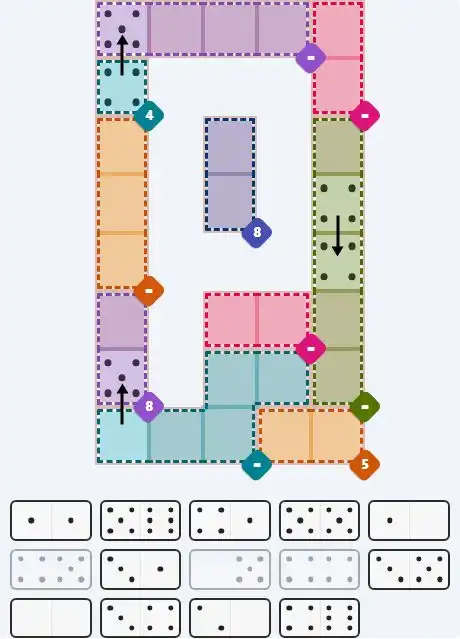
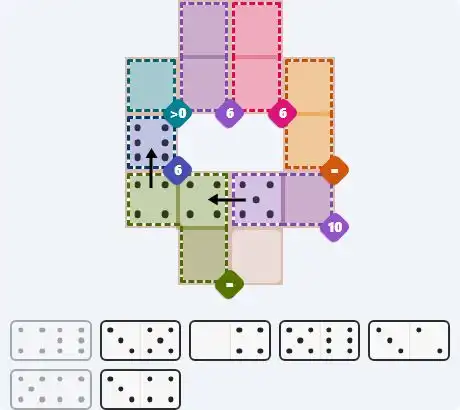
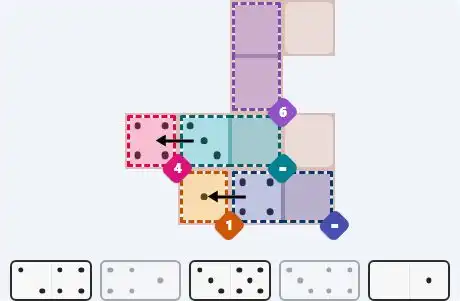
Pips hint for April 16, 2026 – hard level puzzle grid with critical first placements and strategy

This image shows the initial puzzle grid for the hard level, with a few critical first placements highlighted.

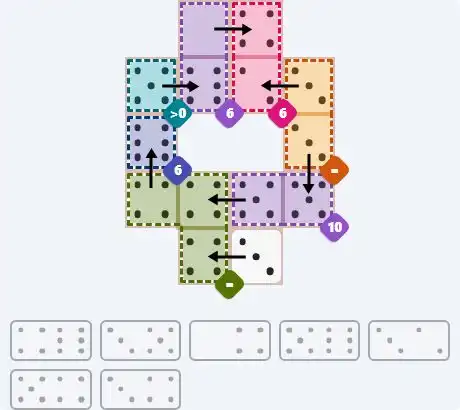
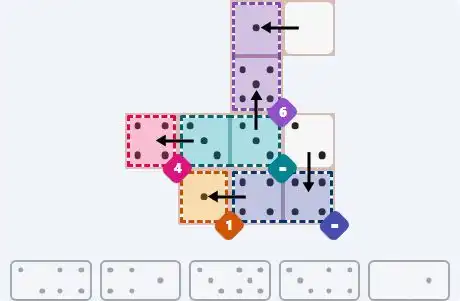
Final Answer: The Solved Grid for Hard Mode
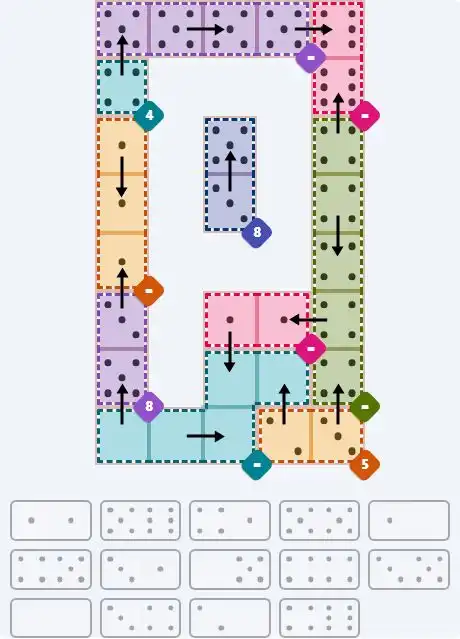
NYT Pips April 16, 2026 hard puzzle full solution grid showing final answer with hints

Compare this final grid with your own solution to see the correct placement of all dominoes.

🔧 Step-by-Step Answer Walkthrough For Easy Level

1
Step 1: Sum=4 at (2,0) — (2,0)=4; [3|4] places (2,1)=3
Cell (2,0) must equal exactly 4. Domino [3|4] covers (2,1) and (2,0): orient it with 4 at (2,0) — sum=4 ✓ — and 3 at (2,1).
2
Step 2: Equals (2,1),(2,2): (2,1)=3 forces (2,2)=3; [3|5] places (1,2)=5; sum=6 → (0,2)=1
The equals region at (2,1) and (2,2) requires both cells to match. (2,1)=3, so (2,2)=3. Domino [3|5] covers (2,2) and (1,2): 3 at (2,2) ✓, 5 at (1,2). Sum=6 at (0,2) and (1,2): (1,2)=5, so (0,2)=1.
3
Step 3: Sum=1 at (3,1) — (3,1)=1; [4|1] places (3,2)=4; equals (3,2),(3,3) → (3,3)=4; [2|4] closes (2,3)
Cell (3,1) must equal exactly 1. Domino [4|1] covers (3,2) and (3,1): orient it with 1 at (3,1) — sum=1 ✓ — and 4 at (3,2). Equals at (3,2) and (3,3): (3,2)=4, so (3,3)=4. Domino [2|4] covers (2,3) and (3,3): 4 at (3,3) ✓, 2 at (2,3) — empty ✓.
4
Step 4: [0|1] closes the board; (0,3)=0
Domino [0|1] covers (0,3) and (0,2): orient it with 1 at (0,2) — sum=6 at (0,2),(1,2): 1+5=6 ✓ — and 0 at (0,3) — empty ✓. All seven constraints satisfied. Puzzle complete.

🔧 Step-by-Step Answer Walkthrough For Medium Level

1
Step 1: Sum=6 at (2,0) — (2,0)=6; [4|6] places (3,0)=4
Cell (2,0) must equal exactly 6. Domino [4|6] covers (3,0) and (2,0): orient it with 6 at (2,0) — sum=6 ✓ — and 4 at (3,0).
2
Step 2: Equals {(3,0),(3,1),(4,1)}=4: (3,0)=4 forces (3,1)=4 and (4,1)=4; [5|4] places (3,2)=5
The three-cell equals region at (3,0),(3,1),(4,1) requires all three to match. (3,0)=4 from Step 1, so (3,1)=4 and (4,1)=4. Domino [5|4] covers (3,2) and (3,1): orient it with 4 at (3,1) ✓ and 5 at (3,2). Domino [3|4] covers (4,2) and (4,1): 4 at (4,1) ✓, 3 at (4,2) — empty ✓.
3
Step 3: Sum=10 at (3,2),(3,3): (3,2)=5 → (3,3)=5; [3|5] places (2,3)=3; equals (1,3)=(2,3)=3; [3|2] places (1,2)=2
Sum=10 at (3,2) and (3,3): (3,2)=5 from Step 2, so (3,3)=5. Domino [3|5] covers (2,3) and (3,3): 5 at (3,3) ✓, 3 at (2,3). Equals at (1,3) and (2,3): (2,3)=3, so (1,3)=3. Domino [3|2] covers (1,3) and (1,2): 3 at (1,3) ✓, 2 at (1,2).
4
Step 4: Sum=6 at (0,2),(1,2): (1,2)=2 → (0,2)=4; [0|4] places (0,1)=0; sum=6 at (0,1),(1,1): (0,1)=0 → (1,1)=6
Sum=6 at (0,2) and (1,2): (1,2)=2, so (0,2)=4. Domino [0|4] covers (0,1) and (0,2): 4 at (0,2) ✓, 0 at (0,1). Sum=6 at (0,1) and (1,1): (0,1)=0, so (1,1)=6.
5
Step 5: [5|6] places (1,0)=5; greater>0 ✓; puzzle complete
Domino [5|6] covers (1,0) and (1,1): 6 at (1,1) ✓, 5 at (1,0). Greater>0 at (1,0)=5 — 5>0 ✓. All eight constraints satisfied. Puzzle complete.

🔧 Step-by-Step Answer Walkthrough For Hard Level

1
Step 1: Sum=4 at (1,0) — (1,0)=4; [4|5] places (0,0)=5
Cell (1,0) must equal exactly 4. Domino [4|5] covers (1,0) and (0,0): orient it with 4 at (1,0) — sum=4 ✓ — and 5 at (0,0).
2
Step 2: Equals (0,0)–(0,3)=5: [5|5] double fills (0,1),(0,2); [5|6] places (0,3)=5 and (0,4)=6
The four-cell equals region at (0,0),(0,1),(0,2),(0,3) requires all cells to match. (0,0)=5 from Step 1, so all must be 5. Domino [5|5] covers (0,1) and (0,2): 5 at both ✓. Domino [5|6] covers (0,3) and (0,4): 5 at (0,3) ✓, 6 at (0,4).
3
Step 3: Equals (0,4),(1,4)=6; [4|6] places (2,4)=4
The two-cell equals region at (0,4) and (1,4) requires both to match. (0,4)=6, so (1,4)=6. Domino [4|6] covers (2,4) and (1,4): 6 at (1,4) ✓, 4 at (2,4).
4
Step 4: Equals {(2,4),(3,4),(4,4),(5,4),(6,4)}=4: [4|4] fills two cells; [4|1] places (5,3)=1; [3|4] places (7,4)=3
The five-cell equals column requires all to match at pip 4. Domino [4|4] covers (3,4) and (4,4): 4 at both ✓. Domino [4|1] covers (5,4) and (5,3): 4 at (5,4) ✓, 1 at (5,3). Domino [3|4] covers (7,4) and (6,4): 3 at (7,4), 4 at (6,4) ✓.
5
Step 5: Equals (5,2),(5,3)=1; [1|0] places (6,2)=0; sum=5 at (7,3),(7,4) → (7,3)=2; [2|0] places (6,3)=0
Equals at (5,2) and (5,3): (5,3)=1, so (5,2)=1. Domino [1|0] covers (5,2) and (6,2): 1 at (5,2) ✓, 0 at (6,2). Sum=5 at (7,3) and (7,4): (7,4)=3 from Step 4, so (7,3)=2. Domino [2|0] covers (7,3) and (6,3): 2 at (7,3) ✓, 0 at (6,3).
6
Step 6: Equals {(6,2),(6,3),(7,0),(7,1),(7,2)}=0: [0|0] double fills two cells; [0|5] places (6,0)=5
The five-cell equals region requires all to match. (6,2)=0 and (6,3)=0 from Step 5, confirming pip 0. Domino [0|0] covers (7,1) and (7,2): 0 at both ✓. (7,0) must also be 0. Domino [0|5] covers (7,0) and (6,0): 0 at (7,0) ✓, 5 at (6,0).
7
Step 7: Sum=8 at (5,0),(6,0): (6,0)=5 → (5,0)=3; [3|1] places (4,0)=1; equals {(2,0),(3,0),(4,0)}=1: [1|1] closes
Sum=8 at (5,0) and (6,0): (6,0)=5, so (5,0)=3. Domino [3|1] covers (5,0) and (4,0): 3 at (5,0) ✓, 1 at (4,0). The three-cell equals region at (2,0),(3,0),(4,0) requires all to match: (4,0)=1, so all must be 1. Domino [1|1] covers (2,0) and (3,0): 1 at both ✓.
8
Step 8: Sum=8 at (2,2),(3,2): [3|5] covers both; puzzle complete
Sum=8 at (2,2) and (3,2): the only remaining domino, [3|5], covers (3,2) and (2,2) — 3+5=8 ✓. All ten constraints satisfied. Puzzle complete.

💡 Pro Tips for Similar Puzzles

Start with Constraints
Always begin with the most constrained regions - sum regions with small numbers or tight spaces.
Use Equal Regions
Use "equal" regions as anchors - they eliminate many possibilities quickly.
Work Systematically
Let the rules guide your placement rather than guessing randomly.
Double-Check
Verify each region's rules are satisfied before moving to the next.

🎓 Keep Learning & Improve