NYT Pips Hints & Answers for September 30, 2026

Sep 30, 2026

🚨 SPOILER WARNING

This page contains the final answer and the complete solution to today's NYT Pips puzzle. If you haven't attempted the puzzle yet and want to try solving it yourself first, now's your chance!

Click here to play today's official NYT Pips game first.

Want hints instead? Scroll down for progressive clues that won't spoil the fun.

SEE ALSO:

🎲 Today's Puzzle Overview

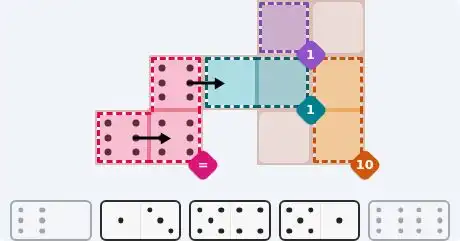
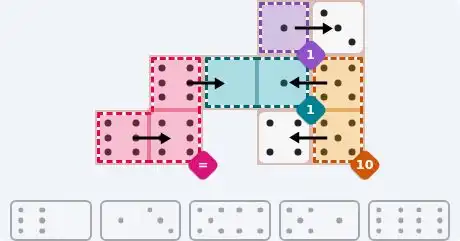
Ian Livengood opens today's NYT Pips easy with a deliberately stingy design: two separate regions both target a sum of 1 — a lone cell tucked into the top-right corner and a pair running across the middle of the board — while a three-cell equals block in the bottom-left can only be satisfied one way. That equals block is the spine of the puzzle; it quietly decides the value of the tile that feeds the pair right beside it, so the two constraint families lean on each other instead of sitting apart. The uncoloured squares in the top-right and bottom-right act as pressure valves, absorbing whatever is left over.

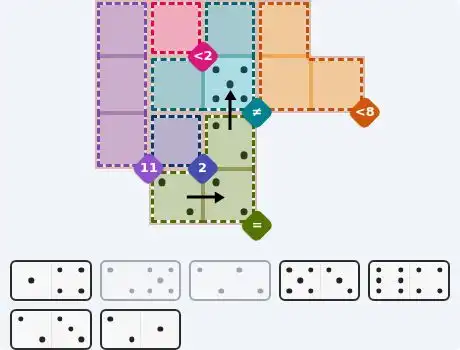
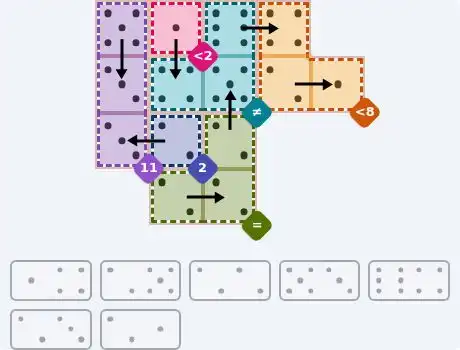
Rodolfo Kurchan's medium tightens things with a mixed toolkit: a three-cell sum 11 column down the left edge, a less-8 block of three on the right, a single less-2 cell, a sum 2 single, and an unequal trio near the middle that refuses to repeat itself. The design signature is the way the equals block at the bottom acts as a fixed point — once you accept that its three cells must agree, the unequal trio above it and the purple column off to its left both begin to collapse. Kurchan also tucks his tightest single-cell constraints against the edges, where the dominoes running into them have nowhere else to turn.

Kurchan's hard is the most architectural of the three: a four-cell equals block in the bottom-right, a three-cell equals block in the top-left, and a sum 22 block that swallows the fattest pips on the tray. Between them sit two greater-than singles and one less-than single like gates, and the teal sum 3 run along the top is a lovely piece of misdirection — it reads like filler but it resolves first. Wide sums plus repeated-value blocks is a signature Kurchan pairing: the big sums soak up high pips, and the equals regions tell you exactly which pips they have to be.

💡 Progressive Hints

Try these hints one at a time. Each hint becomes more specific to help you solve it yourself!

💡 Match before you add
Start with the constraint that forces cells to agree rather than total up. One region on this board must repeat the same pip in every cell — find it and the whole grid starts falling into line.
💡 The pink equals block, bottom-left
The pink equals region in the bottom-left corner has to show the same pip three times. Scan the tray: only the single double can supply two of those cells, and just one other tile carries the matching half. That settles the block's value before you place a thing — and the tile that breaks away from the double must send its other half right into the teal sum 1 pair beside it.
💡 The full layout, tile by tile
Everything. The pink equals block reads 6, 6, 6: the 6/6 double lies flat across its two bottom cells, and the 6/0 tile lays its 6 in the block's top-right cell, sliding its 0 right into the left cell of the teal sum 1 pair. That pair's right cell takes the 1 from the 5/1 tile, which lies flat with its 1 on the left and its 5 on the right in the upper cell of the orange sum 10 column. The column's lower cell takes the 5 from the 5/4 tile, whose 4 steps left into the bottom-right free square. Last, the 1/3 tile lies flat across the top-right: 1 on the left in the purple sum 1 cell, 3 on the right in the free square beside it.
💡 Find the fixed point
Begin with the region where every cell must match rather than add up, then check the tray for the one tile that can serve it twice.
💡 The green equals block at the bottom
The green equals region at the bottom must repeat a single pip across its three cells. The tray's only double handles two of them, so the third cell, at the block's top-right, has to be fed from the teal unequal region sitting directly above it. Once that pip is fixed, the rest of the teal trio and the sum 11 column off to the left start collapsing too.
💡 The complete solution
The green equals block reads 2, 2, 2: the 2/2 double lies flat across its two bottom cells, and the 2/5 tile comes down from the teal unequal region with its 2 in the block's top-right cell and its 5 in the teal cell above. The teal trio finishes as 6, 4, 5 — the 6/4 tile lies flat on the top row with 6 in the teal block's top-right cell and 4 in the top-left cell of the orange less 8 block, while the 1/4 tile stands vertically with 1 up in the pink less 2 cell and 4 down in the teal block's bottom-left cell. Down the left side, the purple sum 11 column takes the 5/3 tile standing vertically (5 in its top cell, 3 in the middle) and the 2/3 tile lying flat across the bottom with 3 in the column's lowest cell and 2 in the blue sum 2 cell to its right. Finally the 2/1 tile lies flat inside the orange less 8 block, 2 on the left and 1 on the right.
💡 This one runs on equals
The grid leans hardest on its matching constraints — one tight trio in the top-left corner and a four-cell block in the bottom-right — and both have to be measured against the doubles on the tray. Before either of them, though, hunt down the smallest sum region on the board.
💡 The teal sum 3 run along the top
The teal region in the top-right is a three-cell run totalling 3, and the tray holds a 0/0 double. Three cells adding to 3 with a double zero available leaves the run almost spoken for: two cells take the zeroes, and the third is left holding the 3.
💡 The 3/4 tile reaches left
The teal run's left cell takes the 3 from the 3/4 tile, which lies flat with its 4 stepping left into the right cell of the pink sum 6 pair on the top row. That leaves the pink pair needing a 2 in its left cell, and the tile that brings it while feeding the purple equals block is the 2/4, whose own 4 slides further left into the block's top-left cell.
💡 The purple equals trio reads 4
With a 4 already in the block's top-left cell, all three purple equals cells read 4. The 4/4 double stands vertically, 4 up in the block's bottom-left cell and 4 down in the left cell of the green sum 9 pair beneath it, and the 4/1 tile lies flat with 4 in the block's bottom-right cell and 1 stepping right into the upper cell of the orange sum 2 pair.
💡 The complete solution
Top edge: the 2/4 tile lies flat with 2 in the pink sum 6 pair's left cell and 4 in the purple equals block's top-left cell; the 3/4 tile lies flat with 4 in the pink pair's right cell and 3 in the teal sum 3 run's left cell; and the 0/0 double lies flat across the run's middle and right cells. Middle band: the 4/4 tile stands vertically, 4 up in the purple equals block's bottom-left cell and 4 down in the left cell of the green sum 9 pair; the 4/1 tile lies flat with 4 in the block's bottom-right cell and 1 stepping right into the upper cell of the orange sum 2 pair; the 4/6 tile lies flat across the blue sum 22 block's top row, 4 left and 6 right; the 5/6 tile stands vertically, 6 up in blue's bottom-left cell and 5 down in the single teal greater 4 cell; the 2/6 tile stands vertically, 6 up in blue's bottom-right cell and 2 down in the top-right corner of the orange equals block; and the 1/5 tile lies flat with 5 in the green sum 9 pair's right cell and 1 in the lower cell of the orange sum 2 pair. Bottom edges: the 4/0 tile lies flat with 4 in the upper cell of the lower purple sum 9 pair and 0 in the pink less 1 cell beside it; the 4/5 tile stands vertically, 5 up in that pair's lower cell and 4 down in the bottom-left free square; the 3/1 tile lies flat with 3 in the right-hand of the two bottom-left free squares and 1 in the green unequal pair's left cell; the 3/2 tile lies flat with 3 in the green unequal pair's right cell and 2 in the purple sum 2 cell; the 2/2 double stands vertically, 2 up in the orange equals block's middle-right cell and 2 down in its bottom-right cell; and the 2/5 tile lies flat with 5 in the blue greater 4 cell and 2 in the orange equals block's middle-left cell.

🎨 Pips Solver

Sep 30, 2026

Click a domino to place it on the board. You can also click the board, and the correct domino will appear.
✅ Final Answer & Complete Solution For Hard Level

The key to solving today's hard puzzle was identifying the placement for the critical dominoes highlighted in the starting grid. Once those were in place, the rest of the puzzle could be solved logically. See the final grid below to compare your solution.

Starting Position & Key First Steps
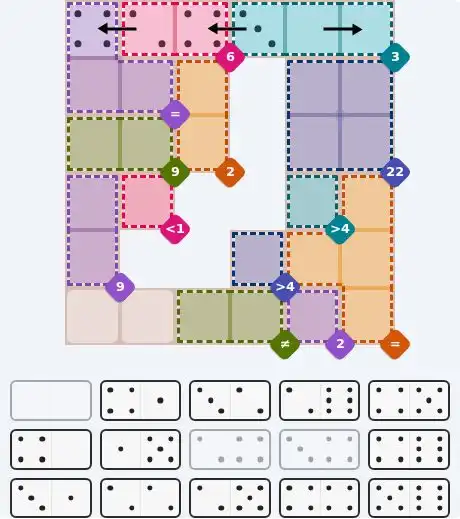
Pips hint for Sept 30, 2026 – hard level puzzle grid with critical first placements and strategy

This image shows the initial puzzle grid for the hard level, with a few critical first placements highlighted.

Final Answer: The Solved Grid for Hard Mode
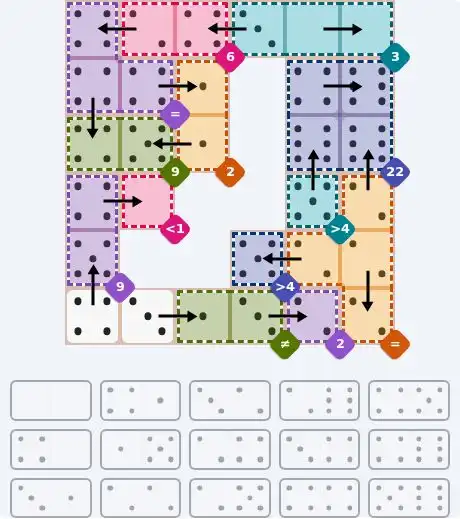
NYT Pips Sept 30, 2026 hard puzzle full solution grid showing final answer with hints

Compare this final grid with your own solution to see the correct placement of all dominoes.

🔧 Step-by-Step Answer Walkthrough For Easy Level

1
Step 1: Why the pink block must repeat a 6
The pink equals region in the bottom-left needs the same pip in all three of its cells. Run down the tray — 6/0, 1/3, 5/4, 5/1, 6/6. Only the 6/6 is a double, and 6 is the only pip that appears on two tiles, so the block has to read 6, 6, 6. The 6/0 tile supplies the third one, which means its 0 half has to leave the region.
2
Step 2: Lay the double and let the 0 escape
Set the 6/6 double flat across the pink block's two bottom cells, 6 on the left and 6 on the right. The 6/0 tile then lies flat with its 6 in the block's top-right cell, and the only way out for its 0 is to the right — into the left cell of the teal sum 1 pair across the middle of the board.
3
Step 3: Finish the teal sum 1 pair
The teal pair now holds a 0 on its left. Its right cell has to be a 1, and the tile that can put one there while still reaching the orange sum 10 column is the 5/1: it lies flat with its 1 on the left in the teal pair and its 5 on the right in the upper cell of the orange region.
4
Step 4: Close the orange column and the top-right corner
The orange sum 10 column already has a 5 up top, so its lower cell needs another 5 — the 5/4 tile lies flat with its 5 on the right in that lower cell and its 4 on the left in the bottom-right free square. Finally the 1/3 tile lies flat across the top-right: 1 on the left in the purple sum 1 cell, 3 on the right in the top-right free square.

🔧 Step-by-Step Answer Walkthrough For Medium Level

1
Step 1: The green block picks its value
The green equals region at the bottom has to repeat a single pip across all three cells. The tray is 1/4, 2/5, 2/2, 5/3, 6/4, 2/3, 2/1 — only the 2/2 is a double, so the block's value is 2, and a third 2 has to arrive from a tile reaching in from outside.
2
Step 2: Placing the double and the incoming 2
Lay the 2/2 double flat across the green block's two bottom cells. Its top-right corner then takes the 2 from the 2/5 tile, which stands vertically: 2 down into the green block, 5 up into the bottom-right cell of the teal unequal trio above it.
3
Step 3: The teal trio resolves into three different pips
The teal unequal block already holds a 5, and the tray has to give it two more differing values. Its top-right cell takes the 6 from the 6/4 tile, which lies flat with its 4 stepping right into the top-left cell of the orange less 8 block; its bottom-left cell takes the 4 from the 1/4 tile, which stands vertically with its 1 above in the pink less 2 cell.
4
Step 4: The purple sum 11 column
The purple column down the left edge needs 11 across three cells. The 5/3 tile stands vertically with 5 in the top cell and 3 in the middle, and the 2/3 tile lies flat across the bottom with 3 in the column's lowest cell and 2 stepping right into the blue sum 2 cell — which needs a 2 of its own anyway.
5
Step 5: The orange less 8 block closes the board
The orange less 8 block already has its 4 in the top-left corner. The 2/1 tile lies flat along its bottom row, 2 on the left and 1 on the right, so the block reads 4, 2, 1 — every cell safely under 8, and the last two tiles placed.

🔧 Step-by-Step Answer Walkthrough For Hard Level

1
Step 1: The teal sum 3 run gives up first
The teal three-cell run along the top-right has to total 3, and the tray contains a 0/0 double. Two zeroes plus a third cell that must then be a 3 is the only shape that fits, so the 0/0 lies flat across the run's middle and right cells and the 3/4 tile brings the 3 into the run's left cell.
2
Step 2: The pink pair and the purple equals block
The 3/4 tile lies flat with its 3 in the teal run's left cell and its 4 stepping left into the right cell of the pink sum 6 pair. The pink pair's left cell must therefore be a 2, and the 2/4 tile is the one that brings it, sliding its 4 further left into the top-left cell of the purple equals block.
3
Step 3: The purple trio and the green pair beneath it
With a 4 sitting in the block's top-left cell, the whole purple equals trio reads 4. The 4/4 double stands vertically, 4 up in the block's bottom-left cell and 4 down in the left cell of the green sum 9 pair beneath it, and the 4/1 tile lies flat with its 4 in the block's bottom-right cell and its 1 stepping right into the upper cell of the orange sum 2 pair.
4
Step 4: The blue sum 22 block swallows the sixes
The big blue block needs 22 across four cells, so it wants the fattest pips on the tray. The 4/6 tile lies flat across its top row, 4 left and 6 right; the 5/6 tile stands vertically with 6 up in blue's bottom-left cell and 5 down in the single teal greater 4 cell; and the 2/6 tile stands vertically with 6 up in blue's bottom-right cell and 2 down in the top-right corner of the orange equals block. That closes blue at 22 with three sixes.
5
Step 5: The left column and the bottom edge
The 1/5 tile lies flat with its 5 in the right cell of the green sum 9 pair and its 1 in the lower cell of the orange sum 2 pair, completing both regions. Lower left: the 4/0 tile lies flat with 4 in the upper cell of the bottom purple sum 9 pair and 0 in the pink less 1 cell beside it, and the 4/5 tile stands vertically with 5 up in that pair's lower cell and 4 down in the bottom-left free square.
6
Step 6: The orange equals block and the last bottom tiles
The orange equals block in the bottom-right must repeat one pip across four cells. The 2/6 has already dropped a 2 into its top-right corner; the 2/2 double stands vertically, 2 up in its middle-right cell and 2 down in its bottom-right cell; and the 2/5 tile lies flat with 2 in its middle-left cell and 5 stepping left into the blue greater 4 cell. Left of that, the 3/1 tile lies flat with 3 in the right-hand of the two bottom-left free squares and 1 in the green unequal pair's left cell, and the 3/2 tile lies flat with 3 in that pair's right cell and 2 in the purple sum 2 cell.

💡 Pro Tips for Similar Puzzles

Start with Constraints
Always begin with the most constrained regions - sum regions with small numbers or tight spaces.
Use Equal Regions
Use "equal" regions as anchors - they eliminate many possibilities quickly.
Work Systematically
Let the rules guide your placement rather than guessing randomly.
Double-Check
Verify each region's rules are satisfied before moving to the next.

🎓 Keep Learning & Improve