🔧 Step-by-Step Answer Walkthrough For Easy Level
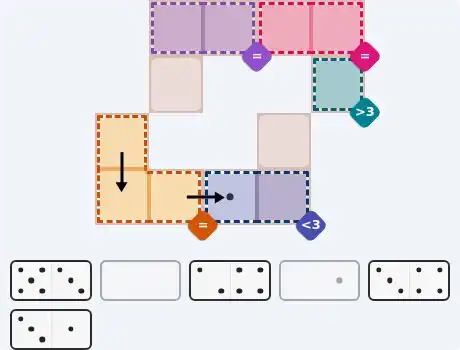
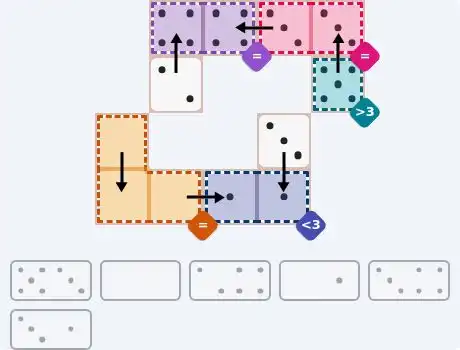
The equals region covering [2,0], [3,0], and [3,1] requires three identical pips. The only way to achieve this is with the double-0 domino covering two of these cells (say [2,0] and [3,0]), forcing both to 0. The third cell, [3,1], must also be 0, which will come from a domino that also contains a 0.
The less-3 region at [3,2] and [3,3] can only accept values 0, 1, or 2. Since [3,1] still needs a 0 and is adjacent to [3,2], the 0-1 domino is the perfect fit: place its 0 at [3,1] and its 1 at [3,2]. This satisfies both the equals (0) and less-3 (1) constraints for those cells.
Cell [1,4] is subject to a greater-3 constraint (must be 4,5,6). The only available domino with a pip above 3 that can reach this cell is the 5-3. Place 5 at [1,4] and 3 at [0,4]. Now the top-row equals pair [0,3] and [0,4] must match—[0,4] is 3, so [0,3] must also be 3. That forces the 3-4 domino: 3 at [0,3], 4 at [0,2].
The other top-row equals pair [0,1] and [0,2] must now match. Since [0,2] is already 4, [0,1] must be 4. The last domino containing a 4 is the 2-4, so place 4 at [0,1] and 2 at [1,1] (the empty cell below it). Finally, the remaining 3-1 domino covers the leftover cells [2,3] (empty) and [3,3] (less-3) with 3 and 1 respectively, completing the puzzle.
🔧 Step-by-Step Answer Walkthrough For Medium Level
The single-cell sum-1 region at [3,2] must equal 1. Only the 1-3 and 1-5 dominoes contain a 1. Whichever is chosen, its 1-pip will go in that cell, and the other pip will land in the adjacent cell [3,1], which is part of the equals region with [3,0].
If the 1-5 domino were used, [3,1] would become 5, forcing [3,0] to also be 5. No remaining domino can supply a 5 to [3,0] while also satisfying the equals chain at the left. Therefore, the 1-3 domino must be placed: 1 at [3,2], 3 at [3,1]. This means [3,0] must also be 3, accomplished by the 2-3 domino (3 at [3,0], 2 at [2,0]).
The equals region [3,3], [3,4], [3,5] requires three identical pips. The only way is to use a double-number domino to provide two of them. The 0-0 domino is ideal: place it covering [3,3] and [3,4] (both 0). The cell [3,5] still needs a 0; that will come from the 6-0 domino placed later at [2,5] and [3,5] with 6 above and 0 below.
The equals region [0,0], [1,0], [2,0] requires all three cells to match. We already have [2,0]=2 from the 2-3 domino, so [0,0] and [1,0] must be 2. The 2-2 domino is the only one that can provide two 2s; place it at [0,0] and [1,0].
The remaining dominoes slot into the top: the 1-5 domino places 5 at [0,2] and 1 at [0,1] (empty), establishing the [0,2]/[0,3] equals pair as both 5 (the 5 for [0,3] comes from the 4-5 domino, with 4 at [0,4]). The 4-5 domino thus covers [0,4] and [0,3] with 4 and 5. The equals pair [0,4]/[0,5] both become 4, with the 6-4 domino supplying 6 at [1,5] and 4 at [0,5]. Finally, the 6-0 domino finishes the grid: 6 at [2,5] (matching [1,5]=6) and 0 at [3,5], completing the triple-zero block.
🔧 Step-by-Step Answer Walkthrough For Hard Level
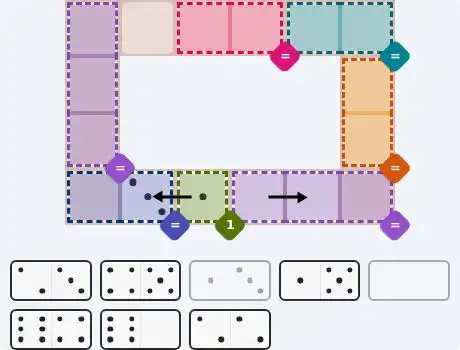
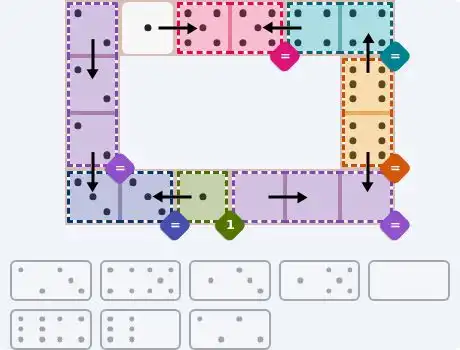
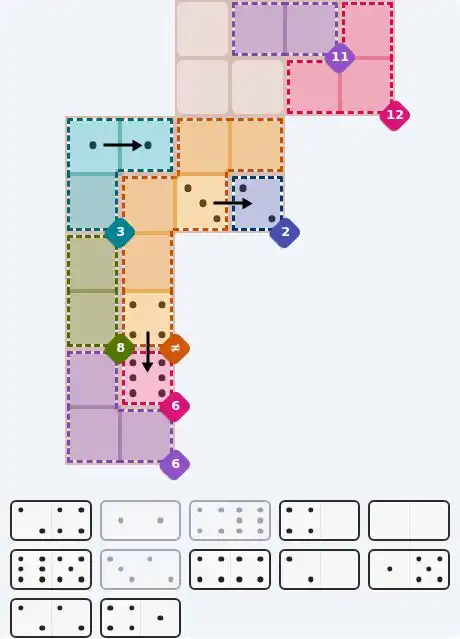
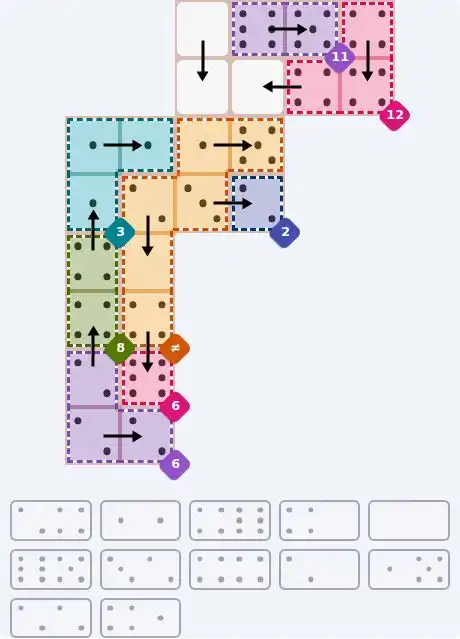
The sum-3 region at [2,0], [2,1], [3,0] must add to 3 with three cells—the only feasible split is 1,1,1. Place the 1-1 domino on [2,0] and [2,1] to establish two 1s. The third cell, [3,0], will later receive a 1 from the 4-1 domino.
The single-cell sum-6 region at [6,1] can only hold the value 6. The 4-6 domino is the only one containing a 6. Place it with 6 at [6,1] and 4 at [5,1]; this introduces 4 into the large unequal region.
The sum-2 cell at [3,3] must be 2. The 3-2 domino is the only remaining option that can supply a 2 and also fit the adjacent cell [3,2] (which will become 3). Place 2 at [3,3] and 3 at [3,2], adding two more distinct values to the unequal region.
The sum-8 pair [4,0]/[5,0] must sum to 8. The sum-6 region [6,0],[7,0],[7,1] must sum to 6. Notice [5,0] is adjacent to [6,0] and [5,1] (already 4). To balance both, place the 2-4 domino with 4 at [5,0] and 2 at [6,0]. This sets [6,0]=2, leaving the sum-6 region needing two more 2s to make 6. Place the 2-2 domino on [7,0] and [7,1] (both 2). Now the sum-8 region has 4 from [5,0], so [4,0] must be 4. The 4-1 domino provides that 4 at [4,0] and finally delivers the missing 1 to [3,0], completing the sum-3 region with three 1s.
The unequal region still needs distinct values at [2,2], [2,3], [3,1], and [4,1]. The 2-0 domino places 2 at [3,1] and 0 at [4,1]. The 1-5 domino fills [2,2] with 1 and [2,3] with 5. Now the six cells of the unequal region hold 1,5,2,3,0,4—all distinct.
The sum-11 pair [0,3]/[0,4] must be 6 and 5 (in either order). The 6-5 domino settles this: 6 at [0,3], 5 at [0,4]. The sum-12 region ([0,5],[1,4],[1,5]) needs a total of 12; the only possible arrangement with remaining dominoes is 4,4,4. The 4-4 domino covers [0,5] and [1,5] (both 4), and the 4-0 domino provides the third 4 at [1,4] and 0 at [1,3]. Finally, the 0-0 domino fills the empty cells [0,2] and [1,2] with 0s, completing the grid.
💬 Community Discussion
Leave your comment