NYT Pips Hints & Answers for April 30, 2026

Apr 30, 2026

🚨 SPOILER WARNING

This page contains the final **answer** and the complete **solution** to today's NYT Pips puzzle. If you haven't attempted the puzzle yet and want to try solving it yourself first, now's your chance!

Click here to play today's official NYT Pips game first.

Want hints instead? Scroll down for progressive clues that won't spoil the fun.

🎲 Today's Puzzle Overview

In today's NYT Pips easy, Ian Livengood constructs a compact grid around a solitary greater-than region—a rare design signature that forces a high domino into a corner, sparking a cascade through interlocking sum-4 regions. The puzzle feels like a tiny gearbox, where once the 5 is placed, every other cell clicks into order with minimalist elegance. His medium puzzle scales up the ambition, deploying a pair of equals regions that span the top and middle rows. A greater-8 constraint in the upper-left quadrant demands a pair of 5s, while the equals regions lock in 6s and 2s across columns, creating a rhythmic pattern. The structural neatness of having two thematic equalities—one horizontal, one vertical—shows a designer delighting in symmetric constraints.

Rodolfo Kurchan’s hard puzzle is a masterclass in sum-of-zero architecture. The grid is dotted with single-cell sum-0 regions that act as vacuum chambers, forcibly drawing in the 0-pip sides of dominos. Along the top row, sum-2, sum-3, and sum-4 single-cell constraints create a precise arithmetic spine that, combined with an empty central row, turns the board into a deductive domino-laying puzzle. The less-than and greater-than regions at the bottom add a final flourish, locking the last few values without ever feeling arbitrary. The result is a dense but fluid solve that rewards methodical scanning.

💡 Progressive Hints

Try these hints one at a time. Each hint becomes more specific to help you solve it yourself!

💡 Hint 1: Threshold Key
Scout for a region that demands a cell exceed a threshold—it will anchor your first domino by forcing a uniquely high pip.
💡 Hint 2: Corner Lock
The greater-than region at row 2, column 2 is your key. Only one domino in the set can fulfill that cell, and its partner will slip into the adjacent sum-4 spot at [2,1].
💡 Hint 3: Full Chain
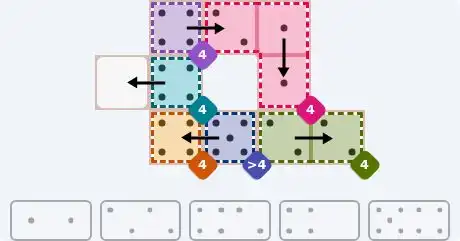
Place the 5-4 domino with 5 at [2,2] and 4 at [2,1]. Then use the 4-0 domino for 4 at [1,1] and 0 at [1,0]. The 4-2 domino goes to 4 at [0,1] and 2 at [0,2]. Finish with the 1-1 domino at [0,3]/[1,3] and the 2-2 domino at [2,3]/[2,4].
💡 Hint 1: Equality Webbing
Identify regions that enforce equality among cells—tying values across rows and columns. They will dictate domino pairings by forcing matching pips.
💡 Hint 2: Top-Left Push
The single sum-3 cell at [0,0] forces a 3, which must come from the 5-3 domino, placing 5 at [0,1]. That triggers the greater-8 region demanding [1,1] also be 5, so the 5-2 domino lands there.
💡 Hint 3: Full Layout
Complete the grid: 5-3 at [0,0]/[0,1]; 5-2 at [1,1]/[1,2]. The equals row forces all 2s, so 6-2 at [0,4]/[1,4] and 1-6 at [0,2]/[0,3]. The lower equals region uses 1-3 at [2,1]/[2,2] and 2-1 at [1,3]/[2,3]. Finally, 3-0 at [2,5]/[2,4] satisfies the last sum-3.
💡 Hint 1: Zero Cascade
Spot cells forced to be zero—they create a chain reaction. Seek out regions with a sum of 0, and you'll find where all the ‘0’ dominos must go.
💡 Hint 2: Top and Bottom Zeros
The sum-0 at [1,3] forces a 0 there, and its neighbor [1,4] is a sum-5 cell, so the other half must be 5. Similar zero-anchors sit at [2,5], [3,0], [3,1], and [4,4]—each pairs with a specific neighbor constraint.
💡 Hint 3: Partner Values
Sum-0 at [2,5] partners with the sum-4 region above, forcing a 2 at [1,5] via a 0-2 domino. Sum-0 at [3,0] and sum-4 at [4,0] demand a 0-4 domino. The sum-0 at [4,4] with sum-3 at [4,3] calls for a 0-3 domino.
💡 Hint 4: Filling the Spine
With zero-dominoes placed, the top row’s single-cell sums (2, 3, 4) and the rightmost sum-4 region lock in the 2-3 and 2-4 dominos. The leftmost sum-2 and sum-5 force a 2-5, while the central 4-5 domino settles the upper middle.
💡 Hint 5: Complete Solution
Place 0-5 at [1,3]/[1,4]; 0-2 at [2,5]/[1,5]; 0-4 at [3,0]/[4,0]; 0-3 at [4,4]/[4,3]; 0-1 at [3,1]/[3,2]. Top row: 2-3 at [0,2]/[0,3], 2-4 at [0,5]/[0,4], 2-5 at [0,0]/[1,0], 4-5 at [0,1]/[1,1]. Middle: 1-3 at [2,2]/[1,2], 1-4 at [2,3]/[3,3], 1-2 at [2,4]/[3,4], 1-5 at [3,5]/[4,5]. Bottom: 3-5 at [2,1]/[2,0], 3-4 at [4,2]/[4,1].

🎨 Pips Solver

Apr 30, 2026

Click a domino to place it on the board. You can also click the board, and the correct domino will appear.
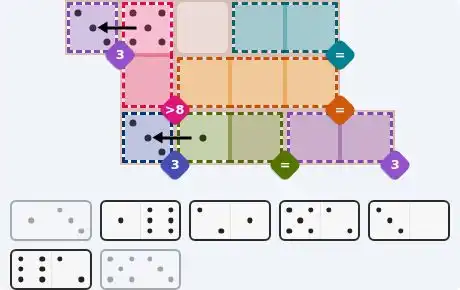
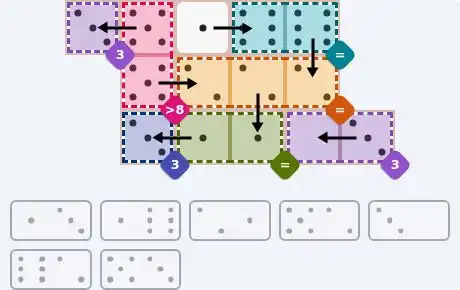
Final Answer & Complete Solution For Hard Level

The key to solving today's hard puzzle was identifying the placement for the critical dominoes highlighted in the starting grid. Once those were in place, the rest of the puzzle could be solved logically. See the final grid below to compare your solution.

Starting Position & Key First Steps
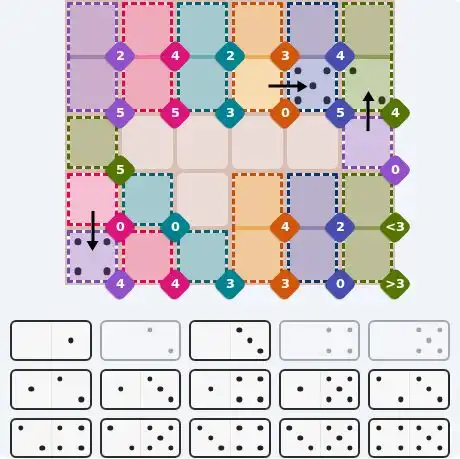
Pips hint for April 30, 2026 – hard level puzzle grid with critical first placements and strategy

This image shows the initial puzzle grid for the hard level, with a few critical first placements highlighted.

Final Answer: The Solved Grid for Hard Mode
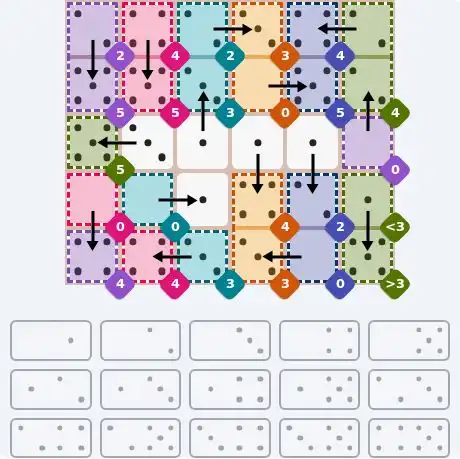
NYT Pips April 30, 2026 hard puzzle full solution grid showing final answer with hints

Compare this final grid with your own solution to see the correct placement of all dominoes.

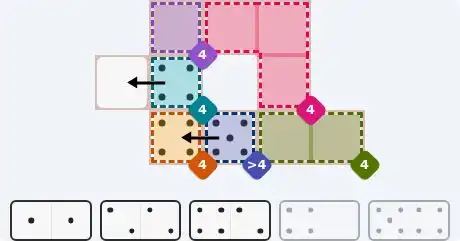
🔧 Step-by-Step Answer Walkthrough For Easy Level

1
Step 1: Single-Cell Sum-4
The region at [0,1] is a single-cell sum-4; it must contain exactly 4. That pip will come from a domino that also covers a neighboring cell.
2
Step 2: Greater-Than Driver
The region at [2,2] is a greater-4, forcing a pip >4 (5 or 6). With available dominos maxing at 5, this cell must be 5. The only 5-bearing domino is 5-4, so place 5 at [2,2] and its partner 4 at [2,1] (fulfilling that cell's sum-4).
3
Step 3: Second Sum-4 and the Empty
The sum-4 region at [1,1] demands a 4. The empty region at [1,0] can accept a 0, so the 4-0 domino is forced: 4 at [1,1] and 0 at [1,0]. Now only the 4-2 and two double dominos remain.
4
Step 4: Finishing the Sum-4 Chain
The three-cell sum-4 region at [0,2],[0,3],[1,3] needs values summing to 4. With 4-2 placed as 4 at [0,1] and 2 at [0,2], the remaining 2 must split into 1+1. Place the 1-1 domino at [0,3]/[1,3]. Finally, the 2-2 domino lands in [2,3]/[2,4] to satisfy the last sum-4 region.

🔧 Step-by-Step Answer Walkthrough For Medium Level

1
Step 1: Anchoring 3
The single-cell sum-3 at [0,0] forces a 3. The only domino that supplies a 3 while also helping the adjacent greater-8 region is 5-3. Place it as 3 at [0,0] and 5 at [0,1].
2
Step 2: Double 5 for Greater-8
The greater-8 region covering [0,1] and [1,1] demands a sum >8. With 5 already at [0,1], [1,1] must be at least 4. The 5-2 domino fits perfectly: 5 at [1,1] and 2 at [1,2]. The region now totals 10.
3
Step 3: Lower 3 and the Equals Pair
Another sum-3 at [2,1] forces a 3. Use the 1-3 domino: 3 at [2,1] and 1 at [2,2]. The equals region [2,2]/[2,3] forces [2,3] =1. The 2-1 domino then places 2 at [1,3] and 1 at [2,3].
4
Step 4: Row of Equals
The equals region along row 1 ([1,2],[1,3],[1,4]) forces all to 2 (since [1,2]=2). Thus [1,4]=2. The 6-2 domino covers [0,4]/[1,4]: 6 above, 2 below. The top-row equals region [0,3]/[0,4] forces [0,3]=6, which the 1-6 domino provides—6 at [0,3] and 1 at [0,2] (empty).
5
Step 5: Final Sum-3
The remaining sum-3 region [2,4]/[2,5] needs a total of 3. With the last domino 3-0, place 0 at [2,4] and 3 at [2,5] to complete the puzzle.

🔧 Step-by-Step Answer Walkthrough For Hard Level

1
Step 1: Zero Sum Regions
Five sum-0 regions ([1,3], [2,5], [3,0], [3,1], [4,4]) must each hold a 0. All five 0-containing dominos (0-1, 0-2, 0-3, 0-4, 0-5) will be placed to satisfy these, with their other halves dictated by neighboring constraints.
2
Step 2: 0-5 and 0-2 Pairs
The sum-0 at [1,3] sits beside sum-5 at [1,4], so its domino must be 0-5 (0 at [1,3], 5 at [1,4]). The sum-0 at [2,5] is adjacent to a sum-4 region covering [0,5]/[1,5]; placing 0-2 gives 0 at [2,5] and 2 at [1,5], later mirrored by a 2 at [0,5].
3
Step 3: 0-4 and 0-3 Dominoes
Sum-0 at [3,0] pairs with sum-4 at [4,0]; the 0-4 domino lands as 0 at [3,0] and 4 at [4,0]. Sum-0 at [4,4] neighbors sum-3 at [4,3], forcing 0-3 with 0 at [4,4] and 3 at [4,3]. The remaining 0-1 goes to [3,1]/[3,2] (0 and 1 in the empty cell).
4
Step 4: Top Row Arithmetic
Top row has single-cell sums: [0,2]=2 (from sum-2), [0,3]=3 (sum-3), [0,4]=4 (sum-4). The 2-3 domino covers [0,2]/[0,3]. The rightmost sum-4 region needs [0,5]=2 (since [1,5]=2 already), so use 2-4 at [0,5]/[0,4]. Sum-2 at [0,0] and sum-5 at [1,0] force 2-5 at [0,0]/[1,0]. Then sum-5 at [1,1] and sum-4 at [0,1] demand 4-5 at [0,1]/[1,1].
5
Step 5: Central Empty Row
The empty cells in row 2 are free but connect to constrained neighbors. Use 1-3 at [2,2]/[1,2] (satisfying sum-3 at [1,2]=3), 1-4 at [2,3]/[3,3] (sum-4 at [3,3]=4), and 1-2 at [2,4]/[3,4] (sum-2 at [3,4]=2).
6
Step 6: Bottom Row Finale
The less-3 region at [3,5] forces 1, while greater-3 at [4,5] forces 5; use 1-5 at [3,5]/[4,5]. Sum-5 at [2,0] gets 5 from 3-5, placing 3 at [2,1] (empty). Finally, sum-3 at [4,2] and sum-4 at [4,1] take 3 and 4 from the 3-4 domino, completing the grid.

💡 Pro Tips for Similar Puzzles

Start with Constraints
Always begin with the most constrained regions - sum regions with small numbers or tight spaces.
Use Equal Regions
Use "equal" regions as anchors - they eliminate many possibilities quickly.
Work Systematically
Let the rules guide your placement rather than guessing randomly.
Double-Check
Verify each region's rules are satisfied before moving to the next.

🎓 Keep Learning & Improve