NYT Pips Hints & Answers for June 14, 2026

Jun 14, 2026

🚨 SPOILER WARNING

This page contains the final **answer** and the complete **solution** to today's NYT Pips puzzle. If you haven't attempted the puzzle yet and want to try solving it yourself first, now's your chance!

Click here to play today's official NYT Pips game first.

Want hints instead? Scroll down for progressive clues that won't spoil the fun.

SEE ALSO:

🎲 Today's Puzzle Overview

Ian Livengood designs today's NYT Pips easy puzzle around a rare single-cell sum-0 region, giving solvers an immediate, unshakable anchor. That zero spreads through a tidy equals pair and a sum-9 duo, creating a short, elegant sequence that feels more like a gentle tutorial than a puzzle. Livengood’s economical touch is unmistakable—every domino has exactly one natural home.

Rodolfo Kurchan takes the medium slot and introduces an unequal constraint alongside sum-10, sum-7, and greater-than regions. The domino set includes a double-5 and a double-6, and Kurchan uses adjacent empty cells to nudge the solving order without ever handing you the path. It’s a crisp, well-balanced construction that rewards methodical region scanning.

Kurchan’s hard puzzle is an ambitious lattice of four sum-10 regions and a sprawling six-cell equals chain, interwoven with less-than and greater-than triggers. This NYT Pips hard design builds tension through its sum cascades—once one sum-10 resolves, it forces key pips into neighboring regions, ultimately locking the entire board. The architecture is dense but immaculately logical, a signature of Kurchan’s precision.

💡 Progressive Hints

Try these hints one at a time. Each hint becomes more specific to help you solve it yourself!

💡 Hint 1: Tightest restriction
Scan the board for a region that leaves no wiggle room whatsoever—a single cell with a sum target that can only be satisfied one way.
💡 Hint 2: Zero in on [0,3]
The sum-0 region at row 0, column 3 forces that cell’s pip to be 0. That directly dictates the placement of the domino that contains a 0, and the neighboring empty cell receives the domino’s other half.
💡 Hint 3: Full solve path
Domino 0-4 places 0 at [0,3] and 4 at [0,2]. The sum-9 region at [2,0]-[2,1] needs a 6, so double-6 goes to [2,0]=6 and [2,1]=3, with the 3-2 domino giving [1,1]=2. Equals at [1,1]-[1,2] makes [1,2]=2, so the 1-2 domino puts 1 at [2,2]. Equals at [2,2]-[3,2] forces [3,2]=1, so the 1-0 domino fills [3,2]=1 and [3,1]=0, satisfying the sum-6 region 6+0.
💡 Hint 1: Pin down the high number
Look for a region that demands a pip greater than a certain value. That restriction, together with the domino roster, points to a specific double.
💡 Hint 2: Double-6 opens row 0
The greater-3 region at [0,6] forces a 6 there, so the double-6 domino must cover [0,6] and [1,6]. This, in turn, heavily constrains the sum-10 region on row 1, columns 2-3.
💡 Hint 3: Complete medium logic
With [1,6]=6, the sum-10 at [1,2]-[1,3] is solved by the 3-6 domino (3 at [0,2], 6 at [1,2]) and the 4-5 domino (4 at [1,3], 5 at [2,3]). The equals [2,3]-[2,4] forces double-5 (5 at [3,4]). Sum-4 at [3,0] forces 4-0 domino (4 at [3,0], 0 at [2,0]). Unequal [1,0] vs [2,0] then accepts 2-0 domino (2 at [1,0], 0 at [0,0]). Finally, sum-7 at [1,5]-[1,6] uses 0-1 domino (1 at [1,5], 0 at [2,5]).
💡 Hint 1: Look for sum and equals anchors
The grid is dominated by multiple sum-10 regions and a large equals region. The equals cluster can only be satisfied by a domino that appears more than once in a specific pip value.
💡 Hint 2: Equals region near the bottom
The four-cell equals region spanning [6,3], [6,4], [7,3], and [8,3] forces all four cells to share the same pip. Only the double-6 can provide the necessary sixes to start this chain.
💡 Hint 3: Sum-4 and equals top-offs
The sum-4 region at [6,5] then forces a 4, so the 4-6 domino must place 6 at [6,4] and 4 at [6,5]. The remaining equal cell at [8,3] then gets a 6 from the 1-6 domino, dropping a 1 at [9,3] to prime the equals pair on row 9.
💡 Hint 4: Top-left sum-10 cascade
The top-left sum-10 regions interplay neatly: the 2-6 domino puts 6 at [0,0] and 2 at [0,1]; the 4-5 domino puts 4 at [1,0] and 5 at [2,0]. Then the sum-10 on row 0 columns 1-3 gets a 4-4 double to finish 2+4+4.
💡 Hint 5: Full hard solve
After the top cascade, the 5-5 double fills [2,1]-[2,2] for sum-10 with [2,0]=5. The four-cell sum-10 region starting at [2,2] is then filled by the 3-1 domino (3 at [3,3], 1 at [2,3]) and the 0-1 domino (1 at [4,3], 0 at [4,2] for sum-0). Less-4 at [2,5] forces 3, greater-4 at [2,6] forces 5; then the 3-4 domino places those, while the double-3 and the 2-3 domino complete the long equals tier at rows 2-4. The remaining 4-0 domino fills the greater-1 cell at [4,0].

🎨 Pips Solver

Jun 14, 2026

Click a domino to place it on the board. You can also click the board, and the correct domino will appear.
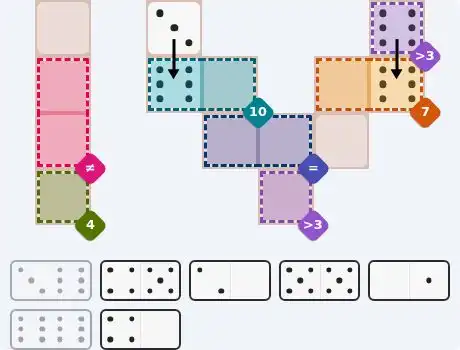
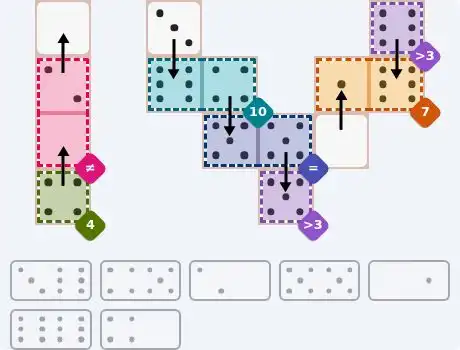
Final Answer & Complete Solution For Hard Level

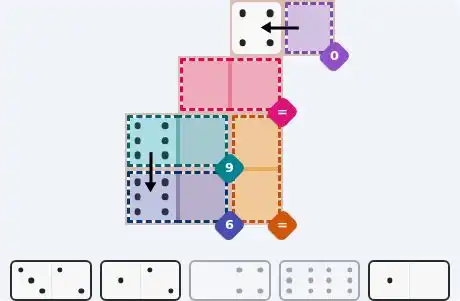
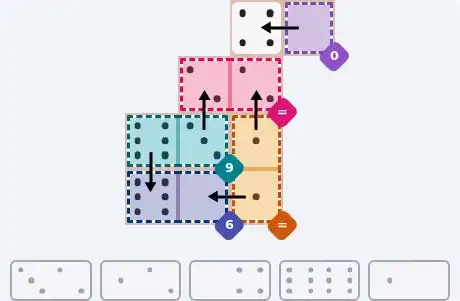
The key to solving today's hard puzzle was identifying the placement for the critical dominoes highlighted in the starting grid. Once those were in place, the rest of the puzzle could be solved logically. See the final grid below to compare your solution.

Starting Position & Key First Steps
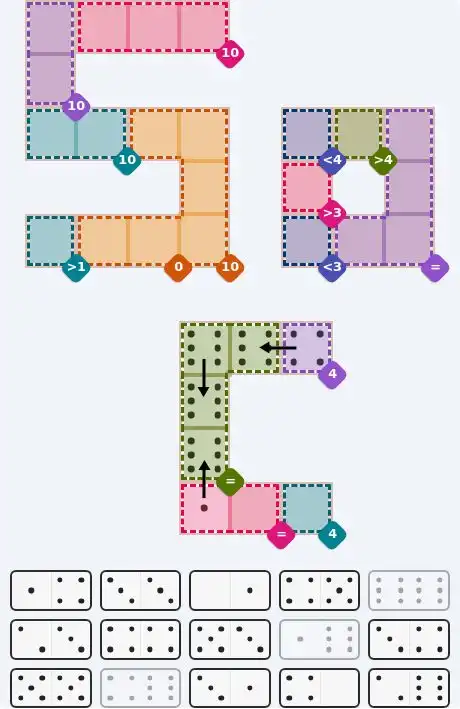
Pips hint for June 14, 2026 – hard level puzzle grid with critical first placements and strategy

This image shows the initial puzzle grid for the hard level, with a few critical first placements highlighted.

Final Answer: The Solved Grid for Hard Mode
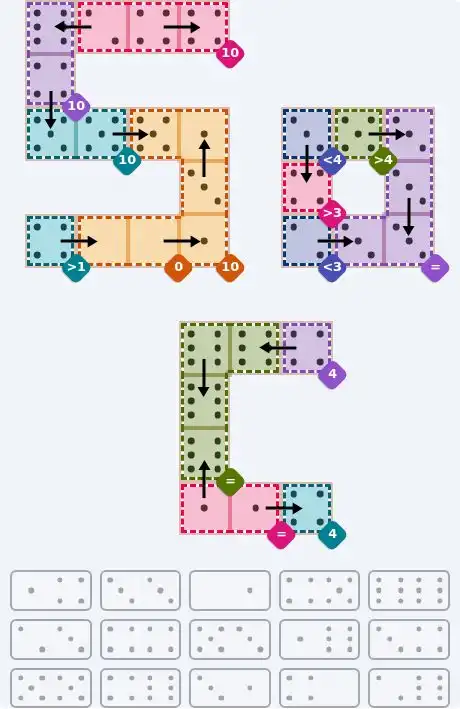
NYT Pips June 14, 2026 hard puzzle full solution grid showing final answer with hints

Compare this final grid with your own solution to see the correct placement of all dominoes.

🔧 Step-by-Step Answer Walkthrough For Easy Level

1
Step 1: The sum-0 anchor
Region at [0,3] is a single cell with sum target 0, so that cell must be 0. The only domino containing a 0 is [0,4]; it must be placed with 0 at [0,3] and 4 at [0,2] (the empty cell).
2
Step 2: Sum-9 demands a 6
The region at [2,0] and [2,1] must sum to 9. The double-6 domino is the sole source of a 6, so it goes to [2,0]=6 and [2,1]=3. The needed 3 comes from the [3,2] domino, which also places a 2 at [1,1].
3
Step 3: Equals spread the twos
The equals region at [1,1] and [1,2] forces [1,2]=2. That means the [1,2] domino must give [1,2]=2 and thus [2,2]=1.
4
Step 4: Closing the loop
The equals region [2,2] and [3,2] now requires [3,2]=1. The [1,0] domino covers [3,2]=1 and [3,1]=0. This also satisfies the sum-6 region at [3,0] and [3,1] (6+0=6) because [3,0] already contains 6 from Step 2.

🔧 Step-by-Step Answer Walkthrough For Medium Level

1
Step 1: Greater-3 forces double-6
Region at [0,6] requires a pip >3, and the only domino that can provide a 6 to a corner cell is the double-6. It is placed with [0,6]=6 and [1,6]=6.
2
Step 2: Sum-10 on row 1
The sum-10 region at [1,2] and [1,3] now sees [1,6] occupied by 6. The [3,6] domino fits perfectly: 6 goes to [1,2], 3 to empty [0,2]. Then [1,3] must be 4 to complete sum 10, so the [4,5] domino places 4 there and 5 at [2,3].
3
Step 3: Equals and sum-4
The equals region at [2,3] and [2,4] forces [2,4]=5, leading to the double-5 domino placed as [2,4]=5 and [3,4]=5. The sum-4 single-cell region at [3,0] forces a 4, so the [4,0] domino sits as [3,0]=4 and [2,0]=0.
4
Step 4: Unequal and top-left empty
The unequal region [1,0] vs [2,0] prevents [1,0] from being 0. The [2,0] domino gives [1,0]=2 and [0,0]=0 (empty, valid).
5
Step 5: Sum-7 wrap-up
Finally, the sum-7 region at [1,5] and [1,6] needs 1+6 to reach 7. So [1,5]=1, and the remaining [0,1] domino fills [2,5]=0 and [1,5]=1. All regions satisfied.

🔧 Step-by-Step Answer Walkthrough For Hard Level

1
Step 1: Lower equals cluster
The four-cell equals region ([6,3],[6,4],[7,3],[8,3]) forces all to match. Only the double-6 domino can provide two of those sixes, so it goes to [6,3]=6 and [7,3]=6. The sum-4 single-cell region at [6,5] then forces a 4, so the [4,6] domino must place 6 at [6,4] and 4 at [6,5]. The remaining equal cell [8,3] gets its 6 from the [1,6] domino, which also sets [9,3]=1 to trigger the equals pair [9,3]-[9,4].
2
Step 2: Top-left sum-10
The sum-10 region at [0,0] and [1,0] requires two numbers summing to 10. The [2,6] domino supplies 6 at [0,0] and 2 at [0,1]; the [4,5] domino provides 4 at [1,0] and 5 at [2,0].
3
Step 3: Top row sum-10
The sum-10 region covering [0,1], [0,2], [0,3] already has [0,1]=2, so the remaining 8 must come from two cells. The only way is the double-4 domino, placed as [0,2]=4 and [0,3]=4.
4
Step 4: Middle sum-10 double
The sum-10 region at [2,0] and [2,1] has [2,0]=5, so [2,1] must be 5. The double-5 domino lands at [2,1]=5 and [2,2]=5. Now the four-cell sum-10 region ([2,2],[2,3],[3,3],[4,3]) has [2,2]=5, leaving 5 for the other three. The [3,1] domino yields 3 at [3,3] and 1 at [2,3]; the [0,1] domino gives 1 at [4,3] and 0 at [4,2], satisfying both the sum-10 region and the sum-0 region at [4,1]-[4,2].
5
Step 5: Right-side less/greater and equals wrap
The less-4 at [2,5] forces 3, the greater-4 at [2,6] forces 5. The [3,4] domino places them as [2,5]=3, [3,5]=4. The [5,3] domino then sets [2,6]=5, [2,7]=3. To complete the equals region ([2,7],[3,7],[4,6],[4,7]) all must be 3: the double-3 domino covers [3,7]=3, [4,7]=3, and the [2,3] domino fills [4,5]=2, [4,6]=3. Finally, the greater-1 at [4,0] demands >1; the [4,0] domino places 4 at [4,0] and 0 at [4,1], with the sum-0 at [4,1]-[4,2] holding 0+0.

💡 Pro Tips for Similar Puzzles

Start with Constraints
Always begin with the most constrained regions - sum regions with small numbers or tight spaces.
Use Equal Regions
Use "equal" regions as anchors - they eliminate many possibilities quickly.
Work Systematically
Let the rules guide your placement rather than guessing randomly.
Double-Check
Verify each region's rules are satisfied before moving to the next.

🎓 Keep Learning & Improve