NYT Pips Hints & Answers for June 10, 2026

Jun 10, 2026

๐Ÿšจ SPOILER WARNING

This page contains the final **answer** and the complete **solution** to today's NYT Pips puzzle. If you haven't attempted the puzzle yet and want to try solving it yourself first, now's your chance!

Click here to play today's official NYT Pips game first.

Want hints instead? Scroll down for progressive clues that won't spoil the fun.

๐ŸŽฒ Today's Puzzle Overview

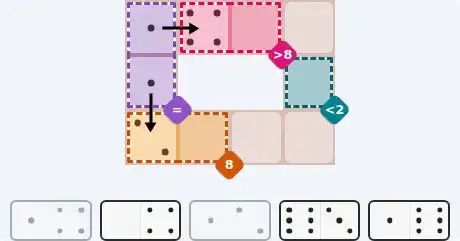
Ian Livengood sets today's NYT Pips easy with a characteristic dual-anchor logic: an equals region at top-left pairs with a greater-than-8 constraint beside it, forcing an elegant interplay between the 1 and 4 pips. The design's tightness comes from the scarcity of 0 and 6, which funnel the remaining dominos into a clean sum-8 resolution on the bottom row.

Livengood's medium puzzle ups the ante with a triple-equals column on the left, a structural signature that demands three identical values. He complements this with twin sum-4 regions and a solitary sum-1 cell, crafting a puzzle where each domino's orientation is sharply restricted by adjacent equals and sum constraints.

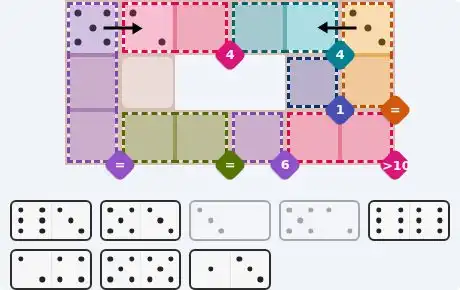
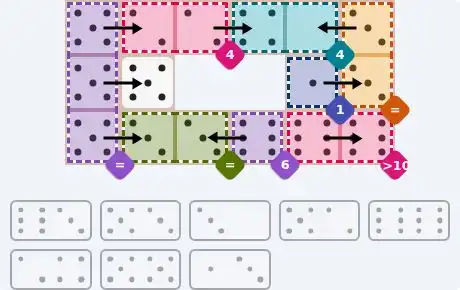
Rodolfo Kurchan's hard is a showcase of maximalism: an entire 5-cell row locked to equal values immediately sets the stage, forcing a cascade of fours across the top. The sum-0 triple below it and dual sum-15 blocks create a lattice of inevitability, demonstrating Kurchan's ability to build a puzzle that feels architecturally monumental yet resolves with satisfying inevitability.

๐Ÿ’ก Progressive Hints

Try these hints one at a time. Each hint becomes more specific to help you solve it yourself!

๐Ÿ’ก Hint 1: Search for twin values
Identify the region that demands two cells share the same pip value. This equality, combined with the adjacent greater-than constraint, narrows your options dramatically.
๐Ÿ’ก Hint 2: Top-left lock
The equals pair at [0,0] and [1,0] must both be 1. Consider which dominos with a 1-pip can serve that purpose, and how the 4 from one of those dominos satisfies the greater-8 requirement at [0,1]-[0,2].
๐Ÿ’ก Hint 3: Complete solution
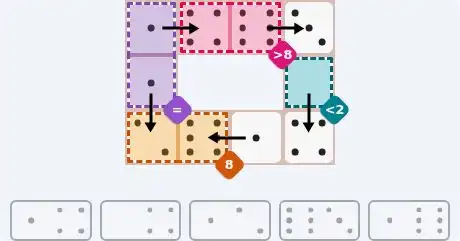
Place [1,4] at [0,0]=1 / [0,1]=4; [6,3] at [0,2]=6 / [0,3]=3; [1,2] at [1,0]=1 / [2,0]=2; [0,4] at [1,3]=0 / [2,3]=4; [1,6] at [2,2]=1 / [2,1]=6.
๐Ÿ’ก Hint 1: Triplet equality
Seek the column where three stacked cells must all display the same pip value. That insight, along with a tiny sum-1 singleton, will unlock the grid.
๐Ÿ’ก Hint 2: Left column equals 5
The triple-equals region in column 0 forces the value 5 (the only pip appearing on three distinct dominos). Meanwhile, the sum-1 cell at [1,4] must be a 1, which forces the [1,3] domino to give 1 to [1,4] and 3 to [1,5].
๐Ÿ’ก Hint 3: Full placements
Place [5,2] at [0,0]=5 / [0,1]=2; [2,4] at [0,2]=2 / [0,3]=4; [3,0] at [0,5]=3 / [0,4]=0; [5,5] at [1,0]=5 / [1,1]=5; [1,3] at [1,4]=1 / [1,5]=3; [5,3] at [2,0]=5 / [2,1]=3; [6,3] at [2,3]=6 / [2,2]=3; [6,6] at [2,4]=6 / [2,5]=6.
๐Ÿ’ก Hint 1: Row of uniformity
Notice the entire top row must be equal. Also find the tiny region that sums to zero โ€” it forces all zeros.
๐Ÿ’ก Hint 2: Top row locks to 4
With five cells all equal and only fours available from the domino pool to fill them, the top row becomes a solid phalanx of 4s. The sum-0 region at [1,1]/[2,0]/[2,1] forces each to 0, which anchors the 0-pip from specific dominos.
๐Ÿ’ก Hint 3: Sum-15 splits
Two sum-15 regions on row 1 and 2 need 6+6+3 in one and 5+5+5 in the other. The double-6 domino [6,6] covers [1,2]=6/[1,3]=6, and the remaining 3 comes from [0,3] in the sum-15. Meanwhile, the second sum-15 uses three 5s from [5,5] and a 5 from [5,4].
๐Ÿ’ก Hint 4: Lower-left sum-11
The sum-11 region at column 0 rows 3-4: with [2,0]=0 already set, the domino [5,0] gives 5 to [3,0] and 0 to [2,0], while [2,1] provides 2 to [4,0] and 1 to [5,0], balancing with [4,1]=4 to reach 11.
๐Ÿ’ก Hint 5: Complete solution
Place [4,6] at [0,0]=4/[1,0]=6; [4,0] at [0,1]=4/[1,1]=0; [4,4] at [0,2]=4/[0,3]=4; [5,4] at [1,4]=5/[0,4]=4; [6,6] at [1,2]=6/[1,3]=6; [5,5] at [2,3]=5/[2,4]=5; [0,3] at [2,1]=0/[2,2]=3; [5,0] at [3,0]=5/[2,0]=0; [2,1] at [4,0]=2/[5,0]=1; [1,4] at [5,1]=1/[4,1]=4; [6,3] at [6,4]=6/[5,4]=3; [2,3] at [4,3]=2/[5,3]=3; [3,3] at [3,4]=3/[4,4]=3; [1,1] at [6,0]=1/[6,1]=1; [2,2] at [6,2]=2/[6,3]=2.

๐ŸŽจ Pips Solver

Jun 10, 2026

Click a domino to place it on the board. You can also click the board, and the correct domino will appear.
โœ… Final Answer & Complete Solution For Hard Level

The key to solving today's hard puzzle was identifying the placement for the critical dominoes highlighted in the starting grid. Once those were in place, the rest of the puzzle could be solved logically. See the final grid below to compare your solution.

Starting Position & Key First Steps
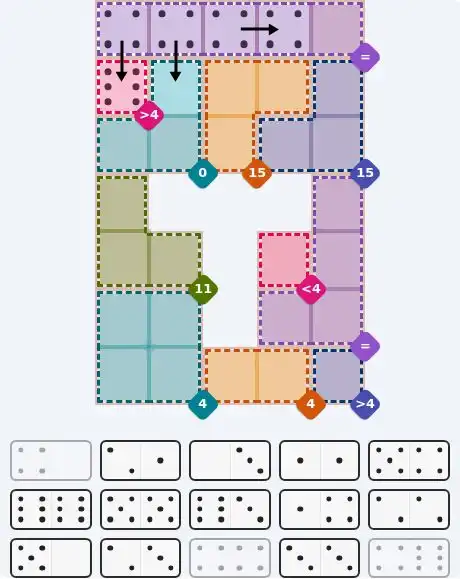
Pips hint for June 10, 2026 โ€“ hard level puzzle grid with critical first placements and strategy

This image shows the initial puzzle grid for the hard level, with a few critical first placements highlighted.

Final Answer: The Solved Grid for Hard Mode
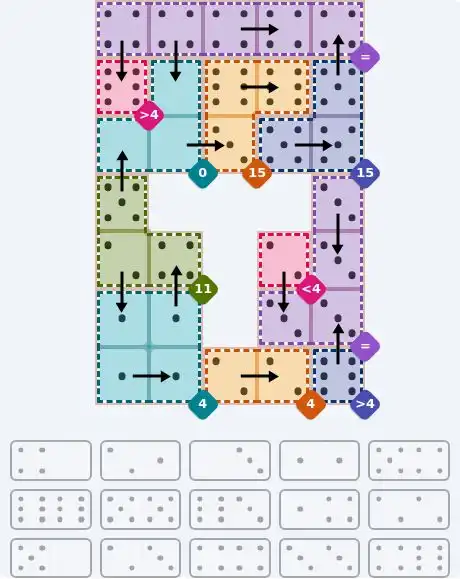
NYT Pips June 10, 2026 hard puzzle full solution grid showing final answer with hints

Compare this final grid with your own solution to see the correct placement of all dominoes.

๐Ÿ”ง Step-by-Step Answer Walkthrough For Easy Level

1
Step 1: Equals region forces 1
The equals region covering [0,0] and [1,0] demands the same value in both cells. The only pip value that can repeat from available dominos is 1 (dominant in [1,4] and [1,2]). Both cells must therefore be 1.
2
Step 2: Greater-8 region demands 4+6
The greater-8 constraint on [0,1] and [0,2] requires a sum >8; with the available pips, 4+6=10 is the only viable combination. The domino [1,4] already places a 4 at [0,1], so [0,2] must get the 6 from [6,3]. That forces [0,3] to be 3 from the same domino, since it's adjacent.
3
Step 3: Less-2 cell takes the zero
The cell [1,3] must be less than 2, so 0 or 1. With 1 already used twice and only one domino containing a 0 ([0,4]), [1,3]=0. Its partner 4 must occupy [2,3], as no other adjacent cell is free.
4
Step 4: Sum-8 completes the bottom row
The sum-8 region at [2,0] and [2,1] now has remaining dominos: [1,2] gives 2 to [2,0] (since [1,0] already has 1), and [1,6] places 6 at [2,1] and 1 at [2,2]. The grid resolves cleanly.

๐Ÿ”ง Step-by-Step Answer Walkthrough For Medium Level

1
Step 1: Triple-equals column locks 5
The three cells in column 0โ€”[0,0], [1,0], [2,0]โ€”must be equal. Looking at the domino pool, pip 5 appears on three dominos ([5,3], [5,2], [5,5]), while no other pip appears three times. Thus the entire column will be 5.
2
Step 2: Sum-4 pairs restrict the top row
The sum-4 region at [0,1]-[0,2] needs a sum of 4, forcing 2+2 (the only double from available 2s; the [2,4] domino provides 2 and [5,2] provides the other 2 via its 2 at [0,1]). Pair this with another sum-4 at [0,3]-[0,4] that must be 4+0 from domino [3,0] (4 at [0,3], 0 at [0,4]).
3
Step 3: Sum-1 singleton dictates [1,3] placement
The single-cell sum-1 at [1,4] forces a 1. The only domino with a 1 is [1,3], placing 1 at [1,4] and its 3 at [1,5]. This fulfills the equals region at [0,5]-[1,5] (both 3).
4
Step 4: Equals at bottom row resolves
The equals region [2,1]-[2,2] needs the same pip. Domino [5,3] already gave 3 to [2,1] via its 3, so [2,2] must also be 3. That fits domino [6,3] (6 at [2,3], 3 at [2,2]), matching the sum-6 cell at [2,3] (6).
5
Step 5: Greater-10 region ends with double 6
The greater-10 region at [2,4]-[2,5] demands a sum >10; only double 6 from [6,6] works, placed [2,4]=6, [2,5]=6. The grid is complete.

๐Ÿ”ง Step-by-Step Answer Walkthrough For Hard Level

1
Step 1: Top row equals forces all 4s
The equals region spans the entire top rowโ€”[0,0] to [0,4]. All five cells must share the same pip value. The domino pool contains four 4s across dominos [4,6], [4,0], [4,4], and [5,4] (which carries a 4). The only way to cover five cells with 4s is to use all 4-bearing dominos, forcing every top cell to be 4.
2
Step 2: Sum-0 triplet clears the way
The sum-0 region at [1,1], [2,0], [2,1] requires all zeros. The only zero-bearing dominos are [4,0] (which must place 0 at [1,1] from its 0 after giving 4 to [0,1]), [0,3] (0 at [2,1]), and [5,0] (0 at [2,0]). That fixes those placements.
3
Step 3: Greater-4 at [1,0] absorbs the 6
The single cell [1,0] must be greater than 4; the only pip >4 available is 6, so [1,0]=6. This comes from domino [4,6], which also places 4 at [0,0].
4
Step 4: Sum-15 split into 6+6+3 and 5+5+5
Two sum-15 regions sit on row 1-2: [1,2]/[1,3]/[2,2] and [1,4]/[2,3]/[2,4]. The first must be 6+6+3 (only way with available large pips), using domino [6,6] for the two 6s at [1,2] and [1,3], and [0,3]'s 3 at [2,2]. The second sum-15 requires three 5s, from [5,5] at [2,3]/[2,4] and [5,4]'s 5 at [1,4] (its 4 already at [0,4]).
5
Step 5: Lower-left sum-11 solves with 5+2+4
The sum-11 region covering [3,0], [4,0], [4,1] needs 5+2+4 (the 5 from [5,0] at [3,0], 2 from [2,1] at [4,0], 4 from [1,4] at [4,1]). The dominos interlock neatly: [5,0] already placed 0 at [2,0], [2,1] provides 1 at [5,0] and 2 at [4,0], and [1,4] gives 4 at [4,1].
6
Step 6: Equals tetrad and final lower dominoes
The equals region [3,4]/[4,4]/[5,3]/[5,4] forces all to be 3. Domino [3,3] places 3 at [3,4] and [4,4]; [6,3] gives 3 at [5,4] and 6 at [6,4] (satisfying greater-4 at [6,4]). The bottom-left sum-4 region [5,0]-[6,1] finishes with [1,1] giving 1s to [6,0] and [6,1]; sum-4 at [6,2]-[6,3] uses [2,2] for 2 and 2. All constraints met.

๐Ÿ’ก Pro Tips for Similar Puzzles

Start with Constraints
Always begin with the most constrained regions - sum regions with small numbers or tight spaces.
Use Equal Regions
Use "equal" regions as anchors - they eliminate many possibilities quickly.
Work Systematically
Let the rules guide your placement rather than guessing randomly.
Double-Check
Verify each region's rules are satisfied before moving to the next.

๐ŸŽ“ Keep Learning & Improve