NYT Pips Hints & Answers for August 17, 2026

Aug 17, 2026

🚨 SPOILER WARNING

This page contains the final **answer** and the complete **solution** to today's NYT Pips puzzle. If you haven't attempted the puzzle yet and want to try solving it yourself first, now's your chance!

Click here to play today's official NYT Pips game first.

Want hints instead? Scroll down for progressive clues that won't spoil the fun.

SEE ALSO:

🎲 Today's Puzzle Overview

Livengood's easy puzzle greets you with a pair of isolated single-cell less-than regions on the left edge, so the opening is more about reading tight constraints than hunting for domino shapes. Once those caps lock, the neighboring equals regions ripple outward and the grid resolves almost automatically, domino by domino.

Livengood's medium turns up the architecture: a broad low-sum block in the upper left wants almost nothing in four cells, while two single-cell greater-than clues act as high-value anchors that split their dominos into low/high pairs. From there you're guided into a satisfying bottom-row equals crystallization.

Kurchan's hard is the kind of NYT Pips grid that rewards patience. A two-cell zero-sum pocket anchors the lower-left, then stacked sum-4 regions and equal triples propagate through the center, while greater-than pairs on the top and bottom edges set the outer frame. You'll bounce between micro-sums and large thresholds, and each placement opens the next.

💡 Progressive Hints

Try these hints one at a time. Each hint becomes more specific to help you solve it yourself!

💡 Find the tightest caps
Look first for the tiny single-cell less-than regions; they are the most constrained pieces in the grid and will release the rest.
💡 Anchor the left edge
The isolated cells at [0,0] and [2,0] are your starters. Once you honor their less-than caps, the adjacent equals regions on the right tell you what their domino partners must be.
💡 Full easy answer
Place [0,6] across [0,0]–[0,1] (0,6), [1,0] across [2,1]–[2,0] (1,0), [2,6] across [0,3]–[0,2] (2,6), [6,1] across [1,2]–[2,2] (6,1), and [5,4] across [1,3]–[2,3] (5,4). The two equals regions set the 6s and 1s; the sum-7 pair needs 2+5.
💡 Start with the low-sum signal
Look for the large low-sum region first, then let the single-cell greater-than clues split your dominos into high and low halves.
💡 Tripod in the upper left
The four-cell sum region near [1,0]-[2,2] is your first lock. Then the greater-than cells at [1,1] and [3,1] force specific high values on their lower ends while feeding tiny values back into that sum.
💡 Full medium answer
Place [0,0] at [1,0]–[2,0] (0,0), [6,0] at [2,1]–[3,1] (0,6), [2,3] at [1,2]–[1,1] (2,3), [2,2] at [0,3]–[1,3] (2,2), [0,5] at [2,3]–[3,3] (0,5), [5,2] at [2,2]–[3,2] (2,5), and [5,5] at [3,4]–[3,5] (5,5). The bottom equals row is all 5s.
💡 Find the spine of sum constraints
Scan for the sum-0 pocket and the surrounding sum-4 regions; those small sums, plus the greater-than pairs on the outer edges, are the backbone of this hard grid.
💡 Open the zero-sum pocket
The two-cell region at [4,0]–[5,0] is a sum-0, so both cells are 0. The cells immediately above and below, [3,0] and [6,0], each belong to separate sum-4 regions, which forces your first two domino values.
💡 Work the left-hand chain
Once [3,0] is set, the sum-4 above at [2,0]/[3,0] fixes [2,0]. That pulls the top-left greater-than pair [0,0]/[1,0] into play, and the less-than pair [0,1]/[0,2] then sets the top edge.
💡 Unlock the center and bottom strips
The equal triple at [4,3]/[5,3]/[6,3] must match; use the sum-4 pair [2,3]/[3,3] to set it. Then solve the bottom-left sum-4 [6,0]/[6,1], the single sum-4 at [6,2], and the bottom-right greater-than pair [6,5]/[6,6].
💡 Full hard answer
Place [0,2] at [4,0]–[3,0] (0,2); [0,3] at [5,0]–[6,0] (0,3); [0,4] at [0,2]–[0,3] (0,4); [0,5] at [0,1]–[0,0] (0,5); [0,6] at [2,3]–[1,3] (0,6); [1,1] at [4,7]–[5,7] (1,1); [1,3] at [4,6]–[4,5] (1,3); [1,4] at [6,1]–[6,2] (1,4); [1,5] at [5,5]–[6,5] (1,5); [1,6] at [6,7]–[6,6] (1,6); [2,2] at [5,3]–[6,3] (2,2); [2,4] at [4,3]–[3,3] (2,4); [2,6] at [2,0]–[1,0] (2,6). That sets the top greater-than pairs as 5/6 and 4/6, the central equals triple to all 2s, and the right-side sum-4 strip to all 1s.

🎨 Pips Solver

Aug 17, 2026

Click a domino to place it on the board. You can also click the board, and the correct domino will appear.
Final Answer & Complete Solution For Hard Level

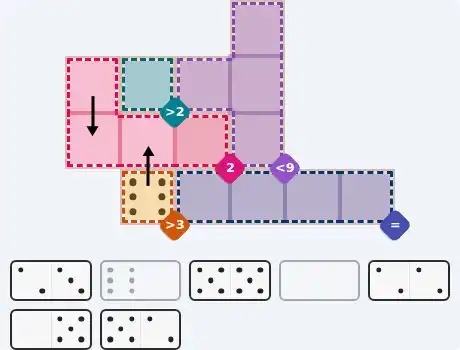
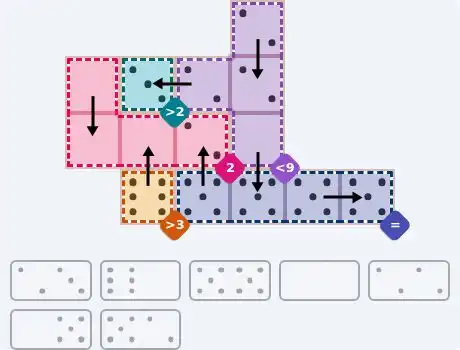
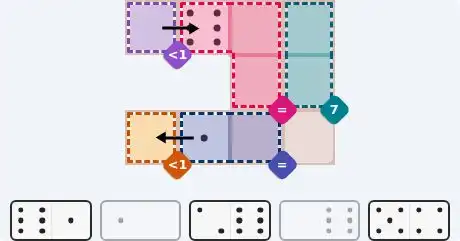
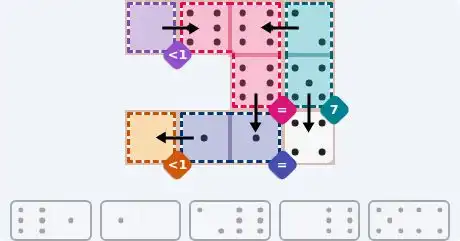
The key to solving today's hard puzzle was identifying the placement for the critical dominoes highlighted in the starting grid. Once those were in place, the rest of the puzzle could be solved logically. See the final grid below to compare your solution.

Starting Position & Key First Steps
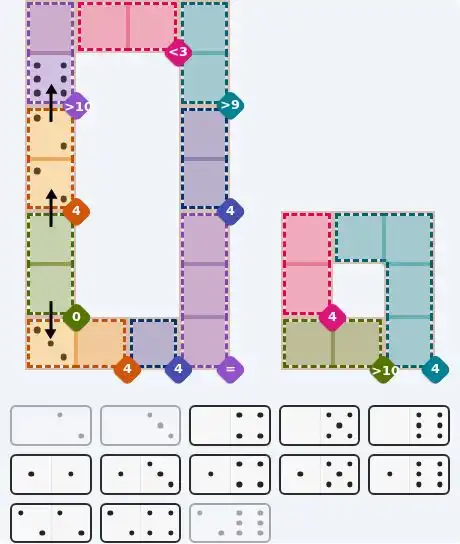
Pips hint for August 17, 2026 – hard level puzzle grid with critical first placements and strategy

This image shows the initial puzzle grid for the hard level, with a few critical first placements highlighted.

Final Answer: The Solved Grid for Hard Mode
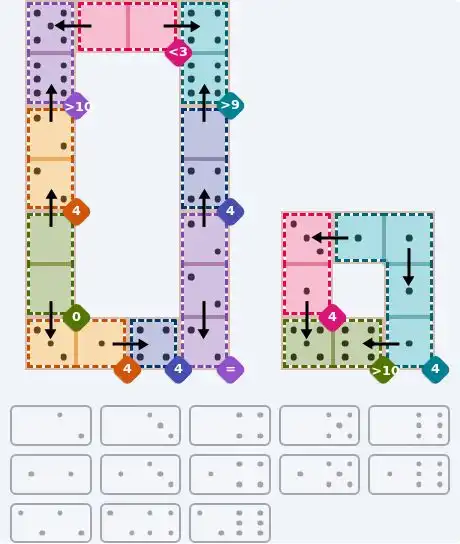
NYT Pips August 17, 2026 hard puzzle full solution grid showing final answer with hints

Compare this final grid with your own solution to see the correct placement of all dominoes.

🔧 Step-by-Step Answer Walkthrough For Easy Level

1
Step 1: Cap the left-edge singles
The single-cell less-than regions at [0,0] and [2,0] cannot exceed their cap, so both must be 0. Place [0,6] with 0 at [0,0] and 6 at [0,1], and [1,0] with 0 at [2,0] and 1 at [2,1].
2
Step 2: Let the equals regions echo
[0,1] must equal [0,2] and [1,2], so all three become 6. Place [2,6] across [0,3]–[0,2] (2,6), and [6,1] across [1,2]–[2,2] (6,1). Below, [2,1] and [2,2] must match, so both become 1.
3
Step 3: Solve the sum-7 pair
The region [0,3] + [1,3] must total 7. Since [0,3] is 2, [1,3] must be 5. Place [5,4] across [1,3]–[2,3], giving 5 and 4.
4
Step 4: Finish the empty corner
The only uncovered cell [2,3] sits in an empty region and already receives 4 from the [5,4] domino, completing the grid.

🔧 Step-by-Step Answer Walkthrough For Medium Level

1
Step 1: Lock the low-sum block
The sum-2 region over [1,0],[2,0],[2,1],[2,2] can barely accept anything. The vertical pair [1,0]–[2,0] is forced to use [0,0], giving 0 and 0, because any higher start would overrun the region.
2
Step 2: Split the greater-3 cell
The single-cell greater-than at [3,1] demands a value above 3. Pairing it with [2,1], which sits in the low-sum block, means [2,1] is 0 and [3,1] is 6 from [6,0].
3
Step 3: Place the greater-2 cell
The greater-than at [1,1] must be above 2. Use [2,3] across [1,2]–[1,1], giving 2 at [1,2] and 3 at [1,1], which also starts the less-than-9 region.
4
Step 4: Complete the top less-than region
The region [0,3],[1,2],[1,3],[2,3] must stay below its limit. With [1,2] set to 2, [2,2] in the low-sum must be 2, and [0,3]/[1,3] take the [2,2] domino. Then [0,5] connects [2,3]=0 to [3,3]=5.
5
Step 5: Fill the equals row
The bottom region [3,2],[3,3],[3,4],[3,5] must be equal. Since [3,3] is 5, [3,2] becomes 5 from [5,2] (with 2 at [2,2]), and [3,4]–[3,5] take [5,5]. The row is all 5s.

🔧 Step-by-Step Answer Walkthrough For Hard Level

1
Step 1: Anchor the sum-0 pocket
The region [4,0]/[5,0] must sum to 0, so both cells are 0. Place [0,2] across [4,0]–[3,0] (0 at [4,0], 2 at [3,0]) and [0,3] across [5,0]–[6,0] (0 at [5,0], 3 at [6,0]). The adjacent 2 and 3 are set up by the sum-4 regions those cells belong to.
2
Step 2: Climb the left-side sum-4 chain
[3,0] is 2, so the sum-4 region [2,0]+[3,0] forces [2,0] to be 2. Place [2,6] across [2,0]–[1,0] (2,6). Then the greater-10 region [0,0]+[1,0] must exceed 10, so [0,0] becomes 5; place [0,5] across [0,1]–[0,0] (0,5). The less-than pair [0,1]/[0,2] keeps [0,2] at 0.
3
Step 3: Resolve the top-right greater-than corridor
With [0,2]=0, place [0,4] across [0,2]–[0,3] (0,4). The greater-9 region [0,3]+[1,3] must exceed 9, so [1,3] has to be 6; place [0,6] across [2,3]–[1,3] (0,6). Now the sum-4 region [2,3]+[3,3] forces [3,3]=4.
4
Step 4: Unlock the central equals spine
With [3,3]=4, place [2,4] across [4,3]–[3,3] (2,4), so [4,3]=2. The equals region [4,3],[5,3],[6,3] now forces all three to 2. Place [2,2] across [5,3]–[6,3] (2,2).
5
Step 5: Work the bottom sums and greater pair
[6,0] is 3, so the sum-4 region [6,0]+[6,1] forces [6,1]=1. Place [1,4] across [6,1]–[6,2] (1,4), which also satisfies the single-cell sum-4 at [6,2]. The bottom greater-10 region [6,5]+[6,6] must exceed 10, so [6,5]=5 and [6,6]=6. Place [1,5] across [5,5]–[6,5] (1,5) and [1,6] across [6,7]–[6,6] (1,6). Then [5,5]=1 forces the sum-4 [4,5]+[5,5] to have [4,5]=3; place [1,3] across [4,6]–[4,5] (1,3).
6
Step 6: Close the right-side all-1 strip
The sum-4 region [4,6],[4,7],[5,7],[6,7] must total 4. With [4,6]=1 and [6,7]=1 already set, the only way is all four cells to be 1. Place [1,1] across [4,7]–[5,7] (1,1) to finish the grid.

💡 Pro Tips for Similar Puzzles

Start with Constraints
Always begin with the most constrained regions - sum regions with small numbers or tight spaces.
Use Equal Regions
Use "equal" regions as anchors - they eliminate many possibilities quickly.
Work Systematically
Let the rules guide your placement rather than guessing randomly.
Double-Check
Verify each region's rules are satisfied before moving to the next.

🎓 Keep Learning & Improve