NYT Pips Hints & Answers for September 17, 2026

Sep 17, 2026

🚨 SPOILER WARNING

This page contains the final answer and the complete solution to today's NYT Pips puzzle. If you haven't attempted the puzzle yet and want to try solving it yourself first, now's your chance!

Click here to play today's official NYT Pips game first.

Want hints instead? Scroll down for progressive clues that won't spoil the fun.

SEE ALSO:

🎲 Today's Puzzle Overview

Today's NYT Pips easy opens with a freebie: a lone single-cell sum region in the right-hand column that surrenders its value the second you spot it. Because Ian Livengood deals only five dominoes, that one cell pins its vertical neighbour, which in turn unlocks the three-cell sum region along the top — and its target is small enough that only one grouping of values can satisfy it. From there the solve runs downhill: a doubling domino filling two squares at once, a pair of matching sums in the bottom row, and a greater-than square paired with a less-than square to confirm you finished cleanly.

Rodolfo Kurchan's medium shifts the weight from arithmetic to shape. The tightest constraints here are equalities — a two-cell pair and a three-cell run — so your opening minutes go into auditing which dominoes can feed matching cells rather than adding anything up. The first real lock arrives at the smallest sum region in the bottom-left corner: whichever digit lands there immediately dictates its partner, and that partner's domino drags a whole row of identical values into place. The lone empty cell and the single less-than square act as rails rather than drivers.

Kurchan's hard is a 16-domino sprawl where the isolated single-cell regions do the heavy lifting. A handful of lone squares are dictated before you place anything, and each one tells you exactly where its partner must sit — several of them perch at the top of short sum regions that resolve into high-value pairs. From there the architecture fans out: a five-cell sum region that can only be filled by one repeated digit, a three-cell equality run along the top edge, a matching pair in the upper-right, and a six-cell unequal block in the bottom-right that becomes pure elimination. Expect the final third to be bookkeeping.

💡 Progressive Hints

Try these hints one at a time. Each hint becomes more specific to help you solve it yourself!

💡 Start with the lonely square
Your entry point is a constraint type, not a cell. Hunt for a region made of exactly one square that carries a sum target. A single cell can't negotiate with anything — whatever value satisfies its target is the value it takes.
💡 The right-hand column
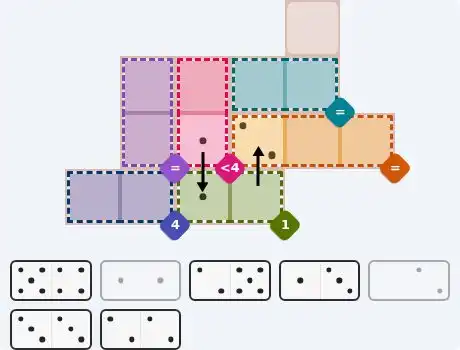
The lone sum square is [1,3], the middle row's rightmost cell, and its target is the smallest on the board — only one pip value can satisfy it. Whatever domino carries that value has to reach into a neighbouring cell, and just one of the five can manage it.
💡 Full solution
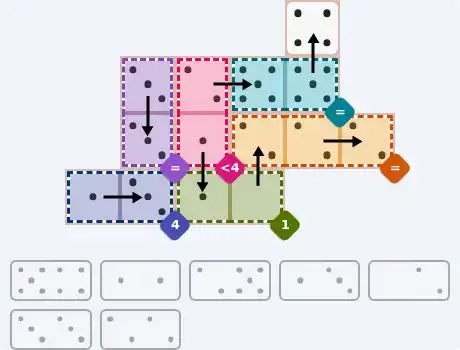
[1,3] is a sum-0 cell, so it reads 0, and the only domino holding a zero is [4,0] — lay it vertically for [1,3]=0 and [2,3]=4, which also satisfies the less-than-5 square. The top three cells form a sum-2 region, so they must be 0,1,1; the double-one domino [1,1] covers [0,2] and [0,3], leaving [0,1]=0. Domino [0,5] then runs from [0,1]=0 down to [1,1]=5, and since [1,0]+[1,1]=7, [1,0]=2. Place domino [3,2] as [1,0]=2 / [2,0]=3, then finish with domino [4,3] at [2,1]=4 / [2,2]=3 — satisfying both the sum-7 pair and the greater-than-2 square.
💡 Equal signs first
This grid is built on equality rather than addition — scan for regions where every cell must match its neighbours. You'll find one pair and one triple, and between them they carry most of the solve.
💡 The bottom-left corner
Zero in on the two-cell sum region at [3,2] and [3,3]. Its target is tiny, so it can only be assembled from the two smallest pip values, and exactly one domino supplies that combination. Whichever way you orient it, the triple-equals run up and to the right collapses instantly.
💡 Full solution
[3,2]=1 and [3,3]=0 satisfy the sum-1 pair. Domino [0,2] carries [3,3]=0 up to [2,3]=2, and the three-cell equality region then reads 2,2,2 — the double-two domino [2,2] fills [2,4] and [2,5]. Next, [3,2]=1 pairs with [2,2]=1 via the double-one domino [1,1]; the less-than-4 region above then takes [1,2]=2 from domino [2,5], whose other half gives [1,3]=5. Equality drags [1,4]=5 along, and domino [5,4] places [0,4]=4 in the empty region. Finally the equals pair [1,1]/[2,1] takes the double-three domino [3,3], and domino [1,3] completes the sum-4 region as [3,0]=1 and [3,1]=3.
💡 Hunt the single squares
The hard grid is salted with regions that hold exactly one cell and a sum target. Each one is a complete answer the instant you find it — no cross-checking, no neighbours required. Locate them all before you place anything.
💡 Four free cells
Your anchors are [3,2], [4,3], [6,1] and [6,2] — four isolated sum squares whose values are fixed on sight. Two of them sit directly above or beside a sum-eleven pair, and those pairs will tell you plenty about the cells next door.
💡 Trace the columns
Once [4,3] and [6,1] have their values, their domino partners are forced: one drops downward into a cell belonging to a sum-eleven pair, the other reaches sideways into the same kind of pair. Each pair then needs only one more value, and that value cascades up the column into the left-hand block.
💡 Build the top corner
Now look at the five-cell sum region running down the left side. Its target is small and its cell count large, so it can only be filled with a single repeated digit — the same value that anchors the three-cell equality run in the top-left corner. The two-cell equality in the upper-right works identically: a matching pair fed by a domino that also completes a sum-zero pair beside it.
💡 Full solution
Domino [0,6] → [4,3]=0, [5,3]=6; domino [4,5] → [6,2]=4, [6,3]=5, so the sum-11 pair [5,3]/[6,3] reads 6+5. Domino [3,5] → [6,1]=3, [6,0]=5; the other sum-11 pair then needs [5,0]=6, placed by domino [1,6] as [4,0]=1 / [5,0]=6. The five-cell sum region is all 1s: [1,0]=1 (domino [1,5]), [2,0]=1 & [3,0]=1 (domino [1,1]), [3,1]=1 & [3,2]=4 (domino [1,4]), plus [4,0]=1. Domino [1,5] also sets [0,0]=5, so the top-left equality run is 5,5,5 — the double-five domino [14] takes [0,1] and [0,2]. Upper right: domino [2,5] → [0,5]=2, [0,6]=5; domino [0,2] → [2,5]=0, [1,5]=2; domino [0,4] → [2,6]=0, [2,7]=4. Middle: domino [3,6] → [1,3]=3, [2,3]=6 (sum 9). Top-right empties: domino [6,6] → [0,7]=6, [1,7]=6. Unequal six: domino [1,2] → [4,6]=1, [4,7]=2; domino [0,3] → [5,6]=0, [6,6]=3; domino [4,6] → [7,5]=4, [7,6]=6.

🎨 Pips Solver

Sep 17, 2026

Click a domino to place it on the board. You can also click the board, and the correct domino will appear.
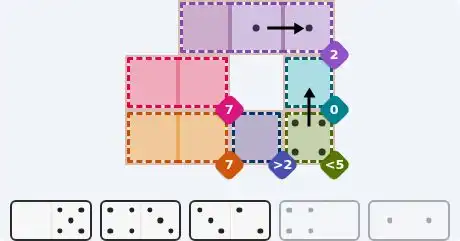
Final Answer & Complete Solution For Hard Level

The key to solving today's hard puzzle was identifying the placement for the critical dominoes highlighted in the starting grid. Once those were in place, the rest of the puzzle could be solved logically. See the final grid below to compare your solution.

Starting Position & Key First Steps
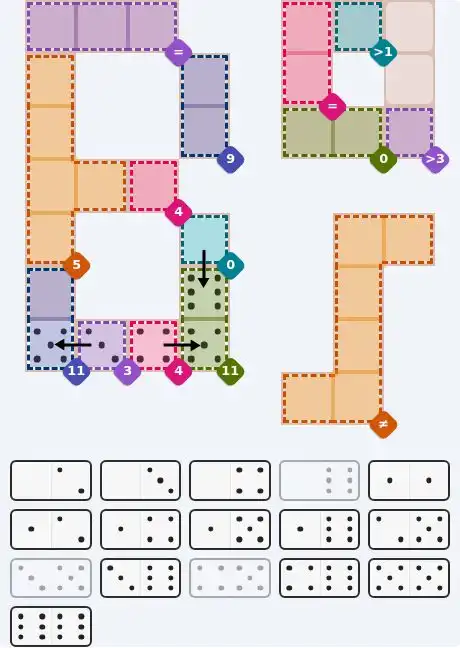
Pips hint for Sept 17, 2026 – hard level puzzle grid with critical first placements and strategy

This image shows the initial puzzle grid for the hard level, with a few critical first placements highlighted.

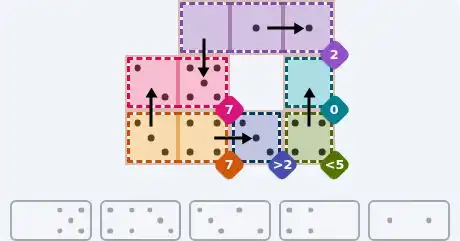
Final Answer: The Solved Grid for Hard Mode
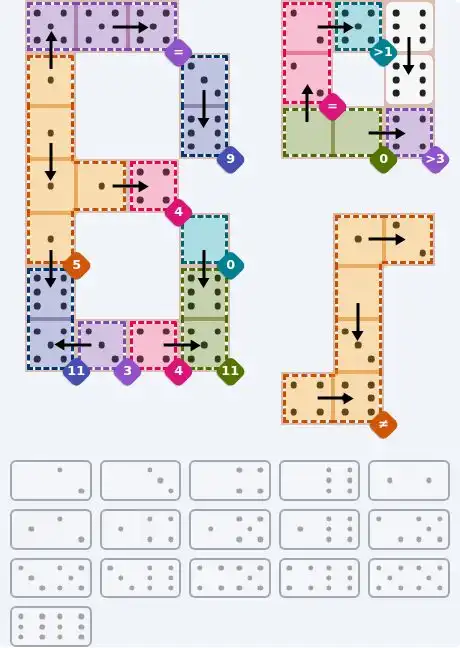
NYT Pips Sept 17, 2026 hard puzzle full solution grid showing final answer with hints

Compare this final grid with your own solution to see the correct placement of all dominoes.

🔧 Step-by-Step Answer Walkthrough For Easy Level

1
Step 1: The free single cell
[1,3] sits alone in a sum-0 region, so its value is forced to 0 with no help at all. Scan the domino list for a zero: only [4,0] carries one, and it must lie vertically because [1,3]'s only open neighbour is [2,3]. That also plants [2,3]=4, which sails through the less-than-5 check.
2
Step 2: Build the top row
The three cells [0,1], [0,2], [0,3] form a sum-2 region. With pip values from 0 to 6, the only triple that reaches 2 is 0+1+1. The double-one domino is the only piece that can supply two 1s at once, so it slots into [0,2] and [0,3], leaving [0,1]=0.
3
Step 3: Cascade down the middle
[0,1]=0 needs a partner, and the only remaining domino with a 0 is [0,5] — so [1,1]=5 in the sum-7 region below. Because that region is [1,0] plus [1,1], the maths gives [1,0]=2 immediately.
4
Step 4: Close out the bottom
Domino [3,2] supplies [1,0]=2 with [2,0]=3. The second sum-7 pair is [2,0]+[2,1], so [2,1] must be 4 — which leaves domino [4,3] to finish as [2,1]=4 and [2,2]=3. That final 3 clears the greater-than-2 square, and the grid is complete.

🔧 Step-by-Step Answer Walkthrough For Medium Level

1
Step 1: A one-two punch at the bottom
The sum-1 region [3,2]/[3,3] must be built from 0 and 1. Only domino [0,2] contains a 0, but its partner value can't stay inside that two-cell region, so the zero belongs at [3,3] and the domino reaches up to [2,3]=2. That leaves [3,2]=1.
2
Step 2: The equal triple
Since [2,3]=2 and all three cells of that equality region must match, [2,4] and [2,5] are both 2. The double-two domino [2,2] completes them without disturbing anything else.
3
Step 3: Feed the double one
[3,2]=1 still needs its domino partner. The double-one piece is the only one that can supply a second 1, and its natural slot is straight up: [2,2]=1. That satisfies the less-than-4 region's lower cell and leaves only [1,2] to pin down.
4
Step 4: The right column cascades
Domino [2,5] fits [1,2]=2 (comfortably under 4) with [1,3]=5. Equality in the [1,3]/[1,4] region forces [1,4]=5, and domino [5,4] then drops [0,4]=4 into the empty cell at the top-right.
5
Step 5: Close the left column
The remaining equality region [1,1]/[2,1] must be a matching pair, and the double-three domino is the only piece that fits — giving both cells 3. That leaves the sum-4 region [3,0]/[3,1] to be finished by domino [1,3] as [3,0]=1 and [3,1]=3.

🔧 Step-by-Step Answer Walkthrough For Hard Level

1
Step 1: Read the single cells
Four squares stand alone. [4,3] is a sum-0 region → 0. [6,1] is sum-3 → 3. [6,2] is sum-4 → 4. [3,2] is also sum-4 → 4. None of these needs a neighbour's help, and each one immediately constrains whichever domino touches it.
2
Step 2: Lock the lower columns
[4,3]=0 must be matched by domino [0,6], placing [5,3]=6. The sum-11 pair [5,3]/[6,3] then needs [6,3]=5, and domino [4,5] delivers exactly that alongside [6,2]=4 (its already-known sum-4 square). On the other side, [6,1]=3 pairs with domino [3,5] for [6,0]=5, forcing [5,0]=6 in the neighbouring sum-11 pair.
3
Step 3: Build the five 1s
[5,0]=6 pairs upward through domino [1,6], landing [4,0]=1. That 1 tells you how the five-cell sum region must be built: five identical digits. Domino [1,1] takes [2,0] and [3,0] as 1s; domino [1,4] takes [3,1]=1 with [3,2]=4; and domino [1,5] sets [1,0]=1 while placing [0,0]=5 one row above.
4
Step 4: The top-left equality
Because [0,0]=5 and the three top-left cells must be equal, the whole run reads 5,5,5. The double-five domino covers [0,1] and [0,2], and the top-left corner is sealed.
5
Step 5: Upper right and the middle
The equal pair [0,5]/[1,5] is fed by domino [0,2]: [1,5]=2 and [2,5]=0. Domino [2,5] then supplies [0,5]=2 plus [0,6]=5, clearing the greater-than-1 square. Domino [0,4] finishes the sum-0 pair with [2,6]=0 and sets [2,7]=4, clearing the greater-than-3 square. In the middle, domino [3,6] makes the sum-9 pair [1,3]=3 and [2,3]=6.
6
Step 6: The unequal block
Six cells need six different values. Domino [0,3] gives [5,6]=0 and [6,6]=3; domino [1,2] gives [4,6]=1 and [4,7]=2; domino [4,6] gives [7,5]=4 and [7,6]=6 — all distinct. Finally domino [6,6] closes the two remaining empty squares as [0,7]=6 and [1,7]=6.

💡 Pro Tips for Similar Puzzles

Start with Constraints
Always begin with the most constrained regions - sum regions with small numbers or tight spaces.
Use Equal Regions
Use "equal" regions as anchors - they eliminate many possibilities quickly.
Work Systematically
Let the rules guide your placement rather than guessing randomly.
Double-Check
Verify each region's rules are satisfied before moving to the next.

🎓 Keep Learning & Improve