NYT Pips Hints & Answers for September 12, 2026

Sep 12, 2026

🚨 SPOILER WARNING

This page contains the final **answer** and the complete **solution** to today's NYT Pips puzzle. If you haven't attempted the puzzle yet and want to try solving it yourself first, now's your chance!

Click here to play today's official NYT Pips game first.

Want hints instead? Scroll down for progressive clues that won't spoil the fun.

SEE ALSO:

🎲 Today's Puzzle Overview

Ian Livengood's easy grid is a compact deduction graph with two early bottlenecks. A single-cell less-than filter at the top row removes the only low-cap domino from the pool, and that ripple converts the sum-10 pair into a strict two-value split. The unequal block then functions as a sink for the remaining high-low pairings, so the equals region closes almost automatically.

The medium from the same constructor is more of a daisy chain. The top three-cell sum region is the initial fork: it forces a matched vertical domino and detaches a low edge cell. From there, two equal-pair regions on the left relay the constrained values downward into a larger three-cell equals hub. The lone right-edge sum cell then acts as the terminal lock.

Rodolfo Kurchan's hard is a distributed constraint graph. A five-cell equals block in the upper-left operates as a hub, fed by two high-threshold single-cell greater constraints at the top edge. Parallel vertical sum columns on the right and high-threshold pairs along the bottom row create independent branch chains that interlock late. In this NYT Pips hard, the bottom three rows are really a second puzzle connected to the top-left hub by a short middle band.

💡 Progressive Hints

Try these hints one at a time. Each hint becomes more specific to help you solve it yourself!

💡 Spot the tight cap
Look for a single-cell ceiling that is nearly impossible to miss. That kind of less-than region will give away a pip and immediately pull a specific domino into the top row.
💡 Col 1's zero domino
At [0,1] the less-1 limit sets the cell to zero. The only zero-bearing domino is [0,5], and its partner cannot go left to [0,0] because of the less-4 cap or down to [1,1] without breaking the equals pair, so it must be [0,2].
💡 The full easy finish
Place [0,5] on [0,1]-[0,2]. The sum-10 pair [2,1]-[2,2] must be 4 and 6, so [6,6] goes to [2,2]-[2,3]. Put [1,4] on [1,1]-[2,1] with 4 in [2,1] and 1 in [1,1]. Complete with [3,1] on [0,0]-[1,0] and [4,2] on [0,3]-[1,3].
💡 Follow the small top sum
Begin in the upper band. A three-cell sum is small enough that only one domino arrangement gives three legal pips, and the vertical portion of that region is the hinge.
💡 Top-row vertical lock
The sum-4 block at [0,2]-[0,3]-[1,3] must be two equal small pips and one other small pip. Domino [1,1] covers [0,3]-[1,3], leaving [0,2] to pair with [0,1] through [0,2].
💡 Finish the medium chain
Place [1,1] at [0,3]-[1,3], [0,2] at [0,1]-[0,2], and [0,0] at [0,0]-[1,0]. The equal [1,0]-[1,1] pair forces [3,0] onto [1,1]-[1,2]; the big equals hub takes [3,3] at [2,1]-[2,2]. On the right, [2,4]'s sum-3 forces [6,3] at [2,3]-[2,4], and [0,6] completes [3,2]-[3,3].
💡 Find the isolated anchors
This grid is built from several independent constraint clusters. Start by locating the five-cell equals block in the upper-left, the lone sum/empty cell top-right, and the high-threshold greater blocks in the bottom three rows.
💡 Lock the top-right and upper-left
At [0,6] the sum-4 cell has only empty neighbor [1,6], so [0,4] is forced there. In the upper-left, the five-cell equals block needs five matching low pips; [4,1] on [0,0]-[1,0] and [1,6] on [0,2]-[1,2] satisfy the greater-3 and greater-4 singles while seeding the hub.
💡 Fill the hub and middle band
Complete the equals hub with [1,1] on [2,0]-[2,1] and [1,3] on [2,2]-[3,2], which also clears the greater-1 cell at [3,2]. Mid-grid, [2,4] fits the sum-6 pair [2,4]-[2,5], [2,5] satisfies the less-4/greater-4 stack at [3,6]-[4,6], and [3,3] fills the equals pair [2,7]-[2,8].
💡 Stack the right-side sums
On the lower right, use [0,3] for the less-2 cell [6,6] and [7,6], then [3,6] for [8,6]-[9,6] to finish the sum-12 column. The sum-2 cell [6,8] takes [3,2] on [6,8]-[7,8], and [6,6] on [8,8]-[9,8] completes the sum-15 column.
💡 Full hard answer
Place the complete set: [0,4] at [1,6]-[0,6]; [4,1] at [0,0]-[1,0]; [1,6] at [1,2]-[0,2]; [1,1] at [2,0]-[2,1]; [1,3] at [2,2]-[3,2]; [2,4] at [2,4]-[2,5]; [2,5] at [3,6]-[4,6]; [3,3] at [2,7]-[2,8]; [0,3] at [6,6]-[7,6]; [3,6] at [8,6]-[9,6]; [3,2] at [7,8]-[6,8]; [6,6] at [8,8]-[9,8]; [4,3] at [7,0]-[7,1]; [3,5] at [8,1]-[9,1]; [6,4] at [7,3]-[7,4]; [5,6] at [9,3]-[9,4].

🎨 Pips Solver

Sep 12, 2026

Click a domino to place it on the board. You can also click the board, and the correct domino will appear.
Final Answer & Complete Solution For Hard Level

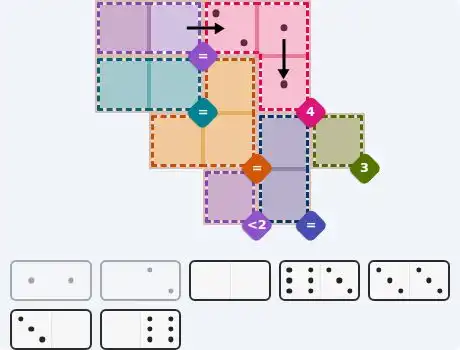
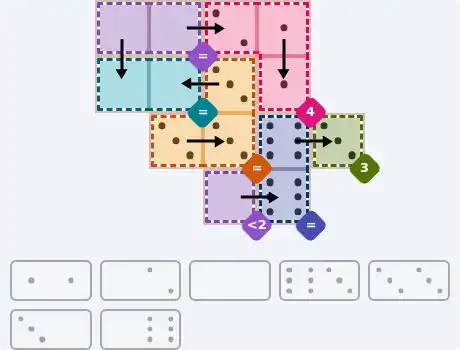
The key to solving today's hard puzzle was identifying the placement for the critical dominoes highlighted in the starting grid. Once those were in place, the rest of the puzzle could be solved logically. See the final grid below to compare your solution.

Starting Position & Key First Steps
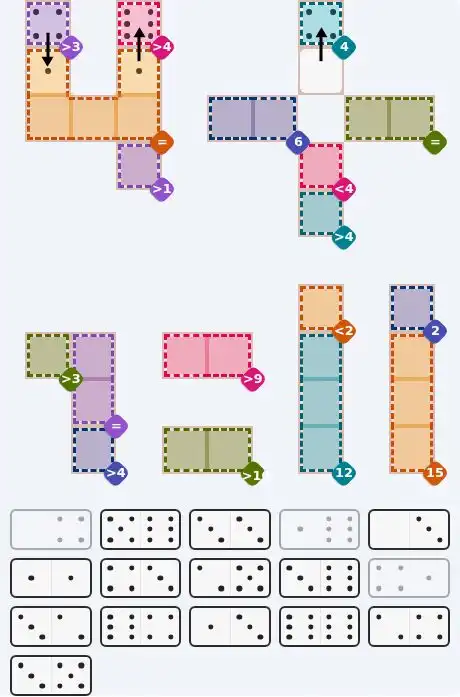
Pips hint for Sept 12, 2026 – hard level puzzle grid with critical first placements and strategy

This image shows the initial puzzle grid for the hard level, with a few critical first placements highlighted.

Final Answer: The Solved Grid for Hard Mode
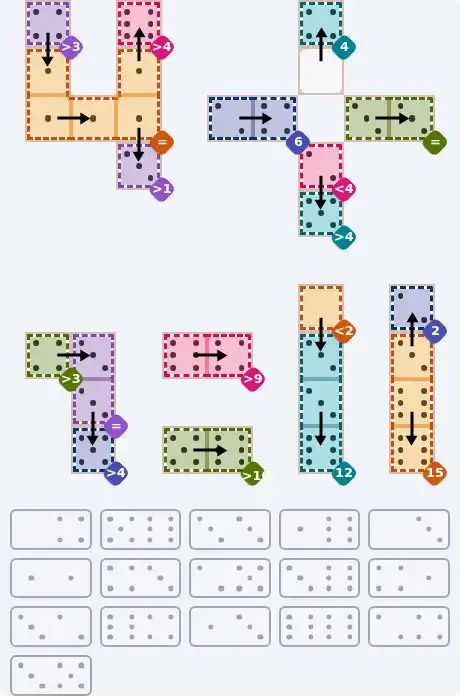
NYT Pips Sept 12, 2026 hard puzzle full solution grid showing final answer with hints

Compare this final grid with your own solution to see the correct placement of all dominoes.

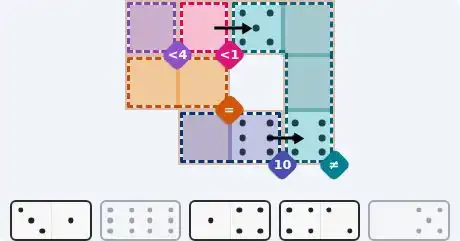
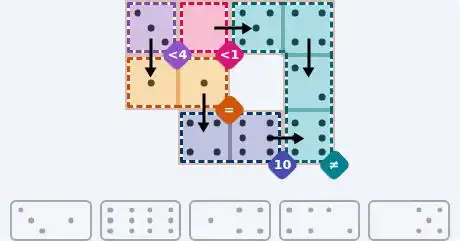
🔧 Step-by-Step Answer Walkthrough For Easy Level

1
Step 1: Tight top-row ceiling
The single-cell less-1 region at [0,1] can only take a 0. Since the only domino carrying a 0 is [0,5], and its other half cannot go left into the less-4 cell or down into the equals pair, it must cover [0,1]-[0,2] with [0,1]=0 and [0,2]=5.
2
Step 2: Split the sum-10 pair
With [0,5] used, the sum-10 region [2,1]-[2,2] must be 4+6. The [6,6] domino cannot cover both sum cells because that would total 12, so it locks horizontally on [2,2]-[2,3], making [2,2]=6 and [2,3]=6.
3
Step 3: Place the 4 in the sum
[2,1] must now supply the missing 4. Domino [1,4] fits the vertical [1,1]-[2,1] slot, placing 1 at [1,1] and 4 at [2,1]. The equals region then forces [1,0] to also be 1.
4
Step 4: Close the grid
Domino [3,1] covers [0,0]-[1,0], giving [0,0]=3 to satisfy its less-4 cap and [1,0]=1 for the equals pair. The remaining [4,2] fills [0,3]-[1,3], completing the unequal block.

🔧 Step-by-Step Answer Walkthrough For Medium Level

1
Step 1: Top sum-4 hinge
The three-cell region [0,2],[0,3],[1,3] must total 4. With nonnegative pips, that total all but forces two equal low values plus a partner. The only available equal-pip domino that fits the [0,3]-[1,3] vertical is [1,1], so place it there.
2
Step 2: Left equals relay
With [0,3] and [1,3] set, [0,2] must carry the remaining small value in the sum. Pairing it leftward with [0,1] via [0,2] gives [0,1] the low pip; the equal pair [0,0]-[0,1] then forces [0,0] to match. Place [0,0] on [0,0]-[1,0], which also sets [1,0].
3
Step 3: Seed the three-cell equals hub
The equal pair [1,0]-[1,1] now requires [1,1] to take the same value as [1,0]. The only viable cover for [1,1] is [3,0] on [1,1]-[1,2], so [1,2] becomes the larger hub value. The three-cell equals region [1,2],[2,1],[2,2] then forces [2,1] and [2,2] to match, so [3,3] fills that pair.
4
Step 4: Right-edge sum-3
The single-cell sum-3 at [2,4] can only pair with [2,3]. Because the other 3-bearing tiles are already committed to the equals hub, the [6,3] domino must cover [2,3]-[2,4], placing the 6 in [2,3].
5
Step 5: Lower equals closure
The equal pair [2,3]-[3,3] forces [3,3] to take 6. The remaining [0,6] domino fits [3,2]-[3,3], which puts [3,2] below its less-than-2 cap and completes the medium grid.

🔧 Step-by-Step Answer Walkthrough For Hard Level

1
Step 1: Top-right sum cell
The lone sum-4 cell at [0,6] has to sit on a 4-pip tile. Its only available neighbor is the empty cell at [1,6], so domino [0,4] is forced vertically: [1,6]=0 and [0,6]=4.
2
Step 2: Five-cell equals hub
The upper-left equals block at [1,0],[1,2],[2,0],[2,1],[2,2] is the main hub. The top-left greater cells [0,0] and [0,2] force the hub cells below them to take the low halves of their vertical dominoes. That makes the hub's repeated value 1, so place [4,1] on [0,0]-[1,0] and [1,6] on [0,2]-[1,2]. Then fill the rest with [1,1] on [2,0]-[2,1] and [1,3] on [2,2]-[3,2]; the latter also makes [3,2] clear greater-than-1.
3
Step 3: Middle band
The sum-6 pair [2,4]-[2,5] takes domino [2,4] horizontally. The equals pair [2,7]-[2,8] takes [3,3]. At [3,6] the less-than-4 cap and at [4,6] the greater-than-4 floor force [2,5] vertically, placing 2 and 5.
4
Step 4: Right-side sum columns
In the lower right, the less-than-2 cell [6,6] forces a 0, so [0,3] goes to [6,6]-[7,6]. The sum-12 column [7,6],[8,6],[9,6] then needs 9 more from [8,6]-[9,6], which [3,6] supplies. The single sum-2 cell [6,8] forces [3,2] onto [6,8]-[7,8]; then the sum-15 column [7,8],[8,8],[9,8] takes [6,6] on [8,8]-[9,8].
5
Step 5: Bottom threshold strip
At lower left, the greater-than-3 cell [7,0] pairs with [7,1] via [4,3], setting [7,1]=3. The equal pair [7,1]-[8,1] is finished by [3,5] on [8,1]-[9,1], putting 3 at [8,1] and a greater-than-4 pip at [9,1]. The high-threshold pair [7,3]-[7,4] is cleared by the 6+4 total from [6,4], and the 5+6 total from [5,6] clears [9,3]-[9,4].
6
Step 6: Final check
All forced placements interlock: the top-left hub uses four 1-pip dominoes; the top-right and right-side sums stack cleanly; the bottom strip's greater-than sums are exactly satisfied by [6,4] and [5,6]. The grid closes without any unplaced dominoes.

💡 Pro Tips for Similar Puzzles

Start with Constraints
Always begin with the most constrained regions - sum regions with small numbers or tight spaces.
Use Equal Regions
Use "equal" regions as anchors - they eliminate many possibilities quickly.
Work Systematically
Let the rules guide your placement rather than guessing randomly.
Double-Check
Verify each region's rules are satisfied before moving to the next.

🎓 Keep Learning & Improve