NYT Pips Hints & Answers for September 1, 2026

Sep 1, 2026

🚨 SPOILER WARNING

This page contains the final **answer** and the complete **solution** to today's NYT Pips puzzle. If you haven't attempted the puzzle yet and want to try solving it yourself first, now's your chance!

Click here to play today's official NYT Pips game first.

Want hints instead? Scroll down for progressive clues that won't spoil the fun.

SEE ALSO:

🎲 Today's Puzzle Overview

The NYT Pips easy grid gives you two gifts up front: a lone single-cell sum and a single-cell less-than constraint hand you their pips immediately. From there Ian Livengood's construction turns into a cascade of two-cell sums and equals regions, where each solved cell passes its value to a neighbor and the placements feel almost automatic.

Rodolfo Kurchan's medium starts with a tiny bottom-row sum that asks for a matching pair and a one-cell sum on the left edge. That combination works like a key: one value forces a neighboring column sum, which then trips a greater-than single and sends you upward through the middle. The solving experience is less about heavy arithmetic and more about spotting which domino carries the only viable pip for the next cell.

Kurchan's hard is a different beast. A lone sum cell in the middle is the first clean lock, but the puzzle's real architecture is a pair of large equals regions: a five-cell chain in the upper left and a four-cell equals cluster in the lower right. Once the first anchor falls, the lower-right cluster sets off a domino effect, then the top sum and left-side triple close the grid.

💡 Progressive Hints

Try these hints one at a time. Each hint becomes more specific to help you solve it yourself!

💡 Start with the loners
Look for the single-cell sum and single-cell less-than regions first; these little constraints hand you their values without any cross-checking.
💡 Lean into the sums and equals
The lone cell at [0,2] and the less-than cell at [5,0] are anchors. The two-cell sum directly below [0,2] and the equals pair on the left will then decide their partners.
💡 Full chain
Place 6-4 on [1,2]/[0,2] with [0,2]=4. Then 2-5 goes [3,2]/[2,2] with [2,2]=5. That makes [3,1]=2, so 2-3 covers [3,1]/[4,1] and [4,1]=3; 3-1 follows on [5,1]/[5,0] with [5,0]=1. Finish by putting 6-3 on [5,3]/[5,4] and 0-1 on [3,3]/[4,3].
💡 Tiny sums first
Scan for the smallest two-cell sum and the one-cell sum. They're the keys that unlock the rest of the medium grid without guessing.
💡 Bottom row, then left edge
The two-cell sum at [4,2]/[4,3] wants a matching pair; the single-cell sum at [3,0] names its pip. That sets up the column sum at [2,1]/[3,1] and the adjacent greater-than cell.
💡 Medium answer chain
Put 2-2 on [4,2]/[4,3]. Use 2-6 at [3,0]/[3,1], with [3,0]=2. Next 5-2 goes [1,1]/[2,1], [1,1]=5. Then 2-0 fills [2,2]/[3,2]; 3-4 fills [2,3]/[1,3]; 1-1 fills [0,2]/[1,2]; finish with 0-5 on [3,3]/[3,4].
💡 Find the isolated sum and the equals chains
Start by spotting the lone sum cell in the middle and the large multi-cell equals regions; the hard puzzle is all about how these share values across separate dominoes.
💡 The middle sum sends a signal
The single-cell sum at [2,4] gives you a firm value, and its partner at [2,5] is pulled from the same domino. That immediately activates the four-cell equals cluster on the right edge.
💡 Right-side zero chain
In that four-cell equals cluster, [1,6] cannot pair left with [1,5] as the required value, so [1,6] and [2,6] must take the double-zero domino. Then [3,6] is forced to pair downward with [4,6].
💡 Top sum forces the next cascade
With the right side locked, the sum-12 pair at [0,5]/[1,5] must be 6-6. That forces the 3-6 domino onto [1,4]/[1,5], which makes [1,3] a 3 and hands the five-cell equals in the upper left a value of 1.
💡 Hard answer chain
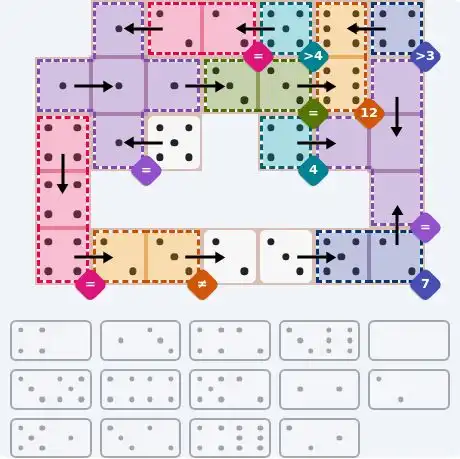
Place 4-0 at [2,4]/[2,5]; 0-0 at [1,6]/[2,6]; 2-0 at [4,6]/[3,6]; 3-5 at [4,4]/[4,5]. Sum-12 forces 3-6 at [1,4]/[1,5] and 4-6 at [0,6]/[0,5]; also 1-3 at [1,2]/[1,3]. Then 1-1 at [1,0]/[1,1], 5-1 at [2,2]/[2,1], 2-1 at [0,2]/[0,1], 5-2 at [0,4]/[0,3]. Finish with 4-4 at [2,0]/[3,0], 4-2 at [4,0]/[4,1], 3-2 at [4,2]/[4,3].

🎨 Pips Solver

Sep 1, 2026

Click a domino to place it on the board. You can also click the board, and the correct domino will appear.
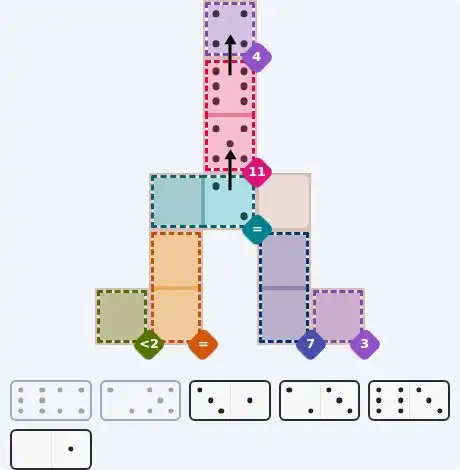
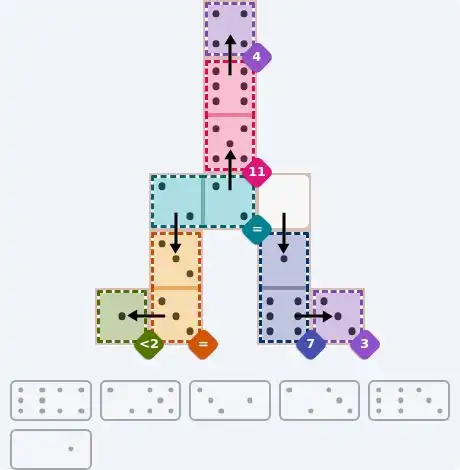
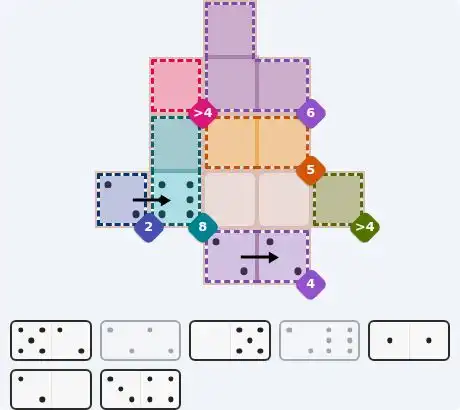
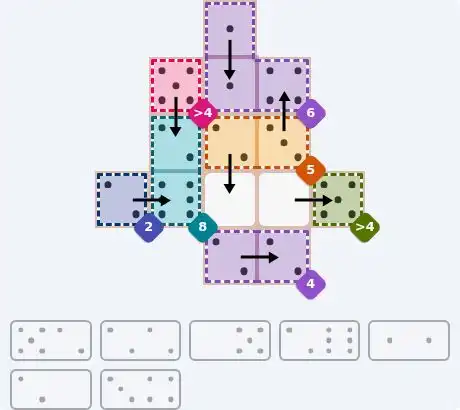
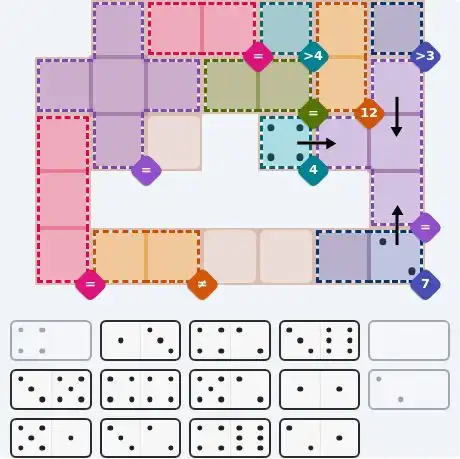
Final Answer & Complete Solution For Hard Level

The key to solving today's hard puzzle was identifying the placement for the critical dominoes highlighted in the starting grid. Once those were in place, the rest of the puzzle could be solved logically. See the final grid below to compare your solution.

Starting Position & Key First Steps
Pips hint for Sept 1, 2026 – hard level puzzle grid with critical first placements and strategy

This image shows the initial puzzle grid for the hard level, with a few critical first placements highlighted.

Final Answer: The Solved Grid for Hard Mode
NYT Pips Sept 1, 2026 hard puzzle full solution grid showing final answer with hints

Compare this final grid with your own solution to see the correct placement of all dominoes.

🔧 Step-by-Step Answer Walkthrough For Easy Level

1
Step 1: Lock the lone sum
The single-cell sum region at [0,2] must be exactly 4. Since [0,2] only pairs with [1,2] in the available 6-4 domino, that domino is forced, giving [1,2]=6 and [0,2]=4.
2
Step 2: Respond to the sum-11
With [1,2]=6, the two-cell sum-11 region at [1,2]/[2,2] forces [2,2]=5. The 2-5 domino must therefore cover [3,2]/[2,2], placing [3,2]=2 and [2,2]=5.
3
Step 3: Pass the equals
The equals region [3,1]/[3,2] now requires [3,1]=2. The 2-3 domino covers [3,1]/[4,1], setting [4,1]=3. That value transfers to [5,1] through the equals region [4,1]/[5,1], so the 3-1 domino covers [5,1]/[5,0] and [5,0]=1.
4
Step 4: Finish bottom-right
The single-cell sum at [5,4] forces 3; the adjacent 6-3 domino gives [5,3]=6 and [5,4]=3. Then the sum-7 at [4,3]/[5,3] makes [4,3]=1, so the final 0-1 domino fills [3,3]=0 and [4,3]=1.

🔧 Step-by-Step Answer Walkthrough For Medium Level

1
Step 1: Bottom sum gives a double
The sum-4 region at [4,2]/[4,3] has to be two 2s. Place the 2-2 domino there horizontally, covering [4,2] and [4,3].
2
Step 2: Single sum on the left
The one-cell sum-2 at [3,0] is exactly 2. Its only available partner is [3,1], so the 2-6 domino is forced, putting [3,0]=2 and [3,1]=6.
3
Step 3: Column sum and greater-than
The sum-8 region [2,1]/[3,1] then forces [2,1]=2. With the 6 already used on [3,1], the greater-than cell at [1,1] must be 5, so the 5-2 domino fits [1,1]/[2,1].
4
Step 4: Middle sum and upper sum
The sum-5 region [2,2]/[2,3] settles as [2,2]=2 and [2,3]=3, because the 2-0 domino covers [2,2]/[3,2] with [3,2]=0. Then 3-4 covers [2,3]/[1,3]. With [1,3]=4, the top sum-6 forces [0,2] and [1,2] to both be 1, using the 1-1 domino.
5
Step 5: Right-edge cleanup
Finally, [3,4] must be greater than 4, so the remaining 0-5 domino fills [3,3]=0 and [3,4]=5. That accounts for all cells and leaves no ambiguity.

🔧 Step-by-Step Answer Walkthrough For Hard Level

1
Step 1: Central sum lock
The sum-4 single at [2,4] must be 4, so the 4-0 domino is forced over [2,4]/[2,5], giving [2,5]=0.
2
Step 2: The zero equals cluster
Because [2,5] belongs to the four-cell equals region [1,6]/[2,5]/[2,6]/[3,6], all four cells are 0. At [1,6], a zero cannot pair left with [1,5] because no 0-6 domino exists, so [1,6] must pair with [2,6] via the 0-0 domino.
3
Step 3: Force the lower right
With [2,6] already covered, [3,6]=0 is forced to pair downward with [4,6]. Use the 2-0 domino, putting [3,6]=0 and [4,6]=2. Then the sum-7 at [4,5]/[4,6] gives [4,5]=5, so the 3-5 domino covers [4,4]/[4,5] with [4,4]=3.
4
Step 4: Top sum forces two 6s
The sum-12 region [0,5]/[1,5] can only be 6+6. The 3-6 domino covers [1,4]/[1,5], giving [1,4]=3 and [1,5]=6. That forces the equals pair [1,3]/[1,4] to make [1,3]=3, so 1-3 covers [1,2]/[1,3] with [1,2]=1. Meanwhile, 4-6 covers [0,6]/[0,5], putting [0,6]=4 and [0,5]=6.
5
Step 5: Upper-left equals cascade
With [1,2]=1, the five-cell equals region [0,1]/[1,0]/[1,1]/[1,2]/[2,1] is all 1. Use 1-1 at [1,0]/[1,1], 5-1 at [2,2]/[2,1], and 2-1 at [0,2]/[0,1]. The equals pair [0,2]/[0,3] then forces [0,3]=2, so 5-2 fills [0,4]/[0,3] with [0,4]=5.
6
Step 6: Left triple and final domino
The equals region [2,0]/[3,0]/[4,0] must be all 4, so place 4-4 on [2,0]/[3,0] and 4-2 on [4,0]/[4,1] with [4,1]=2. The unequal constraint at [4,1]/[4,2] prevents [4,2] from also being 2, so the remaining 3-2 domino closes the grid on [4,2]/[4,3].

💡 Pro Tips for Similar Puzzles

Start with Constraints
Always begin with the most constrained regions - sum regions with small numbers or tight spaces.
Use Equal Regions
Use "equal" regions as anchors - they eliminate many possibilities quickly.
Work Systematically
Let the rules guide your placement rather than guessing randomly.
Double-Check
Verify each region's rules are satisfied before moving to the next.

🎓 Keep Learning & Improve