NYT Pips Hints & Answers for August 30, 2026

Aug 30, 2026

🚨 SPOILER WARNING

This page contains the final **answer** and the complete **solution** to today's NYT Pips puzzle. If you haven't attempted the puzzle yet and want to try solving it yourself first, now's your chance!

Click here to play today's official NYT Pips game first.

Want hints instead? Scroll down for progressive clues that won't spoil the fun.

SEE ALSO:

🎲 Today's Puzzle Overview

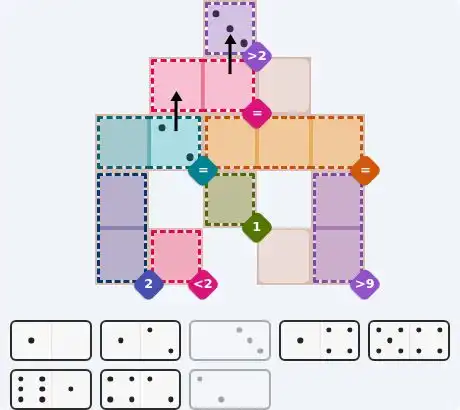
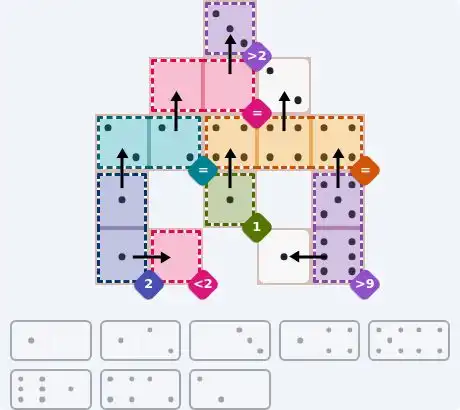
Today's NYT Pips easy is a neat Ian Livengood exercise in small-grid chaining: two tiny equals regions in the upper left set a low anchor, while the bottom row uses a maximal sum to pull the high-pip dominoes into a fixed backbone. The domino budget is so spare that the puzzle reads less like a search and more like a forced sequence.

Livengood's medium design expands the idea into a five-column strip built around a row-length equals spine. Single-cell greater/less pins at the top and bottom edge work as bottlenecks, and the left-hand equals column interlocks with a small sum region to propagate values into the center.

Rodolfo Kurchan's hard grid is the most architectural of the set: a zero-sum block in the upper left consumes nearly every zero in the inventory, while a descending series of equals pairs and single-cell sum pins locks the right side. The interplay between one-cell arithmetic targets and multi-cell equals creates a needle-threading finish.

💡 Progressive Hints

Try these hints one at a time. Each hint becomes more specific to help you solve it yourself!

💡 Follow the max sum
Look for a sum region that acts like a cap in this tiny set; it will force the two highest-pip dominoes to appear.
💡 Bottom-row squeeze
The bottom-row sum-12 pair needs the two highest pips from the available set. Resolve the double-high domino against that pair, then check what it does to the neighboring sum-9.
💡 Full easy chain
The sum-12 pulls the two sixes: place 6-2 vertically at [2,0]-[1,0] and 6-6 horizontally at [2,1]-[2,2]. Then equals pairs force 1-2 vertically at [0,1]-[1,1] and 5-1 vertically at [1,2]-[0,2]; the remaining 3-4 goes vertically at [2,3]-[1,3].
💡 Start with the single cells
Focus on the one-cell greater-than and less-than regions; they create tight bottlenecks that dictate a domino direction.
💡 Top equals feed
The greater cell at [0,2] sits above the equals pair [1,1]-[1,2]; resolving that vertical domino pins a low value below and sends a ripple into the left-hand equals column.
💡 Full medium chain
Place 0-3 vertically with 3 at [0,2] and 0 at [1,2]; place 2-0 vertically with 2 at [2,1] and 0 at [1,1]. Then place 1-2 vertical at [3,0]-[2,0], 1-0 horizontal at [4,0]-[4,1], 1-4 vertical at [3,2]-[2,2], 4-2 horizontal at [2,3]-[1,3], 5-4 vertical at [3,4]-[2,4], and 6-1 horizontal at [4,4]-[4,3].
💡 Look for the zero sink
Begin with the sum-0 block and the single-cell less-than region at the bottom; these are the most restrictive constraints and will anchor the lowest dominoes.
💡 Zero placements
The sum-0 block at [1,0]-[1,1]-[1,2]-[2,2] forces three different zero-bearing dominoes into specific corners. The bottom less-than cell at [9,6] joins a vertical equals pair above it.
💡 Top row arithmetic
With the zeros placed, the top row's single 6-sum cell and the adjacent two-cell 6-sum region pin a high domino across [0,3]-[0,4], and the equals trio at the top right locks the 4s.
💡 Middle sum chain
The middle and lower-middle single sum regions force a vertical 6-3 domino at [3,2]-[3,3], then a 6-2 at [4,2]-[4,3] and a 4-3 at [5,3]-[5,2] to complete the sum targets.
💡 Full hard chain
Place 0-0 horizontal at [1,0]-[1,1], 1-0 vertical at [0,2]-[1,2], and 3-0 horizontal at [2,3]-[2,2]. Place 5-6 horizontal at [0,3]-[0,4]; 4-4 vertical at [0,5]-[1,5] and 1-4 vertical at [1,3]-[1,4]; 2-2 horizontal at [0,0]-[0,1]; 6-3 vertical at [3,2]-[3,3]; 6-2 vertical at [4,2]-[4,3] and 4-3 vertical at [5,3]-[5,2]; 4-5 horizontal at [6,5]-[6,4]; 2-4 vertical at [7,6]-[6,6]; 1-2 vertical at [9,6]-[8,6]; 5-5 horizontal at [6,7]-[6,8].

🎨 Pips Solver

Aug 30, 2026

Click a domino to place it on the board. You can also click the board, and the correct domino will appear.
Final Answer & Complete Solution For Hard Level

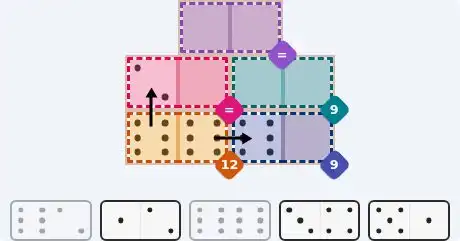
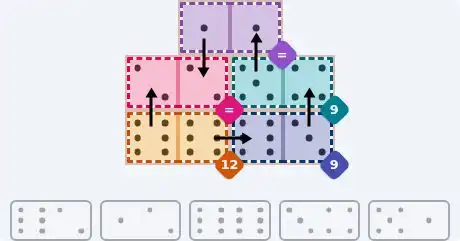
The key to solving today's hard puzzle was identifying the placement for the critical dominoes highlighted in the starting grid. Once those were in place, the rest of the puzzle could be solved logically. See the final grid below to compare your solution.

Starting Position & Key First Steps
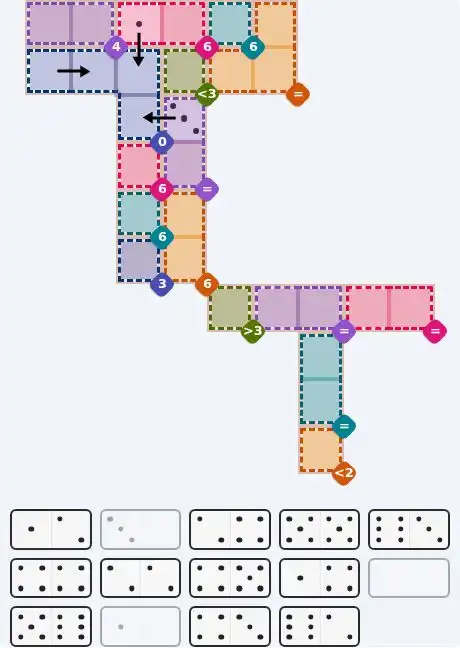
Pips hint for August 30, 2026 – hard level puzzle grid with critical first placements and strategy

This image shows the initial puzzle grid for the hard level, with a few critical first placements highlighted.

Final Answer: The Solved Grid for Hard Mode
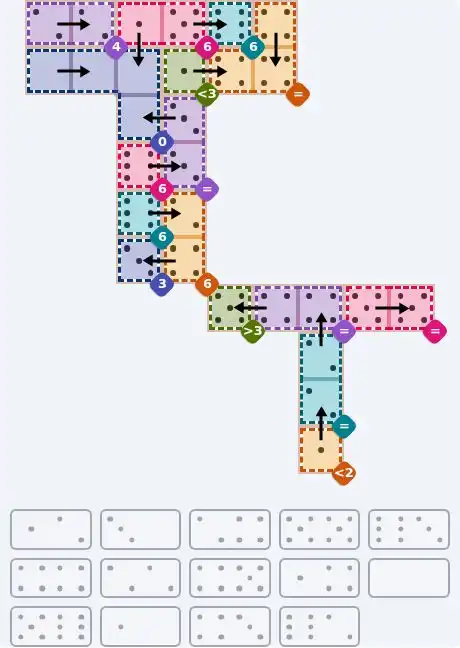
NYT Pips August 30, 2026 hard puzzle full solution grid showing final answer with hints

Compare this final grid with your own solution to see the correct placement of all dominoes.

🔧 Step-by-Step Answer Walkthrough For Easy Level

1
Step 1: Read the sum-12 anchor
The two bottom-row cells [2,0] and [2,1] must sum to 12, which in a 0–6 set means both need to be 6. The double-six tile cannot sit across [2,0]-[2,1] without stranding the other six in an impossible neighboring sum, so place the 6-6 tile horizontally at [2,1]-[2,2] and the 6-2 tile vertically at [2,0]-[1,0].
2
Step 2: Lock the left equals pair
With [2,0] showing 6 and [1,0] showing 2, the equals region [1,0]-[1,1] requires [1,1] to also be 2. The 1-2 domino fits vertically at [0,1]-[1,1], placing 1 at [0,1].
3
Step 3: Complete the top equals pair
The equals region [0,1]-[0,2] now needs [0,2] to match [0,1] as 1. The 5-1 domino has to place its 1 at [0,2] while its 5 lands at [1,2].
4
Step 4: Finish the two sum-9 partitions
With [2,2] already 6, the bottom sum-9 region [2,2]-[2,3] needs 3 more; the 3-4 domino goes vertical at [2,3]-[1,3], placing 3 below and 4 above. The upper sum-9 then closes as 5+4 across [1,2]-[1,3].

🔧 Step-by-Step Answer Walkthrough For Medium Level

1
Step 1: Open the one-cell greater gate
The single greater region at [0,2] is adjacent to the equals pair [1,1]-[1,2]. The only clean way to satisfy the greater cell while spilling a low value into that equals pair is the 0-3 domino placed vertically: 3 at [0,2] and 0 at [1,2].
2
Step 2: Feed the left equals column
With [1,2]=0, the equals pair [1,1]-[1,2] demands [1,1]=0. The 2-0 domino goes vertical at [2,1]-[1,1], putting 0 above and 2 below.
3
Step 3: Settle the left sum-2 column
The equals pair [2,0]-[2,1] forces [2,0] to match the 2 at [2,1]. The 1-2 domino then goes vertical at [3,0]-[2,0] (1 below, 2 above), and the sum-2 column [3,0]-[4,0] forces [4,0]=1, which the 1-0 domino handles horizontally at [4,0]-[4,1].
4
Step 4: Build the row of equals
The three-cell equals region [2,2]-[2,3]-[2,4] must all show the same value. The single sum cell at [3,2] forces the vertical 1-4 domino at [3,2]-[2,2] (1 below 4 above). Then 4-2 goes horizontal at [2,3]-[1,3] and 5-4 vertical at [3,4]-[2,4] to keep the row equal while feeding the top right.
5
Step 5: Close the upper-right greater
With [3,4] now 5, the greater region [3,4]-[4,4] needs the high end, so 6-1 goes horizontal at [4,4]-[4,3], placing 6 at [4,4] and 1 at [4,3]. The 1 at [4,3] fills the empty cell, and [4,1] was already 0 to satisfy the lower less pin.

🔧 Step-by-Step Answer Walkthrough For Hard Level

1
Step 1: Soak up the zero cage
The sum-0 block [1,0],[1,1],[1,2],[2,2] must be all zeros, consuming domino 0-0 horizontally at [1,0]-[1,1], domino 1-0 vertically at [0,2]-[1,2], and domino 3-0 horizontally at [2,3]-[2,2]. This leaves [0,2]=1, [1,2]=0, [2,3]=3, and [2,2]=0.
2
Step 2: Fill the top row 6-sums
The single sum-6 cell [0,4] must be 6, forcing domino 5-6 horizontally at [0,3]-[0,4] with 6 at [0,4] and 5 at [0,3]. The adjacent sum-6 region [0,2]-[0,3] then uses the already placed 1 at [0,2] plus the 5 at [0,3].
3
Step 3: Lodge the top-right equals trio
The equals region [0,5],[1,4],[1,5] requires all three to match. Domino 4-4 goes vertical at [0,5]-[1,5], supplying two of them, and domino 1-4 goes vertical at [1,3]-[1,4], putting 1 at [1,3] for the less-than pin and 4 at [1,4].
4
Step 4: Anchor the top-left and middle sums
The sum-4 pair [0,0]-[0,1] becomes 2+2 via domino 2-2 horizontal. The single sum-6 cell [3,2] plus equals pair [2,3]-[3,3] forces domino 6-3 vertical at [3,2]-[3,3], with 3 at [3,3] matching [2,3].
5
Step 5: Thread the lower-middle sums
The single sum-6 cell [4,2] takes domino 6-2 vertical at [4,2]-[4,3], placing 2 at [4,3]. The sum-6 pair [4,3]-[5,3] then needs 4 at [5,3], so domino 4-3 goes vertical at [5,3]-[5,2], and its 3 at [5,2] completes the single sum-3.
6
Step 6: Web the right-side equals
Domino 4-5 goes horizontal at [6,5]-[6,4], giving 4 at [6,5] to match [6,6] and 5 at [6,4] for the greater pin. Domino 2-4 goes vertical at [7,6]-[6,6], giving 2 at [7,6] and 4 at [6,6]. The vertical 1-2 at [9,6]-[8,6] supplies 1 for the bottom less pin and 2 at [8,6] for the equals [7,6]-[8,6]. Finally 5-5 fills [6,7]-[6,8] horizontally.

💡 Pro Tips for Similar Puzzles

Start with Constraints
Always begin with the most constrained regions - sum regions with small numbers or tight spaces.
Use Equal Regions
Use "equal" regions as anchors - they eliminate many possibilities quickly.
Work Systematically
Let the rules guide your placement rather than guessing randomly.
Double-Check
Verify each region's rules are satisfied before moving to the next.

🎓 Keep Learning & Improve