NYT Pips Hints & Answers for November 3, 2026

Nov 3, 2026

🚨 SPOILER WARNING

This page contains the final answer and the complete solution to today's NYT Pips puzzle. If you haven't attempted the puzzle yet and want to try solving it yourself first, now's your chance!

Click here to play today's official NYT Pips game first.

Want hints instead? Scroll down for progressive clues that won't spoil the fun.

SEE ALSO:

🎲 Today's Puzzle Overview

Easy (Ian Livengood) is today's confidence-builder. Five tiles, a compact board, and two equals regions that do most of the thinking for you: the pink equals column down the left edge and the teal equals pair along the top. Find the double that fits the column and the rest of today's NYT Pips easy unravels in a couple of minutes — no forks, no dead ends, just clean single-path deduction. Expect this one to take about as long as it takes to read the rules.

Medium (Rodolfo Kurchan) gives you one real bottleneck. The purple sum-0 cell on the right edge is the obvious place to start, and the tile that fills it drags a partner straight into the orange unequal run. Miss that pair and orange stays ambiguous for a long while; find it and the greater-8 pair in the top-left corner, the blue sum-3 cell on the left edge and the pink equals pair at the bottom-right all fall in sequence. A genuine but short stuck moment, then smooth sailing.

Hard (Rodolfo Kurchan) is the endurance test: fourteen tiles spread across twenty regions, with single-cell sum-0, less-2 and sum targets scattered everywhere. The opening is deceptively easy — three separate sum-0 cells simply hand you zeros — but the back half is pure bookkeeping across the four-cell green equals block and the purple equals pair on the right edge, where you must commit a pip before you know its twin. Budget ten to fifteen minutes and expect one false start.

💡 Progressive Hints

Try these hints one at a time. Each hint becomes more specific to help you solve it yourself!

💡 Follow the equals signs
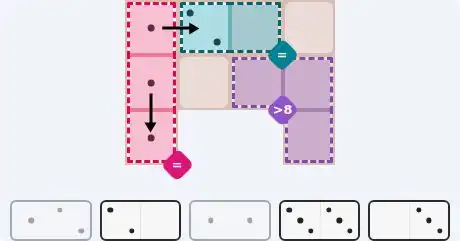
Two separate regions on this board demand matching pip values — a vertical three-cell column down the left edge and a horizontal pair along the top. The purple region on the right demands a total above eight. Read those three together and half the tray is decided before you place anything.
💡 The tall column wants the double
The pink equals column on the left edge is three cells tall, so the 1/1 double is the natural fit — stand it upright in the middle and lower cells and both read 1. The remaining cell at the top of that column still needs another 1, and after the double is used only one tile in the tray carries one.
💡 Full layout
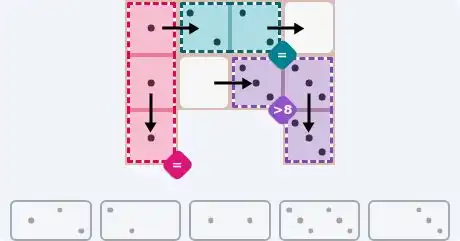
The pink equals column down the left edge reads 1-1-1: the 1/2 tile lies flat across the top row with its 1 in the column's top cell and its 2 in the left cell of the teal equals pair, while the 1/1 double stands upright in the two cells directly below. Teal finishes with the 2/0 tile lying flat along the top-right, 2 in the pair's right cell and 0 in the free square at the top-right corner. The 3/3 double stands vertically in the purple greater-8 block on the right, its two cells both reading 3, and the 0/3 tile lies flat along the middle row, 0 in the free square at the left and 3 in the purple block's top-left cell — pushing that block's total to nine.
💡 Start with the single cells
Look for single-cell regions first — three of them carry a sum target and each hands you an exact pip value for free. A fourth single cell uses a greater-than test instead, and that one is the hinge the whole middle of the board turns on.
💡 The zero cell on the right
The purple sum-0 cell on the right edge can only hold a 0, and the tile that fills it stands vertically, so its partner lands in the right-hand cell of the orange unequal run just above. That already tells you the orange run's last value, and it means the rest of orange has to come from small, distinct pips.
💡 Full layout
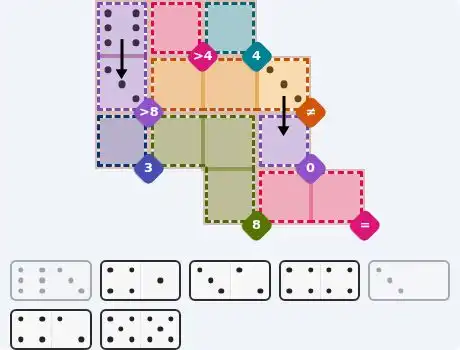
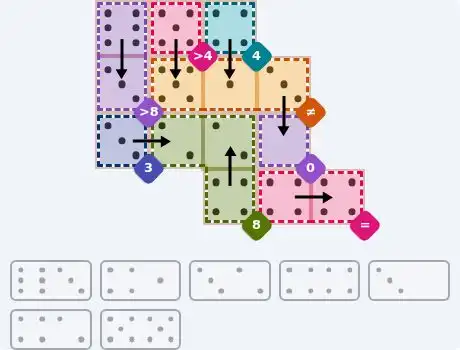
Purple sum 0 on the right edge takes the 0 of the 3/0 tile, which stands vertically with its 3 in the orange run's right-hand cell. The purple greater-8 pair at the top-left corner takes the 6/3 tile, 6 above and 3 below. Pink greater 4 at the top-left is the 5/5 double standing upright, its lower 5 in the orange run's left cell. Teal sum 4 along the top takes the 4/1 tile standing vertically, its 1 dropping into the middle of orange — so orange reads 5, 1, 3. Blue sum 3 on the left edge takes the 3 of the 3/2 tile lying flat, its 2 in the green sum-8 block's top-left cell. Green finishes with the 4/2 tile standing vertically, 2 in the top-right cell and 4 at the bottom-right, and the pink equals pair at the bottom-right is the 4/4 double lying flat.
💡 Hunt the single-cell sums
Look for single-cell sum regions before anything else. Several of them cluster near the top of the board and each hands you an exact pip value with no working required — the rest of the grid is built outward from those anchors.
💡 Two zeros sitting side by side
The blue sum-0 cell at the top-left and the green sum-0 cell immediately to its right both read 0, so each is the lower half of an upright tile. Blue carries its partner up into the pink less-2 cell above it; green carries its partner up into the left cell of the teal greater-9 pair along the top edge.
💡 Finish the top edge
That makes the teal greater-9 pair a matching set of high pips: its right cell takes the 5 from the 1/5 tile, which lies flat across the top with its 1 dropping into the orange less-2 cell at the top-right corner. Two less-2 cells now both read 1, which is the tightest either of them can be.
💡 The equals pair on the right
The purple equals pair on the right edge is filled from opposite ends. The 0/4 tile lies flat in the upper-right, its 0 in the free square there and its 4 in the pair's upper cell; the 3/4 tile stands upright with its 4 in the pair's lower cell and its 3 in the top-right corner of the green equals block. The 6/3 tile then stands vertically with its 3 in that block's top-left corner and its 6 rising into the free square on the right.
💡 Full layout
Purple unequal at the top-left corner is the 2/5 tile, 2 above and 5 below; the pink less-2 above-right of it is the 1 from the 0/1 tile, whose 0 sits in the blue sum-0 cell. The green sum-0 cell holds the 0 of the 0/5 tile, whose 5 is the teal greater-9 pair's left cell, and the 1/5 tile lies flat to its right, 5 in the pair and 1 in the orange less-2 cell at the top-right. The 0/4 tile lies flat in the upper-right, 0 in the free square and 4 in the purple equals pair's upper cell; the 3/4 tile stands upright, 4 in the pair's lower cell and 3 in the green equals block's top-right corner; the 6/3 tile stands vertically, 3 in the block's top-left corner and 6 in the free square on the right. Pink sum 0 on the left edge is the 0 of the 0/6 tile lying flat with its 6 in the teal sum-6 cell beside it. Orange sum 2 on the left edge takes the 2 of the 2/0 tile, standing upright with its 0 in the purple sum-2 pair's upper cell, and the 2/4 tile lies flat along the bottom row, 2 in that purple pair's lower cell and 4 in the orange less-5 cell. The pink sum-3 cell at the bottom-left takes the 3 of the 3/2 tile, whose 2 rises into the blue sum-2 cell directly above it. The 3/3 double stands vertically in the green equals block's right-hand column, the 1/1 double lies flat in the teal less-3 pair at the bottom-right, and the 5/5 double fills the two free squares along the bottom edge.

🎨 Pips Solver

Nov 3, 2026

Click a domino to place it on the board. You can also click the board, and the correct domino will appear.
✅ Final Answer & Complete Solution For Hard Level

The key to solving today's hard puzzle was identifying the placement for the critical dominoes highlighted in the starting grid. Once those were in place, the rest of the puzzle could be solved logically. See the final grid below to compare your solution.

Starting Position & Key First Steps
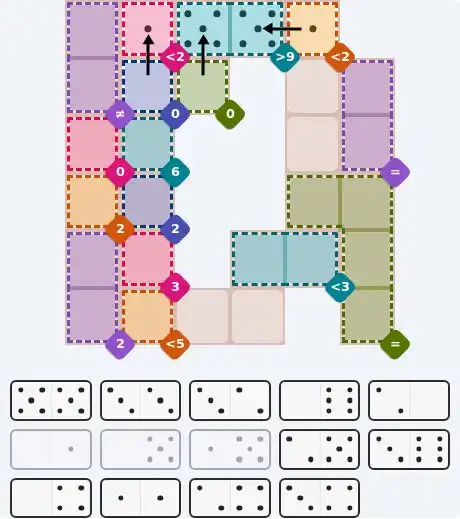
Pips hint for November 3, 2026 – hard level puzzle grid with critical first placements and strategy

This image shows the initial puzzle grid for the hard level, with a few critical first placements highlighted.

Final Answer: The Solved Grid for Hard Mode
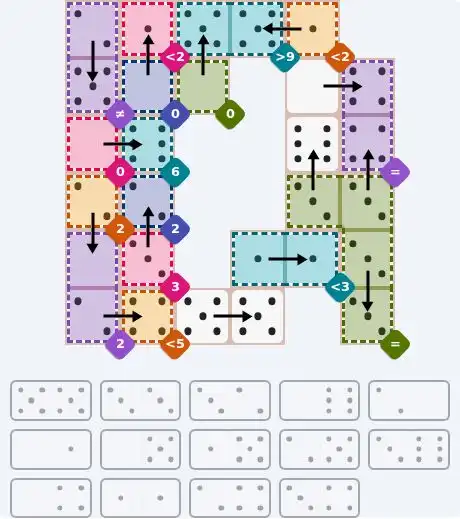
NYT Pips November 3, 2026 hard puzzle full solution grid showing final answer with hints

Compare this final grid with your own solution to see the correct placement of all dominoes.

🔧 Step-by-Step Answer Walkthrough For Easy Level

1
Step 1: Anchor the tall column
The pink equals column down the left edge is three cells tall, and every one of them must show the same pip. Only one tile in the tray can sit inside it and contribute two matching values at once, so the 1/1 double stands upright in the middle and lower cells, both reading 1.
2
Step 2: Feed the column a third 1
The top cell of the pink column still needs a 1. With the double gone, the 1/2 tile is the only one carrying a 1, so it lies flat across the top row, its 1 in the pink column's top cell and its 2 in the left cell of the teal equals pair.
3
Step 3: Close out the teal pair
Teal's left cell now reads 2, so its right cell must also read 2. The 2/0 tile supplies it lying flat along the top-right: 2 in the pair's right cell, 0 in the free square at the top-right corner. That free square is the easiest cell on the board and it costs you nothing.
4
Step 4: Push the purple block past eight
The purple greater-8 block on the right has three cells and needs a total above 8 with every cell contributing. The 3/3 double stands vertically in its two right-hand cells, and the 0/3 tile lies flat along the middle row with its 3 in the block's third cell and its 0 in the free square at the left. Three 3s make nine — the block clears its target and the board is done.

🔧 Step-by-Step Answer Walkthrough For Medium Level

1
Step 1: The pink cell and the greater-8 pair
The pink greater-4 cell at the top-left corner rules out anything below 5, and only the 5/5 double and the 6/3 tile clear that bar. Give the 6/3 to the purple greater-8 pair standing upright directly beneath the pink cell: 6 on top, 3 below. That leaves the 5/5 double for pink, standing upright with its upper 5 in the single cell and its lower 5 in the left cell of the orange unequal run.
2
Step 2: Kill the purple sum-0 cell
Purple sum 0 on the right edge is the tightest region on the board — nothing but a 0 fits. The 3/0 tile supplies it standing vertically, its 3 landing in the right-hand cell of the orange run and its 0 in the purple cell. The orange run now has two of its three values and they are already different, as required.
3
Step 3: Resolve blue sum 3
Blue sum 3 on the left edge is a single cell, and with the 3/0 tile committed elsewhere the 3/2 tile is the fit. It lies flat along the third row, 3 in the blue cell and 2 in the top-left cell of the green sum-8 block.
4
Step 4: Drop the 1 into orange
Teal sum 4 along the top needs exactly 4, which is the 4/1 tile standing vertically: 4 in the teal cell, 1 falling into the middle of the orange run. Orange now reads 5, 1, 3 — three different pips, and the constraint is satisfied.
5
Step 5: Finish green and the equals pair
Green's top-left cell already holds 2, so its remaining two cells must total 6. The 4/2 tile standing vertically delivers both: 2 in the top-right cell and 4 in the bottom-right. The only tile left is the 4/4 double, which lies flat in the pink equals pair at the bottom-right, giving two matching 4s and closing the puzzle.

🔧 Step-by-Step Answer Walkthrough For Hard Level

1
Step 1: Three zeros announce themselves
The blue sum-0 cell at the top-left, the green sum-0 cell immediately to its right, and the pink sum-0 cell on the left edge all read 0 outright. Those three cells are the anchors — each one tells you exactly where a zero goes and forces its partner pip into a neighbouring region.
2
Step 2: Upright tiles, partner pips climbing
The blue sum-0 cell sits directly beneath the pink less-2 cell, so its tile stands upright with the small pip on top: that is the 0/1, putting 1 in pink and 0 in blue. The green sum-0 cell does the same job for the teal greater-9 pair along the top edge, the 0/5 tile standing upright with its 5 in the pair's left cell.
3
Step 3: Complete the greater-9 pair
A 5 in the teal pair's left cell means the right cell must also be a 5 to comfortably pass nine. The 1/5 tile lies flat along the top edge: 5 joining the teal pair, 1 dropping into the orange less-2 cell at the top-right corner. Both less-2 cells now hold the smallest legal pip.
4
Step 4: Build the right-hand tower
The purple equals pair on the right edge is filled from opposite ends. The 0/4 tile lies flat in the upper-right, its 0 in the free square there and its 4 in the pair's upper cell. The 3/4 tile stands upright, its 4 in the pair's lower cell and its 3 in the top-right corner of the green equals block — the first of that block's matching pips.
5
Step 5: Two more 3s and the unequal pair
The 6/3 tile stands vertically so its 3 fills the green block's top-left corner and its 6 rises into the free square on the right. At the far side, the purple unequal pair at the top-left corner needs two different high pips and the 2/5 tile provides them: 2 above, 5 below. The remaining free square on the right and the two uncoloured cells along the bottom are the only unconstrained space left.
6
Step 6: Sweep the bottom-left
Pink sum 3 at the bottom-left takes the 3 of the 3/2 tile, whose 2 climbs into the blue sum-2 cell directly above. Orange sum 2 on the left edge takes the 2 of the 2/0 tile standing upright, its 0 landing in the purple sum-2 pair's upper cell; the 2/4 tile then lies flat along the bottom row, 2 in that pair's lower cell and 4 in the orange less-5 cell. The 0/6 tile lies flat to feed the pink sum-0 and teal sum-6 cells, the 3/3 double stands vertically in the green equals block's right-hand column to give it four matching 3s, the 1/1 double lies flat in the teal less-3 pair at the bottom-right, and the 5/5 double fills the two free squares along the bottom edge.

💡 Pro Tips for Similar Puzzles

Start with Constraints
Always begin with the most constrained regions - sum regions with small numbers or tight spaces.
Use Equal Regions
Use "equal" regions as anchors - they eliminate many possibilities quickly.
Work Systematically
Let the rules guide your placement rather than guessing randomly.
Double-Check
Verify each region's rules are satisfied before moving to the next.

🎓 Keep Learning & Improve