NYT Pips Hints & Answers for May 26, 2026

May 26, 2026

🚨 SPOILER WARNING

This page contains the final **answer** and the complete **solution** to today's NYT Pips puzzle. If you haven't attempted the puzzle yet and want to try solving it yourself first, now's your chance!

Click here to play today's official NYT Pips game first.

Want hints instead? Scroll down for progressive clues that won't spoil the fun.

🎲 Today's Puzzle Overview

Today's NYT Pips features a trio of puzzles that showcase distinct construction philosophies. Ian Livengood's easy grid is a compact gem, using a three‑cell equals region to force a chain reaction: the double‑six domino must straddle the boundary between a sum‑10 pair and that equals row, elegantly locking the entire placement. The result is a puzzle that feels both tight and accessible, with every domino falling into place once you accept the equals logic.

Rodolfo Kurchan's medium puzzle shifts the focus to layered inequality and equality constraints on the right side. The interplay between greater‑than‑3 and less‑than‑3 cells forces a specific domino split, while an equals triplet anchored at [2,2] propagates a zero through the grid, turning a simple less‑than condition into a powerful anchor. It's a design where a single zero domino ripples outward, revealing the structure.

The hard puzzle, also by Kurchan, elevates the constructor's signature of interlocking arithmetic. A vertical equals column of five cells sets a uniform pip, which then dictates the sum‑12 bottom row, pulling in double‑six and double‑two dominoes. Meanwhile, a sum‑4 column weaves across vertical dominoes, and a cascading set of small‑sum single‑cell constraints fine‑tune the remaining numbers. It's a dense, interwoven grid that rewards careful tracking of pip flow.

💡 Progressive Hints

Try these hints one at a time. Each hint becomes more specific to help you solve it yourself!

💡 Spot the rigid region
The easy puzzle has one region where multiple cells must share the same pip value. That forced uniformity is the key that unravels the whole grid—figure out what common pip is possible with the given domino set.
💡 Zero in on row 1
The equals region occupies cells [1,1], [1,2], and [1,3]. With only five dominoes available, the only pip that can appear three times is 6. So all three must be 6. The double‑6 domino is your main tool—where can it sit to give two 6's to these cells while leaving room for the sum‑10 pair above?
💡 Full solve: cascade the sixes
Place double‑6 vertically at [0,1] and [1,1] (0‑1=6,1‑1=6). Then domino [6,1] goes horizontally at [1,2]-[2,2] (6 and 1), and domino [5,6] puts 6 on [1,3] and 5 on [2,3]. The sum‑10 top pair forces [0,0]=4, so domino [4,4] covers [0,0] and [1,0] vertically. The sum‑6 pair then makes [2,0]=2, which pulls domino [2,1] into [2,0]-[2,1] (2 and 1). All constraints satisfied.
💡 Start with conflicting neighbors
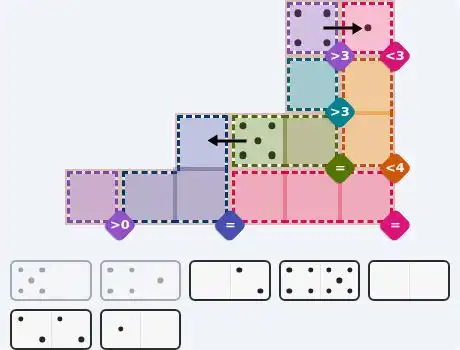
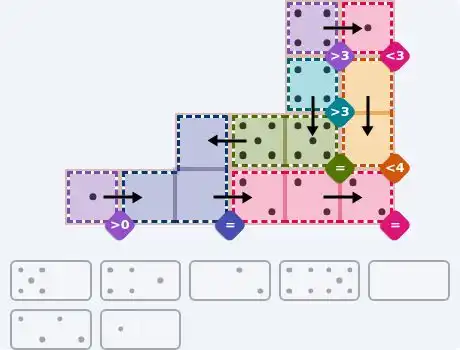
At the top right, two adjacent cells have opposing constraints: one requires a value greater than 3, the other less than 3. That forces them to be opposite faces of the same domino. Look for a domino with one pip above 3 and one below.
💡 Follow the trail of zero
Once you've placed that domino, focus on the equals region that links cell [2,2] with [3,1] and [3,2]. The adjacent less‑than‑4 region suggests these equals cells will be small. The domino [5,0] is the only one that can inject a 0 into that position without conflict—place it with the 0 on [2,2] and the 5 on [2,3].
💡 Finish with the triple‑equals and gaps
With [2,2]=0, the equals chain forces [3,1]=0 and [3,2]=0. Domino [1,0] then fills the left pair [3,0]-[3,1] (1 and 0). The triple‑equals at [3,3]-[3,5] must be 2's, so domino [0,2] goes [3,2]-[3,3] (0 and 2) and domino [2,2] goes [3,4]-[3,5] (2 and 2). The remaining dominos [4,5] and [0,0] settle the greater/less regions on the right side.
💡 Survey the vertical spine
A long column of five cells (rows 1‑4, column 0) all share an equals constraint. This backbone will determine a uniform pip for that column, and it must work with the sum‑12 pair immediately below. Consider which pip can appear on multiple dominoes to fill this column.
💡 Let the sum‑12 speak
The sum‑12 region at [5,0] and [5,1] must be two 6's. That means the column above cannot be 6. The only value that appears on at least two dominoes in the set—enough to cover most of the column—is 2, via the dominoes [2,2] and [2,6]. So the column is all 2's.
💡 Place the column's building blocks
Domino [2,6] is the only one that can give a 6 to [5,0] while placing a 2 at [4,0]. Place it with [4,0]=2, [5,0]=6. Then [2,2] covers [1,0] and [2,0] with 2's. The second 6 for the sum‑12 comes from domino [4,6], placed to give [5,1]=6 and [5,2]=4. Now [3,0] still needs a 2, which will come from domino [2,3] later.
💡 Resolve the top row arithmetic
The sum‑10 pair [0,1]-[0,2] needs two 5's. Domino [2,5] puts 5 on [0,1] (and 2 on the free [1,1]), and domino [5,4] puts 5 on [0,2] and 4 on [0,3]. The equals region [0,3]-[0,4] forces [0,4]=4, and the sum‑2 cell [0,5] must be 2. Domino [4,2] fits perfectly with 4 on [0,4] and 2 on [0,5].
💡 Complete the remaining interlocking sums
Finish with: domino [6,6] at [1,2]-[1,3] (6+6 for sum‑12); [0,0] at [1,4]-[1,5] (0,0) and [0,1] at [2,5]-[3,5] (0,1) for the equals triplet; [2,3] at [3,0]-[3,1] (2,3) to finish the column; [1,4] at [4,4]-[3,4] (1,4) for sum‑4; [0,2] at [4,5]-[5,5] (0,2) for sum‑2; [4,0] at [4,2]-[4,1] (4,0) for the equals‑4 region; [4,3] at [5,3]-[5,4] (4,3) for sum‑3; and [3,1] at [2,2]-[2,1] (3,1) for sum‑3 and sum‑4 column.

🎨 Pips Solver

May 26, 2026

Click a domino to place it on the board. You can also click the board, and the correct domino will appear.
Final Answer & Complete Solution For Hard Level

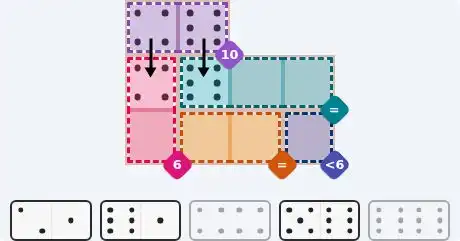
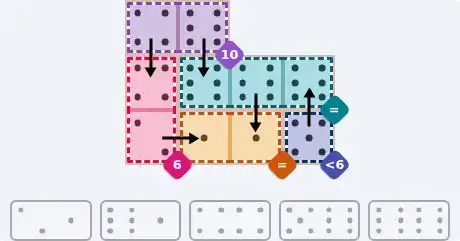
The key to solving today's hard puzzle was identifying the placement for the critical dominoes highlighted in the starting grid. Once those were in place, the rest of the puzzle could be solved logically. See the final grid below to compare your solution.

Starting Position & Key First Steps
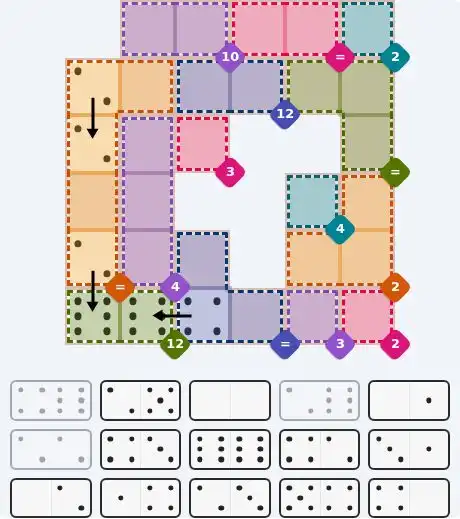
Pips hint for May 26, 2026 – hard level puzzle grid with critical first placements and strategy

This image shows the initial puzzle grid for the hard level, with a few critical first placements highlighted.

Final Answer: The Solved Grid for Hard Mode
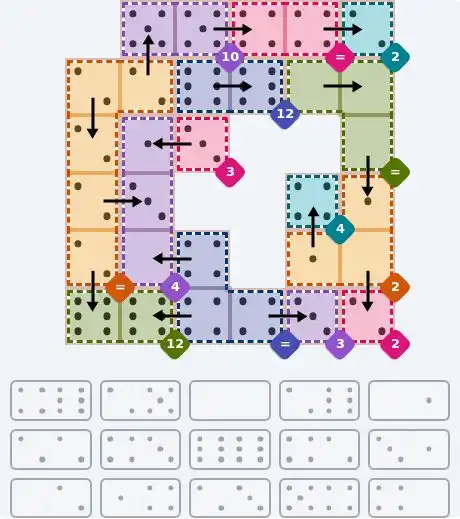
NYT Pips May 26, 2026 hard puzzle full solution grid showing final answer with hints

Compare this final grid with your own solution to see the correct placement of all dominoes.

🔧 Step-by-Step Answer Walkthrough For Easy Level

1
Step 1: Lock in the equals row
The equals region spanning [1,1], [1,2], [1,3] requires all three cells to have the same pip value. Looking at the five available dominoes—[2,1], [6,1], [4,4], [5,6], [6,6]—the only pip that can appear three times is 6 (two from the double‑6, one each from the other 6‑bearing dominoes). Therefore, [1,1], [1,2], and [1,3] must be 6.
2
Step 2: Position the double‑six
The double‑six domino must cover two adjacent cells, both 6. The only placement that doesn't block the required sum‑10 pair above is to put it vertically covering [0,1] and [1,1]. This gives [0,1]=6 and [1,1]=6, satisfying the sum‑10 region's need for a 6 (paired later with a 4) and providing one 6 to the equals row.
3
Step 3: Satisfy the top and left sums
With [0,1]=6, the sum‑10 region [0,0]-[0,1] forces [0,0]=4. The only domino with a 4 that can reach [0,0] is [4,4], so it goes vertically covering [0,0] and [1,0] (both 4). Now the sum‑6 region [1,0]-[2,0] has [1,0]=4, so [2,0] must be 2. This pulls the domino [2,1] into [2,0] (2) and [2,1] (1).
4
Step 4: Distribute the remaining sixes and satisfy the less‑than
The equals row still needs a 6 at [1,2] and [1,3]. Domino [6,1] fits horizontally on [1,2] and [2,2] (6 and 1), meeting the equals‑1 region on [2,1]-[2,2]. For [1,3], domino [5,6] is placed with 6 on [1,3] and 5 on [2,3], fulfilling the less‑6 constraint on [2,3] (5<6). The puzzle is complete.

🔧 Step-by-Step Answer Walkthrough For Medium Level

1
Step 1: Resolve the top‑right conflict
Cells [0,4] (>3) and [0,5] (<3) are adjacent, so they must be opposite ends of the same domino. Scanning the list, only domino [4,1] has one pip >3 and one <3. Place it horizontally covering [0,4] with 4 and [0,5] with 1. This simultaneously satisfies both cell constraints.
2
Step 2: Anchor the zero chain via equals
The equals region tying [2,2], [3,1], and [3,2] forces them all to be the same value. The adjacent less‑than‑4 region at [1,5]-[2,5] suggests low numbers. Domino [5,0] placed with its 0 on [2,2] and 5 on [2,3] sets the equals value to 0. Thus [2,2]=0, [3,1]=0, and [3,2]=0.
3
Step 3: Build the right‑side triple‑equals
The equals region [3,3],[3,4],[3,5] must all match. Since [3,2] is already 0, the only way to pair it and also give a domino that can fill the triple is to use [0,2] at [3,2]-[3,3] (0 and 2). Then domino [2,2] covers [3,4]-[3,5] with 2 and 2, setting the triple to 2's.
4
Step 4: Fill the less‑than‑4 and greater‑3 gaps
The less‑than‑4 region [1,5]-[2,5] needs two cells under 4. Domino [0,0] is perfect, placed horizontally to give both 0. The greater‑3 cell [1,4] must be >3; domino [4,5] placed vertically covers [1,4] with 4 and [2,4] with 5. This also satisfies the equals region [2,3]-[2,4] (the 5 from [5,0] at [2,3] and the new 5 at [2,4] match).
5
Step 5: Place the final domino on the left
The cell [3,0] has a greater‑0 constraint, so it must be at least 1. The remaining domino is [1,0], which covers [3,0] and [3,1] with 1 and 0, fulfilling the requirement and completing the grid.

🔧 Step-by-Step Answer Walkthrough For Hard Level

1
Step 1: Determine the column‑0 uniform pip
The equals region covering [1,0] through [4,0] forces all five cells to share a single value. Below them, the sum‑12 region [5,0]-[5,1] requires two 6's, so the column cannot be 6 (otherwise [4,0] and [5,0] would conflict in domino placement). Looking at the available dominoes, 2 is the only pip that appears on two separate dominoes—[2,2] and [2,6]—enough to supply four of the five column cells. Thus the column value must be 2.
2
Step 2: Place the key vertical dominoes for column and bottom
Domino [2,6] must give a 6 to [5,0] while putting a 2 in the column above. Place it with [4,0]=2 and [5,0]=6. Next, domino [2,2] covers [1,0] and [2,0] with 2's. To supply the second 6 for the sum‑12, domino [4,6] is placed horizontally covering [5,1]=6 and [5,2]=4.
3
Step 3: Complete the column with the last 2
Cell [3,0] still needs a 2. The domino [2,3] can provide it while also placing a 3 at [3,1]; this later helps satisfy the sum‑4 column. So place [2,3] vertically with [3,0]=2 and [3,1]=3. The column‑0 equals region is now fully satisfied.
4
Step 4: Resolve the top row constraints
The sum‑10 region [0,1]-[0,2] requires 5+5. Domino [2,5] places a 5 on [0,1] (and a 2 on the unconstrained [1,1]). Then domino [5,4] places 5 on [0,2] and 4 on [0,3]. The equals region [0,3]-[0,4] forces [0,4]=4, and the sum‑2 cell [0,5] must be 2. Domino [4,2] fits elegantly, covering [0,4] with 4 and [0,5] with 2.
5
Step 5: Handle the interior equals and sum‑12 pair
The sum‑12 region [1,2]-[1,3] needs 6+6; domino [6,6] placed there achieves this. The equals triplet [1,4],[1,5],[2,5] must all agree. Use domino [0,0] to give 0's at [1,4] and [1,5], then domino [0,1] to give 0 at [2,5] and 1 at [3,5] (this 1 later feeds the sum‑2 trio).
6
Step 6: Finish the remaining sums and equals
Now place the remaining dominoes: [1,4] at [4,4]-[3,4] (1 and 4) to satisfy the sum‑4 cell [3,4]; [0,2] at [4,5]-[5,5] (0 and 2) for the sum‑2 requirement at [5,5]; [4,0] at [4,2]-[4,1] (4 and 0) to fill the equals region [4,2],[5,2],[5,3] (all 4's) and the sum‑4 column's top cell [4,1]=0; [4,3] at [5,3]-[5,4] (4 and 3) to satisfy the sum‑3 cell [5,4]; and finally [3,1] at [2,2]-[2,1] (3 and 1) for the sum‑3 cell [2,2]=3 and the sum‑4 column member [2,1]=1. Everything locks.

💡 Pro Tips for Similar Puzzles

Start with Constraints
Always begin with the most constrained regions - sum regions with small numbers or tight spaces.
Use Equal Regions
Use "equal" regions as anchors - they eliminate many possibilities quickly.
Work Systematically
Let the rules guide your placement rather than guessing randomly.
Double-Check
Verify each region's rules are satisfied before moving to the next.

🎓 Keep Learning & Improve