🔧 Step-by-Step Answer Walkthrough For Easy Level
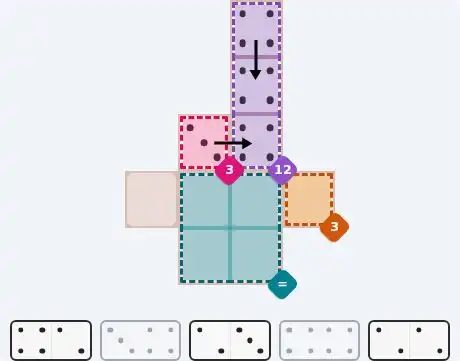
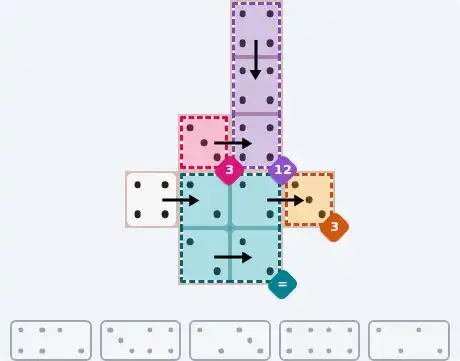
The vertical region at cells [0,2], [1,2], and [2,2] must sum to 12. With pip values 0–6 and the available domino set ([4,2], [3,4], [2,3], [4,4], [2,2]), the only way to hit 12 with three cells is 4+4+4. So all three cells will be 4.
The only domino that can supply two 4's is [4,4]. The cell [0,2] has only one adjacent cell in the grid — [1,2] — so the [4,4] domino must cover [0,2] and [1,2] (both become 4). This locks two of the three sum-12 cells, leaving [2,2] needing a 4.
[2,2] is adjacent to [2,1] (which has its own sum-3 region) and to [3,2] (part of the big equals region). The only remaining domino with a 4 is [3,4]. Placing it with its 4 at [2,2] forces its 3 into [2,1], perfectly satisfying that single-cell sum-3.
The equals region ([3,1],[3,2],[4,1],[4,2]) now demands a uniform value. [3,1] is adjacent to the empty cell [3,0]; use [4,2] there, putting 4 in the empty cell and 2 in [3,1]. This sets the equals value to 2. Then [2,3] covers [3,2] and the sum-3 cell [3,3]: 2 in equals, 3 for the sum. Finally [2,2] fills [4,1] and [4,2] with 2s. All constraints are satisfied.
🔧 Step-by-Step Answer Walkthrough For Medium Level
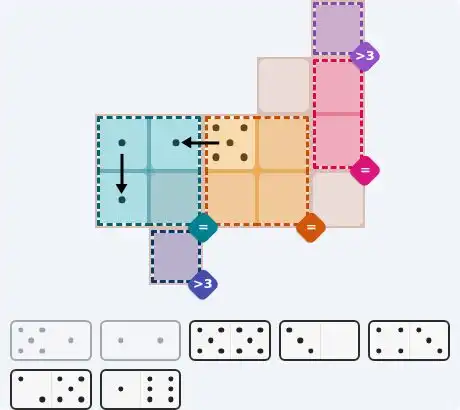
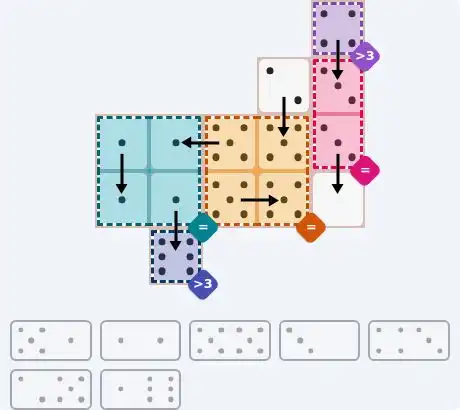
Two large equals regions each demand four identical numbers: one at [2,0]-[3,1] and another at [2,2]-[3,3]. The only double-value dominoes in the set are [1,1] and [5,5]. Therefore the left quartet will be all 1's (forced by [1,1]) and the central quartet all 5's (forced by [5,5]).
Place the [1,1] domino vertically over [2,0] and [3,0] — the only adjacent pair in that cage that doesn't conflict with other constraints yet. Now [2,0] and [3,0] are 1, leaving [2,1] and [3,1] of the equals cage needing 1's.
[3,1] is adjacent to [4,1] (a greater-than-3 cell) and [3,0] (already 1). The [1,6] domino fits perfectly: place its 1 at [3,1] and its 6 at [4,1], satisfying the greater-3. For [2,1], which borders the central cage at [2,2], use the [5,1] domino: put 1 at [2,1] and 5 at [2,2]. Now the central 5's cage has its first 5.
With [2,2]=5, the rest of the central equals cage must be 5's. Place [5,5] vertically at [3,2]-[3,3]. The remaining cell [2,3] needs 5; it is adjacent to the empty cell [1,3]. Use the [2,5] domino there: 2 at [1,3] (empty, no constraint) and 5 at [2,3], completing the 5's cage.
The equals region [1,4]-[2,4] needs equal values. [2,4] is adjacent to the empty [3,4], so a domino covering both must assign one value to the equals cell and one to the empty. The [3,0] domino provides 3 and 0: put 3 at [2,4], 0 at [3,4]. Then [1,4] must also be 3; it pairs with [0,4] (greater-than-3). The [4,3] domino has 3 and 4: place 3 at [1,4] and 4 at [0,4] to satisfy greater-3. All dominoes are used, all constraints met.
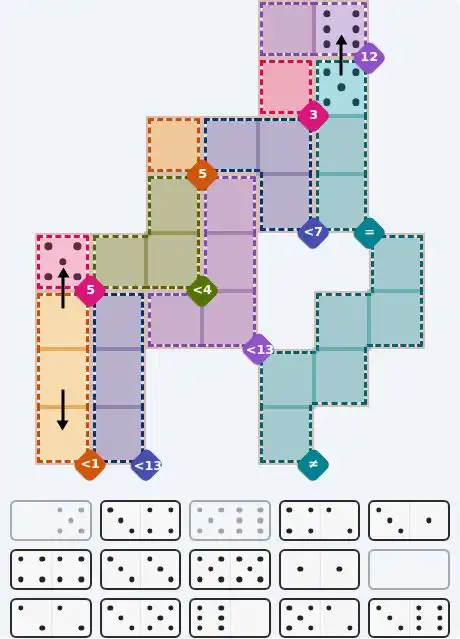
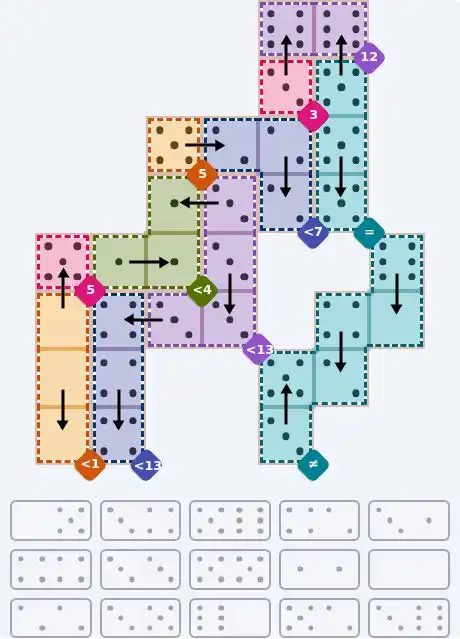
🔧 Step-by-Step Answer Walkthrough For Hard Level
The 'less 1' region at [5,0],[6,0],[7,0] forces these three cells to be 0. The [0,0] double-zero domino covers two of them — logically [6,0] and [7,0] because [5,0] pairs upward with [4,0], which has a sum-5 constraint. The only 0+5 domino is [0,5]; place it with 5 at [4,0] and 0 at [5,0]. Now the column's zeros are set.
The region [0,4],[0,5] must sum to 12, forcing two 6's. No single domino provides a 6+6 pair, so each 6 must come from a separate domino with a 6. [5,6] places 6 at [0,5] and 5 at [1,5]; [3,6] places 6 at [0,4] and 3 at [1,4]. That 3 fulfills the sum-3 requirement at [1,4]. Now [1,5] is 5, triggering an equals chain.
The equals region at [1,5],[2,5],[3,5] forces all three to become 5. With [1,5] already 5, the double-5 domino [5,5] naturally covers the adjacent pair [2,5] and [3,5], giving both the needed 5's. This tower of 5's is now complete.
The less-7 region ([2,3],[2,4],[3,4]) must contain numbers below 7. The [2,2] domino fits here — place it over [2,4] and [3,4], both becoming 2. The less-4 cage ([3,2],[4,1],[4,2]) requires numbers less than 4; the [1,1] domino delivers 1's to [4,1] and [4,2]. Then [3,2] needs a 1, supplied by the [3,1] domino with its 1 at [3,2] and its 3 moving to [3,3] (part of the less-13 zone). To finish the less-7's remaining cell [2,3] with a 2, use the [5,2] domino: 5 at [2,2] (satisfying the sum-5 cell there) and 2 at [2,3].
The large less-13 region [3,3],[4,3],[5,2],[5,3] is satisfied by the low pips already in motion: [3,3] has 3, [4,3] and [5,3] get the [3,3] domino (3 and 3), and [5,2] becomes 3 from the [3,4] domino, which places its 4 at [5,1] (inside the less-13 column). The remaining less-13 column [5,1],[6,1],[7,1] gets 4's: [4,4] covers [6,1]-[7,1] with 4's, and [5,1] already has 4. Finally, the unequal region spans six cells — use [4,2] for 4 at [5,5] and 2 at [6,5]; [6,0] for 6 at [4,6] and 0 at [5,6]; and [3,5] for 5 at [6,4] and 3 at [7,4]. Every domino and constraint now matches.
💬 Community Discussion
Leave your comment